You bring a new plant home, find a place for it on the shelf, and admire how pretty it is.
Then a few days go by, and you realize it would look much nicer closer to the window. So you move it again. Then the next day, you notice you can’t see it as well, so you move it to the coffee table.
You’re just making a few changes. No big deal. But your plant would disagree. And if you keep messing with it, your new plant will show you just how unhappy it is. Every single time you move a plant, you’re keeping it from settling. And if it can’t settle, it can’t grow and adjust to the new environment. It’s not that it will die, but it will struggle for as long as you keep doing “tweaks.”
You need to leave it alone, and I’ll tell you why.
Well, because of his job, he’s out a lot, and since winters in Pennsylvania can get pretty bad, he got in the habit of moving the plant to the southern window every morning, and then he’d move it back to where he can see it at night. After a while, the leaves turned yellow, and the plant looked like it was almost dead, until I told him to put the poor thing somewhere bright with indirect light, and leave it alone.
Now, it has been a few weeks, and the plant is finally doing better.
You see, when you move a plant even a few feet, you’re changing a lot of things, including temperature, light, and humidity. And every time the plant is moved, it has to stop everything it has been doing and readjust. Botanists call this a “reset.”
During reset, the leaves will tilt in the direction of a new light source, and the plant will either grow slower or stop growing entirely.
Even the soil starts to behave differently. The biggest problem is that people see this and think something’s wrong, so they move the plant yet again, because obviously, this spot doesn’t work.
And so the cycle goes on and on and on, into perpetuity.
Situations in Which Moving Plants Is the Most Damaging
Here are situations where you’ll want to keep your hands off.
Right After Repotting
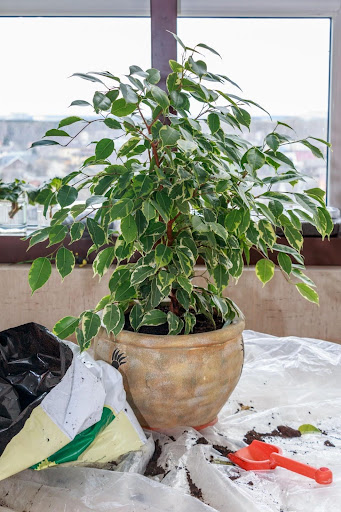
Every time you repot a plant, you shock its system. You disturb its roots and swap out the soil, which is a huge deal for it. And every time you do it, the plant immediately starts to settle in and recover.
If you move it to another spot right after it has been repotted, it’s simply too much. The roots are way too vulnerable at this point, and they’re still getting used to the new soil. Adding another huge change to this is asking for trouble. That’s really the best way I can describe it.
After you’ve repotted a plant, don’t touch it for at least three to four weeks.
During Changes in Seasons
You feel the change as the seasons shift, and so do the plants.
For instance, if the days are getting shorter and the temperatures are getting lower, the plant takes it as a sign to slow down and go into winter mode.
You could see it losing a few leaves or stop growing, and that’s all normal. But if you move it to another place, then you confuse it. The plant doesn’t know if it’s supposed to adjust to this new microclimate or keep going into winter mode.
Chasing Sunlight
Your plants don’t need to sunbathe! I get where people are coming from when they move their plants to catch the best light all day, but that backfires every single time. Plants want consistency, not perfect light for a few hours every day. If you move them all the time, they use up a lot of energy repositioning their leaves to new light sources, and it’s exhausting.
Once again, you’re never letting them settle, and you’ll notice when they start to grow unevenly.
Placing Them Close to Heaters or Drafts
If you place your plants in either of these spots, you’re making them endure huge changes in temperature all day, every day, and they’re not prepared for it.
These places are way too stressful for plants, and they’ll show you when their leaves turn crispy and brown.
Just Let Your Plants Be
Imagine having to move to a new house every single day. That’s exactly what you’re doing if you’re moving your plants around all the time. There’s no need to constantly try to fix your plants. Just let them live their lives without too much interruption from you.
If you really, really need to move them, at least wait until they’re not in a vulnerable phase, like after repotting or right when the seasons start to change.
Julie Bawden-Davis is a best-selling garden author, blogger, YouTuber and Master Gardener dedicated to sharing indoor gardening expertise with aspiring gardeners. She has published several gardening books and more than 5,000 articles in major publications. A former garden columnist for the LA Times, San Francisco Chronicle and Parade.com, she is founder of HealthyHouseplants.com and its YouTube channel.
 Julie Bawden-DavisApril 3, 2026