


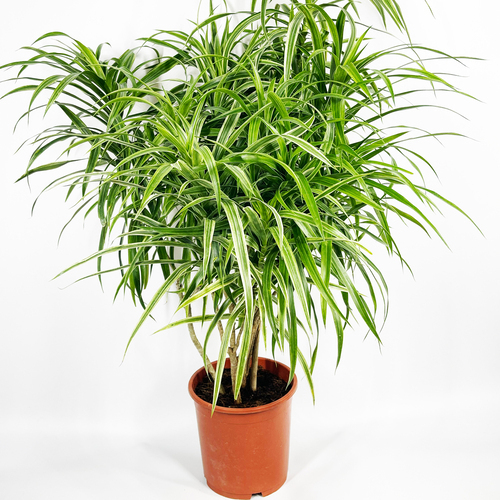
Dracaena angustifolia is an evergreen shrub or small tree native to a broad swath of tropical and subtropical Asia, ranging from India and Sri Lanka eastward through Southeast Asia, including Thailand, Myanmar, Malaysia, and Indonesia, and extending into parts of southern China, New Guinea, and northern Australia. Within this range it typically grows in the understorey of lowland and monsoon forests, along forest margins, and in disturbed or secondary growth, often reaching heights of 6 to 15 feet (2 to 4.5 meters) in its natural habitat, considerably taller than the compact potted specimens most people encounter as houseplants. Its specific epithet, angustifolia, means “narrow-leaved” in Latin, directly referencing the slender, elongated, sword- or grass-like foliage that distinguishes it from the broader-leaved dracaena species more commonly seen in cultivation, such as Dracaena fragrans or Dracaena deremensis.
The plant develops a slender, cane-like trunk or multiple trunks over time, each topped with a rosette or tufted arrangement of narrow, glossy, deep green leaves that can reach 12 to 24 inches (30 to 60 cm) in length but only an inch or two in width, giving the plant an airy, upright, almost bamboo- or yucca-like silhouette quite different from the denser, broader-canopied dracaenas of the houseplant trade. As the plant matures, lower leaves naturally yellow and drop, leaving behind a bare, ringed trunk marked with leaf scars, a characteristic shared across the genus and one that is often intentionally encouraged in cultivation to create a more architectural, tree-like form with an exposed stem beneath a crown of foliage.
In its native range, Dracaena angustifolia holds a place in traditional medicine and folk use in several Southeast Asian cultures, where various plant parts have historically been used in local remedies, and the species is also occasionally planted as an ornamental hedge or accent shrub in tropical gardens for its structural form and low maintenance requirements. In temperate climates it is grown almost exclusively as an indoor foliage plant, valued for the same qualities that have made the broader dracaena genus a mainstay of office and home plant collections: tolerance of moderate to low light, resilience to inconsistent watering, and an easygoing nature that rewards minimal care with years of steady, attractive growth.
Caring for Dracaena angustifolia follows the same forgiving, low-maintenance pattern that has made the wider dracaena genus so popular as an indoor plant, making it a good choice for growers who want an architectural, upright foliage plant without demanding daily attention. The single most important care principle is to avoid overwatering: like most dracaenas, this species is considerably more tolerant of letting its soil dry out between waterings than it is of sitting in consistently damp or waterlogged conditions, which quickly leads to root rot. Allowing the top third to half of the soil to dry before watering again, then watering thoroughly until it drains from the pot’s base, is the most reliable approach across most home environments.
Light and water quality are the next most important factors in keeping this dracaena looking its best. Bright, indirect light produces the most vigorous growth and the richest leaf color, though the plant tolerates medium and even fairly low light reasonably well, making it suitable for offices and rooms set back from windows, albeit with slower growth in those dimmer conditions. Like many dracaenas, this species is notably sensitive to fluoride and other additives commonly found in municipal tap water, which can cause the characteristic brown, crispy leaf-tip and margin scorch dracaenas are known for; using filtered water, rainwater, or water left to stand uncovered overnight helps minimize this common cosmetic issue.
Beyond watering and light, Dracaena angustifolia asks for very little: light, infrequent feeding during the growing season, occasional dusting or wiping of its narrow leaves to keep them photosynthesizing efficiently, and repotting only once every few years as it slowly outgrows its container. Its tolerance of typical indoor temperatures and humidity levels, combined with its striking, upright, grass-like form, make it a rewarding structural accent plant for growers who want dramatic vertical foliage without the fussiness of many other tropical ornamentals.
 Soil
Soil
Dracaena angustifolia thrives in a loose, well-draining potting medium that allows excess water to move away from the roots quickly, since this species, like most dracaenas, is considerably more vulnerable to root rot from soggy soil than to the effects of occasional dryness.
A general-purpose, well-draining potting mix amended with 20 to 30 percent perlite or coarse sand produces an appropriately airy, fast-draining texture. A blend designed for palms or dracaenas specifically is also a suitable off-the-shelf option.
A mildly acidic to neutral pH between 6.0 and 6.5 is ideal, supporting healthy nutrient uptake without the deficiencies that can develop in more strongly alkaline soils.
Excellent drainage is essential; the pot must have drainage holes, and the plant should never be left standing in a saucer of collected water for an extended period.
Horticultural charcoal added at roughly 5 to 10 percent by volume helps keep the medium fresh and reduces the risk of anaerobic, sour soil conditions developing between waterings. Compost or worm castings mixed in lightly at potting time provide a gentle nutrient boost.
Waterlogged soil is the most common cause of decline in this species, leading to root rot, yellowing lower leaves, and a mushy stem base. Repot into fresh, well-draining medium and trim any rotted roots if this occurs.
Dense, compacted soil restricts root aeration and slows growth over time; repot every 2 to 3 years into fresh, well-amended mix to prevent this.
Alkaline soil conditions, often from repeated use of hard tap water, can lead to micronutrient deficiencies visible as pale or yellowing new growth; flushing periodically with filtered water helps maintain appropriate pH.
Sensitivity to salts and additives in tap water is a hallmark of the dracaena genus, showing up as brown, crispy leaf tips and margins. Use filtered water or rainwater where possible and flush the soil with clean water every few months to leach out accumulated salts.
Pale, yellowing foliage during the active growing season, particularly on new leaves, often signals a need for light fertilization; correct with a diluted, balanced houseplant fertilizer.
A plant that has become root-bound will show roots circling visibly at the surface or emerging from drainage holes, along with slowed growth and soil that dries out unusually fast; repot into a slightly larger container when this is observed.
 Fertilizer
Dracaena angustifolia has modest fertilizer needs and benefits from light, regular feeding during its active growing season rather than infrequent heavy applications.
A balanced, water-soluble houseplant fertilizer diluted to half strength, or a fertilizer formulated specifically for dracaenas or foliage plants, applied during the growing season.
Feed every 4 to 6 weeks from spring through summer, and withhold fertilizer entirely in autumn and winter when growth slows significantly.
Apply the diluted fertilizer solution to moist soil rather than dry soil to reduce the risk of root burn, and avoid splashing fertilizer directly onto the foliage.
Brown, burnt-looking leaf tips and margins, and a visible white salt crust on the soil surface, are signs of overfertilization, which compounds the leaf-tip browning this species is already prone to from water quality issues.
Pale, slow-growing new foliage over an extended period, particularly during the active growing season, suggests the plant would benefit from more regular light feeding.
Worm castings top-dressed onto the soil surface, or a diluted liquid seaweed or fish emulsion fertilizer applied monthly, offer a gentler, slow-release alternative to synthetic fertilizers.
 Watering
Dracaena angustifolia is considerably more tolerant of underwatering than overwatering, and the standard approach is to let the top third to half of the soil dry out before watering thoroughly again, always allowing full drainage.
Roughly every 7 to 14 days during the active growing season in most indoor conditions, extending to every 14 to 21 days in cooler, lower-light winter conditions when growth slows.
This species is notably sensitive to the fluoride, chlorine, and other additives found in many municipal water supplies, which contribute to the characteristic brown, crispy leaf-tip scorch common across the dracaena genus. Filtered water, rainwater, or tap water left uncovered overnight to off-gas chlorine are all preferable to straight-from-the-tap water.
Leaves that become thin, slightly curled, or droop and lose their normal firmness, along with dry, pulling-away soil at the pot’s edges.
Yellowing lower leaves, a soft or mushy stem base, and a persistently wet, heavy pot are all signs of overwatering and the early stages of root rot in this species.
Reduce watering frequency in autumn and winter as growth slows with cooler temperatures and lower light, and resume a more regular schedule in spring and summer as active growth resumes.
Stop guessing. Most houseplant failures are caused by volumetric errors and improper moisture tension. Our deterministic calculator moves beyond "once-a-week" watering by analyzing the four critical pillars of root health:
Personalized for this plant
Disclaimer: Our calculator is pretty smart. We’ve crunched the numbers, but we’re not measuring the quantum state of your living room. Since we don’t know your exact indoor temperature, humidity, light, airflow, or whether your plant receives daily sweet nothings and motivational speeches, use this calculator as a guide—and always keep an eye on your plant.
 Lighting
Bright, indirect light produces the most vigorous growth and richest leaf color, though Dracaena angustifolia tolerates medium and even fairly low indirect light reasonably well, roughly 300 to 1,000 foot-candles, making it adaptable to a range of indoor placements.
Slower growth, thinner and paler new leaves, and an overall leggy, sparse appearance as the plant stretches toward whatever light is available.
Direct, intense sun, especially through unfiltered south- or west-facing glass, can scorch the narrow foliage, causing bleached or brown patches on leaves that are otherwise adapted to filtered forest-understorey light in their native habitat.
If natural light is limited, a full-spectrum grow light positioned above the plant for 10 to 12 hours a day can supplement growth in a dim room or office. If light is too intense, move the plant back from the window or filter direct rays with a sheer curtain.
 Temperature
Dracaena angustifolia thrives at typical indoor temperatures between 65 and 80°F (18 to 27°C), reflecting the warm, stable conditions of its native tropical range.
This species is sensitive to cold and should not be exposed to temperatures below 55°F (13°C) for extended periods, with prolonged exposure to cold drafts or near-freezing conditions causing dark, water-soaked patches on the foliage.
The plant handles warm indoor and outdoor conditions well, tolerating temperatures into the high 80s°F (around 30°C) provided it receives adequate water and is not in prolonged direct, intense sun.
Keep the plant away from cold drafts near exterior doors and windows in winter, and away from direct heating vents and air conditioning units, both of which can cause rapid, stressful fluctuations in leaf moisture.
 Humidity
Moderate humidity in the range of 40 to 60 percent is ideal, though Dracaena angustifolia tolerates the average humidity of most homes reasonably well and is not considered a particularly humidity-demanding species.
Very dry indoor air, especially near heating vents in winter, can contribute to browning leaf tips, though this symptom is also commonly linked to water quality, so both factors should be considered together.
Excessive humidity combined with poor air circulation can occasionally encourage fungal leaf spot; ensure adequate airflow around the plant in very humid rooms.
A humidifier positioned nearby is an effective way to raise ambient humidity in dry, centrally heated rooms, particularly during winter.
A wide tray of pebbles and water placed beneath the pot provides a modest, localized humidity boost as the water evaporates around the plant.
Occasional misting of the foliage can offer temporary relief in very dry conditions but is not essential for this relatively humidity-tolerant species.
If fungal leaf spot appears in an overly humid environment, increase air circulation with a small fan and allow slightly more time between waterings.
 Propagation
Dracaena angustifolia propagates readily from stem cuttings, a method widely used across the dracaena genus and one that produces reliable results even for growers with limited propagation experience.
Success Rate: High (75–90%) under warm, consistently moist conditions
Description: The standard method, in which a section of the woody cane is cut and rooted either in water or directly in a moist propagation medium.
Steps:
Spring through summer, when warm temperatures and active growth support the fastest and most reliable rooting.
Rooted cuttings typically establish as independently growing plants within 4 to 8 weeks, with new top growth becoming visible shortly after roots form.
 Potting
A sturdy pot with good drainage, in a material such as terracotta or a heavier plastic or ceramic, suits this upright, sometimes top-heavy species well, helping to prevent tipping as the plant matures and its canes lengthen.
Drainage holes are essential, along with a well-draining potting mix, to prevent the waterlogged conditions that quickly lead to root rot in this species.
Choose a pot only slightly larger than the current root ball when repotting, generally 1 to 2 inches (2.5 to 5 cm) wider in diameter, since an oversized pot holds excess moisture the roots cannot use quickly enough.
Every 2 to 3 years, or when the plant has clearly outgrown its current container, as this species is a relatively slow to moderate grower that does not need frequent repotting.
Roots visibly circling at the soil surface or emerging from drainage holes, water running through the pot unusually quickly without being absorbed, and generally slowed growth despite otherwise good care.
Gently remove the plant from its current pot, loosen the outer roots, trim away any dead or rotted roots with sterile scissors, and repot into fresh, well-draining mix in a slightly larger container at the same soil depth as before.
Light root pruning, trimming no more than 10 to 20 percent of the root mass, can be done at repotting time if the roots are densely circling, to encourage healthier new root growth into the fresh soil.
Water the plant lightly immediately after repotting and keep it in a slightly shadier, more sheltered spot for 1 to 2 weeks afterward to reduce transplant stress before returning it to its normal display location.
 Pruning
Dracaena angustifolia responds well to occasional pruning, which is used primarily to remove damaged or yellowing foliage, control the plant’s height, and encourage a fuller, more branched form over time as new growth emerges below any cut point on the cane.
Spring or early summer, at the start of the active growing season, is the best time for any significant height-reduction or shaping cuts, since the plant will recover and produce new growth most quickly during this period. Light maintenance trimming of damaged leaves can be done at any time of year.
Remove individual damaged or yellowing leaves as needed throughout the year. Perform more significant structural pruning, such as cutting back a cane to control height or encourage branching, once a year or less, only as needed based on the plant’s size and shape.
Use clean, sharp pruning shears or a small saw for thicker canes, sterilized with rubbing alcohol before and between cuts to prevent the spread of disease.
New shoots typically emerge from just below a pruning cut within several weeks under warm, bright conditions. Avoid heavy pruning during the slower winter months, as recovery and regrowth will be considerably slower in low light and cooler temperatures.
 Blooming
Dracaena angustifolia produces small, star-shaped, fragrant flowers, typically white or cream-colored, borne in branched clusters, or panicles, that emerge from the upper leaf axils or the crown of the plant. In its native tropical range, flowering can occur at various points through the warmer months, though bloom timing is somewhat irregular and depends heavily on the maturity of the plant and the stability of its growing conditions. Flowering in cultivated, and especially indoor, specimens is uncommon and considerably less reliable than in outdoor tropical plantings, since the mature size, stable warmth, and high light levels needed to trigger blooming are difficult to replicate consistently indoors. When flowering does occur, the blooms typically open in the evening and release a noticeably sweet fragrance that can be quite strong in an enclosed indoor space, followed in some cases by the development of small, round, berry-like fruits if pollination occurs. Most indoor growers should treat this species primarily as a foliage plant, since flowering is a rare bonus rather than a dependable seasonal event.
 Pests and Diseases
Name: Spider Mites
Symptoms: Fine webbing between leaves and along the stem, along with stippled, dull, or yellowing foliage, most common in warm, dry indoor conditions.
Treatment: Increase humidity, rinse the foliage under lukewarm water to dislodge mites, and treat with insecticidal soap or neem oil, repeating every 5 to 7 days for several cycles.
Name: Mealybugs
Symptoms: White, cottony clusters at leaf bases and along the stem, often accompanied by sticky honeydew residue.
Treatment: Dab visible clusters with a cotton swab dipped in isopropyl alcohol and follow up with an insecticidal soap spray, repeating as needed until the infestation clears.
Name: Scale Insects
Symptoms: Small, brown or tan, shell-like bumps adhered to stems and the undersides of leaves, along with sticky honeydew and gradual yellowing of affected foliage.
Treatment: Scrape or wipe off visible scale with an alcohol-dipped cotton swab, and apply horticultural oil or a systemic insecticide for more widespread infestations.
Name: Root Rot
Symptoms: Yellowing lower leaves, a soft or mushy stem base, and a persistently wet, heavy pot, typically caused by overwatering or poor drainage.
Treatment: Remove the plant from its pot, trim away all soft, dark, or foul-smelling roots with sterile scissors, and repot into fresh, well-draining medium, reducing watering frequency going forward.
Name: Fungal Leaf Spot
Symptoms: Small, irregular brown or black spots on the leaves, sometimes surrounded by a yellow halo, most common in overly humid conditions with poor air circulation.
Treatment: Remove affected leaves, improve air circulation around the plant, avoid overhead watering that wets the foliage, and apply a copper-based fungicide if the issue persists or spreads.
Name: Bacterial Soft Rot
Symptoms: A rapidly spreading, foul-smelling, mushy decay at the base of the stem or cane, often following an injury or prolonged waterlogged conditions.
Treatment: Cut away all affected tissue well into healthy, firm growth using sterile tools, allow the cut surface to dry, and significantly reduce watering; severely affected plants may need to be propagated from healthy upper cane sections if the main stem cannot be saved.
 Special Features
Dracaena angustifolia stands out among cultivated dracaenas for its distinctly narrow, grass- or sword-like foliage, giving it a more airy, upright, almost architectural silhouette compared with the broader-leaved dracaenas typically found in interior plantscaping. Its tolerance of a wide range of indoor light conditions, from bright indirect light down to fairly low light, combined with its resilience to inconsistent watering, makes it an especially practical choice for offices, lobbies, and other spaces where consistent, attentive care cannot always be guaranteed. As it matures, its bare, ringed trunk beneath a crown of narrow foliage develops a small-tree-like form that adds vertical structure and textural contrast to a room, while its occasional, fragrant evening flowers, though uncommon indoors, are a pleasant surprise for growers who manage to coax a mature specimen into bloom.
 Plant Benefits
In parts of its native Southeast Asian range, various Dracaena species, including relatives of Dracaena angustifolia, have a history of use in traditional folk medicine for a range of purposes, though rigorous clinical research validating specific pharmaceutical benefits of this particular species is limited. As with other dracaenas, the plant is best regarded by home growers as an ornamental and air-quality-supporting foliage plant rather than a source of home remedies, particularly given its documented toxicity to pets, and any traditional medicinal use should not be attempted without qualified guidance. Its most reliable benefit to indoor growers is aesthetic and environmental: an easy-care, architecturally striking foliage plant that contributes to the broader air-purifying qualities associated with many dracaena species.
 Additional Information
Dracaena angustifolia is sometimes confused with other narrow-leaved members of the genus, and its taxonomy has historically overlapped with related species and varieties described under slightly different names across different regions of its wide native range. Like most dracaenas, it was formerly classified within the Agavaceae family before molecular studies led to the genus being reclassified into the Asparagaceae family, specifically the subfamily Nolinoideae, alongside other well-known houseplants such as Sansevieria (now also considered part of Dracaena by many taxonomists) and Liriope.
 Life Cycle
Dracaena angustifolia is a slow to moderately growing perennial that, in favorable conditions, continues producing new leaves from the growing tip of each cane indefinitely, while older, lower leaves gradually yellow and drop as the plant matures, exposing a bare, ringed trunk beneath the active crown of foliage. Over years of growth, mature plants may branch, particularly after the growing tip is damaged, pruned, or occasionally flowers, with new shoots emerging from dormant buds along the cane. Flowering, when it occurs, is followed by the development of small, round, berry-like fruits if pollination is successful, though this stage of the life cycle is rare in indoor cultivation. Individual specimens are effectively long-lived under good care, with well-maintained potted plants continuing to grow, and periodically being pruned and repotted, for a decade or more indoors.
 Are Dracaena angustifolia Poisonous, Toxic
Dracaena angustifolia, like other members of the Dracaena genus, is toxic to cats and dogs and mildly toxic if ingested by humans. The ASPCA lists dracaena species generally as toxic to cats and dogs, and this species should be treated with the same caution given to more commonly sold dracaenas.
The leaves are the primary toxic part, containing saponins that cause gastrointestinal and, in cats particularly, sometimes neurological symptoms if ingested in quantity.
Vomiting, sometimes with visible blood, loss of appetite, depression or lethargy, excessive drooling, and in cats, dilated pupils have all been reported following ingestion of dracaena foliage.
The sap is not commonly associated with significant skin irritation, though sensitive individuals may experience mild irritation with prolonged contact.
Mild to Moderate. Symptoms are generally not life-threatening but can cause meaningful discomfort, and veterinary guidance should be sought for any pet that has ingested a significant amount of foliage.
Remove any remaining plant material from the pet’s or child’s mouth, rinse the mouth gently with water, and contact a veterinarian, physician, or poison control center for guidance, particularly if vomiting or lethargy develop.
Wash any irritated skin area with mild soap and water.
Place the plant out of reach of pets prone to chewing foliage, particularly cats, promptly clean up any dropped or trimmed leaves rather than leaving them accessible on the floor, and consider a hanging or elevated display in households with persistent plant-chewing pets.
 Frequently Asked Questions
Yes, like other dracaena species, Dracaena angustifolia is toxic to cats and dogs and can cause vomiting, drooling, and lethargy if ingested.
Water when the top third to half of the soil has dried out, generally every 7 to 14 days in the growing season and less often in winter, allowing the pot to drain fully each time.
Bright, indirect light produces the best growth, but this species tolerates medium and even fairly low indirect light reasonably well, making it suitable for a range of indoor spots.
Brown, crispy leaf tips are usually caused by fluoride or other additives in tap water, or by fertilizer salt buildup, both common issues across the dracaena genus. Using filtered or rainwater helps prevent this.
Take a 4 to 6 inch stem or cane cutting, allow the cut end to dry briefly, then root it in water or moist propagation mix in warm, bright indirect light. Roots typically develop within 3 to 6 weeks.
In its native habitat it can reach 6 to 15 feet tall, though potted indoor specimens are typically kept smaller through pruning and container size.
Flowering is uncommon in indoor cultivation since it usually requires a mature plant and stable, bright, warm conditions that are difficult to replicate consistently indoors.
Yellowing lower leaves can be a normal part of the plant’s natural growth as it matures, but widespread or rapid yellowing, especially with a mushy stem base, usually indicates overwatering or root rot.
Moderate humidity around 40 to 60 percent is ideal, though this species tolerates typical indoor humidity levels reasonably well and is not considered particularly humidity-demanding.
Repot roughly every 2 to 3 years, or when roots are visibly circling the surface or emerging from drainage holes, choosing a pot only slightly larger than the current one.
 Can I grow Dracaena angustifolia in my indoor space
Difficulty: Easy
Size: Medium to Large
Light: Medium
Water: Medium
Flowering: Yes
Pet Safe: No
Air Purifier: High
 Dracaena angustifolia botanical details
Common Name: Dracaena angustifolia
Other Common Names: Narrow-Leaved Dracaena, Pandan Dracaena, Grass-Leaved Dracaena, Malay Dracaena
Botanical Name: Dracaena angustifolia
Native Area: Tropical and subtropical Asia, including India, Sri Lanka, mainland Southeast Asia, Malaysia, Indonesia, southern China, New Guinea, and parts of northern Australia.
Family Name: Asparagaceae (subfamily Nolinoideae)
Plant Type: Perennial evergreen shrub to small tree
Genus: Dracaena
Kingdom: Plantae
 Photo Gallery
 My Dracaena angustifolia Plant Care Recommendations
If you find the Houseplant Encyclopedia helpful and would like to support Healthy Houseplants, you can use the links below to shop for recommended plants, products, and plant-care supplies.
Some links are affiliate links, which means I may earn a small commission if you make a qualifying purchase through them, at no additional cost to you. Thank you for supporting Healthy Houseplants and helping me continue to provide free plant-care information!

Want even more personalized plant-care help? Check out my AI Julie Chatbot—trained on my 20 years of houseplant knowledge, not just information from the internet!  Try it now:Ask AI Julie
 Buy Dracaena angustifolia Online
✅ “Bring Home This Beauty Today”
✅ “Get Your Own Dracaena angustifolia Before It’s Gone”
✅ “Shop Trusted Sellers – Limited Availability”
✅ “Free Delivery”
As an Amazon Associate, I earn commission from qualifying purchases.
 Plant Puns and Jokes
Why did Dracaena angustifolia refuse to wear a wide-brimmed hat? Because with foliage that narrow, it already had a reputation to keep up as the genus’s slim-fit specialist.
 Signup to our newsletter and download Dracaena angustifolia care guide

