


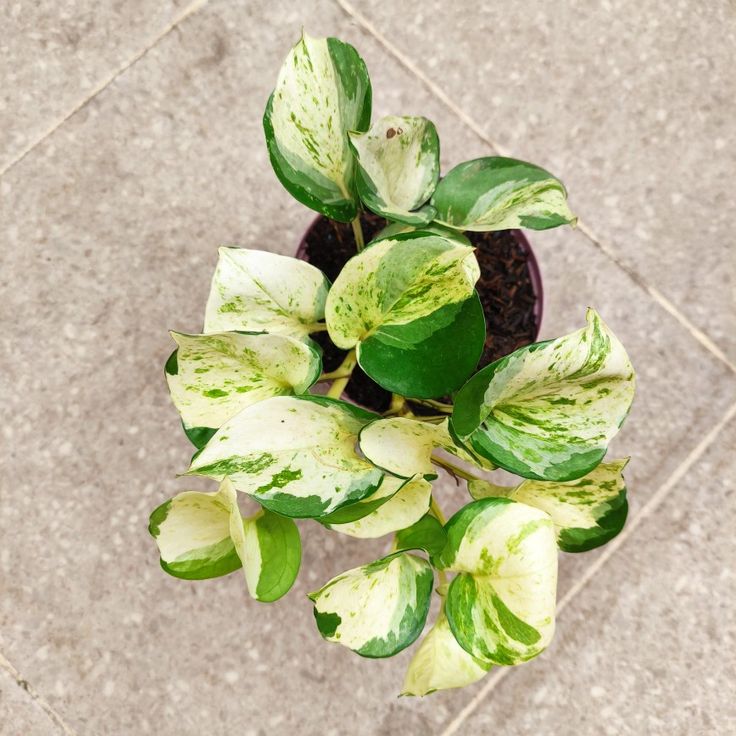
Manjula Pothos (Epipremnum aureum ‘Manjula’) is a patented cultivar of the classic golden pothos, developed and released by the University of Florida’s plant breeding program before being licensed for commercial propagation. It belongs to the Araceae family and shares the same vigorous, trailing growth habit as its parent species, but is distinguished by its wavy, crinkled leaf margins and a striking variegation pattern of cream, white, silvery-gray, and light green splashed irregularly across each heart-shaped leaf. Because the variegation is chimeric and somewhat random, no two leaves look exactly alike, which is part of what makes this cultivar so prized among collectors and casual houseplant owners alike.
Like other members of the Epipremnum genus, Manjula Pothos is native to the tropical forests of French Polynesia, though the wider species Epipremnum aureum originates from the Society Islands and has since become naturalized in tropical regions around the world, including parts of Southeast Asia and Australia, where it is considered invasive in some environments. In its natural habitat, it grows as an epiphytic or hemiepiphytic vine, climbing up tree trunks using aerial roots and producing much larger, more deeply lobed leaves than the smaller juvenile leaves typically seen on houseplants.
Notable features of the Manjula cultivar include its slower growth rate compared to standard golden or marble queen pothos, its higher light tolerance without leaf scorch, and its tendency to produce leaves with more white pigmentation as the plant matures and receives brighter indirect light. Its trailing stems make it a popular choice for hanging baskets, shelves, and as a climbing vine trained up a moss pole, and it is widely appreciated for being relatively low maintenance while still offering a visually dramatic, high-contrast foliage display.
Manjula Pothos is considered a beginner-to-intermediate friendly houseplant, forgiving of occasional care lapses but rewarding consistent attention with lush, heavily variegated growth. The single most important care factor is light: because of its high proportion of white and cream variegation, this cultivar needs brighter indirect light than an all-green pothos to photosynthesize efficiently, since the pale sections of each leaf contain little to no chlorophyll. Bright, indirect light near an east or south-facing window (filtered through a sheer curtain) will produce the most balanced variegation and prevent the plant from reverting to solid green.
Watering should follow a ‘soak and dry’ approach: allow the top 1-2 inches of soil to dry out between waterings, then water thoroughly until liquid drains from the pot’s bottom, and discard any excess in the saucer. Overwatering is the most common cause of problems in this species, leading to root rot, yellowing leaves, and a mushy stem base, while underwatering shows up as crispy leaf edges and drooping. A well-draining aroid potting mix, moderate humidity, and warm, stable temperatures between 65-85°F round out the plant’s core needs.
Beyond the basics, Manjula Pothos benefits from monthly feeding during the growing season (spring through early fall), occasional pruning to encourage bushier growth and manage trailing length, and repotting roughly every one to two years as it outgrows its container. Wiping dust from the leaves periodically helps maximize light absorption, and rotating the pot occasionally encourages even, symmetrical growth. With these fundamentals in place, this cultivar can thrive for many years as a striking centerpiece in a home or office setting.
 Soil
Soil
Manjula Pothos thrives in a light, well-draining, aroid-style potting mix rather than dense, water-retentive garden soil. A good base recipe combines standard indoor potting soil with perlite, orchid bark, and a small amount of coarse sand or horticultural charcoal, aiming for a mix that holds some moisture while allowing excess water to drain freely and air to reach the roots. The ideal soil pH range is slightly acidic to neutral, roughly 6.0 to 6.5, which supports healthy nutrient uptake. Amendments such as worm castings or a slow-release organic fertilizer mixed into the soil at planting time can provide a steady nutrient supply, while horticultural charcoal helps prevent bacterial buildup and keeps the mix fresh for longer between repottings.
Soil composition directly affects root health and, by extension, the vigor and variegation quality of the foliage above. A mix that is too dense or compacted restricts oxygen flow to the roots, encouraging anaerobic conditions that favor root rot pathogens, while a mix that drains too quickly can leave the plant chronically underwatered and stressed. Common soil problems to watch for include poor drainage (often from mixes with too much peat or garden soil, leading to waterlogging and root rot), compaction over time as organic material breaks down, which reduces aeration and should be corrected with fresh mix at repotting, inappropriate pH that can lock out nutrients like iron and manganese, salt build-up from fertilizer or tap water minerals (visible as a white crust on the soil surface or pot rim, addressed by periodic deep watering to flush the mix), nutrient deficiencies from old, depleted soil showing up as pale or yellowing new growth, and root boundness, where a plant left too long in one pot develops a dense, circling root mass that restricts water uptake and signals it is time to repot into fresh, aerated soil.
 Fertilizer
During the active growing season of spring through early fall, Manjula Pothos benefits from monthly feeding with a balanced, water-soluble houseplant fertilizer (such as a 20-20-20 or similar N-P-K ratio) diluted to half strength to avoid root burn. Feeding should be reduced to every 6 to 8 weeks or paused entirely during fall and winter, when the plant’s growth naturally slows and excess nutrients are more likely to build up unused in the soil.
Signs of over-fertilization include a crusty white buildup of salts on the soil surface or pot rim, brown, crispy leaf tips and margins, and in severe cases wilting despite moist soil due to root burn. Signs of under-fertilization include pale, washed-out new growth, stunted or very slow growth during the active growing season, and a general lack of vigor despite otherwise adequate light and water. Organic alternatives include diluted fish emulsion, liquid seaweed or kelp extract, and worm castings worked into the topsoil, all of which provide a gentler, slow-release nutrient source. This species has no unusual or exotic nutrient requirements beyond standard balanced macronutrients (nitrogen, phosphorus, potassium) along with trace micronutrients like magnesium and iron, deficiencies of which typically show as interveinal yellowing on new leaves.
 Watering
Manjula Pothos prefers a thorough soak-and-dry watering cycle: water deeply until liquid runs from the drainage holes, then allow the top 1 to 2 inches of soil to dry out completely before watering again, which typically works out to roughly once every 7 to 10 days indoors, though this varies with light, temperature, and pot size. Room-temperature water is best, and while tap water is generally fine for most households, plants sensitive to fluoride or chlorine may benefit from filtered, distilled, or rainwater, particularly if brown leaf tip burn becomes a recurring issue.
Signs of overwatering include yellowing leaves (especially older, lower leaves), a mushy or blackened stem base, a persistently soggy soil smell, and eventually root rot if the condition continues unaddressed. Signs of underwatering include crispy, curling leaf edges, a lightweight pot that indicates fully dry soil, and drooping stems that perk back up shortly after a thorough watering. Watering needs shift seasonally: during the active growing season in spring and summer, the plant uses water more quickly and may need watering slightly more often, while in fall and winter, growth slows considerably and the soil should be allowed to dry out further between waterings to avoid waterlogged, cold, slow-draining soil sitting around dormant roots.
Stop guessing. Most houseplant failures are caused by volumetric errors and improper moisture tension. Our deterministic calculator moves beyond "once-a-week" watering by analyzing the four critical pillars of root health:
Personalized for this plant
Disclaimer: Our calculator is pretty smart. We’ve crunched the numbers, but we’re not measuring the quantum state of your living room. Since we don’t know your exact indoor temperature, humidity, light, airflow, or whether your plant receives daily sweet nothings and motivational speeches, use this calculator as a guide—and always keep an eye on your plant.
 Lighting
Manjula Pothos performs best in bright, indirect light, ideally near an east-facing window that receives gentle morning sun, or a few feet back from a south- or west-facing window where light is filtered by a sheer curtain. Because this cultivar carries an unusually high amount of white and cream variegation, it actually tolerates and often benefits from brighter light than a solid green pothos, since the reduced chlorophyll content means it needs more available light to fuel photosynthesis. Direct, intense afternoon sun should still be avoided, as it can scorch the delicate white leaf sections, which lack the pigment protection that greener leaves have.
Signs of insufficient light include leggy, stretched-out stems with long gaps between leaves, a gradual loss of variegation as the plant produces more chlorophyll-rich green tissue to compensate (essentially reverting toward a solid green form), and generally slower, weaker growth. Signs of excessive light include bleached or crispy white patches, brown scorch marks concentrated on the palest parts of the leaves, and curling or wilting foliage despite adequate soil moisture. If natural light is insufficient, a full-spectrum LED grow light positioned 12 to 24 inches above the plant and run for 10 to 12 hours a day can effectively supplement or replace natural sunlight, and rotating the plant periodically ensures even light exposure and symmetrical growth on all sides.
 Temperature
Manjula Pothos thrives in typical indoor temperatures between 65°F and 85°F (18°C to 29°C), with an ideal comfort range around 70°F to 80°F. It has moderate tolerance for brief fluctuations but does not handle sustained cold well; temperatures below 50°F (10°C) can cause chilling damage, visible as blackened or mushy patches on the leaves, while temperatures below freezing will kill the plant outright. The plant also has some sensitivity to sudden heat stress or hot, dry drafts, which can cause rapid leaf curling and moisture loss.
To protect the plant from temperature extremes, keep it away from cold, drafty windows in winter, avoid placing it near exterior doors that let in cold air, and keep it clear of heating vents, radiators, and air conditioning units that can create localized hot or cold spots and dry drafts. If temperatures are expected to drop significantly, such as during a winter cold snap, moving the plant to a more interior, temperature-stable room is the simplest protective measure.
 Humidity
Manjula Pothos is adaptable but performs best in moderate to high humidity, ideally in the 50 to 70 percent range, though it will tolerate average household humidity levels of 30 to 40 percent reasonably well without major issues. In low humidity, symptoms of stress include browning or crisping leaf tips and edges, slowed growth, and occasionally curling leaves as the plant attempts to reduce moisture loss through its foliage. High humidity is rarely problematic for this species on its own, though when combined with poor air circulation it can increase susceptibility to fungal issues on the leaves or soil surface.
To raise humidity around the plant, a pebble tray filled with water placed beneath (but not directly under) the pot creates a zone of elevated moisture as the water evaporates, offering mild but steady benefit. Grouping plants together also raises local humidity through collective transpiration. A small room humidifier placed nearby is the most effective and consistent method, particularly in dry climates or during winter when indoor heating lowers ambient humidity significantly. Misting the leaves can offer a brief, temporary humidity boost but is the least effective long-term solution and should be done in the morning if used, to allow foliage to dry before evening and reduce fungal risk.
 Propagation
Manjula Pothos is most commonly and successfully propagated through stem cuttings rooted in water or moist sphagnum moss, a method prized for its simplicity and high success rate compared to less common approaches like soil propagation or air layering. Step-by-step guide: 1) Select a healthy stem with at least two to three leaves and one or more visible aerial root nodes. 2) Using clean, sharp scissors or pruning shears, cut the stem about half an inch below a node, since new roots emerge specifically from these nodal points. 3) Remove the lowest leaf on the cutting if it would sit below the waterline or soil surface. 4) Place the cutting in a clean glass or jar of room-temperature water (or into moistened sphagnum moss), ensuring at least one node is submerged or in contact with the moist medium. 5) Position the cutting in bright, indirect light and change the water every 5 to 7 days to keep it fresh and oxygenated. 6) Watch for root development, which typically begins within 1 to 3 weeks. 7) Once roots reach 1 to 2 inches long, transplant the cutting into a well-draining aroid potting mix. 8) Keep the newly potted cutting consistently moist (not soggy) for the first few weeks to help it establish, then transition to the normal soak-and-dry watering schedule.
Water propagation tends to have a slightly higher visible success rate for beginners since root development can be monitored directly, while soil propagation, though possible, has a somewhat lower success rate due to the difficulty of maintaining consistent moisture without visibility into root progress. Late spring through summer is the best time to propagate, coinciding with the plant’s natural active growth phase, and newly potted cuttings typically establish and resume visible new growth within 4 to 8 weeks.
 Potting
Manjula Pothos should be potted in a container with adequate drainage holes to prevent water pooling at the roots; unglazed terracotta is a popular choice because its porous walls help wick away excess moisture, though plastic or glazed ceramic pots work equally well as long as drainage is present. A well-draining aroid mix of potting soil, perlite, and orchid bark, as described in the soil section, is ideal. Repotting is generally needed every 1 to 2 years, or whenever the plant becomes noticeably root-bound.
Signs that repotting is needed include roots visibly circling the inside of the pot or emerging from drainage holes, water running straight through the pot without being absorbed (indicating the roots have displaced most of the soil), stunted growth despite good care, and a plant that dries out unusually fast between waterings. When repotting, gently loosen the root ball, and if roots are densely circling or matted, light root pruning with clean shears can encourage healthier, more outward root growth in the new container; only remove damaged, mushy, or excessively tangled roots, cutting no more than about a quarter of the total root mass at once. Choose a new pot only one to two inches larger in diameter than the current one, since an oversized pot holds excess moisture the roots can’t use, increasing rot risk. To minimize transplant stress, repot during the active growing season, keep the plant out of direct sun for a week or two afterward, and maintain slightly more consistent moisture during the initial adjustment period.
 Pruning
The best time to prune is during the active growing season in spring or summer, when the plant recovers and produces new growth most quickly, though light trims can be done any time of year if needed for plant health.
Pruning helps control the vine’s trailing length, encourages bushier, fuller growth by triggering branching below the cut, removes damaged or leggy stems, and provides fresh cuttings for propagation.
Use clean, sharp scissors or pruning shears, wiping the blades with rubbing alcohol before and after use to prevent the spread of disease between plants.
Water lightly after pruning if the soil is dry, keep the plant in its normal bright, indirect light spot, and resume regular fertilizing on the usual schedule once new growth appears, typically within one to two weeks.
Wear gloves if you have sensitive skin, as the plant’s sap can cause mild irritation in some individuals, and always prune any stems that have reverted to all-green first, since these grow more vigorously and can crowd out variegated growth if left unchecked.
 Blooming
Manjula Pothos, like most pothos cultivars, essentially never blooms in typical indoor cultivation. Flowering only occurs on mature plants growing in their native tropical habitat under very specific conditions, and even then it is exceedingly rare. When flowering does occur in the wild, it typically happens during the warm, humid growing season, producing a small, unremarkable spadix (a spike of tiny flowers) partially enclosed by a pale green or cream spathe, similar in structure to other aroid flowers such as peace lily or anthurium blooms, though far less showy. Because indoor plants rarely reach the juvenile-to-mature transition needed to flower, gardeners should not expect or plan around blooming with this species; it is grown almost exclusively for its ornamental foliage.
 Pests and Diseases
Name: Spider Mites
Symptoms: Fine webbing on the undersides of leaves, stippled or speckled yellowing, and overall dull, dusty-looking foliage, especially in dry indoor conditions.
Treatment: Isolate the plant, rinse foliage thoroughly under running water, treat with insecticidal soap or neem oil applied to all leaf surfaces every 5-7 days for several cycles, and increase humidity to discourage recurrence.
Name: Mealybugs
Symptoms: Small, cottony white clusters in leaf axils and along stems, sticky honeydew residue, and sooty mold developing on affected surfaces.
Treatment: Dab visible clusters with a cotton swab dipped in isopropyl alcohol, follow with a full plant treatment of insecticidal soap or neem oil, and repeat weekly until no new mealybugs appear.
Name: Scale Insects
Symptoms: Small, brown or tan bumps that appear stuck to stems and leaf undersides, yellowing foliage, and sticky honeydew buildup.
Treatment: Scrape off visible scale with a soft brush or fingernail, treat with insecticidal soap or a systemic insecticide for persistent infestations, and inspect regularly since scale can be difficult to fully eliminate in one treatment.
Name: Fungus Gnats
Symptoms: Small, dark flying insects around the soil surface and larvae in the topsoil, generally more of a nuisance than a direct threat to plant health, though larvae can damage fine roots in large numbers.
Treatment: Allow soil to dry out more between waterings, use yellow sticky traps to catch adults, and apply a mosquito-bit (BTI) soil drench to eliminate larvae.
Name: Root Rot
Symptoms: Yellowing, wilting leaves despite moist soil, a mushy, dark, foul-smelling stem base, and roots that appear brown and slimy rather than firm and white when inspected.
Treatment: Remove the plant from its pot, trim away all affected mushy roots with sterilized shears, repot into fresh, well-draining mix in a clean pot, and reduce watering frequency going forward.
Name: Bacterial Leaf Spot
Symptoms: Small, water-soaked spots on leaves that may have a yellow halo, eventually turning brown or black and sometimes merging into larger dead patches.
Treatment: Remove and discard affected leaves, avoid overhead watering or wetting foliage, improve air circulation around the plant, and apply a copper-based bactericide if the issue persists or spreads.
Name: Southern Blight
Symptoms: White, cottony fungal growth at the base of the stem near the soil line, along with wilting and rapid stem collapse.
Treatment: Remove and discard affected plant material and the surrounding soil immediately, sterilize the pot before reuse, and apply a fungicide labeled for Southern blight to any remaining healthy plant material.
 Special Features
Manjula Pothos stands out for its uniquely irregular, chimeric variegation, which means every leaf displays a different, one-of-a-kind pattern of cream, silvery-gray, and green, making it a favorite among plant collectors seeking visual variety within a single specimen. Its gently wavy, ruffled leaf margins add textural interest that distinguishes it from the smoother-leafed golden or marble queen pothos cultivars, and its relatively slower, more compact growth habit makes it easier to manage in smaller indoor spaces without sacrificing its striking ornamental impact. As a low-maintenance trailing or climbing vine, it also offers strong seasonal-interest-free year-round appeal, staying visually engaging in every month rather than being tied to a specific bloom period.
 Plant Benefits
Manjula Pothos has no established medicinal, herbal, or pharmaceutical use in humans, and due to its calcium oxalate content, ingestion is more likely to cause harm than any therapeutic benefit. Its primary benefit is ornamental and, like many houseplants, it may offer minor indoor air quality improvement through general foliage-based air filtration, though it should not be relied upon as a significant air purification solution.
 Additional Information
Manjula Pothos is a patented cultivar, meaning unlicensed commercial propagation for resale is legally restricted in some regions, though home propagation for personal use is generally accepted practice among hobbyists. The cultivar name honors Manjula Vijaykumar, one of the researchers involved in its development at the University of Florida. Because its variegation is chimeric rather than genetically fixed like some other variegated plants, cuttings taken from all-green reverted stems will grow as solid green plants, so selecting cuttings from well-variegated stem sections is important for propagating true-to-type plants.
 Life Cycle
As a tropical evergreen perennial vine, Manjula Pothos does not follow an annual bloom-to-seed cycle in typical cultivation; instead, it grows continuously and indefinitely under suitable indoor conditions, cycling through phases of active growth in spring and summer and slower, semi-dormant growth in fall and winter. In its native epiphytic habitat, mature plants climbing established trees eventually transition to a mature leaf form with larger, deeply fenestrated leaves, but houseplants are almost always maintained in the smaller-leafed juvenile form indefinitely, since the conditions needed to trigger maturation (climbing a substantial support with consistent high humidity) are rarely replicated indoors. With appropriate ongoing care, a single Manjula Pothos plant can live and continue producing new growth for many years, often a decade or more, particularly when periodically refreshed through pruning and propagation of new cuttings.
 Are Manjula Pothos Poisonous, Toxic
Manjula Pothos is toxic to cats, dogs, and children if chewed or ingested. All parts of the plant contain insoluble calcium oxalate crystals, with the highest concentrations found in the leaves and stems. When plant tissue is chewed, these microscopic, needle-shaped crystals penetrate the soft tissue of the mouth, tongue, and throat, causing immediate irritation. Affected organisms include cats, dogs, and small children, who are most at risk due to curiosity and smaller body size. Symptoms of toxicity include oral pain, intense burning or irritation of the lips, tongue, and mouth, excessive drooling, difficulty swallowing, vomiting, and in some cases swelling of the airway that can cause breathing difficulty. Severity is generally classified as mild to moderate; fatalities are rare, but significant discomfort and, in severe cases involving airway swelling, veterinary or medical attention may be necessary. First aid steps include gently rinsing the mouth with water or milk, wiping away any visible plant material, offering a cold treat or water to soothe irritation, and contacting a veterinarian, pediatrician, or poison control center promptly, especially if swelling, breathing difficulty, or persistent vomiting occurs. Preventive measures include keeping the plant on high shelves or in hanging baskets out of reach of pets and children, using bitter-apple deterrent sprays on foliage, and choosing pet-safe alternatives in households with young animals or children prone to putting plants in their mouths.
 Frequently Asked Questions
Water when the top 1-2 inches of soil are dry, typically about once every 7-10 days, adjusting for light, temperature, and season.
Yes, it contains calcium oxalate crystals that irritate the mouth and throat if chewed, and it should be kept out of reach of pets.
It needs bright, indirect light due to its heavy white variegation; low light can cause it to revert to solid green.
Insufficient light is the most common cause, prompting the plant to produce more chlorophyll-rich green growth to compensate.
Take a stem cutting with at least one node, place it in water or moist sphagnum moss under bright indirect light, and pot it once roots form.
A well-draining aroid mix of potting soil, perlite, and orchid bark with a pH around 6.0 to 6.5 works best.
It stays a medium-sized trailing or climbing vine indoors, with stems that can trail several feet if left untrimmed.
It prefers moderate to high humidity around 50-70% but tolerates average household humidity reasonably well.
Feed monthly with a balanced fertilizer diluted to half strength during the growing season, and reduce or pause in winter.
Brown, crispy edges usually indicate low humidity, underwatering, or excess fertilizer salts, while soft brown spots may signal fungal disease.
 Can I grow Manjula Pothos in my indoor space
Difficulty: Easy
Size: Medium
Light: Medium
Water: Medium
Flowering: No
Pet Safe: No
Air Purifier: Medium
 Epipremnum aureum 'Manjula' botanical details
Common Name: Manjula Pothos
Other Common Names: Marble Pothos, Manjula Pothos Vine, Happy Leaf Pothos, Jade Pothos (occasionally, though this more often refers to a different cultivar)
Botanical Name: Epipremnum aureum 'Manjula'
Native Area: Society Islands of French Polynesia (parent species Epipremnum aureum); the 'Manjula' cultivar itself was developed in cultivation in the United States and is not found in the wild
Family Name: Araceae
Plant Type: Evergreen perennial vine (epiphytic/climbing)
Genus: Epipremnum
Kingdom: Plantae
 Photo Gallery
 My Manjula Pothos Plant Care Recommendations
If you find the Houseplant Encyclopedia helpful and would like to support Healthy Houseplants, you can use the links below to shop for recommended plants, products, and plant-care supplies.
Some links are affiliate links, which means I may earn a small commission if you make a qualifying purchase through them, at no additional cost to you. Thank you for supporting Healthy Houseplants and helping me continue to provide free plant-care information!

Want even more personalized plant-care help? Check out my AI Julie Chatbot—trained on my 20 years of houseplant knowledge, not just information from the internet!  Try it now:Ask AI Julie
 Buy Manjula Pothos Online
✅ “Bring Home This Beauty Today”
✅ “Get Your Own Manjula Pothos Before It’s Gone”
✅ “Shop Trusted Sellers – Limited Availability”
✅ “Free Delivery”
As an Amazon Associate, I earn commission from qualifying purchases.
 Plant Puns and Jokes
Why did the Manjula Pothos refuse to enter the talent show? It didn’t think it could ever be one-leaf in a million… it already knew every leaf was already one of a kind.
 Signup to our newsletter and download Manjula Pothos care guide

