


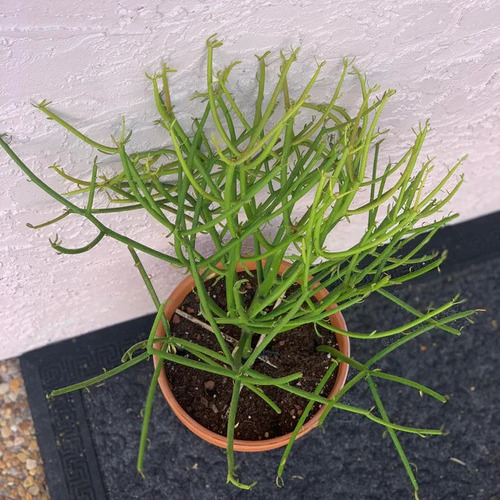
The Pencil Cactus (Euphorbia tirucalli) is a succulent shrub or small tree prized for its striking, near-leafless silhouette of slender, pencil-thick green stems that branch repeatedly into dense, coral-like clusters. Despite its common name and cactus-like appearance, it is not a true cactus at all; it belongs to the spurge family, Euphorbiaceae, and is a classic example of convergent evolution, having independently developed a water-storing, photosynthetic-stem growth habit similar to that of American cacti even though the two lineages are not closely related.
Native to the semi-arid and tropical regions of southeastern and eastern Africa, particularly Kenya, Tanzania, Mozambique, Madagascar, and parts of southern Africa, the species has since become widely naturalized across India, Southeast Asia, and other tropical and subtropical regions, where it is frequently planted as a living fence, windbreak, or erosion-control hedge because of its rapid growth, drought tolerance, and dense, thorny-looking (though actually spineless) branching structure. In its native habitat it can grow into a substantial tree reaching 20 to 30 feet, while in cultivation as a houseplant or landscape specimen it is usually kept much smaller through pruning.
One of the most notable features of Euphorbia tirucalli is its caustic, milky latex sap, which the plant exudes readily from any cut or broken stem. This sap is a defining characteristic of the species and the reason for many of its common nicknames, including ‘Firestick Plant’ (for the reddish-orange coloration some cultivars display in bright sun and cool temperatures) and ‘Milk Bush.’ The sap is a significant irritant and mild toxin, and handling the plant safely is an essential part of its care. Ornamentally, cultivars such as ‘Sticks on Fire’ (or ‘Firesticks’) have become especially popular in xeriscape and succulent gardens for their vivid red, orange, and yellow stem coloration, which intensifies with cooler temperatures and strong sunlight.
Pencil Cactus is widely regarded as one of the easiest succulents to grow, making it a favorite for gardeners who want a bold architectural plant without demanding maintenance. It thrives in bright, direct sunlight and well-draining, sandy or gritty soil, closely mimicking the arid, rocky conditions of its native African habitat. Because it stores water efficiently in its fleshy stems, it is highly drought tolerant and far more likely to suffer from overwatering than underwatering, so a ‘soak and dry’ watering approach, allowing the soil to dry out completely between waterings, is essential to prevent root rot.
Beyond light and water, successful long-term care revolves around three main pillars: appropriate potting and soil, careful handling due to the irritant sap, and periodic pruning to maintain shape and size. A shallow but stable pot with generous drainage holes, filled with a fast-draining cactus or succulent mix, supports healthy root development and prevents the moisture buildup that leads to fungal issues. Because the plant can grow quite tall and top-heavy, using a heavier terracotta or ceramic pot helps prevent tipping. Fertilizing needs are minimal; a diluted, balanced succulent fertilizer applied once or twice during the active spring and summer growing season is generally sufficient.
The single most important safety consideration when caring for Pencil Cactus is its toxic, skin-irritating latex sap. Any pruning, propagation, or repotting work should be done with gloves and eye protection, and the plant should be kept well away from curious pets and children, since the sap can cause significant irritation to skin, eyes, and mucous membranes, and is toxic if ingested. With these precautions in mind, and given its tolerance for neglect, heat, and poor soil fertility, Pencil Cactus rewards minimal-effort care with years of dramatic, low-maintenance structural interest indoors or in warm, dry outdoor landscapes.
 Soil
Soil
Pencil Cactus requires an extremely well-draining, gritty soil that mimics the sandy, rocky substrates of its native African habitat. A commercial cactus or succulent potting mix, ideally amended with extra coarse sand, perlite, or pumice at a ratio of roughly 50 percent mineral grit to 50 percent organic potting soil, provides the aeration and rapid drainage the roots need. The ideal soil pH is slightly acidic to neutral, in the range of 6.0 to 7.0, though the plant is fairly tolerant of mild pH fluctuations outside this range. Because the roots are highly susceptible to rot in waterlogged conditions, drainage is the single most critical soil property; heavy garden loam or standard potting soil used alone will retain far too much moisture. Soil composition directly affects plant health: overly rich or moisture-retentive soil encourages root rot and fungal disease, while soil that is too sandy and nutrient-poor over the long term can lead to slow growth and nutrient deficiencies, so an occasional light feeding helps offset the lean mineral content. Common soil-related problems include poor drainage (leading to root and stem rot), soil compaction over time (which restricts oxygen to roots and should be corrected by repotting with fresh, loose mix), inappropriate pH (which can lock out nutrient uptake), salt build-up from fertilizer or hard tap water (visible as a white crust on the soil surface, remedied by flushing the pot with water), nutrient deficiencies in old, depleted mixes, and root-boundness in pots that have been left too small for too long, which stunts growth and increases the risk of the plant tipping over.
 Fertilizer
Pencil Cactus has modest fertilizer needs and grows well with a diluted, balanced liquid succulent or cactus fertilizer (such as a 10-10-10 or similar low-strength formula diluted to half or quarter strength) applied once every 4 to 6 weeks during the active spring and summer growing season, with feeding suspended entirely during fall and winter dormancy. Over-fertilization shows up as excessive, weak, leggy growth, a white crust of mineral salts on the soil surface or pot rim, and in severe cases, browning or burning at the stem tips from fertilizer salt buildup; under-fertilization, though less common given the plant’s tolerance for lean soil, can eventually manifest as pale green or yellowish stem color and slowed growth over successive growing seasons. Organic alternatives such as well-diluted fish emulsion, compost tea, or a light top-dressing of worm castings applied once at the start of the growing season can substitute effectively for synthetic fertilizers while also improving long-term soil structure. The species has no unusual or species-specific nutrient requirements beyond standard succulent care, though as with most succulents it benefits from slightly higher phosphorus and potassium relative to nitrogen to support sturdy, compact stem growth rather than excessive elongation.
 Watering
Pencil Cactus follows a strict ‘soak and dry’ watering routine: water thoroughly until liquid drains from the pot’s base, then allow the soil to dry out completely before watering again, typically every 2 to 3 weeks during the active growing season and even less frequently, roughly once a month or less, during winter dormancy. The plant is not particular about water quality and generally does well with ordinary tap water, though those in areas with very hard or heavily chlorinated water may prefer filtered, distilled, or rainwater to avoid mineral salt buildup in the soil over time. Overwatering is by far the more common and more dangerous mistake, showing up as yellowing or blackening stem sections, a soft or mushy stem base, stem collapse, and a sour smell from the soil, all indicating root or stem rot; underwatering, though rare given the plant’s succulent tissue, shows up as noticeably shriveled, wrinkled, or limp stem segments that plump back up readily once watered. Watering needs shift with the seasons and growth stage: during the warm, actively growing spring and summer months the plant can tolerate and benefits from more frequent watering, while during the cool, dormant winter months its metabolism slows dramatically and watering should be cut back significantly to prevent rot, since the roots take up far less moisture in cooler, lower-light conditions.
Stop guessing. Most houseplant failures are caused by volumetric errors and improper moisture tension. Our deterministic calculator moves beyond "once-a-week" watering by analyzing the four critical pillars of root health:
Personalized for this plant
Disclaimer: Our calculator is pretty smart. We’ve crunched the numbers, but we’re not measuring the quantum state of your living room. Since we don’t know your exact indoor temperature, humidity, light, airflow, or whether your plant receives daily sweet nothings and motivational speeches, use this calculator as a guide—and always keep an eye on your plant.
 Lighting
Pencil Cactus needs bright, direct sunlight to thrive, ideally at least 6 hours of direct sun per day, such as from a south- or west-facing window indoors or an unshaded, open position outdoors. Ample light is also essential for maintaining compact, sturdy growth and, in colorful cultivars like ‘Sticks on Fire,’ for developing vivid red-orange stem pigmentation. Insufficient light causes the classic sign of etiolation: stems become pale, thin, and stretched out with excessive gaps between growth points as the plant reaches toward a light source, and colorful cultivars will often fade back to plain green. Excessive or sudden intense light, particularly after a period of lower light, can cause sunburn/scorch, visible as bleached, yellowish, or brown patches on the stems, especially on plants moved abruptly outdoors in summer. To correct insufficient natural light indoors, move the plant to the sunniest available window or supplement with a full-spectrum grow light positioned close to the plant for 10 to 12 hours a day; to correct excess light, provide light filtering with a sheer curtain or acclimate the plant gradually over 1 to 2 weeks when transitioning it to a sunnier spot or outdoors.
 Temperature
Pencil Cactus grows best in warm temperatures between 65°F and 85°F (18°C to 29°C) and tolerates considerably higher heat without stress, reflecting its origins in hot, semi-arid African climates. It has essentially no cold tolerance and is only reliably hardy outdoors in USDA zones 10 to 11; temperatures below about 50°F (10°C) can cause stem damage and discoloration, and any exposure to frost or freezing temperatures is typically fatal, causing the water-filled stems to rupture as ice crystals form within the tissue. The plant tolerates day-to-night temperature fluctuations reasonably well as long as extremes are avoided, and interestingly, cooler nighttime temperatures in fall and winter often intensify the red-orange coloration of ‘Firesticks’ type cultivars. To protect the plant from extreme cold, container specimens should be brought indoors well before the first frost, while in-ground plants in marginal climates can be covered with frost cloth or protected with a temporary greenhouse structure during cold snaps; extreme heat above roughly 100°F (38°C) is generally well tolerated provided the plant has adequate, if infrequent, water reserves in its stems.
 Humidity
Pencil Cactus is well adapted to low ambient humidity, generally thriving in the 10 to 40 percent range typical of arid climates and most indoor homes, and it does not require any special humidity intervention under normal conditions. High humidity combined with poor air circulation is actually a stress factor for this species, as damp, stagnant air around the stems increases the risk of fungal and bacterial rot, particularly if the potting mix also stays consistently moist. Symptoms of high-humidity stress include soft, water-soaked patches on stems, mold or mildew developing on the soil surface, and a general increase in pest and disease pressure, while low-humidity stress is essentially nonexistent for this desert-adapted species, though extremely dry indoor heating combined with underwatering can occasionally cause minor stem shriveling. Because supplemental humidity is unnecessary and often counterproductive, methods such as pebble trays, misting, or humidifiers are not recommended for Pencil Cactus; instead, prioritizing good air circulation with a small fan in stagnant indoor spaces is far more beneficial than any humidity-raising technique.
 Propagation
Euphorbia tirucalli is most commonly and successfully propagated from stem cuttings, a method that is fast, reliable, and requires no special equipment beyond gloves and clean tools; the following step-by-step guide outlines the process. 1. Put on gloves and eye protection, since the milky sap is a strong irritant. 2. Using a clean, sharp knife or pruning shears, cut a healthy stem segment 4 to 6 inches long from an actively growing branch. 3. Immediately rinse the cut end of both the cutting and the parent plant under running water to slow the sap flow and clean the wound. 4. Set the cutting in a dry, shaded location for 3 to 7 days to allow the cut end to callus over, which is essential for preventing rot once planted. 5. Once callused, insert the cut end about 1 to 2 inches deep into a pot of well-draining cactus or succulent mix. 6. Water very lightly to settle the soil, then withhold further watering for about a week to encourage root development rather than rot. 7. Place the cutting in bright, indirect light for the first few weeks, then gradually acclimate it to fuller sun. 8. Begin the normal soak-and-dry watering routine once new growth appears, typically in 3 to 6 weeks. Compared to stem cuttings, propagation by seed is far less common in cultivation and has a notably lower and slower success rate, since seeds require fresh material, warm stratification, and consistent moisture to germinate, and the resulting seedlings grow much more slowly than rooted cuttings. The best time to propagate by cuttings is during the warm, active growing months of spring through summer, when callusing and rooting proceed most quickly; under good conditions, cuttings typically root within 3 to 6 weeks and establish as a self-sufficient young plant within 2 to 3 months.
 Potting
Pencil Cactus does best in a sturdy, heavier pot such as terracotta or ceramic, which helps counterbalance the plant’s tendency to become top-heavy as it grows tall, combined with ample drainage holes to prevent water pooling around the roots. The ideal potting medium is a fast-draining cactus or succulent mix amended with extra perlite, pumice, or coarse sand to maximize aeration, since standing moisture is the leading cause of root and stem rot in this species. Repotting is generally needed every 2 to 3 years, or sooner if the plant is a fast-growing young specimen, and should be done in spring or early summer at the start of the active growing season. Signs that a Pencil Cactus needs repotting include roots visibly emerging from the drainage holes or growing in tight circles at the surface, water running straight through the pot without being absorbed, noticeably slowed growth despite good care, and a plant that has become unstable or top-heavy relative to its current pot size. Light root pruning can be done during repotting by trimming away any dead, mushy, or excessively circling roots with clean, sharp tools, which encourages healthier new root growth in the fresh mix. When transitioning to a new pot, minimize stress by handling the root ball gently, choosing a new container only 1 to 2 inches larger in diameter rather than a drastic size jump, using fresh, dry potting mix, and withholding water for about a week after repotting to allow any small root injuries to callus and reduce the risk of rot.
 Pruning
Prune Euphorbia tirucalli in spring or early summer, at the start of the active growing season, so cuts heal quickly and any resulting new growth has a full season to mature before winter dormancy.
Pruning is typically needed once or twice a year to control height, remove damaged or overcrowded stems, encourage bushier branching, and manage the plant’s size when grown indoors or in confined spaces.
Use clean, sharp pruning shears or a knife sterilized with rubbing alcohol. Before starting, put on protective gloves, long sleeves, and eye protection, lay down a drop cloth or newspaper to catch dripping sap, and work in a well-ventilated area away from pets and children.
Keep freshly pruned plants out of direct, intense sun for a few days to reduce stress, and withhold fertilizer for about two weeks while the plant recovers and seals its cuts.
Never prune Euphorbia tirucalli without gloves and eye protection, since the sap is a significant skin and eye irritant; also avoid pruning during winter dormancy, when the plant heals more slowly and is more vulnerable to rot at fresh cut sites.
 Blooming
Euphorbia tirucalli blooms sporadically and inconspicuously, most commonly in late winter to early spring when grown outdoors in warm climates, though indoor specimens rarely flower at all. The flowers are tiny (a few millimeters wide), yellow-green, cup-like structures called cyathia, clustered at the branch tips, and each bloom lasts only a few days before giving way to small three-lobed seed capsules. Flowering is encouraged by strong, direct sunlight, warm temperatures, and a period of slight water restriction, conditions that are difficult to replicate indoors, which is why the species is grown almost entirely for its foliage and stem form rather than for its blooms.
 Pests and Diseases
Name: Mealybugs
Symptoms: Small, white, cottony clusters at stem joints and crevices, sticky honeydew residue, and localized yellowing or stunted growth near infested areas.
Treatment: Dab visible mealybugs with a cotton swab dipped in isopropyl alcohol, then treat the whole plant with insecticidal soap or neem oil, repeating every 7 to 10 days until the infestation clears.
Name: Spider mites
Symptoms: Fine webbing between stem segments, tiny yellow or bronze speckling on stem surfaces, and an overall dull, stippled appearance, especially in hot, dry conditions.
Treatment: Rinse stems with a strong stream of water to dislodge mites, increase air circulation, and apply insecticidal soap or a miticide, repeating treatments every 5 to 7 days for two to three weeks.
Name: Scale insects
Symptoms: Small, brown or tan, immobile bumps adhering to stems, accompanied by sticky honeydew and sometimes sooty mold growth.
Treatment: Scrape off visible scale with a soft brush or fingernail, then apply horticultural oil or neem oil to smother remaining insects and prevent new infestations.
Name: Root rot
Symptoms: Blackened, mushy stem bases, a foul odor from the soil, wilting or collapsing stems despite adequate moisture, and stunted or halted growth.
Treatment: Remove the plant from its pot, trim away all black or mushy roots and stem tissue with sterilized tools, allow remaining healthy tissue to dry and callus, then repot in fresh, fast-draining mix and resume watering only once new growth appears.
Name: Stem canker / fungal lesions
Symptoms: Sunken, discolored, or corky patches on stems, sometimes with a visible margin between healthy and infected tissue.
Treatment: Cut out affected stem sections well into healthy tissue using sterilized tools, discard infected material, avoid overhead watering, and apply a copper-based fungicide to remaining cut surfaces if the infection is widespread.
Name: Bacterial soft rot
Symptoms: Rapidly spreading, water-soaked, foul-smelling soft spots on stems that can collapse a section of the plant within days.
Treatment: Immediately isolate and remove all affected tissue with sterilized tools well beyond the visible damage, improve drainage and airflow, reduce watering frequency, and discard severely affected plants if the rot cannot be contained.
 Special Features
Beyond its architectural, low-maintenance appeal, Euphorbia tirucalli offers several distinctive features that set it apart from other succulents. Its rapid, dense branching habit and near-total absence of leaves for most of the year make it a striking sculptural focal point in modern and xeriscape garden design, while colorful cultivars like ‘Sticks on Fire’ add vivid seasonal color that intensifies with cooler temperatures and bright light, effectively giving the plant a form of ornamental seasonal interest. In its native range, the plant has long been used in traditional hedging and boundary-marking for its dense, rapid growth and the deterrent effect of its irritant sap, and various parts of the plant have historically been used in some traditional medicine practices, though such uses carry significant safety risks given the plant’s toxicity and are not recommended without professional guidance. Its extreme drought tolerance and minimal soil-fertility requirements also make it valuable for erosion control and low-water landscaping in hot, arid regions.
 Plant Benefits
Historically, various parts of Euphorbia tirucalli have been used in traditional folk medicine in parts of Africa and India for purposes such as treating skin conditions, warts, and as a purgative, and the latex has been studied in some traditional and pharmacological contexts for its bioactive diterpene compounds. However, these traditional uses come with substantial risk due to the sap’s caustic and potentially carcinogenic properties when misused, and the plant is not recommended for home herbal or medicinal use; any such applications should only be considered under qualified professional or clinical supervision.
 Additional Information
Euphorbia tirucalli is sometimes confused with true cacti due to its spiny, leafless, water-storing stems, but it can be distinguished by its milky latex sap, a trait absent in the Cactaceae family. It is considered a fast-growing, weedy species in some tropical regions outside its native range and can become invasive if planted in the ground in favorable climates without management, so gardeners in warm-winter regions should monitor and control its spread. The plant is also of interest to researchers due to compounds in its latex that have been studied for potential industrial and biofuel applications, given its high biomass yield in poor, dry soils.
 Life Cycle
As a long-lived evergreen succulent shrub or tree, Euphorbia tirucalli follows a perennial life cycle without a defined annual dieback. It germinates from seed (or roots readily from stem cuttings), then enters a juvenile phase of rapid vegetative branching for the first few years as it establishes a woody base and extensive stem structure. Growth is fastest during warm, bright conditions in spring and summer and slows or pauses during cooler winter months. The plant reaches reproductive maturity after several years, at which point it may periodically produce small, inconspicuous flowers followed by seed capsules, though vegetative propagation remains far more common in cultivation. With minimal care, a healthy specimen can live for decades, gradually developing a thicker, more tree-like woody trunk at its base over time.
 Are Pencil Cactus Poisonous, Toxic
Euphorbia tirucalli is toxic to cats, dogs, and humans, including children, due to the caustic milky latex sap contained throughout the stems. Every part of the plant exudes this sap when cut, broken, or chewed, and it is the sap rather than any single plant part that poses the primary hazard. In animals, contact or ingestion can cause drooling, oral and gastrointestinal irritation, vomiting, and diarrhea; skin or eye contact causes redness, swelling, and a painful burning sensation. In humans, the sap is a well-documented severe skin and eye irritant capable of causing blistering dermatitis, and eye exposure can lead to intense pain, corneal damage, and temporary or, in rare severe cases, lasting vision impairment; ingestion causes burning of the mouth and throat, nausea, vomiting, and diarrhea. Severity ranges from mild, temporary irritation with brief contact to serious injury with prolonged skin contact, eye exposure, or ingestion of larger amounts, and reactions can vary by individual sensitivity. First aid for skin contact involves immediately washing the area with plenty of soap and water; for eye exposure, flush the eye continuously with lukewarm water or saline for at least 15 minutes and seek prompt medical attention; for ingestion, rinse the mouth, do not induce vomiting, and contact a poison control center or physician immediately. Preventive measures include wearing gloves and eye protection when pruning or propagating, keeping the plant out of reach of pets and small children, avoiding planting it near play areas, and promptly cleaning any tools or surfaces that contact the sap.
 Frequently Asked Questions
Yes, the milky sap of Pencil Cactus (Euphorbia tirucalli) is a strong skin and eye irritant, so gloves and eye protection should always be worn when handling or pruning the plant.
No, Pencil Cactus is toxic to cats and dogs; its sap can cause oral irritation, drooling, vomiting, and diarrhea if chewed or ingested, and should be kept out of pets’ reach.
Water only when the soil has dried out completely, typically every 2 to 3 weeks in the growing season and even less often in winter, since overwatering is the most common cause of problems.
Yellowing stems are usually a sign of overwatering or root rot, though they can also indicate insufficient light; checking soil moisture and root health is the first step to diagnosing the cause.
In its native habitat Pencil Cactus can grow into a 20 to 30 foot tree, but as a potted houseplant it is usually kept much smaller, from 3 to 8 feet, through regular pruning.
Pencil Cactus is propagated from stem cuttings that are allowed to callus for several days before being planted in well-draining succulent soil, typically rooting within 3 to 6 weeks.
Yes, Pencil Cactus needs at least 6 hours of bright, direct sunlight per day to maintain compact growth and, in colorful cultivars, vivid stem pigmentation.
Firesticks, or ‘Sticks on Fire,’ is simply a colorful cultivar of Euphorbia tirucalli that develops red, orange, and yellow stem tones in bright light and cool temperatures, while the standard species is green.
Pencil Cactus is only reliably cold-hardy in USDA zones 10 to 11 and should be brought indoors or protected from any temperatures below about 50°F, since it has little frost tolerance.
Flush the eye continuously with lukewarm water or saline for at least 15 minutes and seek prompt medical attention, since the sap can cause significant pain and irritation.
 Can I grow Pencil Cactus in my indoor space
Difficulty: Easy
Size: Medium to Large
Light: High
Water: Low
Flowering: Yes
Pet Safe: No
Air Purifier: Low
 Euphorbia tirucalli botanical details
Common Name: Pencil Cactus
Other Common Names: Firestick Plant, Firesticks, Sticks on Fire, Milk Bush, Indian Tree Spurge, Naked Lady, Rubber Euphorbia, Aveloz, Petroleum Plant
Botanical Name: Euphorbia tirucalli
Native Area: Tropical and semi-arid regions of eastern and southeastern Africa, including Kenya, Tanzania, Mozambique, and Madagascar, with naturalized populations across India, Southeast Asia, and other warm regions worldwide.
Family Name: Euphorbiaceae
Plant Type: Succulent shrub/tree (evergreen perennial)
Genus: Euphorbia
Kingdom: Plantae
 Photo Gallery
 My Pencil Cactus Plant Care Recommendations
If you find the Houseplant Encyclopedia helpful and would like to support Healthy Houseplants, you can use the links below to shop for recommended plants, products, and plant-care supplies.
Some links are affiliate links, which means I may earn a small commission if you make a qualifying purchase through them, at no additional cost to you. Thank you for supporting Healthy Houseplants and helping me continue to provide free plant-care information!

Want even more personalized plant-care help? Check out my AI Julie Chatbot—trained on my 20 years of houseplant knowledge, not just information from the internet!  Try it now:Ask AI Julie
 Buy Pencil Cactus Online
✅ “Bring Home This Beauty Today”
✅ “Get Your Own Pencil Cactus Before It’s Gone”
✅ “Shop Trusted Sellers – Limited Availability”
✅ “Free Delivery”
As an Amazon Associate, I earn commission from qualifying purchases.
 Plant Puns and Jokes
Why did the Pencil Cactus refuse to write anything down? It didn’t want to get pointed at for sharp remarks!
 Signup to our newsletter and download Pencil Cactus care guide

