About Living Stones
Living Stones Introduction
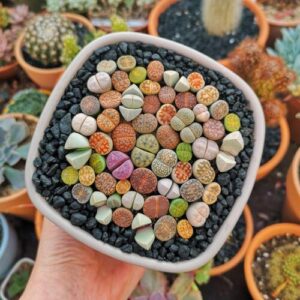
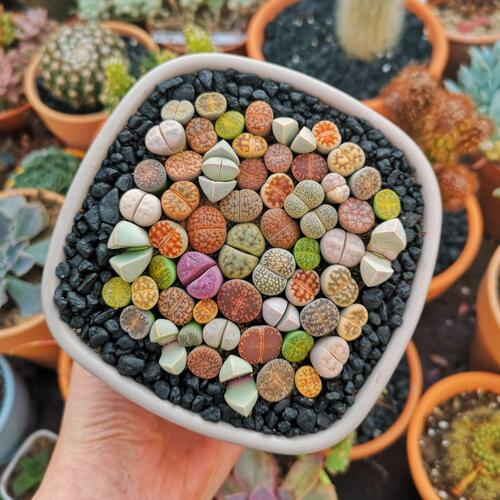
Lithops, commonly called Living Stones, are extraordinary dwarf succulents belonging to the family Aizoaceae. Each plant consists of one or more pairs of thick, fused leaves that form a smooth, rounded body closely resembling a small pebble or stone, an adaptation that helps the plant blend seamlessly into the rocky, arid landscapes where it grows. The genus name is derived from the Greek words ‘lithos’ (stone) and ‘ops’ (face), a fitting description of their stony appearance. There are dozens of recognized species and countless natural varieties, each displaying subtle differences in color, pattern, and surface texture, ranging from gray, tan, and brown to shades of green, pink, and reddish-purple, often marked with intricate dots, lines, or windowed patterns.
Lithops are native to the arid regions of southern Africa, primarily Namibia, South Africa, and Botswana, where they grow in gravelly, mineral-rich soils under intense sun exposure and minimal rainfall. Their camouflage is a survival mechanism that protects them from grazing animals in an environment offering little cover. Most of the plant body remains at or below the soil surface, with only the flattened top exposed, further enhancing the stone-like disguise. This adaptation, along with their ability to store water within their fleshy leaves, allows Lithops to endure long periods of drought.
One of the most fascinating aspects of Living Stones is their annual growth cycle. Each year, a new pair of leaves emerges from the center of the plant and slowly absorbs the nutrients and moisture from the old pair, which shrivels and splits apart as the new leaves take over. This process, along with their late-season daisy-like flowers that emerge from the fissure between the leaf pair, makes Lithops a rewarding and visually captivating plant for collectors and succulent enthusiasts who enjoy observing subtle, seasonal changes.
Living Stones Care & Growing Guide
Caring for Living Stones requires an understanding of their native desert habitat and a willingness to embrace a very different watering philosophy than most houseplants. Lithops thrive in bright, direct sunlight and well-draining, mineral-based soil that mimics the gravelly terrain of their origin. Because they store water in their leaves, they are highly susceptible to rot if overwatered, and their care routine is closely tied to their annual growth cycle rather than a fixed calendar schedule. Successful cultivation depends on observing the plant’s appearance to determine when it needs water, light adjustments, or rest.
The growth cycle of Lithops dictates nearly every aspect of their care. During the dormant summer period, watering should be withheld almost entirely to prevent the body from splitting or rotting. As the weather cools in autumn, flowering begins, followed by watering resumption to support the emergence of new leaves in winter and spring. Once the old leaf pair has fully shriveled and been absorbed by the new pair, typically in late spring, watering should taper off again as the plant prepares for its summer dormancy. Following this cycle closely, rather than a generic watering schedule, is the single most important factor in keeping Lithops healthy long term.
Beyond watering, Lithops benefit from a stable environment with excellent air circulation, minimal humidity, and a pot that offers ample drainage. They generally do not need frequent fertilizing or repotting, and their compact size makes them well suited to shallow containers, terrariums, or dish gardens alongside other slow-growing succulents. With patience and a light touch, Living Stones can live for many years, rewarding their caretaker with intricate patterns and cheerful autumn blooms.
Soil
Ideal Soil Composition
Living Stones require an extremely well-draining, mineral-based soil that mimics the gravelly, rocky terrain of their native habitat. A mix of coarse sand, fine gravel or pumice, and a small amount of standard potting soil (roughly 70-80% mineral material to 20-30% organic material) works best. Many growers use specialized cactus and succulent mixes amended with extra perlite or pumice for additional drainage.
pH and Amendments
Lithops prefer a slightly acidic to neutral soil pH, generally between 5.5 and 6.5. Amendments such as crushed granite, pumice, or coarse sand improve drainage and aeration, while a small amount of compost or worm castings can provide trace nutrients without making the mix too rich.
Effect on Plant Health
Because Lithops store water in their leaves and are prone to rot, soil composition directly determines survival. Heavy, moisture-retentive soil is the leading cause of death in cultivated Lithops, as it keeps roots wet for too long and encourages fungal decay.
Common Soil Problems
Poor drainage leads to root and body rot, the most common cause of Lithops death. Compaction restricts oxygen to the roots and should be avoided by using coarse, chunky mineral aggregates. Inappropriate pH, especially overly alkaline soil, can hinder nutrient uptake. Salt build-up from fertilizer or hard tap water can accumulate on the soil surface and should be flushed occasionally with distilled water. Nutrient deficiencies are uncommon given the plant’s low nutrient needs, but extended growth in the same substrate without any replenishment can eventually cause pale, weak growth. Root boundness is rare due to the plant’s small root system, but very old specimens in tiny pots may benefit from a wider container to prevent overcrowding.
Fertilizer
Living Stones have very low fertilizer needs and can grow well with little to no supplemental feeding. If fertilizing, use a diluted, low-nitrogen cactus and succulent fertilizer (roughly one-quarter strength) no more than once or twice during the active growing season in autumn or winter, and never during dormancy. Signs of over-fertilization include excessive, uncharacteristic growth that causes the body to lose its compact stone-like shape, along with salt crust on the soil surface and root burn. Signs of under-fertilization are uncommon but may include very slow growth or pale coloring over multiple seasons in nutrient-poor substrate. Organic alternatives such as well-diluted compost tea or a small amount of worm castings mixed into the potting medium can provide gentle, low-risk nutrition. Lithops generally prefer a nutrient-lean environment overall, so restraint is more important than supplementation.
Watering
Lithops follow a strict seasonal watering rhythm tied to their growth cycle rather than a fixed schedule. During active growth in autumn and winter, water thoroughly but infrequently, allowing the soil to dry out completely between waterings, roughly every two to three weeks. In spring, as the new leaf pair matures and absorbs the old one, watering should be gradually reduced and then stopped once the old leaves have fully dried. Throughout summer dormancy, withhold water almost entirely, as this is when Lithops are most vulnerable to rot. Rainwater or distilled water is preferred over hard tap water, which can cause mineral build-up in the soil. Signs of overwatering include a mushy, discolored, or split body outside the normal renewal process, and a foul smell at the base. Signs of underwatering include a shriveled, deeply wrinkled appearance that does not plump up after a scheduled watering, though mild wrinkling before a watering cycle is normal and expected.
Living Stones Watering Calculator
🪴 Precision Watering Intelligence
Science-Based Hydration for Your Collection
Stop guessing. Most houseplant failures are caused by volumetric errors and improper moisture tension. Our deterministic calculator moves beyond "once-a-week" watering by analyzing the four critical pillars of root health:
- • Transpiration Coefficients: 120+ species mapped by metabolic rate.
- • Substrate Porosity: Adjusts for Standard vs. Cactus/Well-Draining mixes.
- • Geometric Volume (V = π r² h): Calculates exact cups based on pot surface area.
- • The Drainage Factor: Accounts for pot material (Terracotta) and the risk of a perched water table.
Personalized for this plant
Disclaimer: Our calculator is pretty smart. We’ve crunched the numbers, but we’re not measuring the quantum state of your living room. Since we don’t know your exact indoor temperature, humidity, light, airflow, or whether your plant receives daily sweet nothings and motivational speeches, use this calculator as a guide—and always keep an eye on your plant.
Lighting
Living Stones require intense, direct sunlight to thrive, ideally four to six or more hours daily. A south- or west-facing windowsill is ideal indoors, while outdoor plants do best in full sun once acclimated. Insufficient light causes Lithops to stretch, become elongated or flattened, lose their compact stone-like shape, and develop pale, washed-out coloring; this etiolation is often permanent and cannot be corrected in the affected leaf pair. Excessive or sudden intense light, particularly after a period of low light, can cause sunburn, appearing as white, brown, or translucent scorched patches on the leaf surface. To adjust lighting, use a full-spectrum grow light for 10-14 hours a day if natural sunlight is inadequate, and acclimate plants gradually to brighter conditions over one to two weeks to avoid burn.
Temperature
Lithops thrive in warm daytime temperatures between 70-90°F (21-32°C) and tolerate cooler nights, which mimics the significant day-to-night temperature swings of their native habitat. They can tolerate brief dips to around 40°F (4°C) and some cultivated varieties can handle light frost for short periods, but sustained cold combined with moisture is far more dangerous than cold alone. Extreme heat above 100°F (38°C) is generally tolerated well as long as the plant is not simultaneously overwatered. To protect Lithops from extreme temperatures, move potted specimens indoors or to a sheltered area during unexpected frost, and provide light shade during the most intense heat waves if grown outdoors in exceptionally hot climates, though most established plants handle heat without issue.
Humidity
Living Stones prefer low humidity, generally in the range of 10-30%, reflecting the dry desert air of their native range. High humidity combined with poor air circulation significantly increases the risk of fungal rot. Symptoms of excess humidity stress include soft, translucent, or discolored tissue and mold growth on the soil surface, while low humidity is rarely problematic for this species and is, in fact, preferred. Humidifying methods such as pebble trays or misting, commonly used for tropical houseplants, are not recommended for Lithops and can actively harm the plant. Instead, focus on good air circulation using a small fan in enclosed spaces or terrariums to keep humidity low and prevent stagnant, moist air around the plant.
Propagation
Propagation Methods
Lithops are most reliably propagated by seed, as they generally do not root well from leaf or stem cuttings due to their fused, single-body structure. Division is possible for clumping specimens that have produced multiple heads over the years.
Seed Propagation Steps
- Collect ripe seed capsules in late autumn after flowering, or purchase fresh Lithops seed from a reputable succulent supplier.
- Prepare a shallow tray or pot with a well-draining, sterile mineral mix such as fine sand and pumice.
- Moisten the soil evenly before sowing to avoid displacing the tiny seeds.
- Scatter seeds thinly across the surface without burying them, as they need light to germinate.
- Cover the container with plastic wrap or a humidity dome to maintain consistent moisture.
- Place in bright, indirect light at a temperature around 70°F (21°C).
- Keep the soil lightly moist (not wet) until germination, which typically occurs within one to three weeks.
- Gradually reduce humidity dome use over several months as seedlings develop.
- Begin the normal dry dormancy cycle once seedlings are at least one year old and have gone through an initial leaf-pair renewal.
Division
For clumps with multiple heads, gently separate individual bodies with a clean, sharp tool at a natural division point, allow the cut to callus for several days in a dry, shaded spot, then plant in dry mineral soil and withhold water for about a week before resuming a light watering schedule.
Success Rates and Timeline
Seed propagation has a moderate success rate and requires patience, with plants taking two to three years to reach flowering maturity. Division has a higher success rate for suitable clumping specimens but is only applicable to plants that have already formed multiple heads. The best time to propagate by seed is in autumn, coinciding with the plant’s natural flowering and seed-ripening period.
Potting
Lithops should be planted in shallow, wide pots with excellent drainage, as their root systems are relatively shallow and they are highly sensitive to sitting water. Unglazed terracotta is preferred because it wicks away excess moisture and allows the soil to dry quickly. The potting mix should consist primarily of coarse mineral material such as sand, pumice, and fine gravel, with only a small proportion of organic matter. Repotting is needed infrequently, typically every two to three years, or when the plant has multiplied into a clump that has outgrown its container. Signs that repotting is needed include roots emerging from the drainage holes, a visibly overcrowded clump, or soil that has broken down and no longer drains well. When repotting, minimal root pruning is usually necessary; simply trim any rotted or damaged roots with a clean tool. Repot during the active growing season (autumn to winter) rather than during summer dormancy, and allow the plant to sit dry for about a week after repotting before resuming watering to reduce transplant stress and rot risk.
Pruning
Pruning Overview
Living Stones require minimal pruning due to their compact, single-body or small-clump growth habit. Most maintenance involves removing spent flowers and fully dried old leaf pairs rather than traditional trimming.
Best Time and Frequency
The best time to remove old, shriveled leaf pairs is in late spring to early summer, once they have fully dried and separated from the new growth. This is typically a once-a-year task per plant.
Purpose
Removing fully desiccated old leaves helps prevent trapped moisture and potential fungal issues, and improves the plant’s appearance.
Tools and Preparation
Use a clean pair of fine-tipped tweezers or small scissors, sterilized with rubbing alcohol before use to prevent introducing pathogens.
Step-by-Step Guide
- Wait until the old leaf pair is fully dry, papery, and clearly separated from the healthy new leaves beneath.
- Sterilize tweezers or small scissors with rubbing alcohol.
- Gently grasp the dried outer husk with tweezers.
- Carefully peel or snip away the dried material without disturbing the new leaf pair.
- Avoid pulling on any tissue that still appears green, moist, or attached, as this indicates the renewal process is not yet complete.
- Dispose of the removed material away from the pot to avoid fungal growth.
Aftercare and Special Considerations
After removing old leaves, avoid watering for a few days to let any minor wounds dry. Never force removal of leaf material that has not fully separated on its own, as this can damage the healthy new growth and introduce infection.
Blooming
Lithops typically bloom in autumn, generally from September through November in the Northern Hemisphere, though timing varies by species and hemisphere. Each flower emerges from the fissure between the leaf pair and lasts only a few days, opening in the afternoon under bright light and closing at night, with the overall bloom period for an individual plant lasting one to three weeks. Flowers are daisy-like, with many thin petals in white or yellow, and are often fragrant. Optimal blooming occurs when the plant receives strong direct sunlight, has completed a full dry dormancy period beforehand, and is mature (usually at least three years old). Younger plants may not flower until they have grown large enough to support the energy demands of blooming.
Pests and Diseases
{“pests”: [{“name”: “Mealybugs”, “symptoms”: “White, cottony clusters in the crevice between leaves or at the base of the plant; sticky residue; stunted growth”, “treatment”: “Dab affected areas with rubbing alcohol on a cotton swab, or apply diluted insecticidal soap; isolate the plant and repeat treatment weekly until resolved”}, {“name”: “Spider mites”, “symptoms”: “Fine webbing, tiny speckled or discolored patches on the leaf surface”, “treatment”: “Increase air circulation, wipe leaves gently with a damp cloth, and apply insecticidal soap or a miticide if infestation persists”}, {“name”: “Fungus gnats”, “symptoms”: “Small flying insects around the soil, larvae in overly moist substrate”, “treatment”: “Allow soil to dry fully between waterings, use sticky traps, and top-dress with sand or fine gravel to deter egg-laying”}], “diseases”: [{“name”: “Root and body rot”, “symptoms”: “Soft, mushy, discolored tissue, foul odor, collapse of the plant body”, “treatment”: “Remove the plant from soil, cut away all affected tissue with a sterile blade, allow remaining healthy tissue to callus, and repot in fresh, dry mineral soil; withhold water for one to two weeks”}, {“name”: “Fungal leaf spot”, “symptoms”: “Small, dark, sunken lesions on the leaf surface”, “treatment”: “Improve air circulation, reduce watering frequency, remove severely affected tissue, and apply a fungicide labeled for succulents if the issue spreads”}, {“name”: “Sunburn/scorch”, “symptoms”: “White, brown, or translucent patches, often after a sudden increase in light intensity”, “treatment”: “Move the plant to slightly less intense light temporarily and reintroduce full sun gradually; damaged tissue will not heal but new growth will be unaffected”}]}
Special Features
Living Stones are prized for their extraordinary camouflage, appearing so convincingly like small stones or pebbles that they are often mistaken for rocks until they bloom. Their unique annual leaf-renewal process, in which a new leaf pair slowly consumes the old one, offers a fascinating, slow-motion spectacle rarely seen in other houseplants. Their late-season daisy-like flowers, often fragrant and appearing in white or yellow, add a burst of unexpected color and provide seasonal interest during autumn when many other plants are winding down. Their diminutive size, drought tolerance, and low-maintenance seasonal care cycle make them a favorite among succulent collectors, windowsill gardeners, and anyone drawn to plants with an element of natural surprise and mimicry.
Plant Benefits
Lithops are not commonly used for herbal or pharmaceutical purposes and have no significant documented medicinal applications. Their primary value lies in ornamental and educational contexts, where they are appreciated for their unusual botanical adaptations and role in teaching about plant camouflage, water storage, and desert survival strategies.
Additional Information
Lithops were first documented by Europeans in the late 18th century, though they remained relatively obscure until South African botanist and Lithops specialist Desmond Cole conducted extensive field research in the mid-20th century, greatly expanding scientific understanding of the genus and its many species and varieties. In the wild, Lithops populations are increasingly threatened by habitat loss and over-collection, making seed-grown, nursery-propagated specimens the more sustainable choice for hobbyists. Because of their extreme sensitivity to overwatering, Lithops are often recommended more for intermediate to experienced succulent growers than as a beginner’s first plant, despite their small size and low care frequency.
Life Cycle
Lithops follow a distinctive annual growth cycle centered on the replacement of a single leaf pair each year. In autumn, mature plants flower, followed by winter growth as moisture from the old leaf pair is drawn into the newly forming pair beneath it. Through spring, the new leaves continue to expand while the old pair gradually shrivels, dries, and splits open, eventually being fully absorbed or shed by early to mid-summer. Summer marks a dormant period during which the plant conserves resources and should receive minimal to no water. This cycle repeats annually throughout the plant’s lifespan, which can extend for many decades under proper care, with plants slowly increasing in size or forming additional heads over time.
Are Living Stones Poisonous, Toxic
Lithops are considered non-toxic to cats, dogs, and humans, including children, according to the ASPCA and most horticultural toxicity references. No part of the plant, leaves included, contains known toxic compounds that pose a systemic poisoning risk. However, as with many succulents, ingestion of plant material or the gritty potting substrate can cause mild gastrointestinal upset such as vomiting, diarrhea, or drooling in pets due to the physical irritation of fibrous plant matter rather than any toxin. Severity is generally very low and self-limiting. If a pet or child ingests a piece of the plant and shows signs of distress, offer water, monitor closely, and contact a veterinarian, pediatrician, or poison control center if symptoms persist or worsen. As a preventive measure, keep small pots out of reach of curious pets and young children to avoid choking hazards or soil ingestion, though the plant itself is not a poisoning concern.
Frequently Asked Questions
How often should I water Living Stones (Lithops)?
Water only during active growth in autumn and winter, roughly every two to three weeks, and withhold water almost entirely during summer dormancy and while the old leaf pair is being absorbed in spring.
Why is my Lithops splitting open?
Splitting is usually a normal part of the annual leaf-renewal process, where a new leaf pair emerges and the old pair dries and separates; it becomes concerning only if accompanied by mushiness or odor.
Are Lithops toxic to cats and dogs?
No, Lithops are considered non-toxic to cats and dogs, though ingestion of plant material or gritty soil can cause mild, temporary stomach upset.
How much light do Living Stones need?
Lithops need intense, direct sunlight, typically four to six or more hours daily, such as from a south- or west-facing window.
Why is my Lithops turning mushy?
A mushy, discolored body is usually a sign of overwatering or rot and requires removing the plant from wet soil, trimming affected tissue, and repotting into dry, well-draining mineral soil.
How do I know when my Lithops needs water?
Mild wrinkling before a scheduled watering during the active growth period is normal, but deep, persistent wrinkling that does not plump up afterward indicates it is time to water.
When do Lithops flower?
Lithops typically flower in autumn, generally September through November, with individual blooms lasting only a few days each.
What kind of soil do Lithops need?
Lithops need an extremely well-draining, mineral-based soil made mostly of coarse sand, pumice, or fine gravel with only a small amount of organic matter.
Can Lithops be propagated from leaf cuttings?
No, Lithops generally cannot be propagated from leaf cuttings because their leaves are fused into a single body; propagation is done primarily by seed or, occasionally, by division of clumping specimens.
How long do Living Stones live?
With proper care, Lithops can live for many decades, slowly growing larger or forming additional heads over the years.
Can I grow Living Stones in my indoor space
Difficulty: Intermediate
Size: Small
Light: High
Water: Low
Flowering: Yes
Pet Safe: Yes
Air Purifier: Low
Lithops spp. botanical details
Common Name: Living Stones
Other Common Names: Pebble Plant, Stone Plant, Flowering Stones, Mimicry Plant, Stoneface, Living Pebbles
Botanical Name: Lithops spp.
Native Area: Southern Africa, primarily the arid regions of Namibia, South Africa (including the Northern Cape and parts of the Karoo), and Botswana.
Family Name: Aizoaceae
Plant Type: Perennial succulent
Genus: Lithops
Kingdom: Plantae
Photo Gallery
My Living Stones Plant Care Recommendations
- Perky Plant fertilizer: https://amzn.to/3RdLA00
- Seaweed extract: https://amzn.to/3z2CsFh
- Rooting hormone: https://amzn.to/3bIXi0t
- Espoma fertilizer: https://amzn.to/3vPa9bs
- Worm compost: https://amzn.to/3HVL01u
- Full-spectrum Light Bulb-Large: https://amzn.to/3yR6VBu
- Full-spectrum Lighting: https://amzn.to/3qhhaiv
- Light meter: https://amzn.to/4dpmp3s
- Moisture meter: https://amzn.to/3TEUu5N
- Hygrometer: https://amzn.to/3Cf6h2F
- Pruning shears: https://amzn.to/3X6oOcg
- ProMix Potting Soil: https://amzn.to/3iVIrjE
- My Organic Green Gourmet Houseplant Fertilizer: Healthy Houseplants Store
- My Perfect Pumice: Healthy Houseplants Store
- My Healthy Houseplants Store: All Products
Buy Living Stones Online
✅ “Bring Home This Beauty Today”
✅ “Get Your Own Living Stones Before It’s Gone”
✅ “Shop Trusted Sellers – Limited Availability”
✅ “Free Delivery”
As an Amazon Associate, I earn commission from qualifying purchases.
Plant Puns and Jokes
Why did the Lithops refuse to go to the plant party? Because it was already having a rock-solid time at home.