


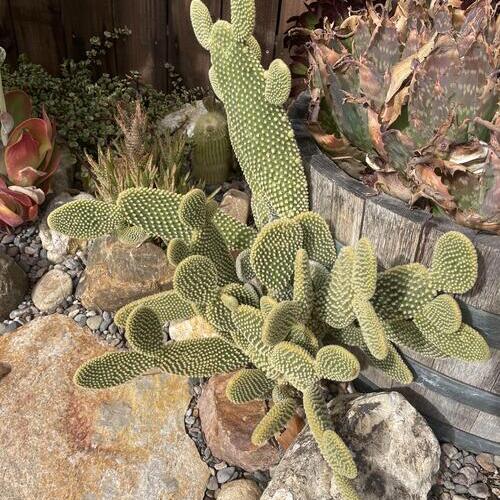
The Bunny Ears Cactus (Opuntia microdasys) is a distinctive, low-growing member of the prickly pear group native to the arid and semi-arid regions of central and northern Mexico, particularly the states of Chihuahua and Zacatecas. It gets its playful common name from the way its flattened, oval-shaped stem segments, called pads or cladodes, branch off in pairs that resemble a pair of rabbit ears. In its native habitat it typically forms low, spreading clumps rather than a tall columnar shape, rarely exceeding 60 cm (2 feet) in height, though individual pads can grow to about 15 cm long.
One of the most notable features of this cactus is its covering of glochids: tiny, barbed, hair-like spines arranged in tufted clusters called areoles across the surface of each pad. Unlike the larger, more visible spines of many other cacti, Opuntia microdasys is often described as spineless because it lacks long central spines; however, the glochids are extremely fine, easily dislodged, and can embed in skin with the slightest touch, making the plant deceptively hazardous despite its fuzzy, harmless appearance. The most commonly cultivated form has golden-yellow glochids, though white and reddish-brown (var. rufida) cultivars are also popular in the houseplant trade.
As a succulent adapted to desert conditions, the Bunny Ears Cactus stores water in its thick, fleshy pads and has evolved to thrive in intense sun, poor soil, and long dry spells. In late spring to early summer, mature specimens produce cheerful pale yellow flowers along the pad margins, which can be followed by small, purplish, edible fruit in habitat, though flowering is far less common in indoor cultivation. Its compact size, architectural form, and low maintenance needs have made it one of the most widely grown ornamental Opuntia species worldwide.
Caring for a Bunny Ears Cactus is relatively straightforward once you replicate its native desert conditions: abundant bright light, fast-draining soil, and a watering rhythm that favors drought over dampness. This plant thrives when treated like the desert succulent it is rather than a typical houseplant, so the biggest care mistakes usually involve overwatering or insufficient light rather than neglect. Because it is a slow grower with modest space requirements, it adapts well to windowsills, sunrooms, and outdoor patios in warm climates.
The single most important element of care is light. Bunny Ears Cactus wants as much direct sun as you can give it, ideally four or more hours daily, along with a gritty, mineral-based potting mix that allows water to drain within seconds rather than minutes. Terracotta pots with drainage holes are strongly preferred over glazed ceramic or plastic because they wick away excess moisture through the porous walls, helping prevent root rot. Watering should follow a soak-and-dry approach: water thoroughly, then allow the soil to dry out completely before watering again, reducing frequency significantly in fall and winter when the plant is semi-dormant.
Beyond light and water, this cactus asks for very little: occasional light feeding during the active growing season, warm temperatures with protection from frost, and infrequent repotting only as it outgrows its container. The main ongoing consideration for indoor growers is safety, since the fine glochids detach at the lightest brush and can be uncomfortable to remove from skin, so handling with tongs, thick gloves, or rolled paper is recommended during repotting, pruning, or moving the plant. With these basics in place, Opuntia microdasys is an exceptionally forgiving and long-lived plant, tolerating irregular watering schedules and traveler-friendly neglect better than almost any other houseplant.
 Soil
Soil
Bunny Ears Cactus requires an extremely fast-draining, mineral-rich soil that mimics the rocky, sandy substrates of its native desert habitat. An ideal mix combines standard cactus or succulent potting soil with generous amounts of coarse sand, pumice, or perlite, often in a ratio of roughly fifty percent mineral grit to fifty percent organic potting mix, to ensure water passes through quickly and does not linger around the roots. The plant prefers a slightly acidic to neutral pH range of approximately 6.0 to 6.5, though it tolerates mildly alkaline conditions reasonably well. Drainage is by far the most critical soil characteristic for this species; poor drainage is the leading cause of root rot and plant failure, so the pot must have ample drainage holes and the soil should never remain soggy after watering. Beneficial amendments include crushed lava rock, coarse builder’s sand, or horticultural grit, which improve aeration and prevent compaction over time. Soil composition directly affects the plant’s health because Opuntia species have shallow, fibrous root systems adapted to absorb moisture quickly after rare rainfall and then dry out; dense or organic-heavy soils hold water too long and suffocate these roots. Common soil-related problems include poor drainage leading to root rot, compaction from repeated watering that reduces oxygen availability, inappropriate pH that limits nutrient uptake, salt build-up from tap water or over-fertilization that shows as white crust on the soil surface or pot rim, nutrient deficiencies from old, depleted potting mix, and root boundness in mature plants that have outgrown their container, which restricts water uptake and slows growth.
 Fertilizer
Bunny Ears Cactus benefits from light, infrequent feeding during its active growing season from spring through early fall, using a fertilizer formulated for cacti and succulents that is lower in nitrogen and higher in phosphorus and potassium, typically applied at half the recommended strength once every four to six weeks. No fertilizer is needed during the fall and winter dormant period. Signs of over-fertilization include a buildup of white salt crust on the soil surface, weak or overly soft new growth, and in severe cases, root burn that leads to wilting or discoloration despite adequate watering; under-fertilization is harder to spot but may present as unusually slow growth or pale coloring over successive growing seasons in an otherwise healthy plant. Organic alternatives include well-diluted fish emulsion or compost tea applied sparingly, as well as top-dressing the soil with a small amount of worm castings at the start of the growing season. This species has no unusual nutrient requirements beyond standard cactus feeding practices, though consistent phosphorus availability supports stronger root development and, in mature plants, flowering.
 Watering
Opuntia microdasys follows a strict soak-and-dry watering pattern typical of desert succulents: water thoroughly until it runs from the drainage holes, then allow the soil to dry out completely before watering again, which during the active growing season in spring and summer typically means every one to two weeks depending on light, temperature, and pot size. Rainwater or distilled water is preferred over hard tap water because it avoids the gradual buildup of mineral salts and chlorine that can accumulate in the soil and stress the roots over time, though occasional tap water is generally tolerated if the plant is otherwise healthy. Overwatering is the most common cause of decline and shows as mushy, discolored, or blackening pads, a sour smell from the soil, and eventual pad collapse from root or stem rot. Underwatering, while far less dangerous, presents as wrinkled, shriveled, or deflated-looking pads that plump back up readily once watered. Watering needs drop significantly in fall and winter when the plant enters a semi-dormant rest period tied to cooler temperatures and shorter days, and during this time watering should be reduced to roughly once a month or even less, allowing the soil to remain dry for extended stretches to encourage flowering the following season and prevent cold-related rot.
Stop guessing. Most houseplant failures are caused by volumetric errors and improper moisture tension. Our deterministic calculator moves beyond "once-a-week" watering by analyzing the four critical pillars of root health:
Personalized for this plant
Disclaimer: Our calculator is pretty smart. We’ve crunched the numbers, but we’re not measuring the quantum state of your living room. Since we don’t know your exact indoor temperature, humidity, light, airflow, or whether your plant receives daily sweet nothings and motivational speeches, use this calculator as a guide—and always keep an eye on your plant.
 Lighting
This cactus thrives in intense, direct sunlight and should receive at least four to six hours of direct sun daily, with a south- or west-facing window being ideal indoors. Outdoors in warm climates it can tolerate full, unfiltered desert sun for most of the day once acclimated. Signs of insufficient light include pale, washed-out coloring, etiolation where the pads grow thin, elongated, or stretch visibly toward the light source, and a general loss of the compact, upright growth habit. Excessive or suddenly intensified light, such as moving a shade-grown plant abruptly outdoors, can cause sunscald, which appears as yellow, white, or brown discolored patches or corky scarring on the sun-facing side of the pads. To adjust lighting in suboptimal conditions, growers can supplement with a full-spectrum LED grow light positioned close to the plant for at least six to eight hours a day, rotate the pot regularly for even exposure, and introduce increased sun exposure gradually over one to two weeks to avoid scald when transitioning the plant outdoors for summer.
 Temperature
This cactus thrives in warm conditions between roughly 21 to 29°C (70 to 85°F) during its active growing season and tolerates cooler temperatures down to about 10°C (50°F) during winter dormancy, provided the soil is kept dry. It has some tolerance for daytime temperature fluctuations typical of desert environments but is sensitive to prolonged cold, damp conditions and cannot survive hard frost or freezing temperatures, which cause tissue damage and blackened, mushy pads. Heat sensitivity is minimal; the plant handles high summer temperatures well as long as it has adequate light and is not left in stagnant, humid heat. To protect it from extreme cold, bring outdoor or patio specimens indoors before nighttime temperatures approach freezing, and avoid placing indoor plants near drafty windows or exterior doors in winter. During heat waves, ensure the plant still has good airflow, since combined excessive heat and high humidity can be more stressful than heat alone.
 Humidity
Bunny Ears Cactus prefers low ambient humidity, generally in the range of 10 to 30 percent, consistent with its native arid desert environment, and does not require any special humidification. High humidity is the primary concern for this species rather than low humidity, since persistently damp air combined with wet soil promotes fungal issues and rot; symptoms of excess humidity stress include soft, mushy pad tissue, dark spotting, and mold or mildew on the soil surface. Low humidity, by contrast, rarely causes visible stress in this cactus and is simply its preferred condition. To reduce humidity around the plant, ensure good air circulation with a small fan, avoid placing it near humidifiers, kitchens, or bathrooms, and space it away from densely grouped, moisture-loving plants. Pebble trays and misting, which are commonly recommended for tropical houseplants, are not appropriate for this cactus and can actively encourage rot if used nearby.
 Propagation
Opuntia microdasys is most commonly and successfully propagated from pad (stem segment) cuttings, a method favored by growers for its high success rate, simplicity, and speed compared to growing from seed. Seed propagation is possible but slow, often taking several years to produce a plant of noticeable size, and is mainly used by breeders or hobbyists interested in genetic variation rather than quick results. Late spring through summer is the best time to propagate, when the plant is actively growing and cuttings root fastest.
1. Using tongs or thick folded newspaper to protect your hands from glochids, select a healthy, mature pad and twist or cut it cleanly away from the parent plant at a natural joint.
2. Set the cutting in a dry, shaded, well-ventilated spot for five to seven days, allowing the cut end to callus over and form a dry, sealed surface, which helps prevent rot once planted.
3. Prepare a shallow container with well-draining cactus soil mixed with extra perlite or sand.
4. Insert the callused end of the pad about one-quarter to one-third of its length into the soil, positioning it upright, and if needed, use small stakes or stones to keep it stable.
5. Place the container in bright, indirect light for the first few weeks to avoid stressing the unrooted cutting with intense direct sun.
6. Withhold water for about one week after planting to allow the wound to seal further, then water very lightly, just enough to slightly moisten the soil.
7. Keep the soil nearly dry, watering only sparingly every one to two weeks, until roots establish, which is usually indicated by new growth or resistance when the pad is gently tugged.
8. Once rooted, typically within four to six weeks, gradually increase light exposure and resume a normal soak-and-dry watering schedule.
Pad cuttings generally have a high success rate, often above 80 to 90 percent when calloused properly, while seed germination rates are lower and far more variable, frequently well under 50 percent without controlled conditions. A newly rooted pad cutting typically establishes as an independent, self-sustaining plant within one to two months, though visible new pad growth confirming full establishment may take a full growing season.
 Potting
Bunny Ears Cactus does best in an unglazed terracotta or clay pot, which allows excess moisture to evaporate through the porous walls and helps prevent overly wet soil. The pot must have at least one functional drainage hole, and a layer of coarse gravel or broken pottery shards at the base can further improve drainage in larger containers.
This slow-growing cactus generally needs repotting only every two to three years, or whenever it visibly outgrows its current container.
Indicators include roots emerging from the drainage holes or growing in tight circles at the soil surface, the plant becoming top-heavy or unstable in its pot, noticeably slowed growth despite proper care, and water running through the pot too quickly because the roots have displaced most of the soil.
Use a fast-draining mix of roughly equal parts cactus potting soil and coarse mineral grit such as perlite, pumice, or coarse sand.
During repotting, any dead, mushy, or excessively long circling roots can be trimmed away with clean, sterilized shears to encourage healthy new root growth, while healthy white or tan firm roots should be left largely undisturbed.
To minimize stress, choose a new pot only one to two inches larger in diameter, allow the plant’s soil to dry out fully before repotting to reduce root fragility, handle the pad with tongs or thick gloves throughout, and withhold water for about a week after repotting to let any root damage callus before resuming a normal watering schedule.
 Pruning
Pruning a Bunny Ears Cactus is typically done to remove damaged, diseased, or overcrowded pads, control the plant’s size and shape, and encourage bushier, more compact growth from remaining segments.
Late spring through summer, during the active growing season, is ideal, since the plant heals and calluses fastest when actively growing and warm weather reduces the risk of rot at the cut site.
This cactus grows slowly and generally needs only occasional, light pruning once or twice a year at most, mainly for shaping or removing problem pads rather than routine maintenance.
A clean, sharp knife or pruning shears sterilized with rubbing alcohol, along with thick gloves, tongs, or several layers of folded newspaper to protect hands from glochids.
Before pruning, ensure the plant is dry and has not been watered recently, sterilize all tools to prevent introducing pathogens into the cut, and choose a well-ventilated work area since dislodged glochids can drift in the air.
Keep the newly pruned plant in bright but slightly less intense light for a week or two, monitor the cut site for any signs of softening or discoloration that could indicate infection, and resume normal watering only once the wound appears fully dry and sealed.
Always wear protective gear when pruning due to glochids, dispose of removed pads carefully since they can still root or cause injury if handled bare-handed, and avoid pruning during cold or dormant winter months when the plant heals much more slowly.
 Blooming
In its native desert habitat, Opuntia microdasys typically blooms in late spring through early summer, generally between May and June, though the exact timing depends on local temperature and rainfall patterns. Each flower is relatively short-lived, lasting only a few days, but a healthy mature plant may produce a succession of blooms over several weeks. Flowering requires several years of maturity, ample direct sunlight, a distinct cooler dry winter rest period, and warm temperatures during the growing season; indoor specimens rarely bloom because they seldom receive light intensity and dormancy cues comparable to outdoor desert conditions. When blooms do appear, they emerge from the areoles along the upper edges of the pads and are cup-shaped, roughly 3 to 5 cm across, with numerous thin, glossy pale-yellow petals surrounding a central cluster of yellow stamens. Pollinated flowers may be followed by small, egg-shaped, reddish-purple fruit.
 Pests and Diseases
Name: Mealybugs
Symptoms: Small white, cottony masses clustered in areoles or crevices between pads, sticky honeydew residue, and stunted or distorted new growth.
Treatment: Dab visible clusters with a cotton swab dipped in isopropyl alcohol, follow up with insecticidal soap or neem oil applied every one to two weeks, and isolate the plant from others until fully clear.
Name: Scale insects
Symptoms: Small brown or tan bumps adhered to the pad surface, yellowing or discolored patches beneath the scales, and a general decline in plant vigor.
Treatment: Scrape off visible scale gently with a soft brush or fingernail, treat with insecticidal soap or a systemic insecticide for persistent infestations, and repeat treatment every couple of weeks until resolved.
Name: Spider mites
Symptoms: Fine webbing between areoles, tiny stippled or speckled discoloration on pad surfaces, and an overall dull or bronzed appearance under heavy infestation.
Treatment: Increase humidity slightly to discourage mites, rinse the plant with a strong stream of water to dislodge them, and apply insecticidal soap or miticide for severe cases.
Name: Root rot
Symptoms: Mushy, discolored, or blackened pads starting near the base, a foul odor from the soil, and roots that appear brown, slimy, or disintegrated when inspected.
Treatment: Remove the plant from its pot, trim away all rotten roots and tissue with sterilized tools, allow the remaining healthy portion to dry and callus, and repot into fresh, fast-draining soil while significantly reducing future watering frequency.
Name: Bacterial or fungal soft rot
Symptoms: Water-soaked, translucent, or dark soft spots on pads that spread quickly, sometimes accompanied by an unpleasant smell.
Treatment: Cut away affected tissue well into healthy material using a sterilized blade, let the cut area dry completely before any further watering, and improve airflow and reduce ambient moisture around the plant to prevent recurrence.
Name: Corky scab (sunscald or physiological scarring)
Symptoms: Rough, brown, corky patches on the pad surface, often on the side most exposed to sudden intense sun or irregular watering.
Treatment: This is generally cosmetic and not treatable once formed, but future occurrences can be prevented by acclimating the plant gradually to increased light and maintaining consistent watering practices.
 Special Features
Beyond its whimsical rabbit-ear silhouette, Opuntia microdasys is prized for its striking texture, with dense tufts of golden, white, or reddish-brown glochids arranged in a neat polka-dot pattern across each flattened pad, giving it strong ornamental and architectural appeal in succulent gardens, rockeries, and container arrangements. It is remarkably drought-tolerant and low-maintenance, making it a popular choice for xeriscaping in warm, dry climates where water conservation is a priority. In its native range, the plant also holds cultural and practical significance, as related Opuntia species have long been used in Mexican cuisine and traditional medicine, and the small fruits, though less commonly harvested from this particular species compared to larger prickly pears, are technically edible once the glochids are carefully removed. Its compact clumping habit and manageable size make it especially well suited to small spaces, sunny windowsills, and desert-themed displays, offering year-round visual interest even without reliable flowering indoors.
 Plant Benefits
While Opuntia microdasys itself is not a major focus of herbal medicine compared to larger prickly pear species like Opuntia ficus-indica, related Opuntia plants have traditionally been used in Mexican folk medicine for managing blood sugar levels, supporting digestive health, and as a topical treatment for minor wounds and inflammation due to the mucilaginous gel found within the pads. Some traditional uses also include the fruit and pads being valued as a source of dietary fiber and antioxidants when properly prepared. However, specific pharmaceutical research on Opuntia microdasys itself is limited, and its glochids make home use for these purposes impractical and potentially hazardous without professional preparation, so it is grown primarily as an ornamental plant rather than a medicinal one.
 Additional Information
Opuntia microdasys has become widely naturalized in some regions outside its native Mexico due to its popularity in cultivation and ease of propagation from dropped or discarded pads, and in a few warm climates it is regarded as a minor invasive species. Growers should note that although it is frequently labeled ‘spineless,’ this refers only to the absence of long central spines; the glochids are still a significant handling hazard and the plant should never be considered fully safe to touch. It is a popular subject for bonsai-style succulent arrangements and dish gardens due to its slow growth and compact form.
 Life Cycle
As a perennial succulent, Opuntia microdasys has a long lifespan, often living for decades under suitable conditions, and grows through a slow, segmented pattern in which new pads bud from areoles on existing pads, gradually building a clumping structure over years. Growth is most active in warm months when light and temperature are highest, slowing considerably or pausing entirely during a cooler, drier winter dormancy period that also helps trigger flowering the following season. Reproduction in habitat occurs both vegetatively, when fallen or damaged pads root readily in the soil, and sexually, through insect-pollinated flowers that develop into small fruit containing seeds. Under cultivation, the plant rarely completes its full reproductive cycle indoors due to insufficient light and lack of a true dormancy period, so most propagation relies on vegetative pad cuttings rather than seed.
 Are Bunny Ears Cactus Poisonous, Toxic
Opuntia microdasys is generally considered non-toxic in the sense of internal poisoning to cats, dogs, and children, meaning it does not contain compounds known to cause systemic organ damage if ingested in small amounts. However, the physical structure of the plant makes it hazardous in a different way: the pads are densely covered in glochids, tiny barbed hair-like spines that detach at the slightest contact and embed readily in skin, paws, mouths, and eyes. All parts of the plant above the growing medium carry these glochids, and any organism that touches or bites the pads, including cats, dogs, small children, and even adult handlers, can be affected. Symptoms of glochid contact include immediate sharp irritation, redness, swelling, and in cases of ingestion, drooling, pawing at the mouth, vomiting, or reluctance to eat due to embedded spines in the tongue, gums, or throat. If glochids are inhaled or contact the eyes, they can cause significant irritation or corneal injury. Severity is usually mild to moderate for surface contact but can become more serious if spines are ingested and cause internal irritation of the digestive tract, or if secondary infection develops at puncture sites. First aid involves removing visible glochids carefully using tweezers, adhesive tape, or a thin layer of white glue that is allowed to dry and peeled off, followed by rinsing the affected area with lukewarm water; eye exposure warrants immediate veterinary or medical attention. Preventive measures include placing the plant well out of reach of pets and young children, choosing a stable location where it cannot be easily bumped or knocked over, and using caution or protective gloves during any handling, repotting, or pruning.
 Frequently Asked Questions
 Can I grow Bunny Ears Cactus in my indoor space
Difficulty: Easy
Size: Small
Light: High
Water: Low
Flowering: Yes
Pet Safe: No
Air Purifier: Low
 Opuntia microdasys botanical details
Common Name: Bunny Ears Cactus
Other Common Names: Angel's Wings, Polka-dot Cactus, Golden Bristle Cactus, Nopal Cactus
Botanical Name: Opuntia microdasys
Native Area: Central and northern Mexico, particularly the Chihuahuan Desert region including Chihuahua, Zacatecas, and neighboring arid states
Family Name: Cactaceae
Plant Type: Succulent, Perennial
Genus: Opuntia
Kingdom: Plantae
 Photo Gallery
 My Bunny Ears Cactus Plant Care Recommendations
If you find the Houseplant Encyclopedia helpful and would like to support Healthy Houseplants, you can use the links below to shop for recommended plants, products, and plant-care supplies.
Some links are affiliate links, which means I may earn a small commission if you make a qualifying purchase through them, at no additional cost to you. Thank you for supporting Healthy Houseplants and helping me continue to provide free plant-care information!

Want even more personalized plant-care help? Check out my AI Julie Chatbot—trained on my 20 years of houseplant knowledge, not just information from the internet!  Try it now:Ask AI Julie
 Buy Bunny Ears Cactus Online
✅ “Bring Home This Beauty Today”
✅ “Get Your Own Bunny Ears Cactus Before It’s Gone”
✅ “Shop Trusted Sellers – Limited Availability”
✅ “Free Delivery”
As an Amazon Associate, I earn commission from qualifying purchases.
 Plant Puns and Jokes
Why did the Bunny Ears Cactus refuse to shake hands? Because it heard the greeting was going to be a little prickly, and it didn’t want anyone to get the wrong impression from its “soft” fuzzy look!
 Signup to our newsletter and download Bunny Ears Cactus care guide

