


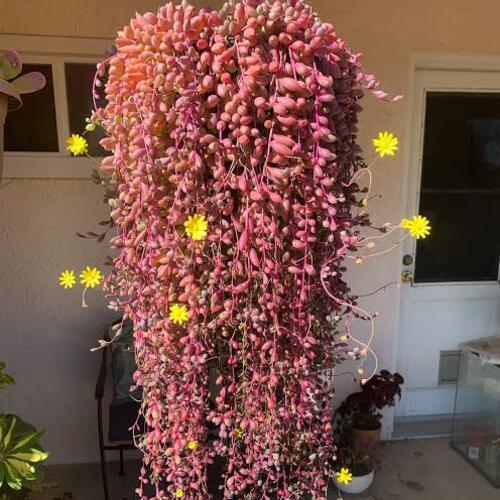
String of Rubies (Othonna capensis), sometimes reclassified in botanical literature as Crassothonna capensis, is a trailing succulent perennial in the daisy family, Asteraceae. It hails from the semi-arid regions of the Western Cape in South Africa, where it grows low to the ground or cascades over rocky outcrops, conserving moisture in its thin, cylindrical, pea-green leaves. The plant takes its common name from the reddish-purple blush that develops along its stems and leaf tips when exposed to bright light, cool temperatures, or drought stress, giving the trailing strands a jewel-like, ruby-tinted appearance.
The stems are slender, wiry, and reddish, capable of trailing a foot or more as they mature, which makes String of Rubies a popular choice for hanging baskets, shelves, and vertical succulent displays. Its narrow, bead-like leaves are technically not true beads (unlike String of Pearls) but rather slightly flattened, elongated cylinders, giving the plant a slightly different silhouette while still fitting the broad “string of” succulent family that includes String of Pearls, String of Bananas, and String of Dolphins.
Despite its succulent appearance, Othonna capensis is a true member of the daisy family and produces small, bright yellow, daisy-like flowers on thin stalks that rise above the foliage, typically in the cooler months. The plant is prized not only for its ornamental foliage color but also for its relative ease of care, fast growth under the right conditions, and its ability to thrive with the same light and watering regimen as other popular trailing succulents.
Caring for String of Rubies largely mirrors the care of other trailing succulents: bright light, infrequent but thorough watering, and fast-draining soil are the three pillars of a healthy plant. Because it is native to a dry, sun-drenched region of South Africa, it has adapted to store water in its leaves and stems, which means it is far more forgiving of neglect than of overwatering. The single most common cause of decline in this species is soggy, compacted soil that keeps the roots wet for extended periods, so choosing a well-draining succulent or cactus mix and a pot with drainage holes is essential from the start.
Light is the second major factor in keeping this plant compact, colorful, and floriferous. In lower light, String of Rubies tends to lose its ruby coloration, stretch out with long gaps between leaves (etiolation), and become leggy and pale green. Bright, indirect light with a few hours of gentle direct morning or evening sun each day will bring out the deepest color in the foliage and encourage denser, bushier growth. Indoors, a south- or west-facing window is usually ideal, while outdoors it appreciates partial shade in hot climates to avoid scorching in the harshest afternoon sun.
Beyond light and water, this species benefits from a light feeding schedule during the active growing season, occasional pruning to encourage branching and prevent bare, leggy stems, and repotting only when it has outgrown its container, since succulents generally prefer being slightly root-bound. With these basics in place, String of Rubies is considered an easy-to-moderate houseplant that rewards minimal intervention with vigorous, cascading growth.
 Soil
Soil
String of Rubies thrives in a fast-draining, gritty soil mix formulated for cacti and succulents, ideally composed of a blend such as two parts commercial succulent or cactus mix to one part coarse sand, perlite, or pumice. This kind of composition mimics the rocky, well-aerated soils of its native Western Cape habitat and prevents water from pooling around the roots. A slightly acidic to neutral pH range of about 6.0 to 6.5 is considered ideal, though this species is fairly adaptable and will tolerate a modestly wider range as long as drainage remains excellent.
Amendments such as perlite, pumice, coarse sand, or crushed granite can be added to any standard potting mix to increase drainage and aeration if a dedicated succulent mix is unavailable. Good soil structure directly affects root health: airy, loose soil allows oxygen to reach the roots and lets excess water drain quickly, while dense, compacted soil starves roots of oxygen and encourages rot.
Common soil problems to watch for include poor drainage, which leads to waterlogged roots and rot; compaction over time, which reduces aeration and should be corrected by repotting with fresh mix; inappropriate pH, which can lock out nutrients even when fertilizer is applied; salt build-up from tap water or over-fertilizing, visible as a white crust on the soil surface and best flushed out with a thorough watering; nutrient deficiencies, which show up as pale or yellowing foliage and are corrected with a diluted balanced fertilizer; and root boundness, which occurs when the plant has filled its pot with roots and needs to be sized up or divided.
 Fertilizer
String of Rubies has modest fertilizer needs and generally benefits from a diluted, balanced liquid fertilizer, such as a 10-10-10 or a cactus and succulent formula diluted to half or quarter strength, applied roughly once a month during the active growing season in spring and summer. Fertilizing should be paused or greatly reduced during fall and winter dormancy, when the plant’s nutrient uptake slows considerably.
Signs of over-fertilization include a white, crusty salt build-up on the soil surface, leaf tip burn, and unusually soft or weak new growth, while signs of under-fertilization include pale or yellowing leaves, slow or stunted growth, and a general lack of vigor over an extended period without feeding. Because this species is not a particularly heavy feeder, it is generally safer to err on the side of underfeeding than overfeeding.
Organic alternatives such as well-diluted compost tea or worm castings worked lightly into the topsoil can provide a gentler, slow-release source of nutrients. This species does not have unusual or specialized nutrient requirements beyond the standard macronutrients (nitrogen, phosphorus, and potassium) and benefits from occasional trace minerals found in most balanced succulent fertilizers.
 Watering
String of Rubies follows the classic succulent watering rule: soak thoroughly, then allow the soil to dry out substantially before watering again. During the active growing season in spring and summer, this typically means watering every 1 to 2 weeks, adjusting for light, temperature, and humidity, while allowing the top half to two-thirds of the soil to dry out between waterings. In fall and winter, when growth slows, watering frequency should be reduced significantly, often to once every 3 to 4 weeks or less.
The plant is not particular about water quality and will generally do well with tap water, though rainwater or distilled water can help avoid mineral and salt build-up in the soil over time, especially in areas with hard water. Signs of underwatering include shriveled, wrinkled, or deflated leaves and stems, along with a duller color as the plant conserves resources. Signs of overwatering include yellowing or translucent, mushy leaves, blackened or soft stems near the soil line, and a general limpness, which are early indicators of root rot.
Watering needs shift with the seasons and growth stage: young or recently propagated plants may need slightly more frequent, lighter watering to establish roots, while mature, established plants can go longer between waterings, especially in a dormant winter period when growth largely pauses.
Stop guessing. Most houseplant failures are caused by volumetric errors and improper moisture tension. Our deterministic calculator moves beyond "once-a-week" watering by analyzing the four critical pillars of root health:
Personalized for this plant
Disclaimer: Our calculator is pretty smart. We’ve crunched the numbers, but we’re not measuring the quantum state of your living room. Since we don’t know your exact indoor temperature, humidity, light, airflow, or whether your plant receives daily sweet nothings and motivational speeches, use this calculator as a guide—and always keep an eye on your plant.
 Lighting
String of Rubies performs best in bright, indirect light with several hours of gentle direct sun, particularly in the morning or late afternoon. A south- or west-facing window indoors, or a partially shaded spot outdoors, generally provides the right balance. Adequate light is what triggers the plant’s signature ruby-red coloration along its stems and leaf tips; without enough light, the foliage tends to stay a flatter green.
Signs of insufficient light include leggy, stretched-out stems with wide gaps between leaves (etiolation), a loss of the reddish-purple blush, and slower, weaker growth reaching toward the light source. Signs of excessive or overly intense direct light, particularly through unfiltered afternoon sun or a magnifying window, include bleached or scorched patches, shriveled or crispy leaf tips, and an overall faded or washed-out appearance.
If natural light is insufficient, moving the plant closer to a bright window, rotating it regularly for even exposure, or supplementing with a full-spectrum grow light for 10 to 12 hours a day can help. Conversely, if the plant shows signs of sunburn, moving it back from intense afternoon sun or adding a sheer curtain to diffuse the light will help it recover.
 Temperature
String of Rubies thrives in average room temperatures between about 65 and 80°F (18 to 27°C) and appreciates cooler nights, particularly in the range of 50 to 60°F (10 to 16°C), which can also encourage more prolific blooming. It is not cold-hardy and should be protected from frost and freezing temperatures, as exposure below about 30°F (-1°C) can cause significant damage or death to the plant.
The plant tolerates moderate temperature fluctuations reasonably well, especially the gradual shifts between day and night, but it is sensitive to sudden extreme changes, drafts from air conditioning or heating vents, and prolonged exposure to intense heat above the mid-90s°F (mid-30s°C), which can cause stress and leaf drop.
To protect the plant from extreme temperatures, bring outdoor or patio specimens indoors before the first frost, keep the plant away from cold windowpanes in winter and from heating vents that dry out the air, and provide light shade during extreme summer heat waves to prevent scorching.
 Humidity
As a drought-adapted succulent, String of Rubies prefers relatively low to average humidity levels, generally in the range that is comfortable in most homes, roughly 30 to 50 percent. It does not require any special humidification and, in fact, can be more susceptible to fungal issues if kept in consistently high humidity combined with poor air circulation.
Symptoms of humidity-related stress are relatively uncommon in this species, but very high humidity paired with overwatering can contribute to soft, mushy stems and increased risk of rot or fungal disease, while extremely dry indoor air combined with underwatering can accelerate shriveling of the leaves. Because the plant is so well adapted to arid conditions, humidifying methods such as pebble trays, misting, or room humidifiers are generally unnecessary and, in the case of misting, can even be counterproductive by encouraging moisture to sit on the foliage and stems, raising the risk of rot. Instead, prioritizing good air circulation and proper watering intervals will do far more for this plant’s health than adjusting ambient humidity.
 Propagation
String of Rubies is very easy to propagate, most commonly through stem cuttings, and to a lesser extent through division of an established plant. Stem cuttings root readily in either soil or water, though soil propagation tends to produce sturdier root systems suited for long-term growth.
1. Select a healthy, mature stem with several leaves and, ideally, a few nodes visible along its length.
2. Using clean, sharp scissors or shears, snip a 3 to 5 inch section of stem just below a node.
3. Allow the cut end to callus over for 1 to 3 days in a dry, shaded spot to reduce the risk of rot.
4. Fill a small pot with well-draining succulent or cactus mix.
5. Lay the cutting horizontally on top of the soil, or insert the bottom inch of the stem vertically into the mix, lightly pressing to secure contact.
6. Place the pot in bright, indirect light and keep it out of direct, harsh sun while roots establish.
7. Mist the soil lightly or water very sparingly, keeping it just barely moist, not wet, for the first couple of weeks.
8. Watch for new root growth and tiny new leaves emerging along the stem, usually within 2 to 4 weeks.
9. Once roots are established, gradually resume a normal watering schedule, allowing the soil to dry between waterings.
10. Transplant into a slightly larger container once the cutting shows vigorous new growth, typically after 1 to 2 months.
Compared to water propagation, soil propagation generally has a higher long-term success rate for this species because it avoids the transition shock of moving roots from water to soil and encourages roots better adapted to a normal growing medium from the start. Late spring through summer is the best time to propagate, taking advantage of the plant’s natural active growth period, and new cuttings typically establish visible roots within 2 to 4 weeks, with a well-rooted, independently growing plant taking roughly 2 to 3 months to become fully established.
 Potting
String of Rubies does best in a shallow, wide pot or hanging basket that accommodates its trailing growth habit and has ample drainage holes to prevent water from pooling around the roots. Terracotta or unglazed ceramic pots are particularly well suited to this species because their porous walls allow excess moisture to evaporate, further reducing the risk of overwatering.
Because this succulent generally prefers being slightly root-bound, repotting is only necessary every 1 to 2 years, or whenever the plant has clearly outgrown its container. Signs that String of Rubies needs repotting include roots visibly growing out of the drainage holes, water running straight through the pot without being absorbed, the plant becoming top-heavy or unstable, and noticeably slowed growth despite otherwise good care.
When repotting, gently remove the plant from its old container, teasing away old, compacted soil from the roots, and trim off any mushy, blackened, or clearly dead roots with clean scissors, leaving healthy white or tan roots intact. Move the plant into a pot only one size larger, filled with fresh, well-draining succulent mix, and avoid watering immediately; wait a few days to a week to let any damaged roots callus and reduce the risk of rot as the plant settles into its new pot.
 Pruning
The best time to prune String of Rubies is during the active growing season in spring or summer, when the plant can recover and produce new growth quickly. Pruning can be done as needed throughout the growing season, typically once every couple of months, whenever stems become leggy, sparse, or overly long.
Pruning serves several purposes for this species: it encourages bushier, denser growth by prompting new branching at the cut points, removes damaged, shriveled, or dead stems, controls the overall length and shape of trailing strands, and provides healthy cuttings that can be used for propagation.
Use clean, sharp scissors or precision pruning snips to avoid crushing the stems, and sterilize the blades with rubbing alcohol before and after use to prevent the spread of disease between plants.
After pruning, keep the plant in bright, indirect light and hold off on fertilizing for a couple of weeks to let it recover. Resume normal watering practices, allowing the soil to dry appropriately between waterings.
Wear gloves if you have sensitive skin, as some people experience mild irritation from the sap of Asteraceae family plants, and always prune with clean tools to minimize the risk of introducing disease to the cut ends.
 Blooming
String of Rubies typically blooms in the cooler months, most commonly from late fall through winter into early spring, though bloom timing can vary indoors depending on light exposure. Each bloom cycle can last several weeks, with individual flowers persisting for a number of days before fading, and the plant may produce flushes of blooms repeatedly through the season rather than a single event. Blooming is most reliable and abundant when the plant receives bright light, cooler nighttime temperatures, and a slightly drier rest period, conditions that mimic its native winter-rainfall habitat in South Africa. The flowers themselves are small, bright yellow, daisy-like blossoms held on thin, wiry stalks that rise above the trailing foliage, each with a central disc surrounded by narrow petal-like ray florets, giving the plant a cheerful contrast against its ruby-green strands.
 Pests and Diseases
Name: Mealybugs
Common Issues: Small, cottony white insects that cluster in leaf joints and along stems, feeding on plant sap.
Symptoms: Sticky honeydew residue, white cottony masses, distorted or yellowing growth near infestation sites.
Treatment: Dab affected areas with rubbing alcohol on a cotton swab, rinse the plant with a strong stream of water, and apply insecticidal soap or neem oil, repeating every 7 to 10 days until resolved.
Name: Aphids
Common Issues: Small soft-bodied insects that cluster on new growth and flower stalks, feeding on sap.
Symptoms: Curled or distorted new growth, sticky honeydew, visible clusters of tiny insects, sooty mold on honeydew residue.
Treatment: Spray affected areas with a strong jet of water to dislodge aphids, then treat with insecticidal soap or neem oil, repeating weekly until the infestation clears.
Name: Spider Mites
Common Issues: Tiny arachnids that thrive in dry, warm conditions and feed on plant cells, causing stippled damage.
Symptoms: Fine webbing between stems, stippled or speckled discoloration on leaves, overall dull or bronzed appearance.
Treatment: Increase ambient humidity slightly, rinse the plant thoroughly, and treat with insecticidal soap or a miticide, repeating every 5 to 7 days as needed.
Name: Fungus Gnats
Common Issues: Small flying insects whose larvae live in overly moist soil and feed on organic matter and roots.
Symptoms: Small flies hovering near the soil surface, larvae visible in wet soil, occasional root damage in severe infestations.
Treatment: Allow the soil to dry out more between waterings, use sticky traps to catch adults, and apply a beneficial nematode drench or hydrogen peroxide solution to the soil to eliminate larvae.
Name: Root Rot
Common Issues: A fungal condition caused by prolonged exposure to overly wet, poorly draining soil.
Symptoms: Mushy, blackened stems near the soil line, yellowing or translucent leaves, a foul odor from the soil, and stunted or collapsing growth.
Treatment: Remove the plant from its pot, trim away all mushy or blackened roots and stems with sterilized tools, allow remaining healthy tissue to dry, and repot into fresh, well-draining soil, adjusting future watering frequency.
Name: Stem Rot
Common Issues: Fungal or bacterial infection affecting the stems, often triggered by excess moisture or physical damage.
Symptoms: Soft, discolored, or collapsing sections of stem, sometimes accompanied by a foul smell.
Treatment: Cut away affected stem sections well into healthy tissue using sterilized tools, improve air circulation and drainage, and reduce watering frequency going forward.
Name: Powdery Mildew
Common Issues: A fungal disease that can occur in conditions of poor air circulation combined with high humidity.
Symptoms: White, powdery patches on stems and leaves, mild leaf distortion in severe cases.
Treatment: Improve air circulation around the plant, remove severely affected growth, and treat with a horticultural fungicide or a diluted neem oil spray.
 Special Features
String of Rubies stands out among trailing succulents for its vivid, ruby-red coloration that intensifies along its stems and leaf tips under bright light and cooler temperatures, making it a striking accent in hanging baskets, macrame planters, and elevated shelving where its cascading strands can be fully appreciated. Beyond its ornamental foliage, it produces cheerful, bright yellow daisy-like flowers during the cooler months, adding seasonal interest and a pop of contrasting color against its jewel-toned stems. It is also valued for being a fast grower and easy propagator, allowing enthusiasts to quickly multiply their collection or share cuttings with friends, and its relatively low-maintenance, drought-tolerant nature makes it a forgiving choice for those new to succulent care or prone to occasional under-watering.
 Plant Benefits
String of Rubies is not widely recognized for established herbal, medicinal, or pharmaceutical uses, and there is limited scientific research documenting any therapeutic compounds specific to this species. Its primary value lies in its ornamental and psychological benefits, such as the calming, biophilic effect of caring for and viewing trailing greenery indoors, which is commonly associated with houseplants in general. As with many members of the Asteraceae family, caution is advised against ingesting the plant given the lack of thorough toxicological study, and it should not be used as a substitute for any medicinal or herbal remedy without professional guidance.
 Additional Information
String of Rubies is sometimes confused with other trailing succulents in the ‘string of’ family, such as String of Pearls (Curio rowleyanus) and String of Bananas (Curio radicans), but it is distinguished by its more elongated, slightly flattened bead shape and its tendency to blush red under stress or bright light, a trait not shared by its round-leaved relatives. It is also occasionally sold under the synonym Crassothonna capensis, reflecting a taxonomic reclassification from the genus Othonna, so shoppers may encounter either name on plant tags. The species is well suited to xeriscaping in warm, dry climates as an outdoor groundcover or container plant, in addition to its popularity as an indoor hanging succulent.
 Life Cycle
String of Rubies is a perennial succulent that, under suitable conditions, can live and continue producing new growth for many years. It begins as a rooted cutting or seedling, quickly establishing a shallow root system suited to its native rocky, well-drained habitat. During its active growing season in spring and summer, it produces new trailing stems and foliage rapidly, while growth slows considerably in the cooler winter months, during which it often blooms. As stems mature and lengthen, older growth nearer the base can become woody and less productive, which is why periodic pruning and propagation of fresh cuttings help maintain a vigorous, full-looking plant over its lifespan.
 Are String of Rubies Poisonous, Toxic
Othonna capensis is generally listed by most toxicity databases as non-toxic to cats and dogs, and it does not appear on the ASPCA’s list of toxic plants for pets. However, because formal toxicological testing on this specific species is limited, some care guides recommend a cautious approach, especially with young children or pets prone to chewing on houseplants. The parts most likely to be ingested are the fleshy leaves and stems, which contain the plant’s stored water and sap. In the rare event that a sensitive individual or animal ingests a large quantity, mild gastrointestinal upset such as drooling, vomiting, or diarrhea could occur, though this is not well documented for this species specifically. Severity, if any reaction occurs, is generally considered mild and self-limiting. As a general first-aid measure, rinse the mouth with water, remove any plant material, and monitor the individual or pet; contact a veterinarian, physician, or poison control center if symptoms persist or worsen. Preventive measures include placing hanging baskets out of reach of curious pets and small children and supervising them around trailing succulents.
 Frequently Asked Questions
Water thoroughly and then let the soil dry out substantially before watering again, typically every 1 to 2 weeks in the growing season and much less often in winter.
String of Rubies is generally considered non-toxic to cats and dogs, though supervision around pets is still recommended.
A loss of red coloration usually means the plant is not receiving enough bright light; moving it to a sunnier spot typically restores the color.
Take a stem cutting, let the cut end callus for a couple of days, then place it on or in well-draining succulent soil until it roots, usually within 2 to 4 weeks.
It needs a fast-draining cactus or succulent mix, ideally amended with perlite or pumice, with a slightly acidic to neutral pH.
Shriveled leaves usually indicate underwatering; give the plant a thorough soak and resume a regular watering schedule.
Yes, it produces small, bright yellow, daisy-like flowers, typically during the cooler months of fall through early spring.
It needs bright, indirect light with a few hours of gentle direct sun to maintain its compact growth and ruby coloration.
Move the plant to brighter light and prune back leggy stems, using the trimmings to propagate fuller new growth.
It stays compact at the base but can trail a foot or more in length as its stems mature, making it well suited to hanging baskets.
 Can I grow String of Rubies in my indoor space
Difficulty: Easy
Size: Small to Medium
Light: Medium to High
Water: Low
Flowering: Yes
Pet Safe: Yes
Air Purifier: Low
 Othonna capensis (syn. Crassothonna capensis) botanical details
Common Name: String of Rubies
Other Common Names: String of Pickles, Ruby Necklace, Ruby Necklace Vine, Othonna
Botanical Name: Othonna capensis (syn. Crassothonna capensis)
Native Area: Western Cape, South Africa
Family Name: Asteraceae
Plant Type: Succulent, trailing perennial
Genus: Othonna
Kingdom: Plantae
 Photo Gallery
 My String of Rubies Plant Care Recommendations
If you find the Houseplant Encyclopedia helpful and would like to support Healthy Houseplants, you can use the links below to shop for recommended plants, products, and plant-care supplies.
Some links are affiliate links, which means I may earn a small commission if you make a qualifying purchase through them, at no additional cost to you. Thank you for supporting Healthy Houseplants and helping me continue to provide free plant-care information!

Want even more personalized plant-care help? Check out my AI Julie Chatbot—trained on my 20 years of houseplant knowledge, not just information from the internet!  Try it now:Ask AI Julie
 Buy String of Rubies Online
✅ “Bring Home This Beauty Today”
✅ “Get Your Own String of Rubies Before It’s Gone”
✅ “Shop Trusted Sellers – Limited Availability”
✅ “Free Delivery”
As an Amazon Associate, I earn commission from qualifying purchases.
 Plant Puns and Jokes
Why did the String of Rubies blush so much? Because it finally got enough sun to feel seen.
 Signup to our newsletter and download String of Rubies care guide

