


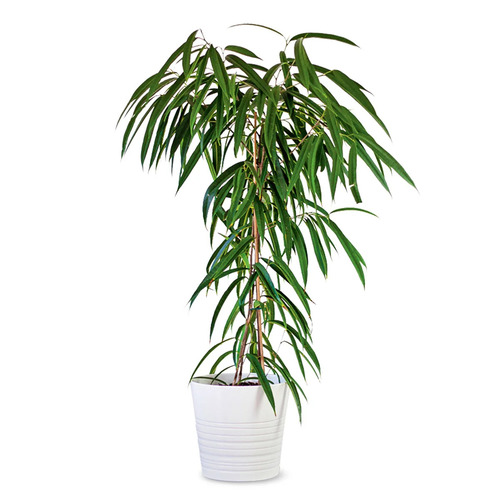
Ficus maclellandii ‘Alii’, commonly known as the Banana Leaf Fig or Alii Fig, is an evergreen tree prized for its long, narrow, glossy leaves that resemble banana foliage far more than the broad, rounded leaves typical of many other ficus species. It belongs to the Moraceae family and shares its genus with the widely cultivated Weeping Fig (Ficus benjamina) and Rubber Plant (Ficus elastica), though its silhouette is noticeably more elegant and willowy. In its native range, thought to include parts of Southeast Asia, it grows as a substantial tree, but in cultivation it is typically kept as an indoor specimen or patio plant, reaching heights of six to ten feet indoors and considerably taller outdoors in frost-free climates.
The plant’s most distinctive feature is its foliage: dark green, lance-shaped leaves that can grow six to ten inches long but remain only an inch or so wide, giving the canopy a graceful, weeping, almost bamboo-like texture. New growth often emerges with a lighter, slightly reddish or bronze cast before maturing to a deep glossy green. The bark is smooth and gray-brown, and mature specimens can develop an attractive braided or twisted trunk when trained while young, a technique commonly used by growers to add ornamental interest.
As a member of the fig genus, Ficus maclellandii produces a milky latex sap when cut or damaged, a trait shared across the Ficus genus and one that has implications for both propagation and safety around pets and children. In its natural tropical and subtropical habitat, it may occasionally produce the small, inedible figs typical of many Ficus species, though this is rare in cultivated indoor specimens. Its adaptability to indoor conditions, relatively forgiving nature once established, and striking form have made it a popular choice for homes, offices, and interior landscaping.
Caring for the Banana Leaf Fig revolves around consistency. Like most ficus species, it dislikes sudden changes to its environment and may respond to relocation, drafts, or fluctuating watering schedules by dropping leaves. The good news is that once you find a stable spot with the right light and a steady watering rhythm, this plant is relatively low-maintenance and rewards patience with vigorous, graceful growth. Bright, indirect light is essential; a position near an east- or west-facing window, or a few feet back from a bright south-facing one, tends to work well.
Watering should follow a ‘soak and dry’ approach: allow the top inch or two of soil to dry out between waterings, then water thoroughly until it drains from the bottom of the pot. Avoid letting the plant sit in standing water, as this quickly leads to root rot. Consistent humidity, ideally in the 40 to 60 percent range, will help the plant maintain lush foliage, especially in drier indoor climates during winter heating months. A well-draining, slightly acidic potting mix, combined with regular but moderate feeding during the growing season, supports healthy, steady growth.
Beyond the basics, the Banana Leaf Fig benefits from occasional pruning to maintain shape and encourage bushier growth, periodic wiping or rinsing of leaves to keep pores clear of dust, and repotting every couple of years as it outgrows its container. Because it is toxic if ingested and its sap can irritate skin, placement should take into account curious pets and small children. With attentive but not excessive care, this fig can become a long-lived, statement-making feature in a home or office setting.
 Soil
Soil
The Banana Leaf Fig thrives in a well-draining, loamy potting mix that retains some moisture without becoming waterlogged. A good base is a standard indoor potting mix amended with perlite or coarse sand to improve drainage, along with a portion of peat moss or coco coir to help retain adequate moisture and support beneficial soil structure. The ideal pH range is slightly acidic to neutral, roughly 6.0 to 6.5, which supports efficient nutrient uptake. Adding a small amount of compost or well-rotted organic matter at potting time can boost fertility, while orchid bark or additional perlite improves aeration for the root system.
Soil composition directly affects the plant’s health: mixes that are too dense or high in clay retain excess moisture and starve roots of oxygen, leading to root rot, while overly sandy or fast-draining mixes may dry out too quickly and stress the plant between waterings. Common soil problems to watch for include poor drainage (leading to soggy soil, root rot, and yellowing leaves), soil compaction over time (which restricts root growth and aeration, addressed by repotting or gently loosening the surface), inappropriate pH (which locks out nutrients even when present in the soil), salt build-up from fertilizer or tap water (visible as a white crust on the soil surface or pot rim, treated by flushing the soil with plenty of water), nutrient deficiencies (often showing as pale or yellowing leaves, corrected with balanced feeding), and root boundness (where roots circle tightly within the pot, restricting growth and water uptake, requiring repotting into a larger container with fresh soil).
 Fertilizer
During the active growing season, spring through early fall, feed the Banana Leaf Fig every four to six weeks with a balanced, water-soluble houseplant fertilizer (such as a 20-20-20 or similar balanced ratio) diluted to half strength, or use a slow-release granular fertilizer according to package directions. Reduce or suspend feeding in fall and winter when growth naturally slows, as fertilizing a dormant or slow-growing plant can lead to salt build-up and root stress.
Signs of over-fertilization include a crust of salts on the soil surface, browned or burned leaf tips and edges, and stunted or wilting growth despite adequate watering; if this occurs, flushing the soil thoroughly with water can help leach out excess salts. Signs of under-fertilization include pale or yellowing leaves, especially on older foliage, and slow or minimal new growth during the active season. Organic alternatives such as diluted fish emulsion, compost tea, or worm castings worked into the topsoil can supplement or replace synthetic fertilizers and tend to release nutrients more gradually. This species has no unusual or highly specific nutrient requirements beyond standard macronutrients (nitrogen, phosphorus, potassium) and occasional micronutrients like magnesium or iron, which support the deep green color of the foliage.
 Watering
The Banana Leaf Fig prefers a consistent watering rhythm rather than a rigid schedule: check the soil and water thoroughly when the top one to two inches have dried out, then allow excess water to drain completely and never let the pot sit in a saucer of standing water. Room-temperature water is preferred; while tap water is generally fine for most households, plants sensitive to fluoride or chlorine may benefit from filtered, distilled, or rainwater, and letting tap water sit out for 24 hours before use can help dissipate some chlorine.
Overwatering typically shows up as yellowing leaves, a mushy or unpleasant-smelling soil, and eventual root rot, while underwatering presents as leaf curling, crisping at the edges, and premature leaf drop. Because this fig is notoriously reactive to change, sudden shifts in watering habits, rather than the habits themselves, are often the real culprit behind leaf drop, so consistency matters more than any single ‘correct’ interval. Watering needs decrease in fall and winter when growth slows and light levels drop, and increase again in spring and summer during the active growing season, so the interval between waterings should be allowed to lengthen naturally in cooler, darker months.
Stop guessing. Most houseplant failures are caused by volumetric errors and improper moisture tension. Our deterministic calculator moves beyond "once-a-week" watering by analyzing the four critical pillars of root health:
Personalized for this plant
Disclaimer: Our calculator is pretty smart. We’ve crunched the numbers, but we’re not measuring the quantum state of your living room. Since we don’t know your exact indoor temperature, humidity, light, airflow, or whether your plant receives daily sweet nothings and motivational speeches, use this calculator as a guide—and always keep an eye on your plant.
 Lighting
This fig performs best in bright, indirect light, ideally near a window that receives filtered sun for several hours a day. An east-facing window with gentle morning sun, or a spot a few feet back from a south- or west-facing window, tends to be ideal. Some direct morning or late afternoon sun is tolerated and can encourage denser growth, but intense midday sun, especially through unfiltered south- or west-facing glass, can scorch the narrow leaves.
Signs of insufficient light include leggy, sparse growth with unusually long gaps between leaves, leaning toward the light source, paler green coloring, and leaf drop, particularly of lower leaves. Signs of excessive or too-direct light include bleached or scorched patches on leaves, crispy brown leaf edges, and leaves that curl or appear dull despite adequate watering. If natural light is limited, a full-spectrum grow light placed a foot or two above the canopy for ten to twelve hours daily can supplement or replace natural sunlight, and rotating the pot periodically ensures even growth on all sides.
 Temperature
The Banana Leaf Fig thrives in typical indoor temperatures between 65 and 80°F (18 to 27°C) and does not tolerate cold well. It is sensitive to temperatures below about 55°F (13°C) and should be protected from cold drafts, air conditioning vents, and exterior doors in winter. It is equally sensitive to sudden hot drafts from heating vents, which can dry out foliage quickly.
While it can handle brief, minor fluctuations, consistent extremes or sudden swings, such as being placed near a frequently opened door in winter, are more likely to cause leaf drop than a stable, slightly less-than-ideal temperature. If grown outdoors in warm climates or moved outside for summer, it should be brought indoors well before nighttime temperatures approach the 50s°F, and any outdoor-to-indoor transition should be done gradually to minimize shock.
 Humidity
This species prefers moderate to fairly high humidity, generally in the 40 to 60 percent range, reflecting its tropical origins. In average home conditions it can tolerate lower humidity reasonably well once established, but prolonged dry air, especially during winter heating season, can lead to stress. Symptoms of low humidity stress include browning or crisping leaf tips and edges, increased leaf drop, and a general dull or limp appearance to the foliage; excessively high humidity combined with poor air circulation, on the other hand, can encourage fungal issues and leaf spot diseases.
To raise humidity, a pebble tray filled with water placed beneath the pot (without letting the pot sit directly in water) offers modest, localized humidity as the water evaporates. Grouping plants together also raises humidity in the immediate area through collective transpiration. A room humidifier is the most effective and consistent solution for larger spaces or drier climates, particularly in winter. Misting can offer brief, temporary relief but is the least effective long-term method and, if leaves stay wet too long, can even encourage fungal problems, so it should be used sparingly and only as a supplement to other methods.
 Propagation
The Banana Leaf Fig is most commonly propagated through stem cuttings, though air layering is also effective for larger or more mature stems. Stem cutting propagation generally has a moderate success rate and is the easiest method for home growers, while air layering has a higher success rate for thicker, semi-woody stems but requires more time and attention.
Step-by-step stem cutting method: 1. Select a healthy stem with at least two or three leaf nodes, ideally semi-hardwood rather than very new, soft growth. 2. Using clean, sharp shears, cut a four- to six-inch section just below a node. 3. Allow the cut end to sit for about 30 minutes to an hour so the milky latex sap can stop flowing, which improves rooting success and reduces rot risk. 4. Remove the lower leaves, leaving two or three at the top. 5. Optionally dip the cut end in rooting hormone to encourage faster root development. 6. Insert the cutting into a moist, well-draining mix of perlite and peat, or place it in water, submerging at least one node. 7. Keep the cutting in bright, indirect light and consistently moist (but not soggy) conditions, using a humidity dome or loose plastic covering if desired. 8. Roots typically begin developing within three to six weeks. 9. Once roots are an inch or two long, transplant the cutting into a small pot with standard potting mix. 10. Continue to keep the new plant in stable, warm, humid conditions until it shows signs of new growth, indicating successful establishment.
The best time to propagate is during the active growing season, spring through summer, when warmth and light encourage faster rooting. New cuttings typically take a few months to establish a strong enough root system to begin noticeable top growth, and a full year or more to mature into a sturdy, independent plant.
 Potting
Choose a pot with ample drainage holes, sized only slightly larger than the current root ball, as an oversized pot can hold excess moisture and increase the risk of root rot. Terracotta or other breathable materials can help excess moisture evaporate, which is beneficial for growers prone to overwatering, while glazed ceramic or plastic pots retain moisture longer and may suit those in drier climates. A well-draining mix, as described in the soil section, should be used at every repotting.
Repotting is generally needed every one to two years, or when roots begin circling visibly at the drainage holes, the plant dries out unusually quickly after watering, or growth slows despite otherwise good care. Signs that repotting is needed also include roots pushing up through the soil surface and a generally root-bound, tightly packed root ball when the plant is removed from its pot. If roots are extensively circled or matted, gently teasing them apart or trimming the outermost, most tangled roots can encourage healthier outward growth in the new pot; avoid removing more than about twenty to twenty-five percent of the root mass at once. To minimize stress during transition, repot in spring or early summer, water thoroughly a day or two beforehand, handle the root ball gently, and keep the newly repotted plant in stable, bright but indirect light for a couple of weeks while it adjusts.
 Pruning
Prune the Banana Leaf Fig in spring or early summer, at the start of its active growing season, so it can recover and produce fresh growth quickly.
Light pruning can be done as needed throughout the growing season to maintain shape, while more significant shaping cuts are best limited to once or twice a year. Pruning encourages bushier, denser growth, controls size, removes damaged or leggy stems, and helps maintain an attractive form, especially for specimens trained with braided or shaped trunks.
Use clean, sharp bypass pruning shears or scissors, sterilized with rubbing alcohol before and between cuts to prevent disease spread. Wear gloves, since the milky sap can irritate skin, and lay down a cloth or paper to catch dripping sap and fallen leaves.
Keep the plant in stable, bright indirect light after pruning, maintain a consistent watering schedule, and avoid fertilizing immediately after a heavy pruning session; resume regular feeding once new growth appears.
Avoid pruning during winter dormancy when the plant is slow to recover, and always wash sap off skin promptly to prevent irritation.
 Blooming
Flowering and subsequent fruiting are rare to nonexistent on indoor-grown specimens, as this cultivar is grown almost exclusively for its foliage. In its native tropical habitat, Ficus species in this group can produce small, rounded figs (syconia) rather than showy flowers, since fig ‘flowers’ are actually enclosed inside the fig structure itself and are pollinated by specialized wasps not present in most cultivated settings. When fruiting does occur outdoors in suitable climates, it can happen sporadically throughout the warm season, but growers should not expect or rely on bloom or fruit as a feature of this plant; its ornamental value comes from foliage rather than flowers.
 Pests and Diseases
Name: Spider mites
Symptoms: Fine webbing on leaves and stems, stippled or speckled yellowing on leaf surfaces, and overall dull or dusty-looking foliage, often worse in dry indoor air.
Treatment: Increase humidity, rinse foliage thoroughly with water, and treat with insecticidal soap or neem oil, repeating every seven to ten days until mites are gone.
Name: Scale insects
Symptoms: Small, brown or tan bump-like insects along stems and leaf undersides, sticky honeydew residue, and sooty mold growth on affected leaves.
Treatment: Manually remove scale with a soft cloth or cotton swab dipped in rubbing alcohol, then apply horticultural oil or insecticidal soap to prevent recurrence.
Name: Mealybugs
Symptoms: White, cottony clusters in leaf axils and along stems, sticky residue, and stunted or distorted new growth.
Treatment: Dab visible mealybugs with a cotton swab soaked in rubbing alcohol, and follow up with insecticidal soap or neem oil applications on a regular schedule until the infestation clears.
Name: Aphids
Symptoms: Small, soft-bodied insects clustered on new growth, curled or distorted leaves, and sticky honeydew that can attract sooty mold.
Treatment: Rinse plants with a strong stream of water to dislodge aphids, then treat with insecticidal soap, repeating as needed for full control.
Name: Root rot
Symptoms: Yellowing and wilting leaves despite moist soil, dark or mushy roots, and a foul odor from the soil, usually caused by overwatering or poor drainage.
Treatment: Remove the plant from its pot, trim away rotted roots with sterilized tools, repot into fresh, well-draining soil, and adjust watering habits going forward.
Name: Leaf spot (fungal or bacterial)
Symptoms: Brown, black, or yellow-ringed spots on leaves, sometimes with a watery or dark border, most common in overly humid conditions with poor air circulation.
Treatment: Remove and discard affected leaves, avoid overhead watering or misting that leaves foliage wet, improve airflow around the plant, and apply a fungicide if the issue persists.
Name: Botrytis (gray mold)
Symptoms: Fuzzy gray mold on damaged or dying plant tissue, often appearing after injury or in overly humid, stagnant conditions.
Treatment: Remove affected plant material promptly, improve air circulation, avoid excess moisture on foliage, and treat with an appropriate fungicide if needed.
 Special Features
The Banana Leaf Fig stands out among houseplants for its unusually narrow, elongated leaves, which give it a graceful, weeping texture quite different from the broader-leaved ficus varieties most people picture. Its dense, upright growth habit and ability to be trained into braided or twisted trunk forms make it a popular choice for adding architectural interest to interior spaces, and it is frequently used in office lobbies, hotels, and other interior landscaping settings for exactly this reason. While it does not offer fragrance or edible fruit in typical cultivation, its year-round evergreen foliage provides consistent visual interest, and its relatively fast growth rate compared to some other ficus varieties means it can fill out a space more quickly. It also tends to be somewhat more tolerant of average indoor humidity than some tropical foliage plants, making it a practical option for growers who want a lush, tree-like presence without excessively fussy care.
 Plant Benefits
Ficus maclellandii ‘Alii’ is grown primarily as an ornamental foliage plant rather than for herbal or pharmaceutical use, and it is not established as a source of traditional medicine or supplements. Like many Ficus species, some components of related plants in this genus have been studied in traditional or folk contexts, but no significant, well-supported herbal or pharmaceutical applications are attributed specifically to this cultivar, and the plant’s sap is an irritant rather than a beneficial compound for topical or internal use.
 Additional Information
The Banana Leaf Fig is sometimes confused with true bamboo or banana plants due to its leaf shape, but it is unrelated to either. It is closely related to the Weeping Fig (Ficus benjamina) and shares similar sensitivities to environmental change, including a tendency to drop leaves after being moved or repotted. Because of this sensitivity, growers are often advised to choose a permanent location for the plant and avoid frequent relocation. It is also a popular subject for trunk-braiding and topiary training in nursery production, which is why many commercially available specimens feature twisted or woven trunks.
 Life Cycle
As a long-lived evergreen tree, Ficus maclellandii ‘Alii’ grows through a continuous vegetative cycle rather than a seasonal die-back and regrowth pattern typical of many perennials. Young plants establish a root system and put on steady vertical growth, developing their characteristic narrow leaves from the outset. Growth is most active in spring and summer with warmth and longer daylight hours, slowing considerably in fall and winter. Given stable indoor conditions, it can live for many years to decades, gradually increasing in height and canopy density, and can be maintained indefinitely at a manageable size through regular pruning and repotting.
 Are Banana Leaf Fig Poisonous, Toxic
Ficus maclellandii ‘Alii’ is considered mildly to moderately toxic to cats, dogs, and humans, primarily due to the milky latex sap (containing ficin and other irritant compounds) found throughout the stems and leaves. All parts of the plant can cause irritation if chewed or broken open, though the sap is the main concern rather than a specific toxic compound concentrated in one part. In pets, ingestion typically causes oral irritation, drooling, vomiting, and diarrhea; contact with the sap can also cause skin redness, itching, or a rash in sensitive animals or people. Symptoms of ingestion in children are similar: mouth and throat irritation, nausea, and stomach upset. Severity is generally classified as mild to moderate; serious systemic poisoning is uncommon, but sap contact with eyes can cause significant irritation. First aid steps include rinsing the mouth and any affected skin thoroughly with water, wiping away visible sap, and offering water to dilute stomach irritation; if eye contact occurs, flush with cool water for several minutes. Veterinary or medical attention should be sought if symptoms are severe, persistent, or if a large amount was ingested. Preventive measures include placing the plant out of reach of pets and young children, wearing gloves when pruning or repotting, and promptly cleaning any sap that contacts skin or surfaces.
 Frequently Asked Questions
No, though they are closely related. Ficus maclellandii ‘Alii’ has much narrower, longer leaves than the broader-leaved Ficus benjamina, giving it a distinctly different, more willowy appearance.
Leaf drop is most often caused by a change in environment, such as relocation, drafts, temperature swings, or inconsistent watering. This species is sensitive to change and tends to shed some leaves in response even when the underlying care is otherwise fine.
Yes, it is mildly to moderately toxic to pets due to its milky latex sap, which can cause oral irritation, drooling, vomiting, or diarrhea if chewed or ingested.
Water when the top one to two inches of soil have dried out, then water thoroughly and let excess drain away. This is usually every one to two weeks, adjusted for season and indoor conditions.
It needs bright, indirect light, such as a spot near an east-facing window or a few feet back from a bright south- or west-facing window, with some tolerance for gentle direct morning or evening sun.
Indoors, it typically reaches about six to ten feet tall, though regular pruning can keep it at a more manageable size for smaller spaces.
The most common method is stem cuttings taken in spring or summer, rooted in water or a moist perlite-and-peat mix after allowing the cut end to callous briefly.
Brown leaf tips are commonly caused by low humidity, inconsistent watering, salt build-up from fertilizer, or exposure to cold drafts or direct heating vents.
It rarely flowers or fruits in cultivation, especially indoors, and is grown primarily for its ornamental foliage rather than for blooms or fruit.
Repotting is generally needed every one to two years, or when roots become visibly crowded, the plant dries out unusually fast, or growth slows despite good care.
 Can I grow Banana Leaf Fig in my indoor space
Difficulty: Intermediate
Size: Large
Light: Medium
Water: Medium
Flowering: No
Pet Safe: No
Air Purifier: Medium
 Ficus maclellandii 'Alii' botanical details
Common Name: Banana Leaf Fig
Other Common Names: Alii Fig, Alii Ficus, Ficus Alii, Long Leaf Fig, Ficus Amstel King, Amstel King
Botanical Name: Ficus maclellandii 'Alii'
Native Area: Southeast Asia, with the broader Ficus maclellandii species associated with regions including India, Malaysia, and surrounding tropical parts of Asia
Family Name: Moraceae
Plant Type: Broadleaf evergreen tree / shrub
Genus: Ficus
Kingdom: Plantae
 Photo Gallery
 My Banana Leaf Fig Plant Care Recommendations
If you find the Houseplant Encyclopedia helpful and would like to support Healthy Houseplants, you can use the links below to shop for recommended plants, products, and plant-care supplies.
Some links are affiliate links, which means I may earn a small commission if you make a qualifying purchase through them, at no additional cost to you. Thank you for supporting Healthy Houseplants and helping me continue to provide free plant-care information!

Want even more personalized plant-care help? Check out my AI Julie Chatbot—trained on my 20 years of houseplant knowledge, not just information from the internet!  Try it now:Ask AI Julie
 Buy Banana Leaf Fig Online
✅ “Bring Home This Beauty Today”
✅ “Get Your Own Banana Leaf Fig Before It’s Gone”
✅ “Shop Trusted Sellers – Limited Availability”
✅ “Free Delivery”
As an Amazon Associate, I earn commission from qualifying purchases.
 Plant Puns and Jokes
Why did the Banana Leaf Fig refuse to move to a new spot in the living room? It didn’t want to leaf its comfort zone.
 Signup to our newsletter and download Banana Leaf Fig care guide

