
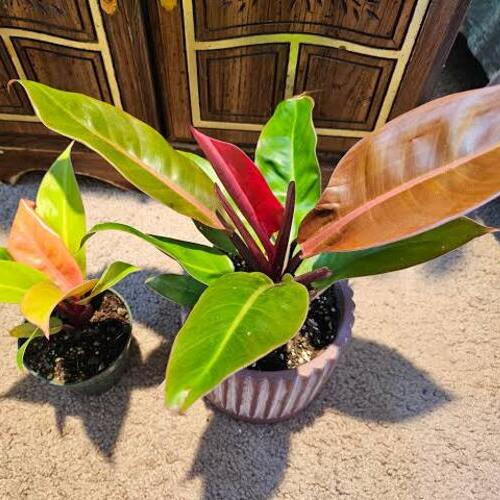
About Prince of Orange Philodendron
Prince of Orange Philodendron Introduction
Philodendron ‘Prince of Orange’ is a hybrid cultivar in the Araceae family, prized by houseplant collectors for its compact, self-heading growth habit and vibrant, color-shifting foliage. Unlike climbing philodendrons such as Philodendron hederaceum or Philodendron melanochrysum, ‘Prince of Orange’ grows as a tidy rosette that gradually adds leaves from a central growth point, making it far better suited to tabletop or shelf display than to a moss pole or totem.
The hallmark of this cultivar is its dramatic new-growth coloration. Leaves emerge in a soft, glowing lime-orange or peachy hue, almost luminous against darker, more mature foliage, before transitioning through shades of amber, copper, and finally settling into a deep, glossy forest green as they age. Because the plant continuously produces new leaves through its growing season, a single healthy specimen often displays three or more distinct leaf colors simultaneously, creating a naturally variegated look without the light requirements or instability that true variegation can bring.
As a hybrid, Philodendron ‘Prince of Orange’ does not occur in the wild, but its parent species trace back to the tropical rainforests of Central and South America, and the cultivar retains the warmth-loving, humidity-loving preferences typical of its aroid relatives. It is generally regarded as one of the easier and more forgiving philodendrons to grow indoors, tolerating a wider range of light and humidity conditions than many of its more delicate, velvet-leaved cousins, while still rewarding attentive care with faster growth and richer color.
Prince of Orange Philodendron Care & Growing Guide
Philodendron ‘Prince of Orange’ is widely considered one of the more beginner-friendly members of the philodendron family, making it a great introduction to aroid care while still offering the lush, colorful foliage that draws collectors to the genus. Because it grows as a compact rosette rather than a climbing vine, it does not require a moss pole or trellis, simplifying its care considerably compared to species like Philodendron melanochrysum or Philodendron ‘Pink Princess.’
The plant does best in bright, indirect light, which helps it produce the most vivid orange and copper tones in its new growth; too little light will mute this coloring and slow growth, while direct sun can scorch the leaves. Pair bright light with a well-draining, chunky aroid mix, watering when the top inch or two of soil has dried, and moderate to high humidity in the range of 50 to 70 percent for the best results. It is more tolerant of average household humidity than many other philodendrons, which is part of what makes it approachable for less experienced growers.
Rounding out its care, regular but light fertilization during the growing season, warm and stable room temperatures, and occasional leaf cleaning to prevent dust buildup and deter pests will keep the plant thriving for years. Repotting every one to two years, along with removing spent lower leaves as they naturally yellow, keeps the rosette looking full and healthy, and most growers find the ongoing maintenance routine quite manageable once the plant is established.
Soil
Philodendron ‘Prince of Orange’ needs a light, chunky, well-draining aroid mix rather than dense potting soil. A good base combines standard potting soil with orchid bark, perlite, and coconut coir in roughly equal parts, which encourages strong root aeration and mimics the loose, organic material the plant’s roots would encounter in the wild. Ideal soil pH sits in a mildly acidic range of about 5.5 to 6.5.
Good drainage is essential; the roots need access to oxygen and will rot quickly in compacted, waterlogged soil. Adding horticultural charcoal helps keep the mix fresh and reduces the risk of root rot, while worm castings or compost can be worked in periodically to supply slow-release nutrients. This airy soil structure directly supports healthy root growth, which in turn drives the size and vibrancy of new leaves.
Common soil problems include poor drainage from soil that has broken down and compacted over time, salt build-up from mineral-heavy tap water and fertilizer residue (visible as a white crust on the soil surface or pot rim), inappropriate pH that can lock out nutrients even when they are present in the soil, nutrient deficiencies showing as pale or yellowing new growth, and root-boundness in plants left too long in the same pot, which restricts water uptake and stunts new leaf size. Flushing the soil with plain water every couple of months and repotting on schedule helps prevent these issues.
Fertilizer
Feed Philodendron ‘Prince of Orange’ with a balanced, water-soluble houseplant fertilizer (roughly a 3-1-2 or 20-20-20 formulation) diluted to half strength, applied every 4 to 6 weeks during the active spring and summer growing season. Reduce or pause fertilizing in fall and winter when growth naturally slows.
Over-fertilization shows up as browned or crispy leaf-tip burn, a visible white crust of salts on the soil surface, and wilting despite adequate watering. Under-fertilization presents as pale, small new leaves, slow growth, and a noticeably less vivid orange color in new foliage.
Organic alternatives include diluted fish emulsion, compost tea, or worm-casting top-dressing, all of which supply a gentler, slow-release nutrient source. This species benefits from adequate nitrogen for overall growth and magnesium for rich leaf color; a light application of Epsom salt solution every couple of months can help address magnesium deficiency if pale interveinal yellowing appears.
Watering
Water Philodendron ‘Prince of Orange’ when the top 1 to 2 inches of soil have dried out, typically every 7 to 10 days, though this will vary with light, humidity, and season. The plant prefers room-temperature water, and rainwater, distilled water, or filtered water is preferable to hard tap water, which can lead to mineral salt build-up and browning leaf tips over time.
Overwatering is signaled by yellowing lower leaves, a mushy or blackened stem base, and a sour smell from the soil, all of which point toward root rot. Underwatering shows up as drooping or curling leaves, dry and crispy leaf edges, and slowed growth. Because this philodendron is grown in a chunky, fast-draining aroid mix, checking soil moisture by finger or a moisture meter is more reliable than following a strict watering calendar.
During the active growing season in spring and summer, the plant uses more water and may need slightly more frequent watering, while growth slows in fall and winter, requiring longer intervals between waterings to prevent waterlogged roots during a period of reduced water uptake.
Prince of Orange Philodendron Watering Calculator
🪴 Precision Watering Intelligence
Science-Based Hydration for Your Collection
Stop guessing. Most houseplant failures are caused by volumetric errors and improper moisture tension. Our deterministic calculator moves beyond "once-a-week" watering by analyzing the four critical pillars of root health:
- • Transpiration Coefficients: 120+ species mapped by metabolic rate.
- • Substrate Porosity: Adjusts for Standard vs. Cactus/Well-Draining mixes.
- • Geometric Volume (V = π r² h): Calculates exact cups based on pot surface area.
- • The Drainage Factor: Accounts for pot material (Terracotta) and the risk of a perched water table.
Personalized for this plant
Disclaimer: Our calculator is pretty smart. We’ve crunched the numbers, but we’re not measuring the quantum state of your living room. Since we don’t know your exact indoor temperature, humidity, light, airflow, or whether your plant receives daily sweet nothings and motivational speeches, use this calculator as a guide—and always keep an eye on your plant.
Lighting
Philodendron ‘Prince of Orange’ thrives in bright, indirect light, such as that from an east-facing window or a spot a few feet back from a south- or west-facing window filtered by a sheer curtain. Bright light is especially important for this cultivar because it directly influences the intensity of the orange, peach, and copper tones in new growth.
Insufficient light typically causes new leaves to emerge a duller, more uniform green rather than the characteristic vivid orange, along with slower growth, smaller leaves, and long gaps between leaves (etiolation). Excessive or direct light, on the other hand, can scorch the foliage, causing bleached, crispy, or brown patches, particularly on the softer, newly emerged leaves.
If natural light is insufficient, a full-spectrum LED grow light positioned 12 to 24 inches above the plant and run for 10 to 12 hours a day is an effective supplement, especially in winter or low-light rooms. Rotating the pot periodically encourages even, symmetrical growth around the rosette.
Temperature
Ideal daytime temperatures range from 65 to 80°F (18 to 27°C), with a slight nighttime drop being well tolerated. The plant is sensitive to cold and should never be exposed to temperatures below about 55°F (13°C), which can cause chilling injury, blackened tissue, or leaf drop.
Philodendron ‘Prince of Orange’ tolerates minor, gradual temperature fluctuations but reacts poorly to cold drafts, air conditioning vents, or sudden swings between hot and cold, which can stress the plant and slow growth. Keep it away from exterior doors and drafty windows in winter, and away from direct heater vents, which can dry it out excessively.
To protect the plant from temperature extremes, move it away from windows during cold snaps or heat waves, avoid placing it near radiators or air conditioning units, and choose a stable indoor spot away from frequently opened exterior doors.
Humidity
Philodendron ‘Prince of Orange’ prefers moderate to high humidity, ideally in the 50 to 70% range, though it is more tolerant of average indoor humidity than many other philodendrons, making it a forgiving choice for typical homes. Very low humidity can still affect leaf quality and the vibrancy of new growth over time.
Low humidity stress presents as crispy or browning leaf edges, curling leaf margins, and slower, smaller new growth. Excessively high humidity combined with poor air circulation can encourage fungal issues, so adequate ventilation matters alongside moisture.
Effective ways to raise humidity include running a small room humidifier near the plant, which is generally the most reliable and adjustable method; grouping plants together to create a shared moist microclimate; and using a pebble tray with water beneath (not touching) the pot base. Misting offers only a brief, superficial humidity boost and is best used as a supplement rather than a primary method.
Propagation
Philodendron ‘Prince of Orange’ is most commonly propagated through stem cuttings that include a node, and less commonly through division of offsets (pups) that form at the base of a mature plant. Stem cuttings typically achieve a 70 to 90% success rate under warm, humid conditions, while division of established offsets has an even higher success rate since the pup already has its own root system, though it requires a mature enough parent plant to have produced offsets. Late spring through summer, during the plant’s active growth phase, is the best time to propagate.
- Select a healthy stem section with at least one node and, ideally, one or two leaves attached, or identify a rooted offset at the base of the plant.
- Using clean, sharp scissors or pruning shears, cut just below the node, or carefully separate the offset from the main plant along with any attached roots.
- Allow the cut end to callous for 30 to 60 minutes in a dry, shaded spot if propagating from a stem cutting.
- Place the cutting in water, moist sphagnum moss, or a light propagation mix, ensuring the node is in contact with the moisture source; pot divisions directly into a chunky aroid mix.
- Keep the cutting or division warm (around 75°F/24°C) and in bright, indirect light with high humidity, using a humidity dome or bag if needed.
- Change water every few days if water-propagating, or keep moss consistently moist but not soggy.
- Roots typically begin appearing on stem cuttings within 3 to 6 weeks.
- Once roots reach 1 to 2 inches long, pot the cutting into a chunky aroid mix.
- Keep newly potted cuttings or divisions in high humidity for several weeks to ease the transition.
- Expect full establishment, with visible new leaf growth, within 2 to 3 months.
Potting
Choose a pot with ample drainage holes, sized only slightly larger than the current root mass, as oversized pots hold excess moisture and increase rot risk. Terracotta pots help wick away excess moisture, while plastic nursery pots retain humidity longer, which can benefit growers in drier climates. A well-draining chunky aroid mix, as described in the soil section, is essential.
Repot every 1 to 2 years, or sooner if growth stalls, water drains unusually fast through the pot, or roots are visibly circling the surface or emerging from drainage holes, all signs of root-boundness.
When repotting, gently loosen the root ball, trim away any mushy, blackened, or clearly dead roots with clean shears, and avoid disturbing healthy roots unnecessarily. Position the plant at the same soil depth it was growing at previously, backfill with fresh mix, and water thoroughly. To minimize transplant stress, repot during the active growing season, keep the plant in stable warmth and humidity for a week or two afterward, and hold off on fertilizing for about a month to let roots recover.
Pruning
Best Time to Prune
Prune Philodendron ‘Prince of Orange’ during the active growing season in spring or summer, when the plant recovers quickly and regrows fastest after cuts.
Frequency and Purpose
This philodendron needs only light, occasional pruning, mainly to remove yellowing or damaged lower leaves and to keep the rosette looking tidy and full.
Tools and Preparation
Use clean, sharp bypass pruners or scissors, sterilized with rubbing alcohol before and between cuts to avoid spreading disease.
Step-by-Step Pruning Guide
- Inspect the plant and identify any yellow, brown, or damaged leaves.
- Sterilize your pruning tool with rubbing alcohol.
- Cut damaged or spent leaves at the base of the petiole, close to the main stem or crown.
- Remove any leggy or leaning stems if the plant has started to lose its compact rosette shape.
- Trim away any old offsets that are overcrowding the pot, if desired.
- Dispose of removed material and avoid composting any diseased tissue.
- Wipe remaining leaves clean after pruning to check for pests.
Aftercare
Water lightly if the soil is dry, keep the plant out of direct sun for a few days, and monitor cut sites for signs of infection.
Special Considerations
Wear gloves when pruning, since the sap can irritate skin, and avoid heavy pruning on young or recently repotted plants.
Blooming
Philodendron ‘Prince of Orange’ is grown for its foliage and only rarely produces the aroid-typical inflorescence indoors. When it does occur, blooming tends to happen in warm weather during late spring or summer on a mature, well-established plant, and the flower consists of a creamy white to pale green spathe wrapped around a slender spadix, following the classic aroid form. Individual blooms last only a few days and are not showy compared to the plant’s foliage. Optimal conditions for flowering include bright indirect light, high humidity, warm stable temperatures, and an already sizable rootbound specimen. Because most home growers keep the plant at a manageable size, flowering is uncommon, and the plant should be selected and enjoyed primarily for its changing leaf color rather than for blooms.
Pests and Diseases
Pests
Name: Spider mites
Symptoms: Fine webbing on leaf undersides, stippled or bronzed leaf surface, dry speckled appearance
Treatment: Rinse foliage with lukewarm water, increase humidity, and apply insecticidal soap or neem oil weekly until resolved
Name: Mealybugs
Symptoms: White, cottony clusters at leaf axils and stem joints, sticky honeydew residue
Treatment: Dab insects with rubbing alcohol on a cotton swab, then treat the whole plant with insecticidal soap or neem oil
Name: Aphids
Symptoms: Clusters of small green or black insects on new growth, curled or distorted young leaves
Treatment: Wash off with a strong stream of water and apply insecticidal soap every 5 to 7 days until cleared
Name: Scale insects
Symptoms: Small brown or tan bumps along stems and leaf veins, sticky residue, yellowing leaves
Treatment: Scrape off manually and treat with horticultural oil or systemic insecticide for persistent infestations
Diseases
Name: Root rot
Symptoms: Wilting despite moist soil, blackened mushy roots, foul soil odor, yellowing lower leaves
Treatment: Remove from pot, trim affected roots with sterilized tools, repot into fresh well-draining mix, and reduce watering frequency
Name: Bacterial leaf spot
Symptoms: Water-soaked dark spots that may develop yellow halos, spreading rapidly in humid conditions
Treatment: Remove affected leaves, improve air circulation, avoid overhead watering, and apply a copper-based bactericide if needed
Name: Fungal leaf spot
Symptoms: Brown or black circular spots with defined edges, sometimes with concentric rings
Treatment: Remove infected leaves, avoid wetting foliage when watering, and apply a fungicide labeled for houseplants
Special Features
Philodendron ‘Prince of Orange’ is best known for the vivid, ever-changing color of its new growth, which unfurls in warm citrus tones of lime, peach, and copper before deepening to rich green as the leaf matures, giving the plant an almost continuously ombré appearance. Unlike many philodendrons, it grows as a compact, self-heading rosette rather than a climbing vine, making it an excellent choice for tabletops, shelves, and desks where a trailing habit would be impractical. It does not produce fragrant flowers or edible fruit, but its rotating palette of foliage color provides season-long visual interest without any need for a moss pole or other support structure, and its manageable mature size makes it popular among collectors with limited space.
Plant Benefits
Philodendron ‘Prince of Orange’ has no established herbal, medicinal, or pharmaceutical use, and due to its calcium oxalate content it should never be ingested. Like other houseplants, its main benefits are ornamental and psychological, and caring for it has been anecdotally associated with reduced stress and a greater sense of connection to nature, though it should not be relied upon for any therapeutic or health-related purpose.
Additional Information
Philodendron ‘Prince of Orange’ is sometimes confused with other self-heading philodendron hybrids that display warm-toned new growth, such as Philodendron ‘Moonlight’ (which emerges chartreuse rather than orange) or Philodendron ‘Autumn.’ Because these cultivars can look similar as young plants, buyers should purchase from a reputable nursery and, where possible, look for the characteristic peachy-orange new leaf color to confirm identity.
Life Cycle
As a self-heading, non-climbing perennial aroid, Philodendron ‘Prince of Orange’ grows from a central rosette rather than trailing or vining along a support. New leaves unfurl from the center of the plant in a striking sequence of color: emerging leaves start out a bright lime-green to peachy orange, gradually shift through amber and copper tones, and finally mature into a deep, glossy green. This continuous color progression means a healthy specimen typically displays several different leaf colors at once. Individual leaves persist for a year or more before naturally aging and being shed as new foliage emerges from the crown. Given consistent warmth, light, and humidity, the plant grows steadily year-round with a modest slowdown in cooler, darker months, and it does not require dormancy to remain healthy. Given enough time and favorable conditions, mature plants may occasionally produce offsets or pups at the base, which can be separated and grown independently.
Are Prince of Orange Philodendron Poisonous, Toxic
Philodendron ‘Prince of Orange’ is toxic to cats, dogs, and humans (especially children) if chewed or ingested. All parts of the plant contain insoluble calcium oxalate crystals, with the leaves and stem sap posing the greatest risk. When plant tissue is chewed, these microscopic crystals penetrate soft tissue, causing immediate oral irritation.
Symptoms in pets and children typically include intense burning or irritation of the mouth, lips, and tongue, excessive drooling, difficulty swallowing, vocalizing in distress, vomiting, and in more severe cases swelling of the airway that can make breathing difficult. Skin contact with sap may cause localized irritation or dermatitis in sensitive individuals.
Severity is generally considered mild to moderate, with symptoms rarely life-threatening, but swelling that affects breathing constitutes an emergency. First aid includes rinsing the mouth thoroughly with water or milk, wiping away any visible plant material, and offering a cold treat or ice chip to soothe irritation; a veterinarian or poison control center (or physician, for children) should be contacted promptly, especially if swelling, drooling, or breathing difficulty is significant. Preventive measures include placing the plant well out of reach of pets and small children and promptly removing any fallen leaf debris.
Frequently Asked Questions
Is Philodendron ‘Prince of Orange’ easy to care for?
Yes, it is considered one of the easier philodendrons to grow, tolerating average home humidity and not requiring a climbing support since it grows as a compact rosette.
Is Philodendron ‘Prince of Orange’ toxic to cats and dogs?
Yes, it contains calcium oxalate crystals that irritate the mouth and digestive tract if chewed or ingested, and it should be kept away from pets and children.
Why is my Philodendron ‘Prince of Orange’ losing its orange color?
Insufficient light is the most common cause of duller, more uniformly green new growth, since bright indirect light is what intensifies the orange and copper tones.
How often should I water Philodendron ‘Prince of Orange’?
Water when the top 1 to 2 inches of soil are dry, typically every 7 to 10 days, adjusting for light, humidity, and season.
Does Philodendron ‘Prince of Orange’ need a moss pole?
No, it grows as a self-heading, non-climbing rosette, so it does not need a moss pole or other climbing support.
What humidity does Philodendron ‘Prince of Orange’ need?
It prefers 50 to 70 percent humidity but is more tolerant of average indoor humidity than many other philodendrons.
Why are my Philodendron ‘Prince of Orange’ leaves turning yellow?
Yellowing is most commonly caused by overwatering and root rot, though natural aging of older leaves as new growth emerges can also be a factor.
How big does Philodendron ‘Prince of Orange’ get?
It stays relatively compact, typically reaching 1 to 3 feet tall and wide indoors, making it well suited to tabletops and shelves.
What is the best soil for Philodendron ‘Prince of Orange’?
A chunky, well-draining aroid mix of potting soil, orchid bark, perlite, and coconut coir works best, with a mildly acidic pH of about 5.5 to 6.5.
How do you propagate Philodendron ‘Prince of Orange’?
The most common methods are stem cuttings with at least one node or dividing rooted offsets (pups) from the base of a mature plant.
Can I grow Prince of Orange Philodendron in my indoor space
Difficulty: Easy
Size: Small to Medium
Light: Medium
Water: Medium
Flowering: No
Pet Safe: No
Air Purifier: Medium
Philodendron 'Prince of Orange' botanical details
Common Name: Prince of Orange Philodendron
Other Common Names: Orange Philodendron, Philodendron Prince, Tangerine Philodendron
Botanical Name: Philodendron 'Prince of Orange'
Native Area: A hybrid cultivar with parentage rooted in tropical Central and South America, where its Philodendron ancestors are native to rainforest understories in countries such as Colombia and Ecuador.
Family Name: Araceae
Plant Type: Perennial self-heading (non-climbing) aroid
Genus: Philodendron
Kingdom: Plantae
Photo Gallery
My Prince of Orange Philodendron Plant Care Recommendations
- Perky Plant fertilizer: https://amzn.to/3RdLA00
- Seaweed extract: https://amzn.to/3z2CsFh
- Rooting hormone: https://amzn.to/3bIXi0t
- Espoma fertilizer: https://amzn.to/3vPa9bs
- Worm compost: https://amzn.to/3HVL01u
- Full-spectrum Light Bulb-Large: https://amzn.to/3yR6VBu
- Full-spectrum Lighting: https://amzn.to/3qhhaiv
- Light meter: https://amzn.to/4dpmp3s
- Moisture meter: https://amzn.to/3TEUu5N
- Hygrometer: https://amzn.to/3Cf6h2F
- Pruning shears: https://amzn.to/3X6oOcg
- ProMix Potting Soil: https://amzn.to/3iVIrjE
- My Organic Green Gourmet Houseplant Fertilizer: Healthy Houseplants Store
- My Perfect Pumice: Healthy Houseplants Store
- My Healthy Houseplants Store: All Products
Buy Prince of Orange Philodendron Online
✅ “Bring Home This Beauty Today”
✅ “Get Your Own Prince of Orange Philodendron Before It’s Gone”
✅ “Shop Trusted Sellers – Limited Availability”
✅ “Free Delivery”
As an Amazon Associate, I earn commission from qualifying purchases.
Plant Puns and Jokes
Why did the Philodendron ‘Prince of Orange’ get invited to every party? Because it always shows up looking fresh, colorful, and ready to glow up!