


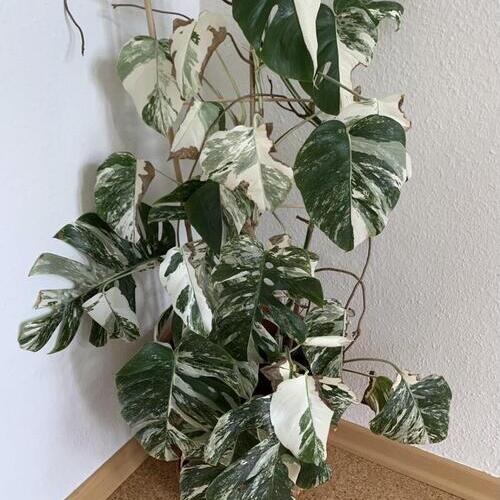
Monstera deliciosa var. borsigiana ‘Albo-Variegata,’ widely known simply as Monstera Albo, is a naturally occurring variegated cultivar of the classic Swiss cheese plant, prized by collectors for its unpredictable white-and-green foliage. The non-variegated parent species is native to the tropical rainforests of southern Mexico and Central America, where it grows as a hemiepiphyte, climbing tree trunks using aerial roots to reach the dappled light of the forest canopy.
The defining feature of this cultivar is its variegation, caused by a genetic mutation that prevents chlorophyll from forming in certain plant cells. This produces leaves marked with patches, streaks, or fine speckling of pure white intermixed with deep green, and no two leaves are ever identical. Variegation patterns generally fall into three categories: sectoral (large, clearly defined blocks of white), marbled or mosaic (fine, scattered white speckling throughout the leaf), and half-moon (a leaf split cleanly in half between solid white and solid green). Because white tissue contains no chlorophyll, it cannot photosynthesize, meaning heavily variegated plants grow more slowly and are more prone to stress than solid green Monstera deliciosa.
As the plant matures, its leaves develop the large splits and perforations (fenestrations) that give Monstera deliciosa its common ‘Swiss cheese plant’ nickname, with fenestration becoming more pronounced as the plant climbs and gains access to more light. Monstera Albo is generally considered an advanced-level houseplant, not because its basic needs are unusual, but because balancing bright light, consistent care, and stable conditions is essential to keeping the variegation from reverting to solid green or from becoming so extensive that the plant weakens and struggles to grow.
Caring for Monstera Albo successfully means understanding that this is fundamentally a Monstera deliciosa with a genetic quirk, and while its basic needs mirror those of the standard green species, the presence of chlorophyll-free variegated tissue makes the plant noticeably more finicky and slower-growing. This is considered an advanced-level houseplant, best suited to growers who already have experience with aroids and are prepared to closely monitor light, humidity, and variegation balance.
The single most important factor for healthy, well-variegated growth is bright, indirect light, ideally more intense than what a standard green Monstera would need, since the white portions of each leaf cannot photosynthesize and the green portions must work harder to compensate. Pair strong indirect light with a sturdy moss pole or totem to encourage larger, more fenestrated leaves, along with a chunky, well-draining aroid mix, watering when the top 1 to 2 inches of soil have dried, and humidity of 60% or higher for the best results.
Beyond the basics, moderate fertilization during the growing season, warm and stable temperatures, and careful attention to how much white variegation each new leaf displays will help maintain a healthy long-term balance; leaves with too much white can stress or eventually kill a stem, while leaves reverting to solid green may need to be pruned back to encourage variegated growth to resume. Repotting every one to two years, along with periodic wiping of the leaves to prevent dust buildup and deter pests, rounds out a maintenance routine that experienced growers generally find manageable, if more demanding than that of an ordinary green Monstera.
 Soil
Soil
Monstera Albo needs a light, chunky, well-draining aroid mix rather than dense potting soil. A good base combines standard potting soil with orchid bark, perlite, and coconut coir in roughly equal parts, which mimics the loose, organic debris the plant’s roots would encounter climbing through rainforest leaf litter. Ideal soil pH sits in a mildly acidic range of about 5.5 to 6.5.
Good drainage is essential; the roots need access to oxygen and will rot quickly in compacted, waterlogged soil. Adding horticultural charcoal helps keep the mix fresh and reduces the risk of root rot, while worm castings or compost can be worked in periodically to supply slow-release nutrients. The airy structure of this mix also supports the plant’s aerial and clinging roots as it climbs a support, which is especially important for a slower-growing variegated specimen that cannot afford setbacks from poor root health.
Common soil problems include poor drainage from soil that has broken down and compacted over time, compaction that suffocates roots and slows already limited energy production in variegated tissue, inappropriate pH that can lock out nutrients even when present, salt build-up from mineral-heavy tap water and fertilizer residue (visible as a white crust on the soil surface or pot rim), nutrient deficiencies showing as pale or yellowing new growth, and root-boundness in plants left too long in the same pot, which restricts water uptake and stunts new leaf size. Flushing the soil with plain water every couple of months and repotting on schedule helps prevent these issues.
 Fertilizer
Feed Monstera Albo with a balanced, water-soluble houseplant fertilizer (roughly a 3-1-2 or 20-20-20 formulation) diluted to half strength, applied every 4 to 6 weeks during the active spring and summer growing season. Reduce or pause fertilizing in fall and winter when growth naturally slows.
Over-fertilization shows up as browned or crispy leaf-tip burn, a visible white crust of salts on the soil surface, and wilting despite adequate watering; variegated leaf portions are especially sensitive to fertilizer burn. Under-fertilization presents as pale, small new leaves, slow growth, and weaker overall vigor.
Organic alternatives include diluted fish emulsion, compost tea, or worm-casting top-dressing, all of which supply a gentler, slow-release nutrient source that is generally safer for a plant already working with limited photosynthetic capacity. This species particularly benefits from adequate nitrogen and magnesium to support the green tissue that must compensate for the non-photosynthesizing white areas; a light application of Epsom salt solution every couple of months can help address magnesium deficiency if pale interveinal yellowing appears.
 Watering
Water Monstera Albo when the top 1 to 2 inches of soil have dried out, typically every 7 to 10 days, though this varies with light, humidity, and season. The plant prefers room-temperature water; rainwater, distilled water, or filtered water is preferable to hard tap water, which can cause mineral salt build-up and leaf-tip browning over time.
Overwatering is signaled by yellowing lower leaves, a mushy or blackened stem base, and a sour smell from the soil, all of which point toward root rot. Underwatering shows up as drooping or curling leaves, dry and crispy leaf edges, and slowed growth. Because the plant’s chunky aroid mix dries faster than dense potting soil, checking soil moisture by finger or a moisture meter is more reliable than following a strict calendar.
During the active growing season in spring and summer, the plant uses more water and may need watering slightly more often, while growth slows in fall and winter, requiring longer intervals between waterings to avoid waterlogging the roots during a period of reduced uptake.
Stop guessing. Most houseplant failures are caused by volumetric errors and improper moisture tension. Our deterministic calculator moves beyond "once-a-week" watering by analyzing the four critical pillars of root health:
Personalized for this plant
Disclaimer: Our calculator is pretty smart. We’ve crunched the numbers, but we’re not measuring the quantum state of your living room. Since we don’t know your exact indoor temperature, humidity, light, airflow, or whether your plant receives daily sweet nothings and motivational speeches, use this calculator as a guide—and always keep an eye on your plant.
 Lighting
Monstera Albo thrives in bright, indirect light, ideally more intense than what a standard green Monstera deliciosa requires, since its white variegated tissue cannot photosynthesize and the plant relies entirely on its green portions to produce energy. A spot near an east-facing window, or a few feet back from a bright south- or west-facing window filtered through a sheer curtain, works well.
Insufficient light typically causes new leaves to revert toward solid green as the plant tries to maximize its photosynthetic capacity, along with slower growth, smaller leaves, and long gaps between leaves on the stem (etiolation). Excessive or direct light, on the other hand, can scorch the leaf surface, and white variegated sections are especially vulnerable to sunburn since they have no chlorophyll to help dissipate light energy, often showing crispy, bleached, or brown patches first.
If natural light is insufficient, a full-spectrum LED grow light positioned 12 to 24 inches above the plant and run for 10 to 12 hours a day is an effective supplement, particularly in winter months or low-light rooms, and can also help maintain more balanced variegation. Rotating the pot periodically ensures even growth on all sides of the plant.
 Temperature
Ideal daytime temperatures range from 65 to 85°F (18 to 29°C), with a slight nighttime drop being well tolerated. The plant is sensitive to cold and should never be exposed to temperatures below about 55°F (13°C), which can cause chilling injury, blackened tissue, or leaf drop.
Monstera Albo tolerates minor, gradual temperature fluctuations but reacts poorly to cold drafts, air conditioning vents, or sudden swings between hot and cold, which can stress the plant and slow growth. Keep it away from exterior doors and drafty windows in winter, and away from direct heater vents, which can dry it out excessively.
To protect the plant from temperature extremes, move it away from windows during cold snaps or heat waves, avoid placing it near radiators or air conditioning units, and consider a stable indoor spot away from doors that open frequently to the outside.
 Humidity
Monstera Albo prefers high humidity, ideally 60 to 80%, reflecting the rainforest origins of its parent species. Average home humidity (often 30 to 40%) is usually too low for the plant to reach its full leaf size and fenestration potential, though it can survive at lower levels with some compromise in leaf quality.
Low humidity stress presents as crispy or browning leaf edges, curling leaf margins, and slower, smaller new growth, and variegated white sections are often the first to show crisping since they lack the chlorophyll-rich tissue that helps regulate moisture loss. Excessively high humidity combined with poor air circulation, on the other hand, can encourage fungal issues, so ventilation matters alongside moisture.
Effective ways to raise humidity include running a small room humidifier near the plant, which is generally the most reliable and adjustable method; grouping plants together to create a shared moist microclimate; and using a pebble tray with water beneath (not touching) the pot base. Misting offers only a brief, superficial humidity boost and is best used as a supplement rather than a primary method. Many collectors also grow Monstera Albo in a greenhouse cabinet or enclosed grow tent for consistently elevated humidity, especially while the plant is young and establishing.
 Propagation
Monstera Albo is most commonly propagated through stem cuttings that include at least one node, ideally with visible variegation present at or near the node, and less commonly through air layering on mature climbing stems. Stem cuttings offer a reasonably reliable success rate, typically 60 to 80% under warm, humid conditions, somewhat lower than a standard green Monstera due to the reduced vigor of variegated tissue, while air layering can achieve similarly good success but requires more setup and patience. Late spring through summer, during the plant’s active growth phase, is the best time to propagate.
 Potting
Choose a pot with ample drainage holes, sized only slightly larger than the current root mass, as oversized pots hold excess moisture and increase rot risk. Terracotta pots help wick away excess moisture, while plastic nursery pots retain humidity longer, which can benefit growers in drier climates. A well-draining chunky aroid mix, as described in the soil section, is essential.
Repot every 1 to 2 years, or sooner if growth stalls, water drains unusually fast through the pot, or roots are visibly circling the surface or emerging from drainage holes, all signs of root-boundness.
When repotting, gently loosen the root ball, trim away any mushy, blackened, or clearly dead roots with clean shears, and avoid disturbing healthy roots unnecessarily. Position the plant at the same soil depth it was growing at previously, backfill with fresh mix, and water thoroughly. Because variegated plants are more sensitive to stress than solid green specimens, minimizing transplant shock is especially important: repot during the active growing season, keep the plant in stable warmth and humidity for a week or two afterward, and hold off on fertilizing for about a month to let roots recover.
 Pruning
Prune Monstera Albo during the active growing season in spring or summer, when the plant recovers most quickly from cuts and regrowth is strongest.
Light pruning is typically needed a few times a year to remove damaged or overly yellowed leaves, manage the plant’s climbing height, and correct stems that have reverted to solid green or become excessively white.
Use clean, sharp bypass pruners or a sharp knife, sterilized with rubbing alcohol before and between cuts to prevent spreading disease between plants.
Water lightly if the soil is dry, keep the plant out of direct sun for a few days, and monitor cut sites for signs of infection.
Wear gloves when pruning, since the sap can irritate skin, and avoid heavy pruning on young, recently repotted, or already stressed plants, since variegated tissue recovers more slowly than solid green growth.
 Blooming
Monstera Albo is grown exclusively for its dramatically variegated foliage and essentially never flowers in an indoor setting. In its native range, mature Monstera deliciosa var. borsigiana can eventually produce a classic aroid inflorescence with a creamy white spathe wrapped around a spadix, typically during the warm growing months once the plant has reached significant size and maturity, often after climbing many feet up a support. Because variegated tissue lacks chlorophyll and photosynthesizes less efficiently, Albo specimens grow more slowly than their fully green counterparts and almost never reach the size or maturity required to flower indoors. Growers should not expect blooms from this cultivar and should instead focus entirely on supporting healthy variegated leaf growth.
 Pests and Diseases
Name: Spider mites
Symptoms: Fine webbing on leaf undersides, stippled or bronzed leaf surface, dry speckled appearance, often especially visible on white variegated sections
Treatment: Rinse foliage with lukewarm water, increase humidity, and apply insecticidal soap or neem oil weekly until resolved
Name: Mealybugs
Symptoms: White, cottony clusters at leaf axils and stem joints, sticky honeydew residue
Treatment: Dab insects with rubbing alcohol on a cotton swab, then treat the whole plant with insecticidal soap or neem oil
Name: Aphids
Symptoms: Clusters of small green or black insects on new growth, curled or distorted young leaves
Treatment: Wash off with a strong stream of water and apply insecticidal soap every 5 to 7 days until cleared
Name: Scale insects
Symptoms: Small brown or tan bumps along stems and leaf veins, sticky residue, yellowing leaves
Treatment: Scrape off manually and treat with horticultural oil or systemic insecticide for persistent infestations
Name: Root rot
Symptoms: Wilting despite moist soil, blackened mushy roots, foul soil odor, yellowing lower leaves
Treatment: Remove from pot, trim affected roots with sterilized tools, repot into fresh well-draining mix, and reduce watering frequency
Name: Bacterial leaf spot
Symptoms: Water-soaked dark spots that may develop yellow halos, spreading rapidly in humid conditions, sometimes progressing faster in white variegated tissue
Treatment: Remove affected leaves, improve air circulation, avoid overhead watering, and apply a copper-based bactericide if needed
Name: Fungal leaf spot
Symptoms: Brown or black circular spots with defined edges, sometimes with concentric rings
Treatment: Remove infected leaves, avoid wetting foliage when watering, and apply a fungicide labeled for houseplants
 Special Features
Monstera Albo is prized above nearly all other houseplants for its striking white variegation, which appears as irregular patches, streaks, or fine marbling of pure white against the deep green of its large, fenestrated leaves, making every leaf visually unique. Its dramatic split-leaf silhouette, inherited from its Monstera deliciosa parentage, combines with this unpredictable variegation pattern to create a truly one-of-a-kind specimen plant. As a climbing aroid, it develops an impressive vertical presence when trained onto a moss pole or totem, with leaf size and fenestration increasing as the plant matures and climbs higher. It does not produce fragrant flowers or reliably fruit indoors, and its rarity, slow growth, and finicky variegation stability have made it one of the most sought-after and highly valued plants in the collector community.
 Plant Benefits
Monstera Albo has no established herbal, medicinal, or pharmaceutical use, and due to its calcium oxalate content it should never be ingested. Its primary benefit is ornamental and psychological: like many houseplants, caring for it has been associated anecdotally with stress reduction and a sense of accomplishment among collectors, though it should not be relied upon for any therapeutic or health-related purpose.
 Additional Information
Monstera Albo is frequently confused with Monstera ‘Thai Constellation,’ a tissue-cultured variegated cultivar with a more stable, speckled variegation pattern that grows somewhat more predictably. Because true Monstera Albo variegation is unstable and can shift or revert over time, and because it commands very high prices, buyers should purchase from a reputable seller and be cautious of counterfeit listings, mislabeled seedlings, or plants advertised with unrealistically heavy variegation.
 Life Cycle
As a hemiepiphytic perennial, Monstera Albo begins life with smaller, entire (unsplit) juvenile leaves before its aerial roots latch onto a support and it begins to climb. As it matures and gains height, leaves increase in size and develop the iconic fenestrations (splits and holes) typical of Monstera deliciosa, while also displaying the plant’s signature white variegation, which can appear as large sectoral patches, fine marbling, or a mix of both on the same leaf. Because variegated cells contain little or no chlorophyll, the plant’s overall growth rate is slower than a standard green Monstera, and heavily variegated leaves are smaller and more fragile than solid green ones. Individual leaves persist for a year or more before naturally yellowing and being shed as new growth emerges. Given time, consistent light, and a sturdy climbing support, the plant continues to produce increasingly fenestrated and variegated leaves indefinitely, though flowering in cultivation is essentially unheard of.
 Are Monstera Albo Poisonous, Toxic
Monstera Albo is toxic to cats, dogs, and humans (especially children) if chewed or ingested. All parts of the plant contain insoluble calcium oxalate crystals, with the leaves and stem sap posing the greatest risk. When plant tissue is chewed, these microscopic crystals penetrate soft tissue, causing immediate oral irritation.
Symptoms in pets and children typically include intense burning or irritation of the mouth, lips, and tongue, excessive drooling, difficulty swallowing, vocalizing in distress, vomiting, and in more severe cases swelling of the airway that can make breathing difficult. Skin contact with sap may cause localized irritation or dermatitis in sensitive individuals.
Severity is generally considered mild to moderate, with symptoms rarely life-threatening, but swelling that affects breathing constitutes an emergency. First aid includes rinsing the mouth thoroughly with water or milk, wiping away any visible plant material, and offering a cold treat or ice chip to soothe irritation; a veterinarian or poison control center (or physician, for children) should be contacted promptly, especially if swelling, drooling, or breathing difficulty is significant. Preventive measures include placing the plant well out of reach of pets and small children, training climbing vines onto high shelving or hanging supports, and promptly removing any fallen leaf debris.
 Frequently Asked Questions
No, it is generally considered an advanced-level houseplant, since balancing bright light, humidity, and stable conditions is essential to keeping its variegation healthy and preventing reversion.
Yes, it contains calcium oxalate crystals that irritate the mouth and digestive tract if chewed or ingested, and it should be kept away from pets and children.
Its variegation arises from an unstable genetic mutation that cannot be reliably reproduced from seed, so plants must be propagated from cuttings of already variegated stems, making supply limited relative to demand.
Water when the top 1 to 2 inches of soil are dry, typically every 7 to 10 days, adjusting for light, humidity, and season.
Reversion often happens when the plant does not receive enough light, since it tries to maximize photosynthetic tissue by producing more green, chlorophyll-rich leaves.
A moss pole or similar climbing support is strongly recommended, as it encourages larger, more fenestrated, and better-variegated mature leaves.
It thrives at 60 to 80 percent humidity, and lower humidity can result in crispy leaf edges, especially on the white variegated sections.
A chunky, well-draining aroid mix of potting soil, orchid bark, perlite, and coconut coir works best, with a mildly acidic pH of about 5.5 to 6.5.
The most reliable method is stem cuttings with at least one node, ideally showing some variegation, rooted in water, moist sphagnum moss, or a light propagation mix under warm, humid conditions.
It essentially never flowers indoors, as its slower growth and reduced photosynthetic capacity mean it rarely, if ever, reaches the size and maturity needed to bloom in cultivation.
 Can I grow Monstera Albo in my indoor space
Difficulty: Advanced
Size: Large
Light: Medium
Water: Medium
Flowering: No
Pet Safe: No
Air Purifier: Low
 Monstera deliciosa var. borsigiana 'Albo-Variegata' botanical details
Common Name: Monstera Albo
Other Common Names: Variegated Monstera, Albo Variegata, White Monstera, Ghost Monstera
Botanical Name: Monstera deliciosa var. borsigiana 'Albo-Variegata'
Native Area: A naturally occurring variegated form of Monstera deliciosa var. borsigiana, whose non-variegated parent species is native to the tropical rainforests of southern Mexico and Central America, particularly Panama.
Family Name: Araceae
Plant Type: Perennial climbing vine (epiphyte/hemiepiphyte)
Genus: Monstera
Kingdom: Plantae
 Photo Gallery
 My Monstera Albo Plant Care Recommendations
If you find the Houseplant Encyclopedia helpful and would like to support Healthy Houseplants, you can use the links below to shop for recommended plants, products, and plant-care supplies.
Some links are affiliate links, which means I may earn a small commission if you make a qualifying purchase through them, at no additional cost to you. Thank you for supporting Healthy Houseplants and helping me continue to provide free plant-care information!

Want even more personalized plant-care help? Check out my AI Julie Chatbot—trained on my 20 years of houseplant knowledge, not just information from the internet!  Try it now:Ask AI Julie
 Buy Monstera Albo Online
✅ “Bring Home This Beauty Today”
✅ “Get Your Own Monstera Albo Before It’s Gone”
✅ “Shop Trusted Sellers – Limited Availability”
✅ “Free Delivery”
As an Amazon Associate, I earn commission from qualifying purchases.
 Plant Puns and Jokes
Why did the Monstera Albo refuse to blend in at the plant show? Because it was determined to stay two-toned and totally one of a kind!
 Signup to our newsletter and download Monstera Albo care guide

