


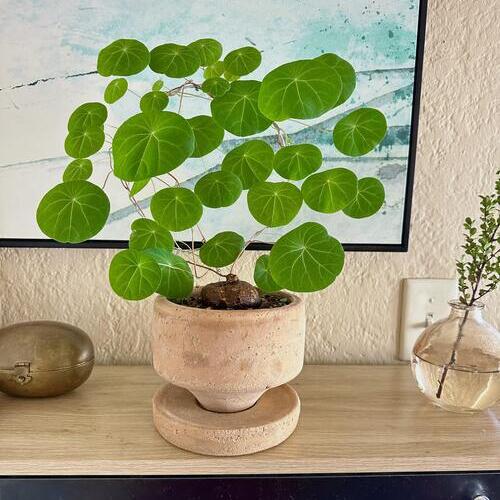
Stephania erecta is a caudiciform perennial vine belonging to the Menispermaceae, or moonseed family, prized among succulent and oddity collectors for its rounded, semi-exposed caudex and delicate, umbrella-shaped leaves. Native to Thailand and adjacent parts of Southeast Asia, it grows naturally in seasonally dry forests and on rocky, well-drained slopes, where its swollen underground-to-partially-exposed tuber allows it to survive extended dry periods by storing water and energy reserves.
The defining feature of this species is its caudex, a smooth to slightly textured, grayish-brown, potato- or stone-like structure that can range from the size of a golf ball in young plants to a large, rounded mass many inches across in mature specimens after years of cultivation. From the top of the caudex, slender, wiry stems emerge each growing season, bearing distinctive peltate leaves, rounded or heart-shaped foliage attached to the petiole near the center of the leaf blade rather than at the margin, giving the plant an umbrella-like or lily-pad appearance as it climbs or trails.
What makes Stephania erecta especially appealing to growers is its clearly defined seasonal rhythm: it grows actively through the warm months, producing fresh vines and foliage, and then drops its leaves entirely to rest as a bare caudex during cooler, drier periods. This dramatic transformation between a leafy, vining plant and a dormant, sculptural tuber, combined with its relatively compact size compared to many other caudiciforms, has made it an increasingly popular specimen among houseplant enthusiasts and succulent collectors seeking novel, conversation-worthy plants.
Caring for Stephania erecta successfully hinges on recognizing and supporting its natural cycle of active growth followed by leafless dormancy, rather than expecting year-round evergreen behavior. During the warmer months when vines and leaves are actively growing, the plant should receive bright, indirect light, regular watering that allows the soil to dry partially between applications, and occasional light feeding to support healthy foliage and gradual caudex development. A fast-draining, mineral-rich potting mix formulated for succulents or caudiciforms is essential, since the caudex is vulnerable to rot if kept excessively wet, particularly once the plant begins to slow down or lose its leaves.
As autumn approaches and the vines naturally begin to yellow, watering should be gradually reduced to match the plant’s declining water use, and once the foliage has fully died back, the caudex should be kept mostly dry through its winter dormancy, with only very light, infrequent watering to prevent excessive shriveling. This bare caudex stage often causes new growers concern, but it is a completely normal and expected part of the plant’s life cycle rather than a sign of decline, provided the caudex remains firm rather than soft or mushy.
As temperatures warm again and the plant senses the return of its growing season, typically in spring, watering can gradually resume to encourage new shoots to emerge from the top of the caudex. With attentive seasonal adjustment to light, water, and feeding, Stephania erecta rewards patient growers with fresh, umbrella-like foliage each year and a slowly but steadily swelling caudex that becomes more characterful with every growing cycle.
 Soil
Soil
Stephania erecta requires an exceptionally well-draining, mineral-rich soil that mirrors the rocky, fast-draining terrain of its native habitat. A good mix combines a standard cactus and succulent potting soil with generous additions of coarse perlite, pumice, and coarse sand, often at a ratio grittier than a typical houseplant mix, to ensure water moves through quickly and does not pool around the caudex. The ideal soil pH is slightly acidic to neutral, generally between 6.0 and 7.0.
Soil composition is critical to this species’ long-term health because the caudex, while somewhat protected by its firm outer skin, is still vulnerable to rot if kept in consistently damp, poorly aerated soil, particularly during dormancy. Adding horticultural charcoal to the mix can help absorb excess moisture and reduce fungal risk, while a top-dressing of coarse grit around the base of the caudex improves surface drainage and keeps moisture away from direct, prolonged contact with the caudex skin.
Common soil problems to watch for include poor drainage, which is especially dangerous during dormancy and can quickly lead to caudex or root rot; soil compaction over time, which restricts aeration and root health and should be corrected with periodic repotting into fresh, loose mix; inappropriate pH, which can interfere with nutrient uptake; salt build-up from tap water or fertilizer residue, visible as a white crust on the soil surface and best remedied by flushing thoroughly with water during active growth; and nutrient deficiencies, which often present as pale or weak new growth and can be corrected with light, appropriately timed fertilization. Root-boundness is less of a pressing concern for this relatively slow-growing species, but if roots become densely circled and congested, repotting into a slightly larger container with fresh, gritty soil during the active growing season is advisable.
 Fertilizer
Stephania erecta has fairly light fertilization needs and should be fed only during its active growing season, using a balanced, diluted fertilizer formulated for cacti and succulents, applied at roughly half strength every four to six weeks while vines and leaves are actively developing. Fertilization should be paused entirely during dormancy, when the plant has no leaves and is not actively taking up nutrients, since feeding a dormant caudex offers no benefit and risks salt buildup in the soil. Signs of over-fertilization include white, crusty deposits on the soil surface, leaf tip or margin burn, and unusually soft or distorted new growth, while under-fertilization typically shows as pale, weak leaves and minimal seasonal vine growth. Organic alternatives such as diluted fish emulsion or worm castings tea can be used during active growth for growers who prefer a more natural approach, though nitrogen should be kept moderate, since excessive feeding does not meaningfully speed up this naturally slow-growing plant’s caudex development.
 Watering
Watering Stephania erecta should closely track its seasonal growth cycle, as inconsistent timing is one of the most common causes of trouble with this species. During the active growing season, when vines are producing leaves, water thoroughly and then allow the top inch or two of soil to dry out before watering again, typically every seven to twelve days depending on light, temperature, and pot size. Rainwater, distilled water, or filtered water is preferred over hard tap water, which can lead to mineral buildup in the gritty soil over time; if tap water is used, letting it sit out for 24 hours helps dissipate chlorine.
As the vines naturally yellow and die back in autumn, signaling the approach of dormancy, watering should be gradually reduced and then withheld almost entirely once the plant is fully leafless, with only very occasional, light watering through winter to prevent the caudex from shriveling excessively; overwatering during this dormant period is a leading cause of caudex and root rot. Signs of overwatering include a soft, mushy, or discolored caudex and a sour or foul smell from the soil, while underwatering during active growth shows up as wilting or crisping leaves and stalled new growth, though the caudex itself is fairly drought-tolerant and can handle short dry spells without lasting harm. As temperatures warm in spring and new shoots begin to emerge, watering should gradually resume to support the plant’s return to active growth.
Stop guessing. Most houseplant failures are caused by volumetric errors and improper moisture tension. Our deterministic calculator moves beyond "once-a-week" watering by analyzing the four critical pillars of root health:
Personalized for this plant
Disclaimer: Our calculator is pretty smart. We’ve crunched the numbers, but we’re not measuring the quantum state of your living room. Since we don’t know your exact indoor temperature, humidity, light, airflow, or whether your plant receives daily sweet nothings and motivational speeches, use this calculator as a guide—and always keep an eye on your plant.
 Lighting
Stephania erecta grows best in bright, indirect light, with a few hours of gentle direct morning sun tolerated or even beneficial during the active growing season, though harsh, intense midday sun can scorch the delicate leaves. An east-facing window or a spot a few feet back from a bright south- or west-facing window works well indoors, while outdoor plants in suitable climates appreciate light shade or filtered sun, especially in hotter regions. Insufficient light during the growing season leads to weak, stretched, or sparse vine growth and pale leaves, while excessive direct sun can cause bleached or scorched patches on the tender foliage. A plant moved into brighter conditions should be acclimated gradually over one to two weeks to avoid leaf stress. If natural light is limited, especially during the active spring and summer growth period, supplement with a full-spectrum LED or fluorescent grow light for about twelve hours daily to support healthy vine and leaf development; during winter dormancy, when the plant is leafless, light requirements are minimal since the bare caudex can tolerate a range of light conditions.
 Temperature
Stephania erecta thrives in warm, temperate-to-subtropical conditions, doing best between 65°F and 85°F (18°C to 29°C) during its active growing season, and tolerating brief dips to slightly cooler temperatures during dormancy without harm. It has limited cold tolerance and should be protected from temperatures below 50°F (10°C), with hard frost being potentially fatal to the caudex; prolonged exposure to cold, damp conditions is especially risky. The plant appreciates relatively stable, warm temperatures during active growth to support vigorous vine and leaf development, but as a dormant, leafless caudex it can tolerate a somewhat wider range of cooler indoor temperatures. To protect it from temperature extremes, bring outdoor or unheated greenhouse specimens indoors well ahead of any cold snap, avoid placing the plant near drafty windows or air conditioning vents, and provide light afternoon shade in regions with intense summer heat.
 Humidity
Stephania erecta does well in moderate humidity, generally in the range of 40 to 60 percent, and adapts reasonably well to typical indoor home humidity levels without requiring special intervention in most cases. Very low humidity, particularly combined with heat, can occasionally cause crisping or browning along leaf edges during active growth, while excessively high humidity combined with poor air circulation increases the risk of fungal issues, especially around the caudex. Symptoms of humidity-related stress include curling or crispy leaf margins in dry conditions, or soft spotting and fungal growth near the caudex base in overly damp, stagnant conditions. If indoor air is very dry, light misting of the foliage (avoiding the caudex itself) or use of a small humidifier nearby can help, though pebble trays and grouping with other humidity-loving plants are less critical for this relatively adaptable species; prioritizing good airflow is generally more important than pushing humidity artificially high.
 Propagation
Stephania erecta is most commonly and reliably propagated from seed, as it does not readily produce offsets and is difficult to root from stem cuttings, which generally lack the ability to form a new caudex. Because plants are often dioecious in cultivation, with separate male and female individuals, seed production requires both sexes flowering in proximity during the growing season, and hand-pollination can improve seed set indoors. The best time to sow seed is in spring, coinciding with the natural start of the plant’s active growing period, when warmth encourages germination.
Compared to cuttings, which have a low success rate for this species due to the difficulty of initiating a new caudex, seed propagation offers a notably higher, though still gradual, success rate when fresh seed and warm, consistently moist conditions are provided. Seedlings typically establish a small, visible caudex within their first year, but reaching a substantial, ornamentally significant caudex size generally takes several years of steady seasonal growth, reflecting this species’ characteristically slow, patient growth habit.
 Potting
Stephania erecta should be planted in a wide, shallow to moderately deep pot with ample drainage holes, allowing the caudex to sit partially exposed above the soil line, both to showcase its sculptural form and to reduce prolonged moisture contact with its skin. Unglazed terracotta or other porous pot materials are well-suited, as they help wick excess moisture away from the root zone. Repotting is needed infrequently, typically every two to three years for actively growing specimens, given the plant’s moderate to slow growth rate, and should be done during the active growing season using a fresh, gritty succulent or caudiciform mix. Signs that repotting is needed include roots visibly circling the interior of the pot or emerging from drainage holes, water running through too quickly without being absorbed, and a caudex that has visibly outgrown its container’s proportions. When repotting, handle the caudex and root system gently, since the firm outer skin protects a more tender interior; any necessary root trimming should be done with clean, sterilized tools, allowing cuts to callus briefly before repotting into fresh mix. To minimize transplant stress, repot only during active growth, avoid disturbing a dormant, leafless plant, and withhold heavy watering for several days after repotting to let the root system settle.
 Pruning
Stephania erecta requires very little pruning, and any trimming is best carried out during the active growing season when new vine growth is being produced, or as the vines naturally die back at the start of dormancy. Pruning is mainly useful for removing spent or dead vine growth once dormancy begins, managing the direction or length of climbing stems for aesthetic or spatial reasons, and occasionally shaping the plant for a tidier display.
Use a small, clean, sharp pair of pruning snips or scissors, sterilized with rubbing alcohol before and between cuts to minimize the risk of spreading disease. Light gloves are a sensible precaution when handling cut stems, since the plant’s sap can occasionally cause mild irritation in sensitive individuals.
After pruning during active growth, resume normal watering and light care, since the plant continues to photosynthesize through its remaining foliage. When vines are removed at the end of the growing season, no special aftercare is required beyond transitioning the plant into its typical dry winter dormancy. Because the exposed caudex is the plant’s most valuable ornamental feature, avoid cutting, scraping, or otherwise damaging the caudex itself, reserving all pruning strictly for the herbaceous vine growth above it.
 Blooming
Stephania erecta produces small clusters of pale yellow-green to cream flowers during its active growing season, typically in spring through early summer as new vine growth emerges from the caudex. Individual flowers are tiny, star-shaped, and arranged in loose umbel-like clusters at the leaf axils, with male and female flowers usually borne on separate plants, meaning fruit set requires both a male and female specimen in proximity. The blooms themselves are more a subtle botanical detail than a showy display, easily overlooked among the plant’s distinctive round, peltate leaves. Optimal flowering is encouraged by bright, indirect light, warm temperatures between 65°F and 80°F (18°C to 27°C), and consistent moisture during the active growing period, with individual flowers lasting only a few days before giving way, in successfully pollinated female plants, to small berry-like fruits.
 Pests and Diseases
Name: Mealybugs
Symptoms: Cottony white masses at leaf axils, along stems, and occasionally at the base of the caudex, accompanied by sticky honeydew residue and weakened new growth.
Treatment: Dab visible clusters with rubbing alcohol on a cotton swab, then treat the plant with insecticidal soap or neem oil, repeating every seven to ten days until the infestation is resolved.
Name: Spider Mites
Symptoms: Fine webbing on stems and leaf undersides, stippled or bronzed leaf coloring, and general decline, particularly in hot, dry indoor conditions during active growth.
Treatment: Rinse foliage with water to dislodge mites, increase air circulation and humidity slightly, and apply a miticide or insecticidal soap as needed for persistent infestations.
Name: Aphids
Symptoms: Small clusters of green or black insects on new stem growth and leaf tips, causing curling or distorted leaf development.
Treatment: Dislodge aphids with a strong stream of water and follow with insecticidal soap or neem oil applications until the population is under control.
Name: Fungus Gnats
Symptoms: Small flying insects around the soil surface and larvae in overly moist soil, occasionally contributing to root stress in young plants.
Treatment: Allow the soil surface to dry more between waterings, use sticky traps to catch adults, and apply a biological larvicide such as Bacillus thuringiensis israelensis (BTI) to the soil if needed.
Name: Caudex and Root Rot
Symptoms: Soft, discolored, or mushy patches on the caudex surface, a foul odor from the soil, and wilting or collapse of vine growth despite otherwise adequate care.
Treatment: Remove the plant from its pot, cut away all soft or discolored tissue using a sterilized blade, allow the remaining healthy caudex to dry and callus thoroughly, and repot in fresh, dry, fast-draining mix; significantly reduce watering going forward, especially during dormancy.
Name: Fungal Leaf Spot
Symptoms: Brown or black spots, sometimes with a yellow halo, appearing on the leaves during humid or poorly ventilated conditions in the active growing season.
Treatment: Remove affected leaves promptly, improve air circulation, avoid wetting foliage during watering, and apply a copper-based fungicide if the problem persists or spreads.
Name: Powdery Mildew
Symptoms: A white, powdery coating on leaves and young stem growth, typically appearing in humid conditions with poor airflow during the active growing season.
Treatment: Improve ventilation around the plant, remove heavily affected foliage, and apply a fungicide labeled for powdery mildew if the infection is widespread.
 Special Features
Stephania erecta is treasured chiefly for its swollen, semi-exposed caudex, a rounded, often stone-like or potato-shaped structure that sits partially above the soil line and gives the plant a whimsical, sculptural quality even when leafless. Its rounded, peltate leaves, attached to their stalks near the center rather than the edge, create a distinctive umbrella-like silhouette on delicate, twining stems that make an eye-catching addition to a hanging display or trellis. The plant’s natural deciduous cycle, in which it dies back to a bare caudex during dormancy and then flushes with fresh, textural foliage each growing season, adds a rewarding sense of anticipation and seasonal change that appeals strongly to caudiciform and succulent collectors seeking something different from typical evergreen houseplants.
 Plant Benefits
The genus Stephania is well known in ethnobotanical and pharmacological literature for containing bioactive alkaloids, including compounds that have been studied for various physiological effects in traditional Asian medicine systems. However, Stephania erecta itself is grown almost exclusively as an ornamental caudiciform specimen in home and collector cultivation, and given the presence of potentially toxic alkaloids throughout the plant, it is not recommended for home herbal or medicinal use. Any interest in this species’ bioactive compounds remains firmly within the realm of scientific or pharmacological research rather than practical home remedy application, and ingestion of any part of the plant should be avoided.
 Additional Information
Stephania erecta belongs to the Menispermaceae, or moonseed family, a group that includes numerous species historically used in traditional medicine across Asia and Africa, though many members of this family, including Stephania erecta, contain alkaloids that make them unsuitable for casual home use. The genus Stephania is taxonomically complex, with many species and varieties in cultivation sometimes traded under similar or overlapping names, so sourcing plants from reputable specialist nurseries helps ensure accurate identification. Because of its rising popularity as a collector’s plant, growers should be mindful of sourcing nursery-propagated specimens rather than wild-collected tubers, to support sustainable cultivation of this and related caudiciform species.
 Life Cycle
Stephania erecta follows a distinctive seasonal growth pattern built around its swollen, above-ground caudex, and is a slow-growing, long-lived perennial capable of persisting for many years, even decades, in cultivation. It begins as a seed or, more commonly in collector circles, as an already-established tuber, sending up slender, twining vines and rounded, umbrella-like peltate leaves once warmth and moisture signal the start of the growing season. During spring and summer, the plant grows vigorously, producing new leaves and stems that climb or trail from the top of the caudex, and may flower if conditions are favorable. As temperatures cool and day length shortens in autumn, the vines typically yellow and die back, and the plant enters a dormant rest period through winter during which the caudex persists bare and largely inactive. Each year this cycle repeats, and over time the caudex gradually swells and develops a more pronounced, rounded, potato-like form, with older specimens becoming increasingly prized for their size and sculptural character.
 Are Stephania Erecta Poisonous, Toxic
Stephania erecta contains bioactive alkaloids throughout its tuber, stems, and foliage, and is considered toxic to cats, dogs, and humans, particularly children, if ingested, given the pharmacologically active compounds present in members of the Menispermaceae family. The caudex and underground portions tend to be the most concentrated with these compounds, and ingestion can cause gastrointestinal upset in pets and people, with symptoms including drooling, vomiting, diarrhea, and abdominal discomfort; larger ingestions may lead to more pronounced effects such as lethargy, dizziness, or altered heart rate due to the alkaloid content, and should be treated as a more serious exposure. Severity generally ranges from mild to moderate with typical accidental nibbling, but any significant ingestion, especially by small pets or children, warrants prompt medical attention. If ingestion occurs, rinse the mouth with water, do not induce vomiting unless directed by a professional, and contact a veterinarian, pediatrician, or poison control center for guidance, bringing a plant sample or photo if possible. Preventive measures include keeping the plant, and especially its exposed caudex, out of reach of curious pets and young children, and supervising interactions with the plant given its accessible, above-ground tuberous structure.
 Frequently Asked Questions
Yes, the plant contains bioactive alkaloids that are toxic to cats, dogs, and humans if ingested, and can cause gastrointestinal upset such as vomiting and diarrhea.
Stephania erecta is deciduous and naturally drops its leaves each year as it enters seasonal dormancy, leaving behind a bare caudex; this is normal and expected rather than a sign of a problem.
Water thoroughly and allow the soil to partially dry between waterings during active growth, roughly every seven to twelve days, and reduce watering dramatically to near-none once the plant is dormant and leafless.
It needs bright, indirect light, with some gentle morning direct sun tolerated, especially during its active growing season.
It requires a fast-draining, gritty mix such as a cactus and succulent blend enriched with extra perlite, pumice, or coarse sand, with a soil pH between 6.0 and 7.0.
Stephania erecta is propagated most reliably from fresh seed sown in warm, moist conditions in spring, since it does not readily produce offsets and cuttings rarely succeed.
Reaching a substantial, ornamentally impressive caudex size typically takes several years of consistent seasonal growth, as this species has a naturally slow, patient growth habit.
Yes, it can be grown indoors near a bright window, though growers should support its natural seasonal cycle of active growth followed by leafless dormancy for best results.
A soft or discolored caudex usually indicates rot caused by overwatering, particularly during dormancy, and requires removing affected tissue and repotting in dry, fast-draining soil.
Yes, growing the caudex partially above the soil line is standard practice for this species, both to showcase its sculptural form and to help reduce prolonged moisture contact with the caudex skin.
 Can I grow Stephania Erecta in my indoor space
Difficulty: Intermediate
Size: Small to Medium
Light: Medium
Water: Low
Flowering: Yes
Pet Safe: No
Air Purifier: Low
 Stephania erecta botanical details
Common Name: Stephania Erecta
Other Common Names: Elephant Foot Stephania, Stephania Caudex Vine, Roundleaf Stephania
Botanical Name: Stephania erecta
Native Area: Southeast Asia, primarily Thailand and neighboring regions, where it grows in seasonally dry, semi-deciduous forests and rocky or well-drained terrain
Family Name: Menispermaceae
Plant Type: Deciduous caudiciform vine/perennial tuberous succulent
Genus: Stephania
Kingdom: Plantae
 Photo Gallery
 My Stephania Erecta Plant Care Recommendations
If you find the Houseplant Encyclopedia helpful and would like to support Healthy Houseplants, you can use the links below to shop for recommended plants, products, and plant-care supplies.
Some links are affiliate links, which means I may earn a small commission if you make a qualifying purchase through them, at no additional cost to you. Thank you for supporting Healthy Houseplants and helping me continue to provide free plant-care information!

Want even more personalized plant-care help? Check out my AI Julie Chatbot—trained on my 20 years of houseplant knowledge, not just information from the internet!  Try it now:Ask AI Julie
 Buy Stephania Erecta Online
✅ “Bring Home This Beauty Today”
✅ “Get Your Own Stephania Erecta Before It’s Gone”
✅ “Shop Trusted Sellers – Limited Availability”
✅ “Free Delivery”
As an Amazon Associate, I earn commission from qualifying purchases.
 Plant Puns and Jokes
Why did Stephania erecta refuse to come out of its pot during winter? It said it was already rounding into its off-season and preferred to keep a low, tuberous profile!
 Signup to our newsletter and download Stephania Erecta care guide

