


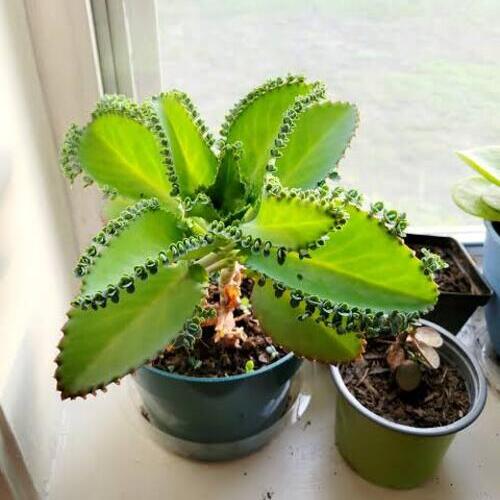
Mother of Thousands, botanically known as Kalanchoe daigremontiana, is a distinctive succulent species prized and sometimes cautiously managed by growers for its remarkable, almost science-fiction-like method of vegetative reproduction. It belongs to the stonecrop family, Crassulaceae, and is native to the dry, rocky terrain of southern and southwestern Madagascar, an environment characterized by seasonal drought and intense sunlight that has shaped the plant’s highly efficient water-storage and propagation strategies.
The defining feature of this species is the row of small plantlets that develop spontaneously along the notched, serrated edges of its narrow, lance-shaped leaves, each miniature plantlet forming with tiny rudimentary roots while still attached to the parent leaf. As the plant matures, these plantlets eventually detach on their own, whether through a light touch, air movement, or simple gravity, and fall to the soil below, where they root almost instantly and grow into new, independent rosettes, a reproductive strategy so effective that a single mature plant can produce hundreds of offspring in a single growing season. The main plant itself grows as an upright, single-stemmed succulent, typically reaching one to three feet in height, with fleshy, gray-green leaves marked with distinctive dark purplish-brown blotches along their length.
What makes Kalanchoe daigremontiana particularly notable among succulent collectors and casual houseplant growers alike is the sheer ease and speed with which it propagates itself, often without any intentional effort on the grower’s part, alongside its striking, upright architectural form that stands apart from more compact, rosette-shaped succulents. This combination of low-maintenance resilience and prolific, almost autonomous reproduction has made Mother of Thousands both a popular novelty plant for sharing with friends and, in warmer climates where it can escape cultivation, a species requiring mindful containment to prevent it from spreading into surrounding garden beds or natural areas.
Caring for Mother of Thousands is refreshingly straightforward, making it an excellent choice for beginner succulent growers, though its ease of care comes with the responsibility of managing its famously prolific plantlet production. This plant thrives with bright light, infrequent watering that allows the soil to dry out fully between applications, and a fast-draining, mineral-rich potting mix typical of cacti and succulents, since like most succulents it is highly susceptible to root and stem rot if kept in consistently moist conditions.
During the active growing season in spring and summer, Mother of Thousands benefits from bright, direct to indirect light for several hours daily, regular but well-spaced watering, and light, infrequent feeding to support steady growth of both the main rosette and its characteristic plantlets. Because those plantlets root readily wherever they fall, growers who wish to control the plant’s spread should regularly remove spent leaf margins or collect fallen plantlets before they establish in the surrounding soil, particularly for plants kept near other houseplants or in outdoor garden beds in mild climates.
As temperatures cool in autumn and winter, watering should be reduced further to match the plant’s slower growth, and light should remain bright to prevent the naturally upright stem from becoming weak or leggy. With minimal care requirements and remarkable resilience to neglect, Mother of Thousands rewards growers with fast, easy growth and an endless supply of plantlets for propagation, provided its enthusiastic self-propagating nature is kept in check through occasional pruning and mindful placement away from curious pets and small children, given the plant’s toxicity.
 Soil
Soil
Mother of Thousands requires a well-draining, mineral-based soil typical of cacti and succulents, mimicking the rocky, sharply drained terrain of its native habitat. A recommended mix combines a standard cactus and succulent potting soil with additional coarse sand, perlite, or pumice to ensure water passes through quickly without pooling around the roots or stem base. The ideal soil pH is slightly acidic to neutral, generally between 6.0 and 6.5.
Soil composition plays a significant role in this species’ health, since although the plant is quite drought-tolerant and forgiving overall, its fleshy roots and stem base are vulnerable to rot if kept in consistently damp, poorly draining soil. Adding a small amount of horticultural charcoal to the mix can help absorb excess moisture and reduce fungal risk in humid environments, while a light top-dressing of coarse gravel or grit around the base of the stem improves surface drainage and airflow.
Common soil problems to watch for include poor drainage, which can quickly lead to root and stem rot, particularly during cooler months when watering should already be reduced; soil compaction over time, which restricts aeration and root health and should be corrected with periodic repotting into fresh, loose mix; inappropriate pH, which can hinder nutrient uptake; salt build-up from tap water or fertilizer residue, visible as a white crust on the soil surface and best remedied by flushing thoroughly with water during the active growing season; and nutrient deficiencies, often presenting as pale, weak growth and correctable with light, appropriately timed fertilization. Root-boundness can occur in this moderately fast-growing species if left in the same pot for several years, so repotting into a slightly larger container with fresh, gritty soil during the active growing season is advisable once roots become visibly crowded.
 Fertilizer
Mother of Thousands has modest fertilization needs and benefits from feeding during its active spring and summer growing season, using a balanced or slightly nitrogen-light fertilizer formulated for cacti and succulents, diluted to half strength and applied every four to six weeks while the plant is actively producing new growth. Fertilization should be reduced or suspended entirely during the cooler autumn and winter months, when growth naturally slows and the plant is not actively taking up nutrients, as feeding during this period offers little benefit and can lead to salt buildup in the soil. Signs of over-fertilization include white, crusty salt deposits on the soil surface, leaf tip burn, and unusually soft or elongated new growth, while under-fertilization typically presents as pale, weak growth and minimal seasonal development. Organic alternatives such as diluted fish emulsion or compost tea can be used during the active growing season for growers preferring a more natural approach, though nitrogen should be kept moderate, since excessive feeding tends to encourage leggy, weak growth rather than compact, sturdy development in this naturally vigorous species.
 Watering
Watering Mother of Thousands should follow a typical succulent regimen, allowing the soil to dry out completely between waterings to mimic the plant’s native dry, rocky habitat. During the active growing season in spring and summer, water thoroughly and then wait until the soil is fully dry before watering again, typically every ten to fourteen days depending on light, temperature, and pot size. Rainwater or distilled water is preferred over hard tap water, which can lead to mineral buildup in the gritty soil over time; if using tap water, letting it sit for 24 hours helps dissipate chlorine.
During the cooler months of autumn and winter, watering should be reduced significantly, often to once every three to four weeks or less, as the plant’s growth naturally slows. Signs of overwatering include yellowing or translucent, mushy leaves, a soft or blackened stem base, and a foul odor from the soil, all of which indicate rot and require immediate corrective action, while signs of underwatering include shriveled, wrinkled leaves and a general loss of plumpness, though this species is notably drought-tolerant and recovers quickly once watered. Because Mother of Thousands stores substantial water in its thick leaves, erring on the side of underwatering is far safer than overwatering for this resilient, low-maintenance succulent.
Stop guessing. Most houseplant failures are caused by volumetric errors and improper moisture tension. Our deterministic calculator moves beyond "once-a-week" watering by analyzing the four critical pillars of root health:
Personalized for this plant
Disclaimer: Our calculator is pretty smart. We’ve crunched the numbers, but we’re not measuring the quantum state of your living room. Since we don’t know your exact indoor temperature, humidity, light, airflow, or whether your plant receives daily sweet nothings and motivational speeches, use this calculator as a guide—and always keep an eye on your plant.
 Lighting
Mother of Thousands thrives in bright light and performs best with several hours of direct or very bright indirect sun daily, making a south- or west-facing window ideal for indoor specimens, while outdoor plants in suitable climates do well in full sun to very light afternoon shade in the hottest regions. Insufficient light causes the naturally upright stem to stretch and become weak, pale, or leggy, with wider spacing between leaves as the plant reaches for a light source, while excessive sudden sun exposure on a plant unaccustomed to intense light can cause scorched or bleached patches on the foliage. A plant moved into much brighter conditions should be acclimated gradually over one to two weeks to prevent sunburn. If natural light is inadequate, particularly for indoor specimens in lower-light rooms, supplement with a full-spectrum LED or fluorescent grow light for twelve to fourteen hours daily to maintain compact, sturdy growth and healthy leaf coloration.
 Temperature
Mother of Thousands prefers warm, subtropical-to-tropical temperatures, thriving between 65°F and 85°F (18°C to 29°C) during its active growing season, and tolerating brief dips to cooler temperatures during winter dormancy without significant harm. It has very limited cold tolerance and should be protected from temperatures below 45°F (7°C), with frost being fatal to the plant, as this species is not winter-hardy outdoors in most temperate climates. The plant handles typical indoor temperature fluctuations well and does not require special humidity or temperature control beyond avoiding cold drafts near windows or doors in winter. To protect it from temperature extremes, bring container specimens indoors well ahead of any cold snap in autumn, and provide light afternoon shade in regions with extremely intense summer heat to prevent leaf scorch, even though the plant is generally quite heat-tolerant.
 Humidity
Mother of Thousands prefers low to moderate humidity levels, generally in the range of 30 to 50 percent, consistent with the dry, arid conditions of its native Madagascar habitat, and adapts easily to typical indoor humidity without any special adjustment in most homes. High humidity, especially combined with cool temperatures or poor air circulation, increases the risk of fungal issues and stem or root rot, making good ventilation more valuable than elevated ambient moisture for this species. Symptoms of excess humidity stress include soft, mushy patches on leaves or stems and the appearance of fungal spotting, while low humidity is rarely problematic for this drought-adapted succulent. Because misting and pebble trays raise humidity and can encourage rot risk, they are unnecessary and best avoided for this species; instead, prioritize bright light, good airflow, and well-draining soil to keep the plant healthy.
 Propagation
Mother of Thousands is remarkably easy to propagate, primarily through the tiny plantlets that form naturally along its leaf margins, though stem cuttings and leaf cuttings can also succeed. Because the species produces viable plantlets so readily and continuously during active growth, plantlet propagation is by far the most common, fastest, and most reliable method, requiring essentially no special technique beyond providing suitable rooting conditions. The best time to propagate is during the active growing season in spring or summer, when both the parent plant and new plantlets are growing vigorously.
Compared to leaf or stem cuttings, which can also root successfully but take longer to establish and carry a somewhat higher risk of rot if kept too moist, plantlet propagation has an exceptionally high success rate, often approaching total success under reasonable care, since each plantlet arrives pre-formed with functional root initials. New plantlets typically establish as independent, self-sufficient rosettes within just a few weeks, making this one of the fastest-propagating succulents commonly grown by collectors.
 Potting
Mother of Thousands should be planted in a pot with ample drainage holes and a size proportionate to the plant’s upright, moderately fast-growing habit, allowing some room for growth without being excessively oversized, which can encourage waterlogged soil. Unglazed terracotta or other porous materials are well-suited, as they help wick away excess moisture from the root zone, though any well-draining container works if watering is managed carefully. Repotting is typically needed every one to two years for actively growing specimens, given the plant’s moderately fast growth rate, and should be done during the active growing season using a fresh, gritty cactus and succulent mix. Signs that repotting is needed include roots visibly emerging from drainage holes or circling the pot’s interior, water passing through too quickly without being absorbed, and a plant that has become top-heavy or unstable relative to its container size. When repotting, handle the root system gently, and if roots are densely circled, light root pruning with clean, sterilized tools can encourage healthier new growth; allow any trimmed roots to callus briefly before repotting. To minimize transplant stress, repot during active growth when possible, and withhold heavy watering for several days after repotting to allow the root system to settle into its new soil.
 Pruning
Mother of Thousands benefits from occasional, purposeful pruning, primarily to manage its height, control its prolific plantlet production, and remove any leggy or damaged growth. Pruning is best performed during the active growing season in spring or summer, when the plant recovers quickly, though spent leaf margins loaded with plantlets can be trimmed at any time to prevent unwanted spread.
Use a clean, sharp pair of pruning shears or scissors, sterilized with rubbing alcohol before and between cuts to reduce the risk of disease transmission. Wearing gloves is strongly recommended when handling this plant, both because the sap can cause mild skin irritation in sensitive individuals and because the entire plant, including cut stems and leaves, is toxic if ingested by pets or children.
After pruning, allow any significant cuts to callus for a day or two in a dry, shaded spot before resuming normal watering, which helps reduce the risk of rot at the cut site. Because this species propagates so readily from both stem cuttings and plantlets, any pruning debris has strong potential to become new plants, so gardeners wishing to limit the plant’s spread should handle and dispose of all trimmings thoughtfully. Always wash hands after pruning and keep cuttings, plantlets, and the parent plant itself out of reach of pets and children due to the plant’s toxicity.
 Blooming
Mother of Thousands is a monocarpic bloomer, meaning individual plants flower only once, typically after reaching two to three years of age, usually in late winter to early spring. When flowering does occur, it produces tall, upright stalks reaching well above the foliage, topped with clusters of small, bell-shaped, dusky pink to grayish-lavender flowers that hang downward in a pendant fashion. The blooming period can last several weeks, with individual flowers persisting for a week or more, though flowering indoors is relatively uncommon compared to outdoor or greenhouse-grown specimens receiving more consistent bright light and seasonal temperature cues. Optimal flowering conditions include bright light, cooler winter temperatures around 55°F to 65°F (13°C to 18°C) to help trigger bud initiation, and a plant that has reached sufficient maturity; after flowering and seed set, the parent rosette typically declines and dies, though by this stage the plant has usually already produced abundant plantlets to ensure its continuation.
 Pests and Diseases
Name: Mealybugs
Symptoms: Cottony white masses in leaf axils and along stems, accompanied by sticky honeydew residue and weakened or distorted new growth.
Treatment: Dab visible clusters with rubbing alcohol on a cotton swab, then treat the plant with insecticidal soap or neem oil, repeating every seven to ten days until the infestation is resolved.
Name: Aphids
Symptoms: Small clusters of green, black, or gray insects on new growth, flower stalks, and leaf undersides, often causing curling or distorted new leaves.
Treatment: Dislodge aphids with a strong stream of water and follow with insecticidal soap or neem oil applications until the population is under control.
Name: Scale Insects
Symptoms: Small, brown or tan, shell-like bumps along stems and leaf undersides, accompanied by sticky residue and occasional yellowing of affected leaves.
Treatment: Scrape off visible scale by hand where accessible and treat with horticultural oil or a systemic insecticide for widespread infestations.
Name: Spider Mites
Symptoms: Fine webbing on stems and leaf undersides, stippled or bronzed leaf coloring, and general decline particularly in hot, dry indoor conditions.
Treatment: Rinse foliage with water to dislodge mites, increase air circulation, and apply a miticide or insecticidal soap as needed for persistent infestations.
Name: Root and Stem Rot
Symptoms: Soft, blackened, or mushy tissue at the base of the stem or on the roots, wilting or collapse of the upper plant despite otherwise adequate care, and a foul odor from the soil.
Treatment: Remove the plant from its pot, cut away all soft or discolored tissue using a sterilized blade, allow the remaining healthy tissue to dry and callus thoroughly, and repot in fresh, dry, fast-draining mix; significantly reduce watering going forward.
Name: Fungal Leaf Spot
Symptoms: Brown, black, or gray spots, sometimes with a yellow halo, appearing on the leaves during humid or poorly ventilated conditions.
Treatment: Remove affected leaves promptly, improve air circulation, avoid wetting foliage during watering, and apply a copper-based fungicide if the problem persists or spreads.
Name: Powdery Mildew
Symptoms: A white, powdery coating on leaves and stems, typically appearing in humid conditions with poor airflow.
Treatment: Improve ventilation around the plant, remove heavily affected foliage, and apply a fungicide labeled for powdery mildew if the infection is widespread.
 Special Features
Mother of Thousands is celebrated, and sometimes notorious, for its extraordinary method of vegetative reproduction: tiny, fully formed plantlets develop along the serrated margins of its fleshy leaves, each one a miniature clone complete with minuscule roots ready to take hold the moment it touches soil. This prolific plantlet production, which gives the species both its common name and much of its fascination for succulent enthusiasts, makes it an easy and rewarding plant to propagate and share, though it also means the species can spread rapidly and become weedy if plantlets are allowed to disperse unchecked, particularly in warm outdoor climates. Its architectural, upright growth habit, with tall stems of narrow, pointed, gray-green leaves marked with irregular purplish-brown blotches, gives it a striking sculptural quality distinct from more rounded or rosette-forming succulents, and its once-in-a-lifetime flowering event, when it occurs, adds a dramatic, memorable culmination to the plant’s multi-year life cycle.
 Plant Benefits
Kalanchoe daigremontiana contains bufadienolide cardiac glycosides, compounds that have been studied in scientific and veterinary literature primarily in the context of livestock poisoning rather than for any beneficial herbal or medicinal application. Unlike some other succulents with recognized traditional or herbal uses, Mother of Thousands is not considered safe or appropriate for any home remedy, herbal, or medicinal use whatsoever, given the potency of its cardiac glycoside content even in small quantities. Any research interest in this species’ bioactive compounds remains strictly within the domain of toxicology and veterinary or pharmacological science, and this plant should be regarded purely as an ornamental succulent, with no home consumption or extraction of any kind ever recommended.
 Additional Information
Mother of Thousands belongs to the genus Kalanchoe within the Crassulaceae, or stonecrop family, a group that includes many popular succulents known for their fleshy, water-storing leaves and ease of propagation. In several regions with warm climates, including parts of the southern United States, Australia, and other subtropical areas, Kalanchoe daigremontiana has escaped cultivation and is classified as an invasive or noxious weed due to its prolific plantlet production and toxicity to grazing livestock, so outdoor gardeners in mild climates should take care to contain the plant and dispose of unwanted plantlets responsibly rather than discarding them in natural areas. Its close botanical relative, Kalanchoe delagoensis, sometimes called Mother of Millions or Chandelier Plant, shares similar reproductive habits and toxicity concerns and is occasionally confused with this species in cultivation.
 Life Cycle
Mother of Thousands follows a distinctive and highly efficient reproductive life cycle centered on vegetative propagation via plantlets rather than relying primarily on seed. It begins as a small plantlet, one of dozens to hundreds produced along the notched margins of a parent leaf, complete with tiny rudimentary roots already formed while still attached to the mother plant. Once these plantlets detach, whether by gentle disturbance, gravity, or simply reaching maturity, they fall to the surrounding soil and root almost immediately, growing into independent rosettes within weeks under suitable conditions. The plant then grows steadily as an upright, single-stemmed succulent rosette over one to several years, producing new fleshy, gray-green, mottled leaves along a thickening central stem. Eventually, typically after two to three years, a mature plant may send up a tall flowering stalk, bloom once, set seed, and then die back, a monocarpic pattern common among some Kalanchoe species; however, because the plant has usually already scattered dozens of viable plantlets by this point, the overall population continues uninterrupted, making this species remarkably persistent and, in favorable climates, difficult to fully eradicate once established.
 Are Mother of Thousands Poisonous, Toxic
Kalanchoe daigremontiana contains bufadienolide cardiac glycosides throughout its tissues, including leaves, stems, and plantlets, and is considered highly toxic to cats, dogs, and other pets, as well as to children if ingested, making it one of the more dangerous common succulents in terms of toxicity. Ingestion primarily affects the gastrointestinal system and, more seriously, the cardiovascular system, with symptoms including drooling, vomiting, diarrhea, lethargy, and abdominal pain in mild to moderate cases; in more significant ingestions, particularly in small pets, cardiac glycoside toxicity can cause irregular heart rhythms, weakness, tremors, and in severe cases can be life-threatening. Severity ranges from mild gastrointestinal upset with small accidental nibbles to serious, potentially fatal cardiac effects with larger ingestions, especially in cats, dogs, and grazing animals, so any suspected ingestion should be treated as a veterinary or medical emergency rather than managed at home. If ingestion occurs, do not induce vomiting unless specifically directed by a professional, and contact a veterinarian, pediatrician, or poison control center immediately, bringing a plant sample or photo if possible to aid identification. Preventive measures include keeping this plant entirely out of reach of pets and children, considering an alternative, non-toxic succulent for households with curious cats, dogs, or young children, and promptly removing and disposing of any fallen plantlets that could be encountered on the floor or in nearby soil.
 Frequently Asked Questions
Yes, Mother of Thousands is highly toxic to cats, dogs, and other pets due to cardiac glycosides found throughout the plant, and ingestion can cause serious symptoms including irregular heart rhythm in significant exposures.
This is a natural reproductive strategy of the species, in which fully formed plantlets develop along the notched leaf margins and drop off to root wherever they land, allowing the plant to reproduce prolifically without seed.
Water thoroughly and then allow the soil to dry out completely before watering again, typically every ten to fourteen days during active growth, and much less often during cooler winter months.
It needs bright light, ideally several hours of direct or very bright indirect sun daily, to maintain compact, sturdy growth.
In warm climates it can escape cultivation and is considered an invasive or noxious weed in some regions due to its prolific plantlet production, so outdoor gardeners should contain the plant and dispose of unwanted plantlets responsibly.
It needs a fast-draining, gritty mix such as a cactus and succulent blend enriched with extra perlite, pumice, or coarse sand, with a soil pH between 6.0 and 6.5.
The easiest method is to place a mature plantlet, already equipped with tiny roots, onto moist succulent soil, where it will establish as an independent plant within a few weeks.
Yes, but only once in the plant’s lifetime, typically after two to three years, producing a tall stalk of small bell-shaped flowers before the parent rosette declines and dies.
Yes, it grows well indoors near a bright window, though its prolific plantlet production means growers should monitor and manage self-seeding within the pot and surrounding area.
Leggy, stretched growth usually indicates insufficient light, and moving the plant to a brighter location or supplementing with a grow light typically helps restore compact growth.
 Can I grow Mother of Thousands in my indoor space
Difficulty: Easy
Size: Medium
Light: High
Water: Low
Flowering: Yes
Pet Safe: No
Air Purifier: Low
 Kalanchoe daigremontiana botanical details
Common Name: Mother of Thousands
Other Common Names: Alligator Plant, Mexican Hat Plant, Devil's Backbone, Bryophyllum daigremontianum
Botanical Name: Kalanchoe daigremontiana
Native Area: Madagascar, particularly the dry, rocky, subtropical regions of the island's south and southwest
Family Name: Crassulaceae
Plant Type: Evergreen perennial succulent
Genus: Kalanchoe
Kingdom: Plantae
 Photo Gallery
 My Mother of Thousands Plant Care Recommendations
If you find the Houseplant Encyclopedia helpful and would like to support Healthy Houseplants, you can use the links below to shop for recommended plants, products, and plant-care supplies.
Some links are affiliate links, which means I may earn a small commission if you make a qualifying purchase through them, at no additional cost to you. Thank you for supporting Healthy Houseplants and helping me continue to provide free plant-care information!

Want even more personalized plant-care help? Check out my AI Julie Chatbot—trained on my 20 years of houseplant knowledge, not just information from the internet!  Try it now:Ask AI Julie
 Buy Mother of Thousands Online
✅ “Bring Home This Beauty Today”
✅ “Get Your Own Mother of Thousands Before It’s Gone”
✅ “Shop Trusted Sellers – Limited Availability”
✅ “Free Delivery”
As an Amazon Associate, I earn commission from qualifying purchases.
 Plant Puns and Jokes
Why did the Mother of Thousands get kicked out of the family reunion? She kept showing up with hundreds of uninvited plus-ones hanging off her leaves!
 Signup to our newsletter and download Mother of Thousands care guide

