


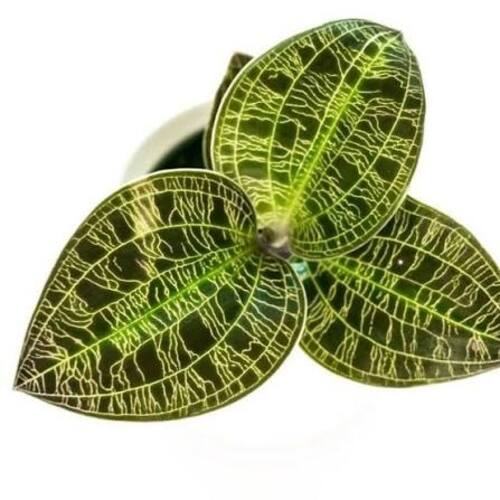
Lightning Bolt Jewel Orchid, botanically classified as Macodes petola, is a terrestrial evergreen orchid belonging to the Orchidaceae family, one of the largest and most diverse plant families in the world, though this particular species stands apart from the typical showy-flowered orchids most houseplant growers know, since it is prized almost exclusively for its foliage rather than its blooms. It is native to the humid, deeply shaded understory of tropical rainforests across Southeast Asia, including Indonesia, Malaysia, the Philippines, and Papua New Guinea, where it grows low along the forest floor in leaf litter and organic debris, an environment that has shaped its strong preference for low, filtered light, high humidity, and consistently moist, well-aerated growing conditions.
The defining feature of this species is its thick, velvety leaves, deep green to almost black in base color, overlaid with an intricate, shimmering network of gold to chartreuse veins that radiate outward in a pattern reminiscent of lightning bolts or a spider’s web, a pigmentation caused by specialized iridescent plastids within the leaf cells that reflect light rather than being a true pigment in the traditional sense. This structural coloration means the intensity and visibility of the gold veining can shift depending on the angle of viewing and the quality of ambient light, giving the foliage a dynamic, almost otherworldly quality that has made this species a favorite subject among houseplant photographers and collectors.
What makes Macodes petola especially appealing to dedicated houseplant enthusiasts is the combination of its extraordinary, jewel-like foliage, its compact terrestrial growth habit well suited to terrariums and humidity domes, and the genuine challenge it presents to growers accustomed to easier houseplants, since its need for consistently high humidity and stable warmth makes it considerably more demanding than typical foliage plants. Its relatively small size, low light tolerance compared to many other ornamental plants, and slow, creeping growth habit have made this jewel orchid an increasingly popular choice among collectors and terrarium enthusiasts seeking a genuinely unique, textural centerpiece for enclosed, humidity-controlled displays.
Caring for Lightning Bolt Jewel Orchid is considerably more demanding than caring for typical houseplants, making it a rewarding but challenging choice best suited to growers with some prior experience keeping humidity-loving terrarium or vivarium plants who can commit to consistently high humidity and stable, warm conditions. This species thrives in a loose, well-aerated, orchid-appropriate mix, low to medium indirect light rather than the bright conditions many houseplants prefer, and a watering routine that keeps the growing medium evenly and consistently moist without ever becoming waterlogged, since this terrestrial orchid is adapted to the constantly damp, humus-rich forest floor of its native habitat.
During active growth in the warmer months, Lightning Bolt Jewel Orchid benefits from gentle, filtered light, consistently moist but never soggy growing medium, very high ambient humidity ideally in the range of 60 to 80 percent or higher, and light, diluted feeding to support steady leaf production and the continued development of its gold veining pattern. Because most home environments fall far short of this species’ humidity requirements, growers typically house this plant in a closed or partially enclosed terrarium, glass cabinet, or humidity dome, where consistent moisture and air quality can be maintained far more reliably than in open room air, and occasional grooming of yellowing or spent leaves helps keep the low, spreading rosette looking tidy.
During the cooler months, watering and feeding should be reduced slightly to match the plant’s more modest growth rate, though temperature and humidity should remain relatively stable year-round rather than following a pronounced seasonal rest period, since sudden drops in either can quickly stress this sensitive species. With warm, stable temperatures, very high humidity, gentle indirect light, and a consistently moist but well-draining growing medium, Lightning Bolt Jewel Orchid rewards patient, attentive growers with an ever-expanding mat of shimmering, gold-veined foliage that becomes more impressive with each season of stable, humidity-rich care.
 Soil
Soil
Lightning Bolt Jewel Orchid requires a loose, airy, well-aerated growing medium quite different from standard potting soil, more closely resembling a fine orchid or terrarium mix rather than a chunky bark-based mix used for epiphytic orchids. A recommended mix combines fine orchid bark, sphagnum moss, perlite, and a small amount of charcoal or leaf litter, replicating the loose, organically rich, consistently damp forest floor substrate this species would naturally root into in the wild. The ideal soil pH is slightly acidic, generally between 5.5 and 6.5.
Soil composition plays a particularly significant role in this plant’s long-term health, since its relatively fine, shallow root system is vulnerable to both drying out too quickly in overly coarse mixes and suffocating in mixes that are too dense or moisture-retentive without adequate aeration. Adding extra sphagnum moss helps maintain the consistent moisture this species requires, while incorporating perlite or fine bark improves aeration and prevents the medium from compacting into a solid, poorly draining mass over time.
Common soil problems to watch for include poor drainage, which can quickly lead to root and stem rot in this moisture-sensitive species if the mix becomes waterlogged or compacted; soil compaction over time, which restricts root aeration and should be corrected with periodic refreshing of the growing medium; inappropriate pH, which can hinder nutrient uptake and weaken overall vigor; salt build-up from tap water or fertilizer residue, visible as a white crust on the medium surface and best remedied by flushing thoroughly with distilled or rain water and switching to a lower-mineral water source going forward; and nutrient deficiencies, often presenting as pale, dull foliage with reduced gold veining contrast, correctable with light, appropriately timed fertilization. Root-boundness is generally poorly tolerated by this species compared to true succulents, so periodic refreshing or division of an overcrowded specimen supports better long-term vigor.
 Fertilizer
Lightning Bolt Jewel Orchid has modest but steady fertilization needs and benefits from light feeding during its active growing months, using a balanced, water-soluble orchid fertilizer diluted to quarter strength and applied roughly every three to four weeks while the plant is actively producing new leaves. Fertilization should be reduced to roughly half this frequency during the cooler months when growth naturally slows, as heavier feeding during this period offers little benefit and can lead to salt buildup in the sensitive, fine root system. Signs of over-fertilization include browned or burnt leaf tips, a white or crusty residue on the growing medium surface, and unusually soft or discolored new growth, while under-fertilization typically presents as pale, dull foliage with noticeably reduced contrast in the gold veining pattern and a general slowing of new leaf production over successive growing seasons. Organic alternatives such as a well-diluted seaweed extract or a very dilute fish emulsion can be used during the active growing season for growers preferring a more natural approach, and because this species has a delicate root system easily damaged by mineral salt buildup, consistently light, diluted feeding generally serves this plant better than infrequent, heavier applications.
 Watering
Watering Lightning Bolt Jewel Orchid differs significantly from typical succulent-style approaches, since this terrestrial species is adapted to the consistently damp, humus-rich forest floor of its native habitat and should never be allowed to dry out completely between waterings. The growing medium should be kept evenly and consistently moist at all times, watered lightly and frequently, often every few days, rather than through a deep-soak-and-dry cycle, while still ensuring excellent drainage so the roots are never left sitting in stagnant water. Distilled water, rainwater, or reverse-osmosis water is strongly preferred over tap water for this species, since jewel orchids are particularly sensitive to the chlorine, fluoride, and mineral salts commonly found in municipal tap water, which can cause leaf tip burn and root damage over time.
Watering needs remain relatively consistent throughout the year given this species’ preference for stable, non-seasonal humidity and moisture, though slightly reduced watering frequency in cooler months can help prevent the medium from staying oversaturated when evaporation slows. Signs of overwatering or poor drainage include blackened, mushy stem tissue, foul odor from the growing medium, and leaf yellowing or drop, all of which require immediate corrective action such as improving drainage and reducing watering frequency, while signs of underwatering or insufficient humidity include shriveled, curling, or crispy leaf edges and a noticeable dulling of the gold veining pattern. Because this species tolerates neither prolonged drought nor waterlogged conditions well, maintaining even, consistent moisture through frequent light watering is the safest approach for long-term plant health.
Stop guessing. Most houseplant failures are caused by volumetric errors and improper moisture tension. Our deterministic calculator moves beyond "once-a-week" watering by analyzing the four critical pillars of root health:
Personalized for this plant
Disclaimer: Our calculator is pretty smart. We’ve crunched the numbers, but we’re not measuring the quantum state of your living room. Since we don’t know your exact indoor temperature, humidity, light, airflow, or whether your plant receives daily sweet nothings and motivational speeches, use this calculator as a guide—and always keep an eye on your plant.
 Lighting
Lightning Bolt Jewel Orchid requires low to medium, filtered light to thrive, mimicking the deeply shaded forest floor conditions it would naturally receive beneath a dense rainforest canopy, making an east-facing window well back from direct sun, or a spot with bright, indirect light inside a terrarium under supplemental grow lighting, ideal for this species. Insufficient light can cause the plant to lose some of the vividness and contrast in its gold veining pattern and slow its overall growth rate, though this species tolerates lower light levels considerably better than most houseplants, making it one of the few options suited to genuinely shaded corners or enclosed terrarium setups without strong direct light. Excessive or direct sun exposure is a significant risk for this species and can quickly scorch the delicate, velvety leaves, causing bleached, brown, or crispy patches, so this orchid should never be placed in a direct-sun window and should be shielded carefully if light levels increase unexpectedly. Because natural light in most homes is often too intense or inconsistent for this species’ needs, many growers supplement with a low-intensity, full-spectrum LED grow light positioned inside a terrarium or humidity dome, run for ten to twelve hours daily at a modest distance to provide gentle, even illumination without risking leaf burn.
 Temperature
Lightning Bolt Jewel Orchid prefers warm, consistently tropical temperatures, thriving between 65°F and 80°F (18°C to 27°C) year-round, and showing little to no benefit from any distinct cooler dormancy period, unlike many other orchids that require a winter temperature drop to trigger blooming. It has very limited cold tolerance and should be protected from temperatures below 60°F (15°C), with even brief exposure to cooler conditions potentially causing leaf damage, slowed growth, or increased susceptibility to disease, making this species unsuitable for any outdoor cultivation outside of the warmest, most humid tropical climates. The plant is notably sensitive to sudden temperature fluctuations and drafts, so it should be kept away from air conditioning vents, open windows, and doorways where cold or dry drafts of air could stress the delicate foliage, and terrarium or enclosure setups should be monitored to avoid overheating from grow lights in poorly ventilated spaces. To protect it from temperature extremes, maintain stable, warm conditions year-round within an enclosed or humidity-controlled setup rather than relying on ambient room temperature, which can fluctuate too widely for this sensitive species’ comfort.
 Humidity
Lightning Bolt Jewel Orchid requires very high humidity to thrive, ideally in the range of 60 to 80 percent or higher, directly reflecting the consistently damp, enclosed conditions of the rainforest floor where it grows natively, and this species tolerates the typically low humidity of average indoor homes quite poorly compared to most common houseplants. Low humidity quickly causes crispy, browning leaf edges, curling foliage, and a noticeable dulling or loss of contrast in the plant’s signature gold veining, while symptoms of properly high humidity include plump, glossy, richly patterned leaves and steady, healthy new growth. Because achieving and maintaining sufficiently high humidity in open room air is extremely difficult, the most effective and commonly recommended method for this species is housing it in a closed or largely enclosed terrarium, glass cabinet, or humidity dome, where consistently elevated moisture levels can be reliably sustained; pebble trays and occasional misting alone are generally insufficient and should be considered supplementary at best rather than a primary humidity strategy for this demanding species. Pairing high humidity with adequate airflow, such as an occasional small fan or brief venting inside an enclosed setup, is important to prevent the kind of stagnant, overly saturated air that can encourage fungal or bacterial issues on the plant’s delicate foliage.
 Propagation
Lightning Bolt Jewel Orchid is propagated primarily through stem division, taken from healthy, mature plants with a low, spreading, creeping growth habit, making this by far the most common and reliable method used by home growers, while propagation from seed is technically possible but extraordinarily difficult outside of sterile laboratory conditions due to the orchid family’s specialized symbiotic seed germination requirements, and is essentially never practiced by hobbyists. The best time to propagate is during the active growing season in the warmer months, when both the parent plant and new divisions establish and root most vigorously.
Compared to stem division, growing Lightning Bolt Jewel Orchid from seed is essentially impractical for home growers given the need for sterile, symbiotic fungal culture techniques required for orchid seed germination, making division the overwhelmingly preferred and more successful method. Rooted divisions typically establish as independent, actively growing plants within two to three months under suitable high-humidity conditions.
 Potting
Lightning Bolt Jewel Orchid should be planted in a small, shallow pot or terrarium container with adequate drainage, and plastic or glazed ceramic pots are often preferred over unglazed terracotta for this species, since terracotta’s porous walls can wick away moisture too quickly for a plant that requires consistently damp conditions. Shallow terrarium plantings, glass cabinets, and small humidity-controlled containers are all excellent options given the plant’s naturally low, spreading, terrestrial growth habit. Repotting or refreshing the growing medium is typically needed every twelve to eighteen months for actively growing specimens, and should be done during the warmer growing months using a fresh, loose, moisture-retentive but well-aerated mix, since the organic components of jewel orchid mixes break down and compact more quickly than bark-based mixes used for typical epiphytic orchids. Signs that repotting is needed include a soured or unpleasant smell from the medium, visibly compacted or broken-down substrate, and a noticeable decline in growth rate or leaf vigor despite otherwise appropriate care. When repotting, handle the shallow, delicate root system with particular care, since jewel orchid roots are more fragile than those of many epiphytic orchids, and light root pruning of any rotted or damaged sections can help refresh the plant, though this should be done conservatively. To minimize transplant stress, repot during active growth when possible, maintain very high humidity immediately after repotting, and avoid letting the fresh medium dry out during the plant’s adjustment period.
 Pruning
Lightning Bolt Jewel Orchid benefits from light, occasional grooming to remove yellowing or spent leaves, trim back leggy or bare sections of creeping stem, and keep the low rosette looking full and tidy over time. Grooming is best performed during the active growing season in the warmer months, when the plant recovers and produces new leaves most readily, though dead or damaged leaves can be trimmed away at any time as needed.
Use a clean, sharp pair of small precision scissors or a fine blade, sterilized with rubbing alcohol before and between cuts to reduce the risk of fungal or bacterial infection, since this species can be more susceptible to disease than tougher, more common houseplants. Work gently given the delicate, velvety texture of the leaves, and avoid handling the foliage more than necessary to prevent bruising or damaging the surface sheen that makes the gold veining so visible.
After grooming, keep the plant in its usual warm, humid, low-light location and maintain a normal watering and humidity routine, as this species does not require an extended recovery period following light trimming, though it should be monitored closely for a week or two to ensure no stress symptoms develop. Avoid heavy, drastic pruning all at once, since this delicate orchid can be slow to recover from significant tissue loss; instead, favor light, incremental grooming spread across the growing season. Regular, gentle grooming helps maintain a dense, evenly leafed mat of foliage rather than a sparse, leggy plant with bare, trailing stems.
 Blooming
Lightning Bolt Jewel Orchid can flower at almost any time of year once mature, though blooming most commonly occurs during the warmer months when the plant is actively growing and has accumulated enough energy from its distinctive foliage to support a flower spike. The blooms themselves are small, delicate, and pale in color, ranging from white to soft yellow-green, arranged along a slender upright spike, and while pleasant, they are far less visually striking than the plant’s dazzling gold-veined leaves, which remain the primary reason growers cultivate this species. Because this jewel orchid is grown almost exclusively for its foliage, many collectors choose to snip off developing flower spikes before they fully open, redirecting the plant’s limited energy back into leaf production and overall vigor rather than allowing it to flower and set seed. Flowering frequency and reliability depend heavily on plant maturity, consistent warmth, and stable humidity, with younger or stressed plants often skipping bloom periods entirely in favor of vegetative growth.
 Pests and Diseases
Name: Mealybugs
Symptoms: Cottony white masses nestled at leaf bases and along the creeping stem, often accompanied by sticky honeydew residue and weakened or discolored growth.
Treatment: Dab visible clusters with a very dilute rubbing alcohol solution on a cotton swab, then treat the plant with a gentle insecticidal soap, repeating every seven to ten days until the infestation is resolved, taking care to use reduced-strength treatments given this species’ sensitivity.
Name: Spider Mites
Symptoms: Fine webbing between leaves, stippled or dulled discoloration on the foliage, and general decline, particularly if humidity drops or air circulation is poor.
Treatment: Rinse the foliage gently with room-temperature distilled water to dislodge mites, restore high humidity and adequate air circulation, and apply a mild miticide or insecticidal soap as needed for persistent infestations.
Name: Fungus Gnats
Symptoms: Small, dark flying insects around the growing medium surface, a common issue given this species’ need for consistently moist conditions, with larvae occasionally feeding on fine roots.
Treatment: Use sticky traps to reduce the adult population, avoid overwatering beyond what is necessary for consistent moisture, and consider a thin top layer of sphagnum moss or fine grit to deter egg-laying.
Name: Scale Insects
Symptoms: Small, brown or tan, shell-like bumps along the stem and leaf undersides, accompanied by sticky residue and occasional yellowing of affected areas.
Treatment: Scrape off visible scale by hand where accessible using a soft cloth or cotton swab, and treat with a mild horticultural oil for widespread infestations.
Name: Bacterial or Fungal Leaf Spot
Symptoms: Soft, dark, water-soaked spots on the leaves that may spread rapidly in overly humid, poorly ventilated enclosures, sometimes accompanied by a foul odor.
Treatment: Remove affected leaves promptly with sterilized tools, improve air circulation within the terrarium or growing area, avoid overhead watering that leaves standing moisture on foliage, and apply a copper-based or orchid-safe fungicide if the problem persists or spreads.
Name: Stem and Root Rot
Symptoms: Blackened, mushy, or collapsing stem and root tissue, wilting or leaf drop despite otherwise adequate care, and a sour smell from the growing medium.
Treatment: Remove the plant from its medium, cut away all soft or discolored tissue using a sterilized blade, allow the remaining healthy tissue to dry briefly in a humid but airy spot, and replant in fresh, well-aerated medium, adjusting watering and drainage going forward.
Name: Crispy Leaf Edges from Low Humidity
Symptoms: Browning, curling, or crispy leaf margins, along with a noticeable dulling of the gold veining pattern, most often affecting the newest or most exposed leaves first.
Treatment: Move the plant into a properly enclosed terrarium or humidity dome if not already housed in one, and verify that humidity levels are consistently maintained in the 60 to 80 percent range or higher going forward.
 Special Features
Lightning Bolt Jewel Orchid is celebrated above all for its extraordinary foliage, deep velvety green to near-black leaves etched with an intricate network of shimmering, metallic gold to yellow-green veins that catch the light like tiny bolts of lightning, a pattern so distinctive it has made this species one of the most sought-after jewel orchids among houseplant collectors. Unlike most orchids grown primarily for their showy flowers, Macodes petola is cultivated almost entirely for this dazzling leaf pattern, which shifts subtly in intensity and color depending on the angle of light and the individual plant, making each specimen feel slightly unique. Its low, spreading, terrestrial growth habit makes it an excellent candidate for closed terrariums, bioactive vivariums, and glass cabinets where its need for consistently high humidity can be easily maintained, and its compact size and tolerance for low light compared to many other houseplants make it a fascinating choice for growers looking to move beyond typical foliage plants into the specialized, textural world of jewel orchids.
 Plant Benefits
Macodes petola has a limited history of use in traditional folk medicine in parts of Southeast Asia, where preparations from jewel orchid leaves have occasionally been used in local herbal traditions, though none of these applications have been substantiated through rigorous clinical research, and the plant should not be considered a reliable or safe source of any herbal treatment. Unlike some orchid relatives with more established ornamental or fragrance value, this species is grown almost exclusively for its extraordinary metallic-veined foliage rather than any home health application, and any interest in its chemical constituents remains largely confined to botanical or ethnobotanical curiosity rather than practical herbal use. Growers interested in the wellness or aesthetic associations sometimes attributed to houseplants may appreciate Lightning Bolt Jewel Orchid primarily for its striking visual appeal and the calming, meditative quality of tending a slow-growing terrarium specimen, rather than for any genuine pharmacological benefit.
 Additional Information
Lightning Bolt Jewel Orchid belongs to the genus Macodes, a small group of terrestrial jewel orchids native to Southeast Asia and the Pacific, closely related to and often grown alongside other jewel orchid genera such as Ludisia, Anoectochilus, and Dossinia, all of which share a similar preference for shaded, humid, terrarium-style conditions and are prized primarily for their patterned foliage rather than their flowers. The common name ‘Lightning Bolt’ draws an obvious visual comparison to the jagged, branching gold veining across the leaf surface, though growers should be aware that other Macodes and Anoectochilus species have similarly veined foliage patterns that can be confused with this species, so confirming the botanical name Macodes petola is useful when purchasing or discussing this specific plant. Because jewel orchids as a group are grown for foliage rather than flowers, care approaches often differ significantly from those used for typical epiphytic orchids like Phalaenopsis, and growers coming from a background in more common orchid types should adjust their expectations regarding light, potting media, and humidity accordingly. This species’ compact size and tolerance for shaded conditions make it a popular candidate for bioactive vivariums alongside small amphibians or invertebrates, where its low light needs and love of humidity align well with the enclosed ecosystem.
 Life Cycle
Lightning Bolt Jewel Orchid begins life as a small rooted division or, less commonly, a tissue-cultured seedling, establishing a low rosette of thick, velvety, dark green leaves etched with metallic gold veining radiating outward from a short, creeping rhizome-like stem close to the growing medium. As the plant matures, it produces new leaves in succession from the growing tip while the stem slowly creeps or trails along the surface of the potting mix, occasionally rooting at leaf nodes as it spreads, a growth habit typical of many terrestrial jewel orchids native to the forest floor. Growth is fairly continuous in warm, humid, consistently moist conditions, without a sharply defined dormant period, though growth naturally slows somewhat during the cooler, lower-light months when temperature and humidity in the home tend to drop. Individual leaves persist for many months before naturally yellowing and dying back as new growth continues from the tip, and because the plant spreads horizontally rather than forming a single permanent crown, older, leafless sections of stem can be trimmed away as the newer growth continues to lead the plant forward. With stable warmth, high humidity, and gentle indirect light maintained year-round, a mature Lightning Bolt Jewel Orchid can live and spread for many years, periodically benefiting from division to rejuvenate leggy or declining growth and to produce additional plants.
 Are Lightning Bolt Jewel Orchid Poisonous, Toxic
Macodes petola is generally considered non-toxic to cats, dogs, and humans, making it a relatively safe choice for households and terrarium setups with curious pets or young children compared to many other popular houseplants, though as with most plant material, ingestion of larger quantities can occasionally cause mild gastrointestinal upset in sensitive individuals. Symptoms, if they occur, are typically limited to mild drooling, vomiting, or diarrhea resulting from the physical irritation of ingesting plant fiber rather than any significant toxic compound, and severe reactions are uncommon with this species. If a pet or child does experience digestive upset after chewing on or ingesting plant material, monitoring for resolution of symptoms is usually sufficient, though contacting a veterinarian or pediatrician is advisable if symptoms are severe, persistent, or accompanied by other concerning signs. Because this species is most often kept inside enclosed terrariums or humidity domes, direct access by pets and children is typically limited by the enclosure itself, though it remains good general practice to discourage chewing on any houseplant material and to ensure terrarium lids or covers are secure around curious household pets.
 Frequently Asked Questions
No, Lightning Bolt Jewel Orchid is generally considered non-toxic to cats, dogs, and humans, though ingesting large amounts of plant material can occasionally cause mild digestive upset.
Dulling or loss of the gold veining pattern is usually a sign of low humidity, insufficient light, or nutrient deficiency, since this species needs consistently high humidity and gentle light to display its full coloration.
Water lightly and frequently, keeping the growing medium evenly and consistently moist at all times rather than letting it dry out between waterings, since this terrestrial orchid does not tolerate drought well.
It needs low to medium, filtered light rather than direct sun, mimicking the deeply shaded rainforest floor where it grows natively; direct sun can quickly scorch its delicate leaves.
While not strictly required, a closed or partially enclosed terrarium is strongly recommended, since this species needs very high humidity of 60 to 80 percent or more that is difficult to sustain in open room air.
It needs a loose, airy, moisture-retentive mix of fine orchid bark, sphagnum moss, and perlite, with a soil pH between 5.5 and 6.5.
The standard method is stem division, taking a healthy section of creeping stem with a few leaves and root nodes and rooting it in moist, high-humidity conditions.
Crispy, browning leaf edges are typically a sign of insufficient humidity, since this species requires consistently high ambient moisture in the 60 to 80 percent range to keep its foliage healthy.
No, it is considered an advanced-level plant due to its strict humidity, temperature, and watering requirements, making it more challenging than most common houseplants.
Blackened, mushy stem tissue is usually a sign of stem or root rot from waterlogged or poorly aerated growing medium, so it’s best to improve drainage and adjust watering frequency.
 Can I grow Lightning Bolt Jewel Orchid in my indoor space
Difficulty: Advanced
Size: Small
Light: Low
Water: Medium
Flowering: Yes
Pet Safe: Yes
Air Purifier: Low
 Macodes petola botanical details
Common Name: Lightning Bolt Jewel Orchid
Other Common Names: Jewel Orchid, Gold Vein Orchid, Golden Jewel Orchid, Macodes Orchid, Petola Orchid, Velvet Jewel Orchid (informal)
Botanical Name: Macodes petola
Native Area: Tropical rainforests of Southeast Asia, including Indonesia, Malaysia, the Philippines, Papua New Guinea, and parts of the Pacific Islands, where it grows as a low terrestrial understory plant on the deeply shaded, humid forest floor
Family Name: Orchidaceae
Plant Type: Terrestrial evergreen perennial orchid (foliage orchid)
Genus: Macodes
Kingdom: Plantae
 Photo Gallery
 My Lightning Bolt Jewel Orchid Plant Care Recommendations
If you find the Houseplant Encyclopedia helpful and would like to support Healthy Houseplants, you can use the links below to shop for recommended plants, products, and plant-care supplies.
Some links are affiliate links, which means I may earn a small commission if you make a qualifying purchase through them, at no additional cost to you. Thank you for supporting Healthy Houseplants and helping me continue to provide free plant-care information!

Want even more personalized plant-care help? Check out my AI Julie Chatbot—trained on my 20 years of houseplant knowledge, not just information from the internet!  Try it now:Ask AI Julie
 Buy Lightning Bolt Jewel Orchid Online
✅ “Bring Home This Beauty Today”
✅ “Get Your Own Lightning Bolt Jewel Orchid Before It’s Gone”
✅ “Shop Trusted Sellers – Limited Availability”
✅ “Free Delivery”
As an Amazon Associate, I earn commission from qualifying purchases.
 Plant Puns and Jokes
Why did the Lightning Bolt Jewel Orchid refuse to compete in the houseplant beauty pageant? It already knew it had the leaves striking every judge twice!
 Signup to our newsletter and download Lightning Bolt Jewel Orchid care guide

