


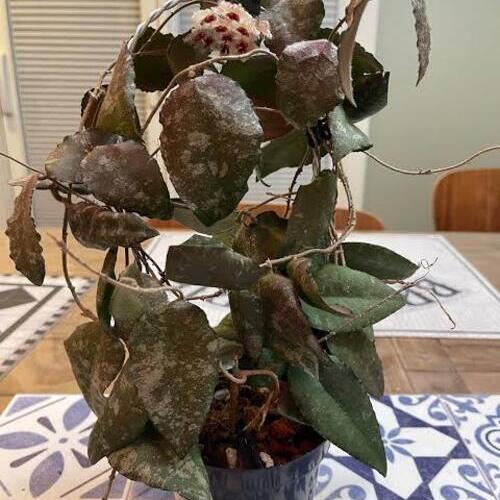
Hoya caudata, commonly known as the Wax Plant or Silver Leaves Hoya, is a climbing and trailing epiphytic vine prized by collectors for its thick, waxy, silver-mottled foliage and its fuzzy, star-shaped flowers. It belongs to the genus Hoya within the milkweed subfamily Asclepiadoideae, part of the dogbane family, Apocynaceae. The species produces thin, wiry stems only a few millimeters thick, along which adventitious roots freely develop to anchor the plant to bark, rock, or other supports as it climbs or trails in the way typical of many epiphytic Hoyas.
Hoya caudata is native to the humid lowland forests and limestone hills of Southeast Asia, with populations recorded across southern Thailand, Peninsular Malaysia, Singapore, Sumatra, and Borneo. In the wild it grows epiphytically on trees and occasionally on exposed rock faces or stream-side outcrops, often described as common within its range but never found in great abundance at any single site. This tropical lowland origin explains the plant’s preference for consistently warm temperatures, high ambient humidity, and bright but filtered light, closely mirroring the dappled conditions of a forest canopy edge rather than open, harsh sun.
The species is especially treasured for its ovate leaves, typically four to fifteen centimeters long, which are thick, leathery, and slightly rough to the touch, with a dull green or olive base color overlaid by pale grey to silvery mottling; young leaves often emerge a dull reddish brown before maturing. Under very bright light, the foliage can flush a deep red across its entire surface, adding significant seasonal and light-dependent visual variety. Its umbels of fuzzy, star-shaped, creamy white to pale yellow flowers with a dark maroon corona appear from spring through late summer on persistent spurs, rewarding patient growers with an elegant, fragrant display once the plant reaches maturity.
Caring for Hoya caudata begins with recreating the bright, filtered light and humid warmth of its native Southeast Asian forest habitat. Position the plant where it receives medium to bright indirect light for most of the day; an east-facing window, or a spot near a south or west window softened by a sheer curtain, works well, since a few hours of gentle direct morning sun can help intensify the leaf’s silvery mottling and, in brighter conditions, its reddish tones, while harsh midday or afternoon sun risks scorching the foliage. A chunky, fast-draining substrate built from orchid bark, perlite, and a smaller portion of peat moss or coco coir supports the plant’s fine, wiry root system while preventing the excess moisture retention that this species is particularly sensitive to.
Water Hoya caudata only once the top two to three inches of the potting mix have dried out, allowing the substrate to dry more thoroughly between waterings than many other tropical houseplants, since this species is notably prone to root rot in soil that stays consistently wet. Because its leaves are thick and somewhat succulent, Hoya caudata tolerates brief dry spells reasonably well, making moderate underwatering far less risky than overwatering for long-term plant health. Humidity remains important for lush growth and reliable flowering; aim for at least 50 to 60 percent using a humidifier, pebble tray, or grouping with other humidity-loving plants, though this species is somewhat more tolerant of average indoor humidity than some of its more delicate Hoya relatives.
Round out care with warm, stable temperatures roughly between 65 and 85°F (18–29°C), protecting the plant from cold drafts and sudden temperature swings, along with light, regular feeding through the active growing season. Because Hoya caudata naturally climbs or trails using its adventitious stem roots, providing a moss pole, trellis, or hanging basket allows the plant to express its natural growth habit and best showcase its mottled or reddened foliage. With patience, bright filtered light, and a more conservative watering hand than many houseplants require, Hoya caudata rewards growers with striking, ever-changing foliage and, once mature, a fragrant and unusual seasonal bloom.
 Soil
Soil
Hoya caudata does best in a light, chunky, fast-draining substrate that mimics the loose organic material and rocky crevices it would root into as an epiphyte or lithophyte in the wild. A well-suited mix combines orchid bark, perlite, and a smaller portion of peat moss or coco coir, often in roughly equal thirds of bark, perlite, and a peat- or coir-based component, with the option to add a small amount of horticultural charcoal to help keep the mix fresh and reduce the risk of root rot. This species prefers a slightly acidic pH range of about 6.0 to 6.5, which supports steady nutrient uptake without allowing salts to accumulate. Good drainage is essential, as Hoya caudata is particularly susceptible to root and stem rot in compacted or overly moisture-retentive mixes, so the substrate should dry relatively quickly and never remain soggy for extended periods. Soil problems to watch for include poor drainage from mixes that are too dense or peat-heavy, compaction over time as organic matter breaks down (requiring a refresh every 1 to 2 years), inappropriate pH from mineral-heavy tap water, salt build-up from over-fertilizing (visible as a white crust on the soil surface), nutrient deficiencies in old, depleted substrate, and root boundness, which this species tolerates reasonably well and which can even help encourage blooming, though it should not be allowed to progress to the point of restricting water and nutrient uptake.
 Fertilizer
Feed Hoya caudata with a balanced, water-soluble fertilizer diluted to half or quarter strength, applied every 4 to 6 weeks during the active growing season from spring through summer, tapering off to minimal or no feeding in fall and winter as growth slows. A fertilizer with slightly elevated phosphorus and potassium content can help support stronger, more reliable flowering once the plant reaches maturity. Signs of over-fertilization include a white, crusty salt buildup on the soil surface, browned or burnt leaf tips and edges, and stunted new growth, while under-fertilization typically shows as pale, slow, or sparse foliage growth and reduced or absent flowering over time. Organic alternatives such as diluted fish emulsion, worm castings tea, or a light compost top-dressing can offer a gentler, slow-release nutrient source, and periodically flushing the soil with plain water helps prevent salt accumulation from any fertilizing routine.
 Watering
Water Hoya caudata only once the top two to three inches of the potting mix have dried out, allowing the substrate to dry more thoroughly between waterings than is typical for many tropical houseplants, since this species is particularly prone to root rot in soil that remains consistently moist. Rainwater, distilled water, or filtered water at room temperature is preferable to hard tap water, which can leave mineral deposits over time and may stress the plant’s fine root system. Signs of underwatering include mildly wrinkled or dulled leaves, though this species tolerates brief dry spells reasonably well thanks to its thick, semi-succulent foliage; overwatering, by contrast, presents as yellowing leaves, a soft or blackened stem base, and a sour smell from the soil, indicating root rot, and is considered the far greater risk for this species. Reduce watering frequency further during the cooler, lower-light months of autumn and winter, and gradually increase it again as active growth resumes with warmer temperatures and stronger light in spring and summer.
Stop guessing. Most houseplant failures are caused by volumetric errors and improper moisture tension. Our deterministic calculator moves beyond "once-a-week" watering by analyzing the four critical pillars of root health:
Personalized for this plant
Disclaimer: Our calculator is pretty smart. We’ve crunched the numbers, but we’re not measuring the quantum state of your living room. Since we don’t know your exact indoor temperature, humidity, light, airflow, or whether your plant receives daily sweet nothings and motivational speeches, use this calculator as a guide—and always keep an eye on your plant.
 Lighting
Hoya caudata grows best in medium to bright indirect light, ideally from an east-facing window or a spot near a south- or west-facing window filtered by a sheer curtain, with a light intensity in the range of roughly 10,000 to 20,000 lux considered ideal for strong growth and coloration. A modest amount of gentle direct morning sun can intensify the silvery mottling of the leaves and, in the brightest conditions, shift the foliage toward a striking deep red. Insufficient light leads to pale, less mottled leaves, weak and sparse vining growth, and a strong reluctance to flower even in an otherwise healthy plant. Excessive or harsh direct light, particularly during the intense midday or afternoon hours, can cause bleached patches, crispy brown edges, or scorching on the thick leaves. If natural light is limited, a full-spectrum LED grow light positioned 12 to 18 inches above the plant for 10 to 12 hours daily can effectively supplement or replace sunlight, and rotating the plant periodically helps maintain even coloration and balanced growth on all sides.
 Temperature
Hoya caudata thrives within a warm temperature range of roughly 60 to 95°F (15–35°C), with an ideal steady range closer to 65 to 85°F (18–29°C) for consistent growth and flowering, reflecting its tropical lowland origins in Southeast Asia. The plant has limited cold tolerance and should be protected from temperatures below about 55°F (13°C) as well as from any frost, which it cannot survive. Sudden cold drafts, proximity to air conditioning vents, or cold windowpanes in winter can cause leaf drop, blackened foliage, or slowed growth, so keep the plant away from these stress points during cooler months. A mild, brief cool period in autumn, with nighttime temperatures dipping into the mid-50s to low 60s°F, can help encourage the following season’s blooms, though prolonged cold or heat above roughly 95°F paired with low humidity should still be avoided.
 Humidity
Hoya caudata prefers moderately high humidity, ideally in the range of 50 to 70 percent, reflecting the humid lowland forests of its native Southeast Asian range, though it is somewhat more tolerant of average indoor humidity than many of its more delicate Hoya relatives. In prolonged low-humidity environments, leaves may lose some of their glossy, waxy appearance, develop dry or curling edges, and show slowed growth, though the species generally withstands brief dips in humidity better than thinner-leaved Hoyas. Effective ways to raise humidity include using a nearby humidifier, placing the pot on a pebble tray filled with water with the pot resting above the waterline, or grouping the plant with other humidity-loving houseplants to create a supportive microclimate; a humidifier tends to be the most consistently effective method for encouraging lush growth and reliable flowering. Misting can offer a brief, minor humidity boost but is not a reliable long-term solution and should not replace more consistent humidity sources, especially since standing moisture on the fuzzy leaves and flowers can encourage fungal issues.
 Propagation
Hoya caudata propagates most reliably from stem cuttings, which generally show a notably higher success rate than seed propagation, the latter being uncommon outside specialized breeding efforts. Cuttings can root in either water or a moist perlite-sphagnum mix, with the soil-based method typically producing sturdier, more transplant-ready root systems and a smoother transition than water propagation alone, which can sometimes make the shift to soil more difficult for this species. Late spring through summer, during the plant’s most active growth period, offers the fastest and most reliable rooting and establishment.
Step-by-step guide: 1) Select a healthy stem with at least two to three leaf nodes, avoiding sections currently in bloom or bearing developing flower buds. 2) Using clean, sharp scissors or pruning shears, cut just below a node to create a cutting roughly 4 to 6 inches long. 3) Remove the lowest set of leaves to expose one or two bare nodes, which is where new roots will emerge, including from any visible aerial roots already present. 4) Optionally dip the cut end in rooting hormone to encourage faster root development. 5) Place the cutting in a jar of room-temperature water with the nodes submerged, or insert it into a moist perlite-sphagnum mix. 6) Keep the cutting in bright, indirect light with warm, humid conditions around 70–78°F. 7) Refresh water every few days if propagating in water, or keep the medium consistently moist but not saturated if using a soil-based method. 8) Expect root growth within 3 to 6 weeks, with roots reaching about an inch long indicating readiness for potting. 9) Transplant the rooted cutting into a well-draining Hoya mix, watering lightly to settle the substrate. 10) Maintain bright, indirect light and moderate to high humidity for several weeks as the new plant establishes, typically taking one to two months to show strong new growth and full establishment.
 Potting
Choose a pot only slightly larger than the current root mass, with ample drainage holes, since Hoya caudata tends to grow and flower more reliably when kept somewhat snug in its container. Because of its natural climbing or trailing habit, a hanging basket, or a pot fitted with a moss pole or small trellis, is strongly recommended so the vine can either cascade freely or climb using its adventitious stem roots. Terracotta or other porous, unglazed containers work particularly well for this rot-sensitive species, as their breathable walls help excess moisture evaporate and further reduce the risk of root rot. Repotting is typically needed every 2 to 3 years, or when roots begin emerging visibly from drainage holes, the potting mix becomes compacted or depleted, or growth stalls noticeably despite good care. When repotting, minimize disturbance to the root ball, trimming away only clearly dead or rotted roots rather than performing extensive root pruning, which this species tolerates poorly. Move the plant into its new pot with fresh, fast-draining mix, water it in lightly, and maintain familiar light and humidity conditions for a couple of weeks afterward to ease the transition with minimal transplant stress.
 Pruning
The best time to prune Hoya caudata is in late winter or early spring, just before the plant enters its active growing season, though light trimming can be done at other times of year as needed.
Pruning is used mainly to remove dead, damaged, or overly long and leggy vining stems and to encourage bushier branching, though it is not necessary to trigger flowering, since blooms arise from persistent spurs rather than fresh growth tips.
Use clean, sharp bypass pruning shears or fine scissors, sterilizing the blades with rubbing alcohol before and after use to prevent the spread of disease between plants.
Return the plant to its usual bright, indirect light location, resume its normal watering rhythm, and wait one to two weeks before fertilizing to allow the plant to recover fully from pruning.
Because Hoya caudata is sensitive to root and stem rot, avoid pruning during cool or low-light periods when the plant heals more slowly, and always wear gloves or wash hands after handling cuttings, as the milky sap can occasionally irritate sensitive skin.
 Blooming
Hoya caudata typically blooms from spring through late summer, with flowers emerging from the same permanent spurs, or peduncles, that form at the leaf axils and along older stem growth. Individual umbels bear roughly ten to twenty small, star-shaped flowers that are delightfully fuzzy to the touch, colored in creamy white to pale yellow with a contrasting dark maroon to deep red corona at the center. Each flower cluster tends to last only a few days to about a week, and the species is generally considered a shier and less frequent bloomer than many other Hoyas, often requiring several years of maturity before flowering begins. Optimal blooming is encouraged by bright, indirect to lightly filtered light, warm and stable temperatures, high humidity, and a somewhat root-bound growing environment, with a mild cool period in autumn sometimes helping to trigger the following season’s blooms.
 Pests and Diseases
Name: Mealybugs
Symptoms: Small, white, cottony clusters in leaf axils and along stems; sticky honeydew residue; yellowing or distorted new growth.
Treatment: Dab visible clusters with a cotton swab dipped in isopropyl alcohol, then treat the entire plant with insecticidal soap or neem oil every 7 to 10 days until fully resolved.
Name: Spider Mites
Symptoms: Fine webbing on the undersides of leaves, stippled or bronzed leaf discoloration, and an overall dulling of foliage, especially in dry indoor conditions.
Treatment: Increase ambient humidity, rinse foliage thoroughly with lukewarm water, and apply insecticidal soap or neem oil weekly until mites are fully eliminated.
Name: Aphids
Symptoms: Clusters of small green or black insects on new growth and flower buds, accompanied by sticky honeydew and curled or distorted young leaves.
Treatment: Rinse affected areas with a gentle stream of water to dislodge aphids, then apply insecticidal soap or neem oil every 5 to 7 days until the infestation clears.
Name: Root and Stem Rot
Symptoms: Soft, blackened roots and stem base, wilting despite moist soil, yellowing leaves, and a foul odor from the potting mix; this is the most common problem affecting the species.
Treatment: Remove the plant from its pot, trim away all rotted roots and stem tissue with sterilized scissors, repot into fresh, fast-draining mix, and significantly reduce watering frequency going forward.
Name: Fungal Leaf Spot
Symptoms: Brown or black spots, sometimes with yellow halos, scattered across leaf surfaces, typically following prolonged leaf wetness, overhead misting, or poor air circulation.
Treatment: Remove affected leaves, improve airflow around the plant, avoid wetting the foliage and flowers during watering or misting, and apply a copper-based fungicide if the spotting continues to spread.
 Special Features
Hoya caudata is best known for its striking, thick, leathery leaves, which display a distinctive silvery-grey mottling over a base of dull mid-green to olive, often tinged with brown, and take on a rough, slightly fuzzy texture on new growth. When grown in very bright light or full sun, the foliage can shift dramatically toward a deep, almost entirely red hue, giving growers a dynamic, color-changing display across the seasons. Its fragrant, fuzzy, star-shaped flowers, borne in umbels with a dark maroon corona set against pale petals, add further seasonal interest, while its wiry, freely rooting stems and natural climbing or trailing habit make it a versatile choice for hanging baskets, totems, or trellised supports where its cascading or climbing growth can be fully appreciated.
 Plant Benefits
Hoya caudata is not recognized in modern scientific or pharmaceutical literature for any significant medicinal properties, though in parts of its native Southeast Asian range, various Hoya species have a history of limited traditional topical use for minor skin complaints. No rigorous scientific research currently substantiates specific therapeutic benefits for this species, and it is best regarded and enjoyed primarily as an ornamental foliage and flowering plant rather than as a source of herbal remedy.
 Additional Information
Hoya caudata was among the later Hoya species to be formally described, and it has long been prized by collectors for the pronounced variability of its leaf mottling and coloration between individual plants and growing conditions, which has led to several named forms and cultivars, such as ‘Sumatra’ and ‘Argene’, being distinguished in cultivation. The species name caudata, meaning ‘tailed’, references the tapering, pointed tips of its leaves and floral parts. While rewarding, it is often considered a step up from beginner Hoya species due to its sensitivity to overwatering and its tendency to bloom only after reaching several years of maturity, making it a popular choice for intermediate growers seeking a distinctive, foliage-forward Hoya.
 Life Cycle
As a long-lived epiphytic perennial vine, Hoya caudata has no fixed annual life cycle and, given stable warmth and humidity, can persist and continue producing new growth for many years or even decades. Early growth centers on establishing a wiry root and stem system, with adventitious roots forming along the stem to help the plant anchor to bark, rock, or a support structure, followed by a period of vegetative vining growth as the plant lengthens and produces its characteristic mottled leaves. Maturity, and the accompanying capacity to flower reliably, is typically reached only after three to five years or more of steady growth, after which the plant settles into a recurring seasonal rhythm of active vining and leafing during the warm months and a slower semi-dormant phase in cooler, lower-light periods, with its permanent flowering spurs continuing to produce fresh umbels each season rather than being renewed from new tissue.
 Are Hoya Caudata Poisonous, Toxic
Hoya caudata is generally regarded as non-toxic to cats, dogs, and humans, including children, consistent with the ASPCA’s classification of the broader Hoya genus as pet-safe. The milky sap does not contain significant toxic compounds, though ingesting a large quantity of leaf or stem material may occasionally cause mild gastrointestinal upset such as drooling, nausea, or mild vomiting, primarily due to the plant’s fibrous texture rather than true poisoning. As with other members of the Apocynaceae family, the sap can occasionally cause mild skin irritation or contact dermatitis in sensitive individuals upon handling. If ingestion occurs and mild symptoms appear, rinse the mouth with water and offer small sips of water while monitoring closely; seek veterinary or medical attention if vomiting persists, breathing difficulty develops, or a substantial amount was consumed. As a general precaution, keep the plant out of easy reach of curious pets and young children, and wash hands after pruning or propagating to avoid transferring sap to the eyes or mouth.
 Frequently Asked Questions
Hoya caudata is considered intermediate in difficulty, mainly due to its sensitivity to overwatering and its tendency to require several years of maturity before it will reliably flower.
No, Hoya caudata is generally considered non-toxic to cats and dogs, though eating large amounts of plant material may cause mild stomach upset.
Leaves shift toward a deep red hue when the plant receives very bright light or direct sun, a natural color response that fades back toward green and silver mottling in lower light.
It prefers moderately high humidity, ideally between 50 and 70 percent, though it tolerates average indoor humidity somewhat better than many other Hoya species.
Water only once the top two to three inches of the potting mix have dried out, since this species is more prone to root rot from overwatering than to stress from occasional dryness.
Lack of blooming is often simply due to plant age, since Hoya caudata typically needs three to five years of maturity, along with bright light and a somewhat root-bound pot, before it flowers reliably.
Hoya caudata is best distinguished by its thick, leathery, silver-mottled leaves that can flush deep red in bright light, along with its fuzzy, star-shaped flowers with a dark maroon corona.
It propagates from stem cuttings with at least one leaf node, rooted in water or a moist perlite-sphagnum mix, typically taking three to six weeks to develop roots.
No, the spurs should always remain on the plant, as they are permanent structures that continue producing new flower umbels in future blooming seasons.
Hoya caudata is a vigorous vining plant that can grow quite long in its native habitat, sometimes reaching many feet, though indoor plants are typically kept more compact through trimming or trained onto a support.
 Can I grow Hoya Caudata in my indoor space
Difficulty: Intermediate
Size: Medium
Light: Medium
Water: Low
Flowering: Yes
Pet Safe: Yes
Air Purifier: Low
 Hoya caudata botanical details
Common Name: Hoya Caudata
Other Common Names: Wax Plant, Silver Leaves Hoya, Fuzzy Caudata, Hoya Caudata Sumatra
Botanical Name: Hoya caudata
Native Area: Southeast Asia, including southern Thailand, Peninsular Malaysia, Singapore, Sumatra, and Borneo
Family Name: Apocynaceae
Plant Type: Epiphytic perennial vine
Genus: Hoya
Kingdom: Plantae
 Photo Gallery
 My Hoya Caudata Plant Care Recommendations
If you find the Houseplant Encyclopedia helpful and would like to support Healthy Houseplants, you can use the links below to shop for recommended plants, products, and plant-care supplies.
Some links are affiliate links, which means I may earn a small commission if you make a qualifying purchase through them, at no additional cost to you. Thank you for supporting Healthy Houseplants and helping me continue to provide free plant-care information!

Want even more personalized plant-care help? Check out my AI Julie Chatbot—trained on my 20 years of houseplant knowledge, not just information from the internet!  Try it now:Ask AI Julie
 Buy Hoya Caudata Online
✅ “Bring Home This Beauty Today”
✅ “Get Your Own Hoya Caudata Before It’s Gone”
✅ “Shop Trusted Sellers – Limited Availability”
✅ “Free Delivery”
As an Amazon Associate, I earn commission from qualifying purchases.
 Plant Puns and Jokes
Why did Hoya caudata get invited to every houseplant party? Because it always knew how to change its colors to match the mood of the room.
 Signup to our newsletter and download Hoya Caudata care guide

