


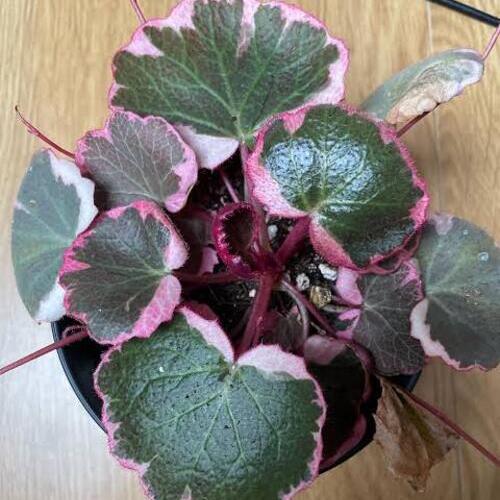
Saxifraga stolonifera, widely known as Strawberry Begonia or Creeping Saxifrage, is a low-growing, mat-forming herbaceous perennial valued for its rounded, silver-veined, fuzzy-textured leaves and its habit of producing cascading runners tipped with small plantlets. Despite its common name, the plant is neither a true begonia nor related to the strawberry, with the nickname arising instead from the way its trailing runners and small offset plantlets visually echo the growth habit of a strawberry plant. It belongs to the genus Saxifraga, part of the family Saxifragaceae, a large group of mostly rock-garden and alpine plants, of which Saxifraga stolonifera is among the most popular for indoor cultivation.
Strawberry Begonia is native to East Asia, including China, Japan, and Korea, where it naturally occurs in shaded, moist mountain forest habitats, often carpeting damp rock crevices and forest floors beneath the tree canopy. This origin in cool, humid, dappled-light understories explains the plant’s preference for bright but indirect light, consistently moist yet well-drained soil, and a distinct cooler rest period in winter that closely mirrors the seasonal temperature shifts of its native mountainous range. In East Asian herbal tradition, the plant has a long history of use in folk remedies, and it remains a well-loved ornamental groundcover and houseplant across many temperate and subtropical regions today.
The species is especially treasured for its foliage: rounded to kidney-shaped leaves with scalloped edges, marked by a network of pale, silvery veins over an olive to deep green base, and covered in a fine layer of soft hairs that give the leaves a velvety texture. From the base of the rosette, the plant sends out numerous thin, reddish, thread-like stolons that root readily wherever they touch soil and form new plantlets at their tips, creating the plant’s signature cascading, self-propagating display that has made it a longstanding favorite for hanging baskets, terrariums, and shaded rock gardens alike.
Caring for Strawberry Begonia begins with recreating the cool, bright, and consistently moist conditions of its native mountain forest floor. Position the plant where it receives bright, indirect light for most of the day; a north- or east-facing window, or a spot a few feet back from a south- or west-facing window, works well, since this species tolerates a bit of gentle morning or late-afternoon direct sun but can scorch under intense midday exposure. A well-draining potting mix rich in organic matter, such as a standard potting soil amended with peat-free compost and perlite, provides the moisture retention and aeration this shallow-rooted species needs to thrive without becoming waterlogged.
Water Strawberry Begonia when the top inch of soil has begun to feel dry, keeping the soil lightly and consistently moist rather than allowing it to dry out completely, since this species is notably more sensitive to drought stress than to brief periods of extra moisture, though standing water and soggy soil should still always be avoided to prevent basal rot. Because its fuzzy leaves are prone to fungal spotting when they stay wet, water at the soil level rather than overhead, and allow any splashed foliage to dry quickly in good airflow. Moderate humidity suits this species well; while it adapts reasonably comfortably to average indoor humidity, an occasional light misting or placement near a humidifier can help during particularly dry winter months when indoor heating lowers ambient moisture.
Round out its care with a distinct cooler winter rest period, ideally around 50 to 55°F (10–13°C), which supports the plant’s natural dormancy cycle and can encourage more reliable flowering the following spring, along with light, regular feeding during the active growing season. Because of its trailing, runner-producing habit, a hanging basket or an elevated shelf lets the cascading stolons and plantlets be fully appreciated, and any runners that sprawl too far can simply be trimmed back or potted up as new plants. With bright indirect light, attentive but moderate watering, and a cool winter rest, Strawberry Begonia rewards even beginner growers with easy, low-maintenance charm and an ever-expanding trail of miniature plantlets to share or repot.
 Soil
Soil
Strawberry Begonia prefers a well-draining potting mix rich in organic matter, with a standard potting soil amended with peat-free compost and perlite offering the moisture retention and aeration this shallow-rooted species needs. This species does well across a fairly wide, slightly acidic to neutral pH range of roughly 6.0 to 7.0, supporting steady nutrient uptake without allowing salts to accumulate. Good drainage is important, as prolonged waterlogging can lead to basal and root rot, though the soil should still retain enough moisture to prevent the shallow, fibrous root system from drying out too quickly between waterings. Soil problems to watch for include poor drainage from mixes that are too dense or compacted, compaction over time as organic matter breaks down (requiring a refresh every 1 to 2 years), inappropriate pH from mineral-heavy tap water, salt build-up from over-fertilizing (seen as a white crust on the soil surface), nutrient deficiencies in old, depleted substrate, and root boundness, which this vigorously spreading species tolerates well and which is rarely a significant concern given how readily it produces new plantlets via runners.
 Fertilizer
Feed Strawberry Begonia with a balanced, water-soluble fertilizer diluted to half strength, applied every 4 to 6 weeks during the active growing season from spring through summer, tapering off to minimal or no feeding in fall and winter as growth slows and the plant enters its cooler rest period. A standard balanced formula suits this species well, without any strong requirement for specialized nutrient ratios. Signs of over-fertilization include a white, crusty salt buildup on the soil surface, browned or burnt leaf tips and edges, and stunted new growth, while under-fertilization typically shows as pale, slow-growing foliage and reduced runner or plantlet production over time. Organic alternatives such as diluted fish emulsion, worm castings tea, or a light compost top-dressing can offer a gentler, slow-release nutrient source, and periodically flushing the soil with plain water helps prevent salt accumulation from any fertilizing routine.
 Watering
Water Strawberry Begonia when the top inch of the potting mix has begun to feel dry, keeping the soil lightly and consistently moist rather than allowing it to dry out completely, since this species is notably more prone to stress and leaf loss from underwatering than from brief periods of extra moisture, though standing water should always be avoided. Rainwater, distilled water, or filtered water at room temperature is preferable to hard tap water, which can leave mineral deposits over time and may stress the plant’s fine root system. Signs of underwatering include crisping, browning leaf edges, stolon or plantlet dieback, and an overall droopy appearance, while overwatering presents as yellowing leaves, a soft or blackened base, and basal rot, which, though less common than drought stress in this species, can still prove fatal if left unaddressed. Reduce watering frequency moderately during the cooler winter dormant period, and increase it again as active growth resumes with warmer temperatures and stronger light in spring and summer.
Stop guessing. Most houseplant failures are caused by volumetric errors and improper moisture tension. Our deterministic calculator moves beyond "once-a-week" watering by analyzing the four critical pillars of root health:
Personalized for this plant
Disclaimer: Our calculator is pretty smart. We’ve crunched the numbers, but we’re not measuring the quantum state of your living room. Since we don’t know your exact indoor temperature, humidity, light, airflow, or whether your plant receives daily sweet nothings and motivational speeches, use this calculator as a guide—and always keep an eye on your plant.
 Lighting
Strawberry Begonia grows best in bright, indirect light, ideally from a north- or east-facing window, or a spot set back a few feet from a south- or west-facing window, since this species tolerates a modest amount of gentle direct morning or late-afternoon sun but is prone to scorching under intense midday exposure. Insufficient light leads to leggy, sparse growth, faded or less distinctly veined leaves, and a marked reluctance to flower even in an otherwise healthy plant. Excessive or harsh direct light, particularly during peak midday hours, causes bleached patches, crispy brown edges, or scorch marks on the fuzzy, delicate foliage. If natural light is limited, a full-spectrum LED grow light positioned 12 to 18 inches above the plant for 10 to 12 hours daily can effectively supplement or replace sunlight, and rotating the plant periodically helps maintain even, balanced growth across the rosette.
 Temperature
Strawberry Begonia thrives within a moderate temperature range of about 60 to 75°F (16–24°C) during active growth, and it notably benefits from a cooler winter rest period of roughly 50 to 55°F (10–13°C), which supports its natural dormancy cycle and can encourage more reliable flowering the following spring. The plant has reasonably good cold tolerance for a houseplant and can be grown outdoors in USDA hardiness zones 6 through 9, though it should still be protected from hard frost and freezing temperatures when grown as a container plant. Sudden cold drafts, proximity to heating vents, or cold windowpanes in winter can cause leaf browning or slowed growth, so keep the plant away from these stress points. In summer, this species tolerates warm temperatures reasonably well, though prolonged heat above the mid-80s°F paired with intense direct sun should be avoided to prevent leaf scorch and stress.
 Humidity
Strawberry Begonia adapts comfortably to moderate humidity levels typical of most indoor environments, generally in the range of 40 to 60 percent, though it appreciates a boost during particularly dry winter months when indoor heating lowers ambient moisture. In low-humidity conditions, leaves may develop dry, crispy edges and a duller overall appearance, though this species is considerably more tolerant of average indoor dryness than many other fuzzy-leaved houseplants. Effective ways to raise humidity include placing the pot on a pebble tray filled with water with the pot resting above the waterline, using a nearby humidifier, or grouping the plant with other humidity-loving houseplants to create a supportive microclimate. Because the leaves are fuzzy and prone to fungal spotting when they stay wet, misting should be used sparingly and only in bright, well-ventilated conditions that allow the foliage to dry quickly, making a humidifier or pebble tray generally the more reliable and lower-risk choice for this species.
 Propagation
Strawberry Begonia propagates most easily and reliably via its naturally occurring plantlets, which form at the tips of thin runners, or stolons, making this by far the most successful and beginner-friendly method compared to division of the main rosette or propagation from seed, the latter being slow and uncommon in home cultivation. Plantlets can be rooted either while still attached to the parent plant or after being separated, with both approaches showing high success rates thanks to the plantlets often already having small root initials forming at their base. Spring through summer, during the plant’s most active growth period, offers the fastest and most reliable rooting and establishment, though propagation can be attempted with reasonable success at other times of year indoors.
Step-by-step guide: 1) Identify a healthy plantlet at the end of a runner, ideally one that already shows small root buds forming at its base. 2) If propagating while still attached, simply place the plantlet in a small pot of moist potting mix or a container of water, keeping it connected to the parent plant via the runner until it roots. 3) Alternatively, snip the runner about an inch from the plantlet using clean, sharp scissors to separate it from the parent plant. 4) Place the separated plantlet in a small pot of moist, well-draining potting mix, or in a jar of room-temperature water if rooting hydroponically. 5) Keep the plantlet in bright, indirect light with consistently moist (not soggy) conditions. 6) Refresh water every few days if propagating in water, or keep the soil evenly moist if using a soil-based method. 7) Expect visible root growth and new leaf development within 2 to 4 weeks under good conditions. 8) Once the plantlet shows signs of active new growth and, if rooted in water, has developed roots about an inch long, transplant it into a well-draining potting mix if not already there. 9) Water lightly to settle the substrate and continue providing bright, indirect light. 10) Maintain consistent moisture and bright indirect light for several weeks as the new plant establishes, typically taking three to six weeks to show strong new growth and full establishment.
 Potting
Choose a pot only slightly larger than the current root mass, with ample drainage holes, since Strawberry Begonia has a shallow, spreading root system that does not require deep or oversized containers. Because of its trailing, runner-producing habit, a hanging basket or an elevated shelf is strongly recommended so the cascading stolons and plantlets can spill gracefully over the container’s edge and be fully appreciated. Terracotta or other porous, unglazed containers work well, as their breathable walls help excess moisture evaporate and further reduce the risk of basal or root rot. Repotting is typically needed every 2 to 3 years, or when roots begin emerging visibly from drainage holes, the potting mix becomes compacted or depleted, or the rosette outgrows its current container. When repotting, minimize disturbance to the shallow root ball, trimming away only clearly dead or rotted roots rather than performing extensive root pruning, which is rarely necessary for this vigorous, easy-to-grow species. Move the plant into its new pot with fresh mix, water it in lightly, and maintain familiar light and moisture conditions for a couple of weeks afterward to ease the transition with minimal transplant stress.
 Pruning
The best time to prune Strawberry Begonia is in spring or early summer, at the start of the active growing season, though light trimming of runners or spent flower stalks can be done at any time as needed.
Pruning is used mainly to control the spread of unruly or overly long runners, remove faded flower stalks after blooming, and tidy up damaged or yellowing leaves, helping keep the plant compact and encouraging fuller rosette growth.
Use clean, sharp scissors or fine pruning snips, sterilizing the blades with rubbing alcohol before and after use to prevent the spread of disease between plants.
Return the plant to its usual bright, indirect light location, resume regular watering, and hold off on fertilizing for one to two weeks to allow the plant to recover fully from pruning.
Because Strawberry Begonia spreads readily and can become leggy or crowded if left untrimmed, regular light maintenance pruning throughout the growing season helps maintain an attractive, well-proportioned shape, and any removed plantlets can easily be propagated into new plants rather than discarded.
 Blooming
Strawberry Begonia typically blooms in late spring to early summer, though indoor plants often skip flowering altogether without the seasonal light and temperature cues found outdoors. When blooms appear, they rise on tall, slender, wiry flower stalks well above the foliage, each carrying loose, airy panicles of small, delicate flowers with unevenly sized petals, usually white to pale pink, giving them an asymmetrical, almost star-like appearance. The floral display can last two to three weeks, and while individual flowers are unscented, a mass of blooms floating above the rounded leaves creates a striking, cloud-like effect in the garden or on a well-lit windowsill. Optimal blooming is encouraged by bright, indirect to lightly filtered light, a distinct cooler winter rest period, and consistent moisture, with plants grown outdoors in cooler climates flowering more reliably than those kept as houseplants.
 Pests and Diseases
Name: Aphids
Symptoms: Clusters of small green or black insects on new growth and flower stalks, accompanied by sticky honeydew and curled or distorted young leaves.
Treatment: Rinse affected areas with a gentle stream of water to dislodge aphids, then apply insecticidal soap or neem oil every 5 to 7 days until the infestation clears.
Name: Spider Mites
Symptoms: Fine webbing on the undersides of leaves, stippled or bronzed leaf discoloration, and an overall dulling of foliage, especially in dry indoor conditions.
Treatment: Increase ambient humidity, rinse foliage thoroughly with lukewarm water, and apply insecticidal soap or neem oil weekly until mites are fully eliminated.
Name: Mealybugs
Symptoms: Small, white, cottony clusters in leaf axils and along stolons; sticky honeydew residue; yellowing or distorted new growth.
Treatment: Dab visible clusters with a cotton swab dipped in isopropyl alcohol, then treat the entire plant with insecticidal soap or neem oil every 7 to 10 days until fully resolved.
Name: Basal or Root Rot
Symptoms: Soft, blackened tissue at the base of the rosette or roots, wilting despite moist soil, yellowing leaves, and a foul odor from the potting mix.
Treatment: Remove the plant from its pot, trim away all rotted roots and affected basal tissue with sterilized scissors, repot into fresh, well-draining mix, and reduce watering frequency going forward.
Name: Fungal Leaf Spot
Symptoms: Brown or black spots, sometimes with a fuzzy or powdery appearance, scattered across the leaf surfaces, typically following prolonged leaf wetness or poor air circulation, to which this species’ hairy foliage is particularly prone.
Treatment: Remove affected leaves, improve airflow around the plant, water at the soil level rather than overhead to keep foliage dry, and apply a copper-based fungicide if the spotting continues to spread.
 Special Features
Strawberry Begonia is prized above all for its charming, rounded, olive-green leaves marked with striking silvery veining and softly fuzzy, textured surfaces, paired with a naturally cascading habit created by its many thin, wire-like runners that dangle downward and produce small plantlets at their tips, much like the runners of an actual strawberry plant. This trailing, self-propagating growth habit makes it an ideal candidate for hanging baskets, elevated shelves, or as an easy-care groundcover in shaded garden beds, since the plantlets can simply be allowed to spill over the container’s edge or be potted up as new plants. Variegated cultivars, most notably ‘Tricolor’, add further visual interest with pink- and cream-edged foliage, while the plant’s airy, asymmetrical white to pale pink flower panicles offer a light, ornamental seasonal bloom that rises delicately above the foliage on tall, slender stalks.
 Plant Benefits
Saxifraga stolonifera has a long history of traditional use in East Asian herbal medicine, where its leaves have historically been applied in poultices and folk remedies valued for purported antibacterial and anti-inflammatory properties, and the plant is referenced in historical Chinese herbal texts. However, modern scientific research has not rigorously validated these traditional therapeutic claims, and the raw plant is understood to contain mild irritant compounds, so it should not be used as a home remedy or ingested. Strawberry Begonia is best appreciated today primarily as an easy-care, ornamental foliage and flowering plant rather than as a source of reliable herbal treatment.
 Additional Information
Despite its common name, Strawberry Begonia is unrelated to both true begonias and strawberries; the name instead reflects the way its cascading runners and small plantlets resemble the growth pattern of a strawberry plant, while its rounded leaves loosely echo the shape of begonia foliage. In parts of East Asia, the plant carries the traditional name ‘Tiger-Ear Grass’, referencing the fuzzy, rounded shape of its leaves, and it has a long history in traditional Chinese herbal medicine, including mentions in historical materia medica texts, though this use is folkloric rather than clinically validated. Its ease of care, tolerance of a range of indoor conditions, and prolific self-propagation via stolons have made it a long-standing favorite for beginner gardeners, terrarium enthusiasts, and anyone looking for an easy, ever-multiplying trailing houseplant.
 Life Cycle
Saxifraga stolonifera is a low-growing herbaceous perennial that persists indefinitely under suitable conditions, spreading and renewing itself through a continuous cycle of runner, or stolon, production rather than relying solely on a single central rosette. Growth begins with a compact basal rosette of rounded, fuzzy leaves, from which the plant sends out thin, wiry, thread-like stolons that root and form new plantlets at their tips, allowing the plant to colonize surrounding space and effectively rejuvenate itself as older rosettes decline. Flowering, when it occurs, typically follows a period of cooler temperatures during winter dormancy, with the plant putting on its most active vegetative growth and stolon production in spring and summer before flowering in late spring to early summer and then entering a slower, semi-dormant resting phase as temperatures drop in autumn and winter.
 Are Strawberry Begonia Poisonous, Toxic
Saxifraga stolonifera is widely regarded as non-toxic to cats, dogs, and humans, including children, and is commonly listed by sources such as the ASPCA as a pet-safe plant suitable for households with curious animals. While some sources note that the raw plant may contain mild irritant compounds and advise against ingestion, no significant or severe toxic effects are documented, and eating a large quantity of leaf material may at most cause mild, temporary gastrointestinal upset such as nausea or mild stomach discomfort. As with many fuzzy-leaved plants, the leaf hairs can occasionally cause mild skin irritation in sensitive individuals upon handling, though this is uncommon. If ingestion occurs and mild symptoms appear, rinse the mouth with water and offer small sips of water while monitoring closely; seek veterinary or medical attention if symptoms persist or worsen. As a general precaution, it is still wise to keep any houseplant out of easy reach of pets and young children prone to chewing on foliage, and to wash hands after handling or pruning the plant.
 Frequently Asked Questions
Yes, Strawberry Begonia is considered an easy, beginner-friendly houseplant, tolerating a range of light conditions and requiring only moderate, consistent watering to thrive.
No, Strawberry Begonia is widely considered non-toxic to cats and dogs, making it a popular choice for pet-friendly households.
No, despite its common name, Strawberry Begonia is neither a true begonia nor related to strawberries; the name comes from its strawberry-like trailing runners and begonia-like leaf shape.
It grows best in bright, indirect light, though it also tolerates partial shade, and should be protected from intense direct midday sun, which can scorch its fuzzy leaves.
Water when the top inch of soil feels dry, keeping the soil lightly and consistently moist, since this species is more sensitive to drought stress than to brief periods of extra moisture.
Many indoor Strawberry Begonias simply don’t flower without a distinct cooler winter rest period, so providing temperatures around 50 to 55°F in winter can help encourage blooming the following spring.
It propagates easily from the small plantlets that form at the tips of its runners, which can be rooted in soil or water either while attached to the parent plant or after being separated.
Crisping, browning leaf edges are most often a sign of underwatering or low humidity, so check that the soil isn’t drying out too much between waterings and consider boosting ambient humidity.
Yes, it can be grown outdoors in USDA hardiness zones 6 through 9 as a shade-loving groundcover, particularly in cool, moist, rocky, or woodland garden settings.
Strawberry Begonia is a small, compact plant, typically staying around 6 to 8 inches tall, though its trailing runners can extend well beyond the base rosette as it spreads.
 Can I grow Strawberry Begonia in my indoor space
Difficulty: Easy
Size: Small
Light: Medium
Water: Medium
Flowering: Yes
Pet Safe: Yes
Air Purifier: Medium
 Saxifraga stolonifera botanical details
Common Name: Strawberry Begonia
Other Common Names: Creeping Saxifrage, Strawberry Saxifrage, Mother of Thousands, Strawberry Geranium, Tiger-Ear Grass
Botanical Name: Saxifraga stolonifera
Native Area: East Asia, including China, Japan, and Korea, where it grows in rocky, shaded, and moist mountain forest habitats
Family Name: Saxifragaceae
Plant Type: Herbaceous perennial groundcover/trailing plant
Genus: Saxifraga
Kingdom: Plantae
 Photo Gallery
 My Strawberry Begonia Plant Care Recommendations
If you find the Houseplant Encyclopedia helpful and would like to support Healthy Houseplants, you can use the links below to shop for recommended plants, products, and plant-care supplies.
Some links are affiliate links, which means I may earn a small commission if you make a qualifying purchase through them, at no additional cost to you. Thank you for supporting Healthy Houseplants and helping me continue to provide free plant-care information!

Want even more personalized plant-care help? Check out my AI Julie Chatbot—trained on my 20 years of houseplant knowledge, not just information from the internet!  Try it now:Ask AI Julie
 Buy Strawberry Begonia Online
✅ “Bring Home This Beauty Today”
✅ “Get Your Own Strawberry Begonia Before It’s Gone”
✅ “Shop Trusted Sellers – Limited Availability”
✅ “Free Delivery”
As an Amazon Associate, I earn commission from qualifying purchases.
 Plant Puns and Jokes
Why did the Strawberry Begonia refuse to enter any fruit or flower competitions? Because judges could never agree on which category it actually belonged in.
 Signup to our newsletter and download Strawberry Begonia care guide

