


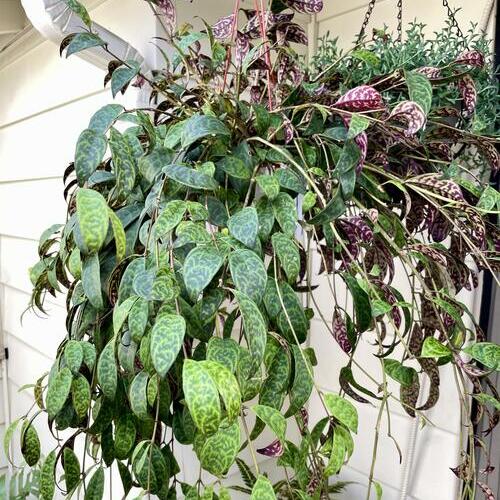
The Black Pagoda Lipstick Plant, botanically known as Aeschynanthus longicaulis, is a striking trailing epiphyte prized for its dramatically patterned foliage and vivid tubular red-orange flowers that emerge from near-black, waxy calyxes resembling small tubes of lipstick, the trait that gives the broader Aeschynanthus genus its common name. The thick, glossy leaves are marked with an intricate mottling of dark green, deep burgundy, and near-black patterning along a paler green background, giving the plant a moody, exotic appearance quite distinct from the more uniformly green leaves of its better-known relative, the common lipstick vine (Aeschynanthus radicans). Its long, cascading stems can reach several feet in length as they mature, making it a superb choice for hanging baskets, elevated shelves, or mounted displays where its trailing habit and dark-hued foliage can be fully appreciated.
Native to the humid tropical rainforests of Southeast Asia, particularly regions of Borneo, Malaysia, and Indonesia, this species grows naturally as an epiphyte, anchoring itself to tree bark and branches high in the rainforest canopy rather than rooting in soil. This epiphytic origin explains its preference for chunky, fast-draining growing media, its tolerance of brief dry spells between waterings, and its need for warm temperatures and elevated humidity that mimic the canopy environment. In its native habitat, it receives dappled, filtered sunlight through the surrounding foliage rather than direct, harsh sun, and its roots are adapted to absorb moisture and nutrients from air, rainfall, and decaying organic debris that collects around its perch.
As a member of the Gesneriaceae family, the Black Pagoda Lipstick Plant is related to African violets and other gesneriads, and it shares their fondness for warmth, humidity, and bright but indirect light. It is considered a moderate grower under good conditions, with mature specimens developing long, richly foliaged trailing stems capable of producing recurring flushes of its dramatic tubular blooms throughout the warmer months. Its combination of unusual dark foliage patterning and vivid flowers has made it an increasingly sought-after specimen among collectors of rare and unusual houseplants.
Caring for the Black Pagoda Lipstick Plant requires a bit more attentiveness than many common houseplants, but it is well within reach of an intermediate-level grower willing to replicate its epiphytic, tropical origins. The plant does best in bright, indirect light; while it can tolerate some gentle morning direct sun, harsh afternoon sun should be avoided as it can scorch the delicate, patterned leaves and inhibit blooming if light is too intense or too dim. A spot near an east-facing window, or a few feet back from a bright south or west-facing window, generally offers the right balance.
Watering should follow a ‘moderate and rhythmic’ approach: allow the top inch of the growing medium to dry out between waterings, then water thoroughly, letting excess drain away completely, since this species dislikes sitting in soggy conditions given its epiphytic, fast-draining native substrate. Because it is sensitive to mineral buildup and chlorine, filtered, distilled, or rainwater is strongly preferred over hard tap water, especially for maintaining healthy, richly colored foliage. Humidity is one of the most important factors for this species; levels below 50 percent can lead to crisping leaf edges, bud drop, and reduced flowering, so regular humidity support through pebble trays, grouping, or a humidifier is highly beneficial.
Beyond light, water, and humidity, the Black Pagoda Lipstick Plant thrives in warm temperatures between 65 and 85°F (18–29°C) and appreciates a chunky, well-aerated potting mix similar to that used for orchids or other epiphytes. Regular light feeding during the active growing season supports its vigorous trailing growth and encourages repeated flushes of its striking tubular flowers, while a period of reduced watering and feeding in cooler months helps the plant rest and can even encourage more prolific blooming when growth resumes in spring.
 Soil
Soil
The Black Pagoda Lipstick Plant, being naturally epiphytic, requires a chunky, fast-draining, and highly aerated growing medium rather than a dense, moisture-retentive potting soil. A mix combining standard potting soil with orchid bark, perlite, and coarse coconut coir husk chips closely mimics the loose, airy substrate it would encounter clinging to tree bark in the wild. A slightly acidic pH range of about 5.5 to 6.5 supports healthy nutrient uptake and root function.
Excellent drainage is essential, as this species’ epiphytic roots are highly prone to rot in compacted or consistently soggy media. Adding extra orchid bark or perlite improves airflow around the roots and helps prevent compaction over time. Soil problems to watch for include poor drainage (leading to root rot and wilting despite moist soil), compaction (which suffocates the fine epiphytic root system), inappropriate pH (which can restrict nutrient absorption and cause pale or yellowing foliage), salt build-up from tap water or fertilizer residue (visible as a white crust on the soil surface or brown leaf edges), and nutrient deficiencies (often appearing as reduced vigor or dull, faded leaf coloration). Because this species has a relatively shallow, fibrous root system, root-boundness is less common than in many houseplants, but a densely packed root mass filling the pot is still a sign that fresh, chunky medium and a slightly larger container are due.
 Fertilizer
During the active growing season of spring and summer, the Black Pagoda Lipstick Plant benefits from feeding every two to four weeks with a balanced, water-soluble fertilizer formulated for flowering houseplants, diluted to about half the label’s recommended strength. Feeding should be significantly reduced or paused entirely during fall and winter, when the plant’s growth slows and its nutrient demands drop accordingly. A fertilizer with a slightly higher phosphorus content can help encourage more abundant and vivid flowering during peak growing months.
Signs of over-fertilization include browned, crispy leaf margins, a visible white crust of salt buildup on the soil surface, and stunted or oddly distorted new growth. Under-fertilization, by contrast, typically presents as pale or dull foliage coloration, reduced patterning intensity, and sparse or absent flowering over an extended period. Organic alternatives such as diluted fish emulsion, seaweed extract, or compost tea can serve as gentler, slow-release nutrient sources well suited to this species’ relatively sensitive root system. This plant has no unusual nutrient requirements beyond standard balanced feeding practices tailored to flowering tropical houseplants.
 Watering
Water the Black Pagoda Lipstick Plant once the top inch of the growing medium has dried out, then water thoroughly until excess moisture drains freely from the pot’s base. During the active growing season in spring and summer, this generally translates to watering every 5 to 9 days, while in fall and winter the interval should be extended to roughly every 10 to 14 days as growth slows. Filtered, distilled, or rainwater is strongly preferred, as this species is notably sensitive to the chlorine, fluoride, and dissolved salts commonly present in tap water, which can cause leaf tip browning and reduced vigor over time.
Signs of underwatering include shriveled or limp leaves, dry and crisp stem tips, and premature flower or bud drop. Overwatering, in contrast, typically manifests as yellowing leaves, a mushy or blackened stem base, and a musty smell from the growing medium, all of which can signal the onset of root rot in this rot-prone epiphyte. Because its watering needs shift meaningfully with the seasons and its fast-draining substrate dries more quickly than standard potting soil, checking the medium’s moisture level by touch before watering, rather than adhering to a fixed schedule, is the most reliable approach for this species.
Stop guessing. Most houseplant failures are caused by volumetric errors and improper moisture tension. Our deterministic calculator moves beyond "once-a-week" watering by analyzing the four critical pillars of root health:
Personalized for this plant
Disclaimer: Our calculator is pretty smart. We’ve crunched the numbers, but we’re not measuring the quantum state of your living room. Since we don’t know your exact indoor temperature, humidity, light, airflow, or whether your plant receives daily sweet nothings and motivational speeches, use this calculator as a guide—and always keep an eye on your plant.
 Lighting
Bright, indirect light is essential for the Black Pagoda Lipstick Plant to maintain its rich foliage coloration and to produce its signature tubular blooms. A spot near an east-facing window offering gentle morning sun, or a few feet back from a bright south- or west-facing window, typically provides the ideal intensity. Some filtered or dappled direct sun can be tolerated and may even encourage more vivid leaf patterning and flowering, but harsh, prolonged direct sun, especially in the afternoon, should be avoided.
Signs of insufficient light include leggy, sparse stem growth, fading or washed-out leaf patterning, and a marked reduction or complete absence of flowering. Excessive or overly intense direct light exposure, on the other hand, can cause bleached patches, scorched leaf tips, or crispy brown edges on the foliage. If natural light is limited, a sheer curtain can help diffuse overly strong sun, while a full-spectrum grow light positioned 12 to 18 inches above the plant for about 10 to 12 hours daily can effectively supplement natural light and support healthy growth and blooming.
 Temperature
The Black Pagoda Lipstick Plant thrives within a temperature range of 65 to 85°F (18–29°C), consistent with its warm, tropical rainforest origins. It has limited cold tolerance and should be protected from temperatures below 60°F (15°C), as cold exposure can cause leaf drop, blackened stem tips, and significant setbacks in growth. The plant should be kept well away from cold drafts, frequently opened doorways, and air conditioning vents, since abrupt temperature swings can stress it considerably.
While it handles normal indoor temperature variation reasonably well, it has no frost tolerance whatsoever and must never be exposed to freezing conditions. In warm climates, it can be grown outdoors in shaded, wind-protected locations during the warmer months, but it should be brought indoors well before nighttime temperatures begin to dip in autumn. Keeping the plant away from both heating vents in winter and overly cold, drafty spots year-round, while maintaining warm and stable conditions, will best support its trailing growth and flowering potential.
 Humidity
The Black Pagoda Lipstick Plant strongly prefers elevated humidity levels, ideally between 60 and 80 percent, reflecting the consistently moist canopy environment of its native rainforest habitat. In typical indoor conditions, especially during winter when heating systems dry the air considerably, the plant may exhibit signs of humidity stress such as crisping or browning leaf edges, curling foliage, and noticeably reduced or absent flowering.
To raise humidity, a pebble tray filled with water positioned beneath the pot (keeping the pot itself elevated above the waterline) offers a modest, localized boost. Clustering this plant among other humidity-loving species creates a beneficial shared microclimate through combined transpiration. A humidifier, however, is by far the most effective and reliable solution for maintaining the consistently high humidity this species needs, particularly in dry climates or centrally heated homes. Occasional misting can offer brief, temporary relief but is considerably less effective than sustained ambient humidity and should be done in the morning to allow foliage to dry before evening, reducing the risk of fungal issues. Because high humidity paired with stagnant air can encourage fungal problems on this species’ dense, patterned foliage, gentle air circulation from a small fan is a valuable complement to humidity-boosting efforts.
 Propagation
The Black Pagoda Lipstick Plant is most commonly and successfully propagated through stem cuttings taken from healthy, non-flowering sections of trailing stems. This method offers considerably higher success rates and faster establishment compared to less common techniques like layering or seed propagation, which are rarely used by home growers due to inconsistent results and slow growth.
Step-by-step stem cutting guide:
1. Select a healthy, non-flowering stem and cut a 4 to 6 inch section just below a leaf node using clean, sharp scissors.
2. Remove the lower one or two sets of leaves, leaving at least two to three leaves at the top of the cutting.
3. Allow the cut end to callus slightly for about an hour in a dry, shaded spot, which can help reduce the risk of rot.
4. Dip the cut end in rooting hormone powder or gel, if desired, to encourage faster root development.
5. Insert the cutting into a small pot filled with a moist, well-draining mix of perlite and peat, or place it in a glass of filtered water to root.
6. Place the cutting in bright, indirect light and maintain warm temperatures around 70 to 80°F (21–27°C).
7. Keep the growing medium consistently moist (or refresh water weekly if rooting in water) and maintain elevated humidity using a humidity dome or plastic bag loosely tented over the cutting.
8. Roots typically begin developing within 3 to 5 weeks; once a healthy root system of an inch or more has formed, transplant the cutting into a chunky, well-draining potting mix.
Stem cutting propagation has a high success rate under warm, humid conditions, typically 75 to 90 percent, with new plants generally establishing and producing visible new growth within 6 to 10 weeks. Late spring through summer is the best time to propagate, as the parent plant’s active growth phase supports faster rooting and establishment.
 Potting
The Black Pagoda Lipstick Plant does best in a pot with generous drainage holes, ideally an unglazed terracotta or a hanging basket that supports its natural trailing habit while allowing excess moisture to escape readily. A chunky, orchid-like potting mix, as described in the soil section, paired with a container only slightly larger than the current root mass, prevents excess moisture retention that could harm this rot-prone epiphyte. Repotting every one to two years is generally adequate, or sooner if the growing medium has broken down and become overly dense.
Signs that repotting is needed include a densely tangled root mass filling the pot, water draining through too quickly without being absorbed, or visibly declining vigor despite otherwise consistent care. When repotting, gently loosen the root ball and trim away any blackened, mushy, or clearly dead roots with sterilized scissors before placing the plant into fresh medium. Choose a new pot only one size larger than the previous one to avoid excess moisture retention in oversized containers. After repotting, water lightly, maintain elevated humidity, and keep the plant in a warm, stable location out of direct sun for one to two weeks to help it recover from transplant stress with minimal setback.
 Pruning
Prune the Black Pagoda Lipstick Plant primarily in late winter or early spring before the main growing season begins, though light grooming to remove spent flowers or damaged foliage can be done throughout the year as needed.
Pruning encourages bushier, fuller growth, prevents overly leggy or sparse trailing stems, removes spent or fading flowers to redirect the plant’s energy, and helps control the plant’s overall size and shape.
Clean, sharp scissors or pruning shears sterilized with rubbing alcohol before and after each use to prevent the spread of disease.
Water lightly if the growing medium is dry, maintain warm temperatures and elevated humidity, and avoid fertilizing immediately after a significant pruning session to allow the plant time to recover.
Avoid removing more than one-third of the plant’s total growth in a single pruning session to prevent excessive stress and support a strong recovery.
 Blooming
The Black Pagoda Lipstick Plant blooms most prolifically from late spring through summer, though under favorable warm, bright, and humid conditions it may produce intermittent flushes of flowers throughout much of the year. Each bloom emerges from a distinctive near-black, waxy calyx that resembles a small closed lipstick tube, from which a vivid tubular red-orange flower eventually extends. Individual flowers typically last several days to about a week, while a healthy, mature plant can produce successive waves of blooms over several weeks per flush, particularly when given a period of slightly cooler, drier rest in winter followed by a return to warmer, brighter, and more consistently moist conditions in spring.
 Pests and Diseases
Name: Mealybugs
Symptoms: Small, cottony white clusters at leaf axils and along stems, sticky honeydew residue on leaves and nearby surfaces.
Treatment: Dab visible clusters with rubbing alcohol on a cotton swab, then treat the entire plant with insecticidal soap or neem oil, repeating every 7 to 10 days until fully resolved.
Name: Aphids
Symptoms: Clusters of small green or black insects concentrated on new growth and flower buds, curling or distorted young leaves.
Treatment: Rinse affected areas with a strong stream of water, then apply insecticidal soap, repeating as needed until the infestation clears.
Name: Spider Mites
Symptoms: Fine webbing between leaves and stems, tiny yellow or bronze speckling on leaf surfaces, overall dulling of foliage color.
Treatment: Increase humidity, rinse leaves thoroughly with water, and treat with insecticidal soap or neem oil every 7 to 10 days until mites are eliminated.
Name: Root Rot
Symptoms: Wilting despite moist soil, yellowing leaves, blackened and mushy stem base, foul odor from the growing medium.
Treatment: Remove the plant from its pot, trim away all blackened or mushy roots and stem tissue, and repot into fresh, fast-draining medium; reduce watering frequency going forward.
Name: Botrytis (Gray Mold)
Symptoms: Fuzzy gray mold on flowers, buds, or damaged foliage, particularly in cool, humid, poorly ventilated conditions.
Treatment: Remove and dispose of all affected plant material, improve air circulation around the plant, avoid overhead watering, and apply a fungicide if the problem persists.
 Special Features
The Black Pagoda Lipstick Plant’s most striking feature is its dramatically patterned foliage, marked with deep burgundy and near-black mottling against a green backdrop, paired with vivid tubular red-orange flowers that emerge from unusual, near-black waxy calyxes resembling small lipstick tubes, giving the species both its common name and its distinctive, moody visual appeal. Its naturally trailing, epiphytic growth habit makes it especially well suited to hanging baskets and elevated displays, where its cascading stems and unusual leaf patterning can be shown off to full effect. Beyond its ornamental value, the plant is generally considered safe around pets and children, and its repeated flowering flushes throughout the warmer months provide extended seasonal interest that few other trailing houseplants can match, making it a coveted specimen among collectors of unusual and richly patterned tropical foliage plants.
 Plant Benefits
The Black Pagoda Lipstick Plant is grown almost exclusively for its ornamental value and does not have well-documented herbal, medicinal, or pharmaceutical applications. Unlike some other tropical species used in traditional remedies, no components of this particular Aeschynanthus cultivar are known to be used therapeutically, and the plant should not be ingested for any purpose.
 Additional Information
The Black Pagoda cultivar is considered one of the more visually dramatic and sought-after members of the Aeschynanthus genus due to its unusually dark, richly mottled foliage, which distinguishes it from the more commonly available solid-green lipstick vine varieties found in general retail settings. Because of its somewhat more specific humidity and drainage requirements compared to its more forgiving relatives, it is often recommended for growers with some prior experience in tropical or epiphytic plant care, and it is more frequently found through specialty growers, plant collectors, or online marketplaces than in general big-box retail stores.
 Life Cycle
The Black Pagoda Lipstick Plant is a trailing, epiphytic perennial that establishes itself from a compact root mass and gradually develops long, cascading stems clothed in richly patterned foliage. In its early stages, young plants focus energy on establishing a root system and producing initial foliage growth before beginning to trail and lengthen significantly. As the plant matures, typically within one to two years under good conditions, it begins producing recurring flushes of tubular flowers from near-black calyxes during the warmer growing months, with older, well-established specimens flowering more prolifically and consistently than younger plants. With appropriate warmth, humidity, and light, this species can live and continue trailing and blooming for many years indoors, periodically benefiting from pruning to maintain fullness and from propagation via stem cuttings to produce fresh, vigorous new plants.
 Are Black Pagoda Lipstick Plant Poisonous, Toxic
The Black Pagoda Lipstick Plant is generally considered non-toxic to cats, dogs, and children, making it a comparatively pet- and family-friendly choice among tropical flowering houseplants. While ingestion of any houseplant material can occasionally cause mild, transient gastrointestinal upset such as drooling, mild vomiting, or stomach discomfort due to plant fibers and compounds irritating the digestive tract, no serious or specific toxic reactions have been documented for this species. Symptoms, if they occur at all, are typically mild and self-limiting.
If a pet or child does ingest plant material and shows signs of discomfort, offering water and monitoring for any worsening symptoms is generally sufficient; however, a veterinarian or pediatrician should be contacted if vomiting, diarrhea, or discomfort persists or worsens. As with any houseplant, it is still good practice to discourage chewing on foliage and to keep hanging or trailing specimens positioned where curious pets cannot easily access dangling stems, both to protect the plant from damage and to minimize any unnecessary ingestion.
 Frequently Asked Questions
Yes, the Black Pagoda Lipstick Plant is generally considered non-toxic to cats and dogs, with only mild stomach upset possible if ingested in quantity.
Lack of flowering is usually caused by insufficient light, low humidity, or a lack of a cooler winter rest period before the growing season.
It needs bright, indirect light, tolerating gentle morning sun but requiring protection from harsh afternoon direct sun.
Water when the top inch of soil dries out, typically every 5 to 9 days during active growth in spring and summer.
It prefers elevated humidity between 60 and 80 percent, closer to its native rainforest canopy environment.
It is most easily propagated from stem cuttings rooted in moist perlite-peat mix or water during the warmer growing months.
Brown, crispy leaf edges are typically caused by low humidity, mineral buildup from tap water, or inconsistent watering.
It needs a chunky, fast-draining mix similar to orchid potting media, since it grows naturally as an epiphyte.
It is considered an intermediate-level plant due to its specific humidity and drainage needs compared to more common houseplants.
It is a medium-sized trailing plant whose cascading stems can reach several feet in length as it matures.
 Can I grow Black Pagoda Lipstick Plant in my indoor space
Difficulty: Intermediate
Size: Medium
Light: Medium
Water: Medium
Flowering: Yes
Pet Safe: Yes
Air Purifier: Low
 Aeschynanthus longicaulis botanical details
Common Name: Black Pagoda Lipstick Plant
Other Common Names: Lipstick Vine, Black Pagoda Aeschynanthus, Longicaulis Lipstick Plant
Botanical Name: Aeschynanthus longicaulis
Native Area: Tropical rainforests of Southeast Asia, including Borneo, Malaysia, and Indonesia
Family Name: Gesneriaceae
Plant Type: Epiphytic trailing perennial
Genus: Aeschynanthus
Kingdom: Plantae
 Photo Gallery
 My Black Pagoda Lipstick Plant Plant Care Recommendations
If you find the Houseplant Encyclopedia helpful and would like to support Healthy Houseplants, you can use the links below to shop for recommended plants, products, and plant-care supplies.
Some links are affiliate links, which means I may earn a small commission if you make a qualifying purchase through them, at no additional cost to you. Thank you for supporting Healthy Houseplants and helping me continue to provide free plant-care information!

Want even more personalized plant-care help? Check out my AI Julie Chatbot—trained on my 20 years of houseplant knowledge, not just information from the internet!  Try it now:Ask AI Julie
 Buy Black Pagoda Lipstick Plant Online
✅ “Bring Home This Beauty Today”
✅ “Get Your Own Black Pagoda Lipstick Plant Before It’s Gone”
✅ “Shop Trusted Sellers – Limited Availability”
✅ “Free Delivery”
As an Amazon Associate, I earn commission from qualifying purchases.
 Plant Puns and Jokes
Why did the Black Pagoda Lipstick Plant refuse to enter the beauty pageant? It didn’t need the extra shade of drama, it already had a killer look and its own signature color!
 Signup to our newsletter and download Black Pagoda Lipstick Plant care guide

