


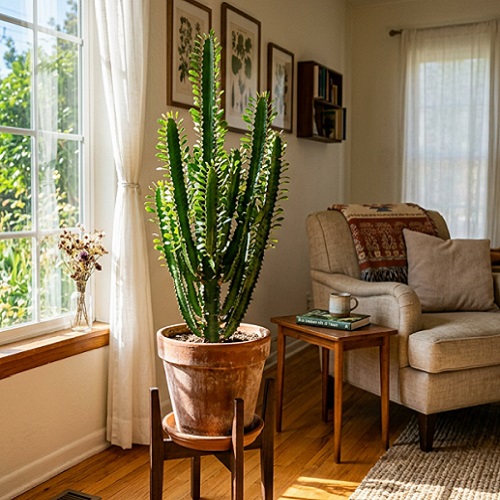
Euphorbia trigona, commonly known as the African Milk Tree, is a dramatic and architecturally striking succulent shrub native to Central Africa, particularly West Africa and the region encompassing present-day Cameroon and Gabon. Despite its common names — Cathedral Cactus and Candelabra Cactus — it is not a true cactus at all, but rather a member of the large and diverse Euphorbiaceae family. It represents a compelling example of convergent evolution, having independently developed a cactus-like columnar form, spines, and drought-adapted physiology in response to the same arid and semi-arid environmental pressures that shaped the cacti of the Americas. In its native habitat, it grows in dry, rocky, well-drained soils and open woodland environments, where it can reach heights of 6–9 feet (1.8–2.7 metres) or more.
The most immediately recognisable feature of Euphorbia trigona is its boldly three-angled (trigonal) columnar stems, which grow in a strongly upright habit and branch profusely from the main central trunk to create a candelabra-like silhouette. Each of the three prominent ribs bears paired thorns (technically modified stipules rather than true spines) and small, bright green or burgundy-red teardrop-shaped leaves that emerge along the ridges. These deciduous leaves are a key distinguishing feature separating Euphorbia trigona from true cacti, which bear no true leaves. The ruby-red cultivar, commonly sold under the name ‘Rubra’ or ‘Royal Red’, is among the most sought-after ornamental forms, displaying deep burgundy-red stems and foliage that intensifies in colour under bright light and slight drought stress.
Like all members of the Euphorbia genus, Euphorbia trigona produces a highly toxic milky white latex sap — the origin of its ‘Milk Tree’ common name — that oozes freely from any cut, broken, or damaged stem. This latex is a significant and serious hazard, causing severe skin and eye irritation and, if ingested, intense gastrointestinal distress. Despite this toxicity, the plant has historically been used in traditional African medicine, and in some cultures the sap has been applied externally for specific purposes, though this must never be attempted without expert guidance. Indoors, Euphorbia trigona serves primarily as a spectacular architectural statement plant, valued for its imposing vertical form, drought tolerance, and low maintenance requirements.
Caring for Euphorbia trigona is straightforward and well-suited to busy or less attentive plant owners, making it one of the most rewarding large succulent houseplants available. Its fundamental requirements mirror the conditions of its native Central African habitat: maximum bright light, infrequent watering, excellent drainage, and warm temperatures year-round. When these core conditions are consistently provided, the African Milk Tree grows with impressive vigour, adding several inches of height per season and developing the bold, branching candelabra form that makes it such a commanding indoor and outdoor specimen.
The single most important aspect of African Milk Tree care is strict adherence to a drought-tolerant watering regime. Euphorbia trigona is highly susceptible to root rot caused by overwatering, and the consequences of excessive moisture are severe and often fatal. The correct approach is to water thoroughly only when the soil has dried out completely — typically every 2–3 weeks in summer and as infrequently as once per month or less in winter. The potting medium must be extremely well-draining: a dedicated cactus and succulent mix, ideally further amended with additional perlite or grit, is essential. This species will tolerate periods of complete drought far better than it tolerates any persistent soil moisture.
Handling Euphorbia trigona safely requires consistent awareness of its toxic latex sap. Always wear nitrile gloves and eye protection when pruning, propagating, or repotting, as the white sap is released from the slightest wound and can cause serious skin and eye irritation within moments of contact. Keep the plant well away from children and pets at all times. Beyond this important safety consideration, the African Milk Tree is an exceptionally low-maintenance plant that requires minimal fertilization, no humidity supplementation, tolerates a wide range of indoor temperatures, and rarely suffers from significant pest or disease problems when its basic care requirements are met.
 Soil
Soil
Euphorbia trigona demands an extremely well-draining, porous, low-fertility soil that closely mimics the dry, rocky substrates of its native Central African habitat. The correct soil is arguably the single most critical factor in the long-term health of this plant. Standard multipurpose or tropical potting mix retains far too much moisture for this species and will almost inevitably lead to root rot if used without significant amendment.
The ideal potting medium consists of 50–60% coarse horticultural grit, perlite, or pumice combined with 40–50% quality cactus and succulent potting mix. Alternatively, a 50/50 blend of coarse sharp sand (horticultural grade, not builders’ sand) and standard cactus mix provides excellent drainage. The mix should feel gritty and loose, draining water almost instantaneously when poured.
Optimal soil pH is between 6.0 and 7.0 (slightly acidic to neutral). This range supports adequate nutrient availability without promoting conditions favourable to root pathogens. Strongly acidic soils (below pH 5.5) may cause micronutrient toxicity, while alkaline conditions (above pH 7.5) can lock out iron and manganese.
Drainage is the absolute non-negotiable requirement for this species. Water must flow freely and completely through the root zone within seconds of application. Any soil that remains damp for more than 24–48 hours after watering represents an unacceptable rot risk. Drainage holes in the pot are mandatory.
Horticultural charcoal added to the mix at approximately 10% by volume helps maintain a sweet, well-aerated root environment and inhibits anaerobic bacterial activity. A thin layer of coarse gravel or perlite over the soil surface helps prevent moisture accumulation at the stem base, which is a common rot initiation site in columnar euphorbias.
The most serious and common soil problem for Euphorbia trigona. Waterlogged soil deprives roots of oxygen and provides ideal conditions for Pythium and Phytophthora root rot pathogens. Symptoms include stem blackening at the base, soft mushy tissue, and sudden plant collapse. Solution: repot immediately into a fast-draining mix with additional grit or perlite.
Over time, fine organic particles in the mix break down and compact, reducing pore space and drainage capacity. Signs include water pooling on the soil surface before absorption. Solution: repot into fresh, gritty mix every 2–3 years regardless of whether the plant is root-bound.
Alkaline soil (pH above 7.5) is commonly caused by hard tap water with high mineral content and can cause chlorosis and nutrient lock-out. Use rainwater or filtered water where possible, and check soil pH annually.
Regular use of tap water and synthetic fertilizers accumulates mineral salts in the soil over time, manifesting as white surface deposits and potentially causing fertilizer burn on shallow roots. Flush the soil thoroughly with clean water every 2–3 months and always use fertilizer at half-strength or less.
Euphorbia trigona is a low-nutrient-demand species and genuine nutrient deficiencies are rare in regularly repotted plants. Pale, washed-out colouring in the ‘Rubra’ cultivar or unusually slow growth may occasionally indicate a need for light fertilization during the growing season.
Unlike many houseplants, Euphorbia trigona tolerates and even benefits from being slightly root-bound, as root restriction helps moderate growth rate and reduces overwatering risk. Repot only when roots are visibly emerging from drainage holes or the plant has become dangerously unstable and top-heavy.
 Fertilizer
Euphorbia trigona is a low-nutrient-demand species that requires only light, infrequent fertilization during its active growing season. Over-fertilization is a more common and damaging error than under-fertilization with this species, producing weak, sappy, etiolated growth and increasing susceptibility to pest and disease problems. Less is definitively more when it comes to feeding this plant.
A balanced, water-soluble cactus and succulent fertilizer with an NPK ratio of approximately 5-10-5 or similar low-nitrogen formula, diluted to one-quarter or one-half of the label-recommended strength, is ideal. Low-nitrogen formulations are preferred as excess nitrogen promotes the soft, lush growth that is most susceptible to rot and structural weakness in columnar euphorbias.
Apply dilute fertilizer once per month during the active growing season (April through September). Withhold all fertilization from October through March during the winter rest period.
Always water the plant thoroughly before applying fertilizer to avoid root burn on dry roots. Apply the dilute fertilizer solution evenly across the soil surface, ensuring it penetrates to the root zone. Never apply fertilizer to a newly repotted plant — wait at least 6–8 weeks.
Unusually soft, pale, rapidly growing stem tissue that lacks structural strength; excessive etiolation and stretching; increased susceptibility to stem rot; white salt crust on the soil surface; yellowing or browning of stem tissue in severe cases.
Pale, washed-out stem and leaf colouring; very slow growth even during the active growing season in a plant that has been in the same potting mix for several years without repotting. Nutrient deficiency is rare in recently repotted plants.
A very light top-dressing of worm castings applied once at the beginning of the growing season provides a gentle, slow-release source of balanced nutrients with minimal burn risk and microbial benefits. Diluted liquid seaweed extract (at quarter strength) can be applied monthly as a gentle micronutrient supplement.
Phosphorus and potassium are more important for the long-term structural integrity and root health of Euphorbia trigona than nitrogen. A fertilizer formula with relatively low nitrogen and higher phosphorus and potassium values is preferable to standard high-nitrogen foliage fertilizers.
 Watering
Euphorbia trigona is a drought-adapted succulent that requires a strictly conservative, ‘less is more’ approach to watering. Its succulent stems store significant water reserves, allowing it to tolerate extended dry periods without any stress. The correct watering method is to water deeply and thoroughly when the soil has dried out completely throughout the entire pot depth, then withhold all water until complete dryness is confirmed again before the next watering.
During the active growing season (spring through early autumn), water approximately every 2–3 weeks, but always check that the top 2–3 inches (5–7 cm) of soil are completely dry before watering. This plant prefers a drying period between waterings, which helps prevent root rot.
During autumn and winter dormancy, significantly reduce watering. In most cases, watering once per month or less is sufficient. If the plant is kept in a cool environment below 60°F (15°C), watering can often be withheld entirely, as the plant’s metabolic activity slows dramatically.
Because this plant stores water within its tissues, it is much more tolerant of underwatering than overwatering. In cultivation, it is generally safer to water too little rather than too much.
Euphorbia trigona is moderately sensitive to the fluoride and chlorine present in municipal tap water, which can cause marginal leaf browning over time. Rainwater or filtered water is preferred. If using tap water, allow it to stand overnight to off-gas chlorine before applying. Hard, mineral-rich tap water contributes to salt build-up in the soil and should be flushed periodically.
Shrivelling, wrinkling, or softening of the stems (indicating depleted internal water reserves); premature leaf drop; dulling of the normally glossy stem surface; very slow growth. Note: these symptoms resolve quickly after thorough watering.
Soft, discoloured, or blackened stem sections — particularly at the base; yellowing and mushy tissue; a foul odour from the soil; fungus gnats around the soil surface; plant instability and wobbling at the base (indicating root loss). Overwatering symptoms are far more serious than underwatering symptoms and often irreversible.
During winter, particularly if temperatures drop below 60°F (15°C), watering should be reduced to an absolute minimum — once every 4–6 weeks or even less. The plant enters a semi-dormant state and its water requirements fall dramatically. Resuming more frequent watering in spring should be done gradually as temperatures warm and active growth resumes.
Stop guessing. Most houseplant failures are caused by volumetric errors and improper moisture tension. Our deterministic calculator moves beyond "once-a-week" watering by analyzing the four critical pillars of root health:
Personalized for this plant
Disclaimer: Our calculator is pretty smart. We’ve crunched the numbers, but we’re not measuring the quantum state of your living room. Since we don’t know your exact indoor temperature, humidity, light, airflow, or whether your plant receives daily sweet nothings and motivational speeches, use this calculator as a guide—and always keep an eye on your plant.
 Lighting
Euphorbia trigona is a high-light species that thrives in the brightest possible indoor location. It performs best in a south- or west-facing window receiving 4–6 or more hours of direct sun daily, combined with bright ambient indirect light throughout the day. Ideal light levels are between 2,000 and 5,000 foot-candles. In its native habitat, this plant grows in full open sun, and the more light it receives indoors, the more vigorous, compact, and richly coloured its growth will be.
While Euphorbia trigona will survive in medium indirect light (500–1,500 foot-candles), growth will slow significantly and the architectural form will become progressively etiolated and weak. The ‘Rubra’ cultivar’s characteristic deep burgundy-red colouration requires intense bright light to develop fully and will fade to plain green in insufficient light.
Etiolated, thin, pale green new growth that leans strongly toward the light source; significant stretching and loss of the compact, upright branching form; loss of the deep red/burgundy colouration in the ‘Rubra’ cultivar; reduced or absent leaf production; very slow growth rate.
In rare cases of extreme, direct sun exposure during the hottest part of summer — particularly through glass that magnifies heat — the plant may develop bleached, white, or yellowed patches on the sun-exposed faces of the stems. This is more likely in plants moved suddenly from lower light to intense direct sun without gradual acclimatisation.
If natural light is insufficient, supplement with a high-output full-spectrum LED grow light providing at least 2,000 foot-candles intensity, running 12–14 hours per day. Position the grow light 12–18 inches above the plant. When moving an indoor-grown plant to outdoor sun, acclimatise it gradually over 2–3 weeks by starting in shade and progressively increasing sun exposure to prevent sun scald.
 Temperature
Euphorbia trigona thrives at temperatures between 60°F and 85°F (15°C–29°C). It performs best in consistently warm conditions and is well-suited to the temperature range of most indoor environments.
This species is cold-sensitive and cannot tolerate frost or sustained temperatures below 50°F (10°C). Brief exposure to temperatures in the 45–55°F (7–13°C) range may cause temporary stress but is usually survivable. Temperatures below 40°F (4°C) will cause irreversible cold damage, manifesting as blackened, sunken, water-soaked stem patches that collapse rapidly.
Euphorbia trigona handles high temperatures well, particularly when well-ventilated and in bright light. It tolerates temperatures up to 95°F (35°C) without significant stress provided it is not overwatered during heat spells. Extreme heat combined with drought may cause temporary leaf drop, which is a normal protective response.
This species tolerates moderate temperature fluctuations better than most tropical houseplants, provided temperatures do not approach the cold damage threshold. It does not require the temperature consistency demanded by tropical aroids. However, cold drafts from windows or air conditioning vents during winter should be avoided.
In regions experiencing mild frost risk, move outdoor-grown specimens indoors before temperatures drop below 50°F (10°C). In winter, keep the plant away from cold, single-pane windows and avoid positioning it near exterior doorways. Never allow the plant to remain outdoors during cold, wet weather, as the combination of cold and moisture is particularly damaging.
 Humidity
Euphorbia trigona is native to semi-arid environments and prefers low to average humidity levels of 20–50%. It is perfectly adapted to the dry conditions typical of most indoor environments and requires no humidity supplementation whatsoever. This makes it particularly well-suited to centrally heated homes during winter, where humidity levels commonly drop to 20–30%.
Euphorbia trigona does not display significant stress symptoms at low humidity levels within normal indoor ranges. Extremely low humidity (below 15%) sustained over long periods may cause minor leaf edge desiccation, but this is rarely observed in typical indoor environments.
High ambient humidity above 70–80%, particularly combined with poor air circulation and cool temperatures, significantly increases the risk of fungal stem rots, basal rot, and the development of sooty mould on honeydew deposits from any pest infestations. Symptoms include soft, water-soaked stem patches and surface mould growth.
Not recommended or necessary for this species. Running a humidifier near Euphorbia trigona is actively counterproductive and increases rot risk.
Never mist Euphorbia trigona. Wetting the stem surfaces in low-airflow conditions promotes fungal disease and is completely unnecessary for this drought-adapted species.
Not recommended. Additional localised humidity around the pot is unhelpful for this species.
If the plant is grown in a naturally humid environment (greenhouse, bathroom, or humid tropical climate), ensure excellent air circulation using fans, maintain a very well-draining potting medium, water even more conservatively than usual, and consider positioning the plant in the driest, most ventilated available location.
 Propagation
Euphorbia trigona is propagated almost exclusively from stem cuttings, which root with reasonable reliability when handled correctly. The process requires careful attention to latex management — the toxic milky sap must be stopped from flowing before the cutting is set to root, or it will form a sticky plug that prevents callous formation and rooting. The best time to propagate is in spring or early summer when temperatures are warm and the plant is in active growth.
CRITICAL: Always wear thick nitrile gloves and safety goggles throughout the entire propagation process. The latex sap is highly toxic and causes severe skin and eye injury. Have soap, water, and an eyewash solution immediately accessible before beginning.
Success Rate: Moderate to High (65–85%) when correctly executed
Description: The standard and most reliable method for propagating Euphorbia trigona. Sections of healthy stem are severed, latex flow is arrested, the cut end is calloused, and the cutting is then rooted in dry, well-draining substrate.
Steps:
Spring through early summer (April–June) when warm temperatures accelerate both callousing and root development. Propagation attempts in autumn or winter have significantly lower success rates due to reduced temperature and the plant’s reduced metabolic activity.
Under optimal warm conditions (above 72°F / 22°C), cuttings typically develop sufficient roots to sustain independent growth within 6–12 weeks from cutting.
 Potting
Terracotta pots are strongly preferred for Euphorbia trigona due to their porous walls, which allow excess moisture to evaporate from the sides and significantly reduce root rot risk. Heavy terracotta also provides essential ballast against the plant’s top-heavy candelabra form. Plastic pots retain too much moisture and are not recommended. For large, mature specimens, heavy ceramic or concrete planters provide the stability necessary to prevent toppling.
Drainage holes are absolutely mandatory. A layer of coarse grit or broken terracotta shards at the base of the pot may provide a small additional drainage buffer. The pot must never be allowed to sit in a saucer holding standing water.
Choose a pot only 1–2 inches larger in diameter than the current root ball. Overpotting — placing the plant in an excessively large container — causes the surrounding soil volume to remain moist long after the roots have absorbed available water, dramatically increasing root rot risk. Euphorbia trigona tolerates and benefits from a degree of root restriction.
Every 2–3 years in spring, or when roots are visibly emerging from drainage holes or the plant has become dangerously unstable. This species does not need to be repotted as frequently as faster-growing tropical houseplants.
Roots emerging visibly and densely from drainage holes; plant becoming top-heavy and unstable, tipping in its pot; soil drying out extremely rapidly after watering (indicating the root mass has displaced most of the soil); visible stunting of growth despite adequate light and seasonal fertilization.
SAFETY FIRST: wear thick nitrile gloves and safety goggles throughout. Allow the soil to dry completely for 1–2 weeks before repotting to firm the root ball and reduce latex flow. Carefully tip the plant from its current pot, loosening the root ball gently. Inspect roots and trim any dead, rotted, or damaged roots with sterile scissors. Allow any cut root surfaces to dry briefly before repotting. Place fresh gritty cactus mix in the new pot, position the plant at the same depth as previously, fill in around the root ball, and firm gently. Do not water for at least 1 week after repotting to allow any root wounds to callous.
Root pruning is not routinely practised with Euphorbia trigona and is not recommended. The potential for latex exposure during root pruning and the associated injury risk to the root system outweigh any benefit. If the plant has become severely root-bound, simply repot into the next appropriate size of pot.
After repotting, withhold water for 7–10 days and keep the plant in moderate indirect light rather than full sun for 2 weeks to minimise stress on any disturbed roots. Resume normal care gradually once the plant shows signs of continued active growth.
 Pruning
Pruning Euphorbia trigona is performed primarily to control height and spread, remove damaged or diseased stem sections, shape the candelabra form, or collect cuttings for propagation. Unlike many houseplants, this species does not require pruning for health maintenance — unpruned specimens simply continue to grow upward and branch naturally. Pruning is therefore an elective management tool rather than an essential care task. The most critical aspect of all pruning operations is comprehensive personal safety protection due to the highly toxic latex sap.
Prune in spring or early summer when the plant is entering its active growth phase. Pruning during this period promotes the fastest healing and regrowth from cut nodes. Avoid pruning in autumn or winter when the plant’s reduced metabolic activity slows wound healing and increases infection risk.
Prune only when necessary — to limit height, remove damaged stems, or collect propagation material. There is no routine annual pruning requirement for this species. The plant’s natural branching habit produces an attractive architectural form without intervention.
Height and spread control; removal of dead, damaged, or diseased stem sections; shaping the candelabra form; stimulating additional lateral branching; and collecting healthy stem cuttings for propagation.
A sharp, clean knife or bypass pruning shears sterilized with 70% isopropyl alcohol. Thick nitrile gloves (latex gloves alone are insufficient — the euphorbia latex may penetrate thin latex). Safety goggles or a full face shield. Old clothing or an apron that can be laundered immediately after. Cold water and soap immediately accessible.
After pruning, keep the plant out of direct intense sun for 1–2 weeks to minimise stress on the fresh wounds. Withhold watering for 5–7 days after pruning to allow cut surfaces on the parent plant to fully callous. Monitor the cut sites over the following weeks for any signs of softening, discolouration, or rot, and address any such issues promptly.
Never prune Euphorbia trigona without full eye and skin protection — the consequences of latex exposure are severe and may be irreversible in the case of ocular contact. If latex contacts the eyes despite precautions, begin emergency eye flushing immediately and seek urgent medical attention. Pruning in an outdoor or very well-ventilated space is recommended to avoid any potential sensitisation from latex aerosol particles generated during cutting.
 Blooming
Euphorbia trigona rarely flowers when grown as an indoor houseplant, and blooming is considered exceptional rather than an annual event in typical cultivation. When it does flower — generally in mature outdoor specimens or in ideal greenhouse conditions — it produces the characteristic cyathia inflorescences typical of the Euphorbia genus. Cyathia are small, cup-shaped structures that are technically not individual flowers but rather specialised floral arrangements: a single female flower surrounded by male flowers, enclosed within a modified leaf structure called an involucre. In Euphorbia trigona, these tiny inflorescences are typically yellowish-green and appear along the stem ridges. They are modest in ornamental value and easily overlooked.
Flowering, when it occurs, typically takes place in late spring or summer under conditions of intense bright light, warmth, and a period of preceding drought stress. The plant must generally reach several years of maturity and substantial size before any flowering is triggered. Indoor specimens almost never flower due to insufficient light intensity relative to outdoor conditions. The primary ornamental value of Euphorbia trigona lies entirely in its bold, architectural columnar form and striking foliage rather than any floral display.
 Pests and Diseases
Symptoms: White, cottony, waxy clusters in stem joints, along the ridges between ribs, and at the base of the plant; sticky honeydew residue on stem surfaces; sooty black mould developing on honeydew; slow growth and stem discolouration in heavy infestations.
Treatment: CAUTION: Wear gloves when treating to protect skin from both the insecticide and any latex sap that may be released if stems are disturbed. Remove visible mealybug clusters with a cotton swab or soft brush soaked in 70% isopropyl alcohol. Spray the entire plant, paying particular attention to all stem crevices, with neem oil solution or insecticidal soap. For severe infestations, a systemic insecticide such as imidacloprid applied as a soil drench is highly effective. Isolate the plant immediately upon identification to prevent spread.
Symptoms: Fine silky webbing between stems and in stem joints; tiny moving specks visible on stem surfaces under magnification; stippled, dull, or bronzed discolouration on stem faces; most common in very dry, hot indoor conditions during winter heating season.
Treatment: Increase air circulation around the plant. Spray all stem surfaces thoroughly with neem oil solution, diluted insecticidal soap, or 70% isopropyl alcohol diluted 1:1 with water. Repeat applications every 5–7 days for 3–4 treatment cycles. Wear gloves during treatment.
Symptoms: Small, rounded, brownish or greyish shell-like bumps firmly adhered to the stem surfaces and rib edges; honeydew deposits and associated sooty mould; yellowing or dimpling of the stem surface beneath attached scale.
Treatment: Physically remove scale with a soft toothbrush or cotton swab dipped in isopropyl alcohol. Apply neem oil or horticultural oil spray to smother remaining juvenile crawlers. Systemic insecticide soil drench for heavy infestations. Always wear protective gloves.
Symptoms: Small dark flies hovering around the soil surface; larvae in the upper soil layer; slowed growth or root damage in severe infestations. More common when the plant has been overwatered.
Treatment: Allow the soil to dry completely between waterings — this alone typically resolves fungus gnat infestations as the larvae require moist soil to survive. Apply a horticultural sand layer over the soil surface. Use yellow sticky traps. Apply Bacillus thuringiensis var. israelensis (Bti) soil drench for persistent infestations.
Symptoms: Soft, blackened, water-soaked tissue at the stem base; the plant becomes unstable and wobbles at the base; a foul odour from the soil; progressive collapse of the lower stem; yellowing and wilting of the entire plant despite moist soil.
Treatment: Root rot in Euphorbia trigona is the most serious and frequently fatal disease issue. Immediately remove the plant from its pot and inspect the root and stem base. If rot is confined to the roots and has not significantly invaded the main stem, trim all rotted roots with sterile scissors, dust with powdered sulphur or cinnamon, allow to air-dry for several days, and repot into completely fresh, dry, gritty mix. If basal stem rot has advanced significantly up the stem, the plant may be unsalvageable at the base. In this case, identify healthy stem sections above the rot, take cuttings, and attempt to propagate from these following the full propagation protocol. Prevention through conservative watering and excellent drainage is far more effective than treatment.
Symptoms: Sunken, soft, dark brown or black patches on stem surfaces following cold exposure or physical injury; the affected area may enlarge slowly and the tissue collapses inward; no foul odour initially unless secondary bacterial infection develops.
Treatment: If the damaged area is small and confined, allow it to dry out and callous naturally by reducing watering and improving ventilation. If the damaged area is large or progressing, cut out all affected tissue with a sterile blade (wearing full protective equipment), treat the wound with powdered cinnamon or sulphur, and allow to dry. Address the underlying cause: cold draft, frost exposure, or physical impact.
Symptoms: A powdery white fungal coating on the leaf and stem surfaces; affected tissue may yellow or distort beneath the coating; more common in humid, poorly ventilated conditions.
Treatment: Improve air circulation around the plant. Reduce ambient humidity if excessive. Apply a dilute neem oil solution or a sulphur-based fungicide to affected surfaces. Remove heavily affected leaves. Avoid overhead watering or misting.
 Special Features
Euphorbia trigona is one of the most architecturally commanding succulent houseplants available, capable of transforming any indoor space with its boldly upright, candelabra-branched columnar form and reaching impressive heights of 6–8 feet (1.8–2.4 metres) indoors over time. Its most celebrated cultivar, ‘Rubra’ (also marketed as ‘Royal Red’), displays deep burgundy-red stems and leaves that intensify dramatically in colour under bright light and mild drought stress, producing an almost jewel-like ornamental intensity rarely matched by other easy-care houseplants. The plant’s triangular, three-ribbed stem cross-section — referenced directly in its species epithet trigona — and the paired thorns and small deciduous leaves along each rib create a textural complexity that distinguishes it clearly from both true cacti and other succulent forms. Despite being one of the most drought-tolerant large houseplants available, Euphorbia trigona grows with surprising vigour under good light, and its bold vertical presence and low-maintenance nature make it particularly valued in minimalist, desert, and biophilic interior design schemes. In many cultures the plant carries associations of good luck, protection, and prosperity, contributing to its enduring popularity as a gift plant and household specimen across Africa, Asia, and beyond.
 Plant Benefits
Euphorbia trigona is not an edible or recognised medicinal plant for safe domestic use, and the toxic nature of its latex sap precludes any therapeutic application without expert guidance. However, various species of Euphorbia — and Euphorbia trigona specifically — have been employed in traditional African and Ayurvedic medicinal systems for centuries. Traditional applications have included the topical use of diluted latex preparations for skin conditions, wart removal, and as a purgative, though these uses carry significant risk of severe chemical burns and systemic toxicity and are strongly discouraged without the supervision of a trained herbalist or physician. Scientific research into Euphorbia species has identified several bioactive compounds in their latex, including diterpene esters and triterpenoids, some of which have demonstrated cytotoxic and anti-tumour activity in laboratory studies. However, none of these findings have been translated into approved clinical treatments, and Euphorbia trigona should not be used medicinally in any home context. Its primary benefits as a houseplant are psychological and aesthetic: its commanding architectural presence, drought tolerance, and adaptability to typical indoor conditions make it an excellent choice for reducing plant-keeping anxiety and introducing biophilic design elements without demanding care.
 Additional Information
Euphorbia trigona is frequently and incorrectly referred to as a cactus in retail settings, which can mislead buyers into providing incorrect care — particularly regarding watering frequency and soil type. While it shares many superficial similarities with cacti (columnar form, spines, drought tolerance), it is classified in an entirely different plant family (Euphorbiaceae versus Cactaceae) and shares far closer botanical relationships with poinsettias, rubber plants, and cassava than with any true cactus. The thorns of Euphorbia trigona are modified stipules (small leaf-like appendages) rather than modified branches (as in cacti) or modified leaves (as in true spines). The genus Euphorbia is one of the largest flowering plant genera in the world, comprising over 2,000 species with an extraordinary range of forms from tiny ground-hugging annuals to towering tree-like shrubs. The species name trigona derives from the Greek meaning ‘three-angled,’ a direct reference to the characteristic triangular cross-section of the stems. The cultivar ‘Rubra’ (Latin for red) is the most commercially available and ornamentally popular form of Euphorbia trigona and commands premium prices in the houseplant market due to its dramatic colouring.
 Life Cycle
Euphorbia trigona is a long-lived perennial succulent shrub with no true seasonal dormancy in its native Central African habitat. In cultivation in temperate climates, it enters a period of reduced growth activity during autumn and winter in response to lower light levels and cooler temperatures, but does not die back to its roots or drop all its leaves as a deliberate dormancy response. Growth resumes vigorously in spring as light levels and temperatures rise. Under optimal conditions, the plant extends its central stem and develops new lateral branches each growing season, gradually building toward its full candelabra form. New stem growth begins as pale green, soft extension at the tips of existing stems, hardening progressively as it matures. The small, teardrop-shaped leaves that emerge along the stem ridges during the growing season are naturally deciduous and drop during periods of water stress or low light, regrowing when conditions improve. Euphorbia trigona is an extremely long-lived plant in cultivation; well-maintained specimens can remain healthy and continue growing for decades. Outdoors in frost-free climates (USDA hardiness zones 9b–11), it grows as a true evergreen perennial and may reach its maximum potential size of 9 feet (2.7 metres) or more.
 Are African Milk Tree Poisonous, Toxic
Euphorbia trigona is highly toxic to humans, cats, dogs, horses, and all other domestic animals. The entire plant produces a caustic, milky-white latex sap (euphorbol, ingenol, and other diterpene esters) that is released from any cut, break, wound, or even minor abrasion to the plant tissue. This sap is one of the primary toxicity hazards of the Euphorbia genus and must be treated with the utmost seriousness. Contact with skin, eyes, or mucous membranes causes immediate and severe reactions.
The entire plant is toxic, but the milky latex sap present throughout all tissues — stems, leaves, roots, and the surface of thorns — represents the greatest hazard. Any damage to the plant releases this sap immediately.
Immediate intense burning, redness, blistering, and severe dermatitis. The reaction can develop within minutes and persist for hours to days. In sensitive individuals, chemical burns may result from prolonged contact.
Euphorbia latex is one of the most dangerous plant substances for ocular exposure. Contact causes immediate, severe pain, intense burning, copious tearing, conjunctivitis, and temporary or permanent vision impairment. Cases of blindness from euphorbia latex eye contact have been documented in medical literature.
Burning pain in the mouth and throat, severe nausea, vomiting, diarrhoea, abdominal cramping, and swelling of the oral mucosa. Ingestion of significant quantities may cause systemic effects.
Drooling, pawing at the mouth, vomiting (in species capable of vomiting), diarrhoea, oral swelling, lethargy, abdominal pain, and loss of appetite. Severe cases may cause neurological symptoms.
High. Euphorbia trigona latex is significantly more toxic than many common houseplant irritants. Ocular exposure in particular constitutes a medical emergency. Veterinary or medical attention should be sought immediately in all cases of significant exposure or ingestion.
Remove contaminated clothing immediately. Wash the affected skin area thoroughly with large amounts of soap and water for at least 20 minutes. Do not rub the area. Seek medical attention if blistering, swelling, or chemical burn symptoms develop.
THIS IS A MEDICAL EMERGENCY. Flush the affected eye immediately and continuously with clean, lukewarm water or saline solution for at least 20–30 minutes, holding the eyelid open. Do not rub the eye. Seek emergency medical or ophthalmic care immediately.
Rinse the mouth thoroughly with water. Do not induce vomiting. Contact Poison Control (1-800-222-1222 in the US) or seek emergency medical care immediately.
Contact a veterinarian or the ASPCA Animal Poison Control Center (1-888-426-4435) immediately. Do not induce vomiting unless specifically directed to do so by a veterinary professional.
Always wear thick nitrile or rubber gloves and safety goggles when handling, pruning, or propagating Euphorbia trigona. Keep the plant in a location completely inaccessible to children and pets. Dispose of pruned material carefully in sealed bags. If sap contacts any surface, clean immediately with soap and water. Consider keeping this plant outdoors or in a dedicated plant room if young children or pets are present in the household.
 Frequently Asked Questions
Water your African Milk Tree only when the soil has dried out completely throughout the pot — approximately every 2–3 weeks in spring and summer, and once per month or less in autumn and winter. Always water thoroughly, then allow complete drying before watering again. Euphorbia trigona is far more tolerant of drought than of overwatering, and root rot from excess moisture is the leading cause of death in this species.
Yes, Euphorbia trigona is highly toxic to cats, dogs, horses, and humans. The entire plant produces a caustic milky-white latex sap that causes severe burning and blistering on skin contact, and can cause serious eye injury including temporary or permanent vision impairment if it contacts the eyes. Ingestion causes intense oral burning, vomiting, and gastrointestinal distress. Always wear gloves and eye protection when handling, and keep the plant completely out of reach of children and pets. Eye contact is a medical emergency requiring immediate, prolonged flushing and urgent medical attention.
Yellowing or blackening at the base of the stem in Euphorbia trigona is almost always caused by root rot resulting from overwatering or poor drainage. Remove the plant from its pot immediately and inspect the roots. Trim all rotted (black, mushy, foul-smelling) roots, allow to air-dry for several days, and repot into a very well-draining, gritty cactus mix in a terracotta pot with drainage holes. Reduce watering frequency significantly going forward. If rot has advanced far up the main stem, take healthy stem cuttings from above the affected area and attempt propagation.
Euphorbia trigona is propagated from stem cuttings taken in spring or early summer. Always wear thick nitrile gloves and eye protection due to the toxic sap. Cut a 4–8 inch stem section with a sharp, sterile blade, then immediately rinse the cut end under cold running water to stop the latex flow. Allow the cutting to dry and callous in a warm, dry location for 5–14 days until the cut end is firm and skin-like. Then place in dry, gritty cactus propagation mix and water minimally every 10–14 days. Roots develop in 4–8 weeks at temperatures above 70°F (21°C).
No, Euphorbia trigona is not a cactus, despite being commonly sold as one. It belongs to the family Euphorbiaceae and is far more closely related to poinsettias, rubber plants, and cassava than to any true cactus (family Cactaceae). While it shares a similar columnar, spiny form with some cacti due to convergent evolution, key differences include its production of toxic milky-white latex sap (cacti do not produce this), its small deciduous true leaves along the stem ribs, and its modified stipule thorns rather than the areole-based spines of true cacti.
Euphorbia trigona is a high-light species that thrives in the brightest available indoor location. It performs best in a south- or west-facing window receiving 4–6 hours of direct sun daily, with bright indirect ambient light throughout the day (2,000–5,000 foot-candles). Insufficient light causes the stems to stretch, etiolate, and lose their upright architectural form. The deep red colouration of the ‘Rubra’ cultivar requires intense bright light to develop fully.
Euphorbia trigona requires an extremely well-draining, gritty potting mix. The ideal blend is 50–60% coarse perlite, pumice, or horticultural grit combined with 40–50% quality cactus and succulent potting mix. Standard potting soil retains too much moisture and will cause root rot. Always use pots with drainage holes, and never allow the plant to sit in standing water.
An African Milk Tree that is leaning or unstable is most commonly the result of one of three causes: root rot (causing loss of root anchorage), the pot being too small or too lightweight relative to the plant’s size and top-heavy candelabra form, or etiolated weak growth from insufficient light. Check the root system for signs of rot. If the plant is structurally sound, repot into a larger, heavier terracotta pot with a well-draining mix, and move to a brighter location to promote stronger, more compact growth.
Indoors under good light conditions, Euphorbia trigona typically reaches 4–8 feet (1.2–2.4 metres) in height over several years, though very mature, well-established specimens in ideal conditions can exceed this. Growth rate is moderate — approximately 6–12 inches (15–30 cm) per year under optimal light and care. Outdoors in frost-free climates, the plant can reach 9 feet (2.7 metres) or more.
Euphorbia trigona ‘Rubra’ (also marketed as ‘Royal Red’) is a cultivar of the standard species selected for its deep burgundy-red stem and leaf colouration, compared to the bright green stems of the standard species. The red colouration is an accumulation of anthocyanin pigments and is most intense under bright light and conditions of mild drought stress. Both forms share identical care requirements. The ‘Rubra’ cultivar is generally more expensive and highly sought after for its dramatic ornamental impact.
 Can I grow African Milk Tree in my indoor space
Difficulty: Easy
Size: Large
Light: High
Water: Low
Flowering: Yes
Pet Safe: No
Air Purifier: Low
 Euphorbia trigona botanical details
Common Name: African Milk Tree
Other Common Names: Cathedral Cactus, Candelabra Cactus, Good Luck Cactus, Abyssinian Euphorbia, High Chaparral
Botanical Name: Euphorbia trigona
Native Area: Central and West Africa, primarily Cameroon and Gabon. Found in dry, rocky, open woodland and semi-arid environments.
Family Name: Euphorbiaceae
Plant Type: Perennial succulent shrub
Genus: Euphorbia
Kingdom: Plantae
 Photo Gallery
✅ “Bring Home This Beauty Today”
✅ “Get Your Own African Milk Tree Before It’s Gone”
✅ “Shop Trusted Sellers – Limited Availability”
✅ “Free Delivery”
As an Amazon Associate, I earn commission from qualifying purchases.
 Plant Puns and Jokes
Why did the African Milk Tree win the office plant award? Because no matter how many times people forgot to water it, it never missed a single day of looking absolutely gorgeous — though it did make one intern cry when they tried to give it a hug!
 Signup to our newsletter and download African Milk Tree care guide
 My African Milk Tree Plant Care Recommendations
 Buy African Milk Tree Online
