


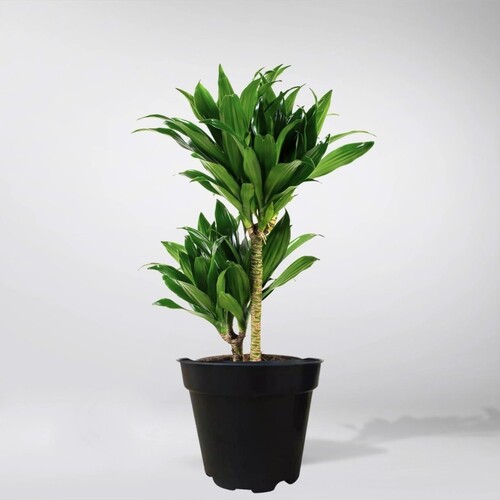
Dracaena Janet Craig is a classic, richly colored cultivar prized for its dense, upright rosettes of long, glossy, deep green leaves that lack the variegation found in many of its Dracaena relatives, giving it a sleek, solid-colored look that fits easily into both traditional and modern interiors. It grows as a woody-caned shrub, with broad, lance-shaped leaves clustered along one or more thick, slow-growing canes, and it is commonly sold as a single-cane specimen, a bushier multi-cane planting, or a compact, low-growing form sometimes marketed as “Compacta.” Over time, mature plants can develop noticeably thick, characterful canes reminiscent of small trees, particularly when grown for many years in bright interior settings.
This cultivar originates from the broader species Dracaena fragrans, which is native to tropical West and Central Africa, including regions such as Sierra Leone, Nigeria, and parts of the Congo Basin, where it grows in the humid, shaded understory beneath the canopy of larger rainforest trees. Because of this heritage, Janet Craig has inherited a strong natural tolerance for the lower, filtered light levels typical of interior spaces, a trait that has made it one of the most popular and dependable low-light houseplants and interior landscaping choices for decades, especially in offices, hotels, and shopping centers where natural light is often limited.
Among its most notable features is its rich, solid dark green foliage, which many growers prefer over variegated Dracaena types for its clean, uniform appearance and its ability to visually anchor a room without competing with other patterned decor. The plant is also valued for its slow, manageable growth rate, its long lifespan under proper care, and its documented ability to help filter certain common indoor air pollutants, a quality that has contributed significantly to its enduring popularity in interior plantscaping since the mid-twentieth century.
Dracaena Janet Craig has earned its reputation as one of the most forgiving and low-maintenance interior plants available, largely because of its exceptional tolerance for lower light conditions and its relatively relaxed watering needs compared to many other popular houseplants. While it will grow most vigorously in bright, indirect light, it is equally capable of surviving, and even thriving in a modest way, in the kind of moderate to low light found several feet back from a window or in an interior office space with only artificial lighting, making it an excellent choice for spaces where brighter options might struggle.
Watering this cultivar successfully means erring on the side of underwatering rather than overwatering, since Janet Craig is considerably more tolerant of a missed watering than it is of consistently soggy soil, which quickly leads to root rot in this species. Allowing the top one to two inches of soil to dry out between waterings, and using filtered, distilled, or rainwater rather than untreated tap water, helps avoid both root problems and the brown leaf-tip burn that Dracaena species are well known for developing in response to fluoride and salt buildup. The plant also strongly prefers to be kept away from cold drafts, heating vents, and sudden temperature swings, all of which can cause stress-related leaf drop or discoloration even when watering and light are otherwise appropriate.
Beyond these fundamentals, routine care includes occasional wiping or dusting of the broad leaves to keep them functioning efficiently, a light and infrequent feeding schedule during the active growing season, and periodic pruning to manage height or encourage new growth points along the cane. With reasonably consistent, undemanding care, a Janet Craig Dracaena can remain a healthy and attractive fixture in a home or office for many years, gradually developing the thick, sculptural cane structure that makes older specimens especially prized in interior design.
 Soil
Soil
Dracaena Janet Craig grows best in a well-draining, loose potting mix, typically a standard all-purpose houseplant soil amended with perlite or coarse sand to improve aeration and prevent excess moisture retention around the roots. A slightly acidic pH range of approximately 6.0 to 6.5 tends to suit this cultivar well, supporting healthy nutrient uptake without the deficiencies that can arise in overly alkaline conditions. Good drainage is especially important for this species, since it is notably sensitive to consistently wet soil and prone to root rot if left in waterlogged conditions for any extended period, making both an appropriate soil mix and a pot with adequate drainage holes essential to long-term health. Amendments such as perlite, coarse sand, or orchid bark can be incorporated into the base mix to further enhance drainage and airflow, while a small amount of organic compost can supply a gentle, steady source of nutrients over time. Soil composition has a direct effect on the plant’s overall vigor, since a mix that is too dense or moisture-retentive contributes to root suffocation and rot, whereas an overly sandy, nutrient-poor mix can lead to slow growth and pale foliage. Common soil-related problems include poor drainage, which quickly encourages root rot in this rot-sensitive species; compaction, which restricts root respiration and water movement as the mix breaks down over time; inappropriate pH, which can interfere with nutrient availability and contribute to subtle deficiencies; salt build-up, frequently caused by fluoride- or chlorine-treated tap water and over-fertilizing, which shows up as the brown leaf-tip burn this genus is well known for; nutrient deficiencies, which can appear as pale, weak, or stalled growth in old, depleted potting mix; and root boundness, which develops in mature specimens left in the same container for several years and is best resolved through timely repotting into a slightly larger pot.
 Fertilizer
Dracaena Janet Craig has relatively modest fertilization needs and generally does best with a balanced, water-soluble houseplant fertilizer diluted to about half strength, applied once every four to six weeks during the active spring and summer growing season, with feeding paused or significantly reduced through fall and winter. Because this species is notably sensitive to salt and mineral buildup, it is important to avoid over-fertilizing, and using filtered or distilled water for routine watering can help offset the additional mineral load that regular fertilizer applications introduce over time. Signs of over-fertilization typically include browning or scorched leaf tips and margins, a visible white or crusty salt residue on the soil surface, and generally stressed-looking new growth, while under-fertilization is less commonly seen in this slow-growing cultivar but may present as pale, weak, or notably slow growth over an extended period without any feeding. Organic alternatives such as a well-diluted fish emulsion, compost tea, or worm castings worked gently into the topsoil can offer a slower-release, gentler nutrient source for growers who prefer to avoid synthetic fertilizers and tend to carry a lower risk of the salt buildup issues associated with regular chemical feeding.
 Watering
Watering Dracaena Janet Craig successfully means allowing the top one to two inches of soil to dry out between waterings, since this cultivar tolerates brief periods of dryness far better than it tolerates consistently wet, poorly drained soil, which quickly leads to root rot. Filtered, distilled, or rainwater is strongly preferred over untreated tap water, since this species is notably sensitive to the fluoride, chlorine, and dissolved salts commonly found in municipal water supplies, which are among the most common causes of the brown, crispy leaf-tip burn frequently seen on Dracaena foliage. Signs of underwatering include drooping, slightly wrinkled, or dull-looking leaves, while overwatering more typically presents as yellowing lower leaves, a soft or foul-smelling base, and visible dark, mushy roots upon inspection in more advanced cases. Watering needs shift somewhat with the seasons, with the plant generally requiring more frequent watering during its active spring and summer growth period and considerably less during the cooler, slower-growing fall and winter months, when allowing the soil to dry out more thoroughly between waterings helps prevent unnecessary root stress.
Stop guessing. Most houseplant failures are caused by volumetric errors and improper moisture tension. Our deterministic calculator moves beyond "once-a-week" watering by analyzing the four critical pillars of root health:
Personalized for this plant
Disclaimer: Our calculator is pretty smart. We’ve crunched the numbers, but we’re not measuring the quantum state of your living room. Since we don’t know your exact indoor temperature, humidity, light, airflow, or whether your plant receives daily sweet nothings and motivational speeches, use this calculator as a guide—and always keep an eye on your plant.
 Lighting
Dracaena Janet Craig is exceptionally tolerant of a wide range of indoor light conditions, and while it grows most vigorously and produces the richest, glossiest foliage in bright, indirect light, it is also one of the more dependable options for lower-light interiors, a trait inherited from its native understory habitat. Insufficient light, while tolerated for extended periods, can eventually show up as slower growth, thinner or slightly duller leaves, and increased spacing between new leaves along the cane, while genuinely excessive or direct sun exposure can cause bleached, scorched, or brown patches on the foliage, particularly if the plant is moved abruptly from shade into strong, direct sunlight. If natural light in a space is very dim, moving the plant closer to a window or supplementing with a full-spectrum grow light for several hours a day can help maintain denser, more vigorous growth, while a plant that is receiving harsh, direct afternoon sun can simply be moved back from the window or given a sheer curtain to soften the light intensity.
 Temperature
Dracaena Janet Craig thrives in warm, stable temperatures generally between 65 and 80°F (18 to 27°C), consistent with its tropical African heritage, and does best when kept away from cold drafts, sudden temperature fluctuations, and drafty windows or exterior doors during colder months. The plant has fairly limited cold tolerance, with temperatures dropping below about 50°F (10°C) risking leaf damage, discoloration, or drop, so keeping it away from unheated rooms, cold glass, or air conditioning vents blowing directly onto the foliage is important during winter. At the other extreme, very high temperatures combined with low humidity can accelerate moisture loss from the leaves and increase the risk of tip burn, so shielding the plant from intense, unshaded heat sources such as radiators or south-facing windows in summer, and moving it to a more temperature-stable interior spot during extreme weather, helps protect it from stress in either direction.
 Humidity
Dracaena Janet Craig adapts well to average household humidity levels, generally performing best in a range of roughly 40 to 60 percent, though it is fairly tolerant of lower humidity compared to more demanding tropical houseplants. Low humidity stress in this species commonly shows up as browning or crisping leaf tips and edges, an effect that can be compounded by the tip burn already associated with mineral-rich tap water, while consistently high humidity paired with poor air circulation can occasionally encourage fungal leaf spot or other moisture-related issues on the dense foliage. To raise humidity around the plant, a pebble tray filled with water and placed beneath the pot offers a simple and moderately effective method, while grouping the plant near other houseplants can help create a slightly more humid microclimate as well. Occasional misting can provide a brief humidity boost and also helps keep dust off the broad leaves, though its effects are relatively short-lived; for more consistent, longer-lasting humidity support, particularly in dry climates or during winter heating season, a small room humidifier placed nearby tends to be the most reliable option.
 Propagation
Dracaena Janet Craig is most commonly and successfully propagated through stem cuttings, or by air layering for larger, leggier specimens, with stem cuttings generally offering the higher and more reliable success rate for most home growers. To propagate by stem cutting: 1. Using a clean, sharp knife or pruning shears, select a healthy section of cane roughly six to twelve inches long from a mature plant. 2. Make a clean cut just below a node, then allow the cut end to callous over for several hours to a full day in a dry spot out of direct sun. 3. Optionally dip the calloused end in a rooting hormone powder to encourage faster root development, though this step is not strictly necessary for this relatively easy-to-root cultivar. 4. Insert the cutting a few inches deep into a pot of well-draining potting mix, or place the base in a jar of water if rooting in water instead. 5. Keep the cutting in bright, indirect light and maintain lightly moist, never soggy, soil, refreshing water regularly if rooting in water. 6. Maintain warm temperatures, ideally between 70 and 80°F, and consider loosely covering the cutting with a clear plastic bag or dome to help retain humidity during the rooting period. 7. Check periodically for developing roots, which typically become visible within about four to eight weeks under favorable conditions. 8. Once a solid root system has formed, transition a water-rooted cutting into potting soil, or begin a normal watering and light feeding routine for a soil-rooted cutting, allowing several more weeks for the new plant to establish before treating it as an independent, mature specimen. Compared to stem cuttings, air layering can also be effective, particularly for reducing the height of a tall, leggy cane while producing a new rooted top section, but it generally requires more time, materials, and technique to execute successfully. Late spring through summer is generally the best time to propagate, taking advantage of the plant’s natural active growth period, with newly rooted cuttings typically reaching a well-established, independently growing state within roughly two to four months.
 Potting
Dracaena Janet Craig does well in a sturdy pot with ample drainage holes, ideally only modestly larger than the current root ball, since this species generally prefers being kept somewhat snug rather than given excessive extra room in its container. A well-draining, all-purpose potting mix amended with perlite or coarse sand provides the aeration this species needs to help prevent root rot, and a heavier pot material such as terracotta or glazed ceramic can also help stabilize larger, more mature specimens, which can become top-heavy as their canes grow taller over time. Repotting is generally needed only every two to three years for most indoor specimens, since this is a slow-growing cultivar that does not require frequent container changes. Signs that repotting is needed include roots visibly circling the surface of the soil or emerging from the drainage holes, water draining through unusually quickly without properly saturating the soil, or a plant that has become noticeably top-heavy and unstable in its current pot. Root pruning is occasionally appropriate for especially root-bound specimens, where trimming away a portion of the densest, most tightly wound roots before repotting can help the plant reestablish more easily in fresh soil. When transitioning to a new pot, handle the root ball gently, keep the plant at the same soil depth it was previously growing, water thoroughly after repotting, and place the plant in slightly lower light than usual for a week or two afterward to help reduce transplant stress while the roots adjust.
 Pruning
The best time to prune Dracaena Janet Craig is during spring or early summer, at the beginning of its active growing season, when the plant is best positioned to recover quickly and produce fresh new growth from the pruning site.
Light, routine pruning to remove damaged or yellowing leaves can be done as needed throughout the year, while more significant height-reduction or branching-encouragement cuts to the cane itself are typically only necessary once every one to two years, or whenever the plant has outgrown its allotted space.
Pruning serves several purposes for this cultivar: removing damaged or unattractive foliage, controlling the overall height of a plant that has become too tall for its location, and encouraging a single cane to branch and produce a fuller, more multi-stemmed appearance.
A clean, sharp pair of pruning shears, or a small saw for thicker, more mature canes, is recommended, with blades wiped down with rubbing alcohol before and between cuts to help prevent the spread of disease.
Before pruning, clearly identify which leaves or cane sections need to be removed, and confirm that your tools are clean and sharp so that cuts heal quickly and place minimal stress on the plant.
Following pruning, keep the plant in its usual bright, indirect light and maintain a normal watering schedule, watching over the following weeks for new growth to emerge from the cut cane.
Because Janet Craig can take some time to visibly respond after a significant cane cut, patience is important, and the plant should not be assumed unhealthy simply because new growth takes several weeks to appear.
 Blooming
Dracaena Janet Craig flowers only rarely indoors, with blooming being far more common on older, mature specimens, particularly those that have spent extended time in bright conditions or experienced some form of environmental stress, and flowering can occur at almost any time of year rather than following a strict seasonal pattern. When it does occur, the bloom period is relatively brief, generally lasting one to two weeks, during which a tall, arching flower stalk emerges from the center of the leaf rosette bearing clusters of small, star-shaped, greenish-white to cream flowers. These blooms are known for producing a notably sweet, somewhat heavy fragrance, particularly noticeable in the evening hours, though the individual flowers themselves are visually modest and often considered secondary in interest to their strong scent. Optimal conditions for encouraging a bloom, while never guaranteed and largely dependent on the plant’s age and maturity, generally include a well-established, mature cane, bright indirect light, and stable warm temperatures over an extended period.
 Pests and Diseases
Spider mites, mealybugs, and scale insects are the most commonly encountered pests on Dracaena Janet Craig, particularly in dry indoor air or when the plant is under some form of environmental stress.
Spider mites cause fine, dust-like stippling across the leaf surface along with faint webbing in more advanced infestations, while mealybugs appear as small, cottony white clusters typically found tucked into leaf axils, and scale presents as small, brown, dome-shaped bumps attached flatly to the leaves or stem. All three pests can produce a sticky honeydew residue and, in significant infestations, cause yellowing, weakened, or distorted new growth.
Isolate the affected plant to prevent spread to nearby houseplants, wipe away visible pests with a cotton swab dipped in rubbing alcohol, and follow up with a thorough application of insecticidal soap or neem oil to all leaf surfaces, repeating every seven to ten days until the infestation is fully resolved. Slightly increasing humidity and routinely inspecting new growth can help reduce the likelihood of future outbreaks, particularly for spider mites, which favor dry conditions.
Root rot and fungal or bacterial leaf spot are the most frequently encountered disease issues affecting this cultivar, both closely tied to excess moisture, poor drainage, or overly humid, stagnant conditions around the foliage.
Root rot typically presents as yellowing lower leaves, a soft or foul-smelling base, and stunted or collapsing growth, often only discovered when the plant is removed from its pot and dark, mushy roots are found. Leaf spot appears as small, discolored, sometimes water-soaked spots on the foliage that can enlarge and merge over time if left untreated.
For root rot, remove the plant from its pot, trim away all visibly rotted or blackened roots with clean shears, and repot into fresh, well-draining soil while significantly reducing subsequent watering frequency. For leaf spot, remove and dispose of affected leaves, improve air circulation around the plant, avoid overhead watering that wets the foliage, and apply a fungicide labeled for houseplant use if the condition persists or continues to spread.
 Special Features
Dracaena Janet Craig is especially valued for its rich, glossy, solid dark green foliage, a look many growers prefer over the variegated forms found in other Dracaena cultivars for its clean, uniform, versatile appearance that pairs easily with a wide range of interior styles. The plant is also notable for its exceptional tolerance of lower light conditions, making it one of the most dependable choices for interior spaces with limited natural light, and for its documented ability to help filter certain common indoor air pollutants, a quality that has made it a long-standing favorite in offices, hotels, and commercial interior plantscaping. On the rare occasions when a mature specimen does bloom, its flowers produce a notably sweet, jasmine-like fragrance that can fill an entire room, offering a pleasant seasonal surprise from an otherwise primarily foliage-focused plant.
 Plant Benefits
Dracaena fragrans ‘Janet Craig’ has no significant history of use in traditional or modern herbal medicine and is not associated with recognized pharmaceutical or medicinal benefits; its primary practical value lies in its well-documented ability to help filter common household air pollutants such as formaldehyde and benzene, a benefit studied and popularized through NASA’s Clean Air Study research on houseplants.
 Additional Information
Janet Craig is one of the most widely used plants in commercial interior plantscaping due to its unusually strong tolerance for low light and fluorescent lighting conditions, and it is frequently sold in multiple forms, including tall single-cane specimens, bushier multi-cane plantings, and a compact, shorter cultivar often labeled ‘Compacta’ that produces tightly whorled, more closely spaced foliage.
 Life Cycle
Dracaena fragrans ‘Janet Craig’ begins as either a rooted stem cutting or, less commonly for named cultivars, a seedling of the parent species, developing an initial rosette of glossy, strap-like leaves atop a slowly thickening cane as it matures. Over years of slow, steady growth, the cane elongates and develops the rough, woody bark typical of mature Dracaena specimens, while older lower leaves naturally yellow and drop as new growth continues to emerge from the top of the cane or from new branching points created through pruning. Under favorable, often long-term indoor conditions, a sufficiently mature specimen may occasionally produce a tall flowering stalk bearing fragrant blooms, though most specimens of this cultivar are propagated and maintained vegetatively through cuttings rather than through this uncommon flowering and seed cycle. With appropriate, undemanding care, a single Janet Craig Dracaena can continue this slow, steady growth pattern for many years, periodically pruned or propagated to manage its height and overall form.
 Are Dracaena Janet Craig Poisonous, Toxic
Dracaena fragrans ‘Janet Craig’ is toxic to cats and dogs, and can cause mild irritation if ingested by children, due to the presence of saponins distributed throughout the plant, with the leaves representing the primary toxic part typically involved in accidental ingestion. In cats and dogs, ingestion commonly leads to vomiting, occasionally with blood visible, along with excessive drooling, loss of appetite, lethargy, and dilated pupils, with symptoms being particularly well documented in cats. The severity of toxicity is generally considered mild to moderate, with serious or life-threatening reactions being uncommon, though the extent of illness can vary depending on how much plant material was consumed relative to the animal’s size. In children, ingestion is typically associated with mild oral or gastrointestinal discomfort, such as mouth irritation, drooling, or a brief upset stomach, rather than severe toxicity. First aid steps for a pet or child suspected of ingesting the plant include removing any remaining plant material from the mouth, offering a gentle rinse if tolerated, providing small amounts of water, and closely monitoring for worsening symptoms such as repeated vomiting, lethargy, or refusal to eat. A veterinarian should be contacted for any pet displaying symptoms of concern, and a poison control center or physician consulted for an affected child showing signs of distress. Preventive measures include keeping the plant well out of reach of pets known to chew on greenery and of young children, promptly cleaning up any fallen or pruned leaf material, and monitoring pets that have previously shown interest in houseplants.
 Frequently Asked Questions
Yes, it is toxic to cats and dogs due to saponins in the leaves, and can cause vomiting, drooling, and lethargy if ingested.
Yes, it is one of the most low-light-tolerant Dracaena cultivars available, making it a popular choice for offices and interiors with limited natural light.
Allow the top one to two inches of soil to dry out between waterings, since this cultivar tolerates dry soil far better than consistently wet, waterlogged conditions.
Brown leaf tips are usually caused by fluoride or chlorine in tap water, or inconsistent watering, and can often be reduced by switching to filtered, distilled, or rainwater.
Yes, it is well known for absorbing common indoor pollutants such as formaldehyde and benzene, as documented in NASA’s Clean Air Study.
Take a six-to-twelve-inch stem cutting below a node, let it callous, then root it in soil or water in bright, indirect light until new roots develop.
Compacta is a shorter, more tightly whorled form of Janet Craig, producing densely clustered foliage rather than the longer, more open leaves of the standard cultivar.
Yes, though flowering indoors is uncommon and mostly occurs on older, mature specimens, producing small, fragrant, jasmine-scented blooms.
Indoors it typically reaches three to six feet, though older single-cane specimens can grow considerably taller over many years.
Yes, it is considered one of the easiest and most forgiving Dracaena cultivars, tolerating low light and infrequent watering with minimal fuss.
 Can I grow Dracaena Janet Craig in my indoor space
Difficulty: Easy
Size: Medium
Light: Low
Water: Low
Flowering: Yes
Pet Safe: No
Air Purifier: High
 Dracaena fragrans 'Janet Craig' botanical details
Common Name: Dracaena Janet Craig
Other Common Names: Janet Craig Dracaena, Dracaena deremensis 'Janet Craig', Compact Janet Craig, Corn Plant (Janet Craig type)
Botanical Name: Dracaena fragrans 'Janet Craig'
Native Area: Tropical West and Central Africa (parent species Dracaena fragrans), including Sierra Leone, Nigeria, and the Congo Basin
Family Name: Asparagaceae
Plant Type: Evergreen perennial shrub
Genus: Dracaena
Kingdom: Plantae
 Photo Gallery
 My Dracaena Janet Craig Plant Care Recommendations
If you find the Houseplant Encyclopedia helpful and would like to support Healthy Houseplants, you can use the links below to shop for recommended plants, products, and plant-care supplies.
Some links are affiliate links, which means I may earn a small commission if you make a qualifying purchase through them, at no additional cost to you. Thank you for supporting Healthy Houseplants and helping me continue to provide free plant-care information!

Want even more personalized plant-care help? Check out my AI Julie Chatbot—trained on my 20 years of houseplant knowledge, not just information from the internet!  Try it now:Ask AI Julie
 Buy Dracaena Janet Craig Online
✅ “Bring Home This Beauty Today”
✅ “Get Your Own Dracaena Janet Craig Before It’s Gone”
✅ “Shop Trusted Sellers – Limited Availability”
✅ “Free Delivery”
As an Amazon Associate, I earn commission from qualifying purchases.
 Plant Puns and Jokes
Why is Dracaena Janet Craig such a great roommate? Because it thrives in low light, never complains about the electric bill, and still manages to purify the air in the room.
 Signup to our newsletter and download Dracaena Janet Craig care guide

