


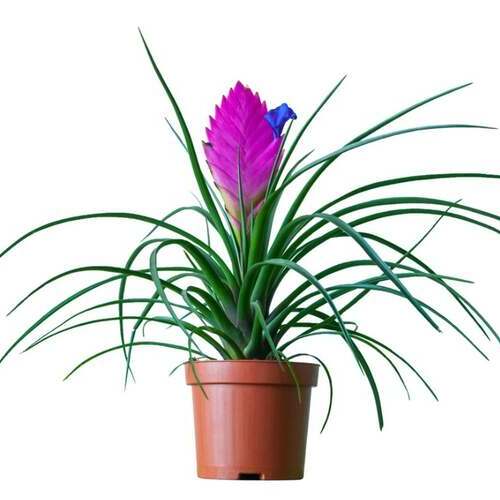
The Pink Quill Plant (Tillandsia cyanea) is one of the most striking members of the bromeliad family, prized for the vivid, feather-like pink bract that rises from its center like a paddle-shaped plume. Unlike many of its Tillandsia cousins that are true “air plants” grown without any soil at all, T. cyanea is an epiphytic species that is more commonly potted in a loose, well-draining substrate for retail and home cultivation, which sets it apart visually and horticulturally from the gray, wispy Tillandsia usually associated with the genus. The plant forms a low rosette of narrow, arching, grass-like leaves in a soft grayish-green, from which the flattened pink inflorescence emerges, often held for many weeks at a time.
Native to the tropical forests of Ecuador, this bromeliad naturally grows as an epiphyte, anchoring itself to the bark of trees using its roots primarily for grip rather than nutrient uptake, and drawing moisture and nutrients from humid air, rainfall, and decaying organic debris that collects around its base. In its native habitat it thrives in the dappled, filtered light of the forest canopy, an environment that informs much of its care in cultivation, where bright indirect light and consistent humidity are far more important than soil richness.
The true flowers of the Pink Quill are small, tubular, and violet-blue, emerging one or two at a time from between the pink bracts along the plume; these individual blooms are short-lived, lasting only a few days each, while the colorful bract itself persists for two to three months, making the plant a long-lasting focal point in interior plantscaping. Because Tillandsia cyanea is monocarpic, meaning the main rosette flowers once and then gradually declines, most specimens seen in cultivation eventually produce offsets, or “pups,” at the base which can be grown on to continue the plant’s presence indefinitely.
Caring for a Pink Quill Plant successfully means recreating the bright, humid, air-circulating conditions of a tropical forest canopy rather than treating it like a typical potted houseplant. Bright, indirect light is the single most important factor for keeping the foliage healthy and encouraging that signature pink bract to develop fully; a spot near an east- or north-facing window, or a few feet back from a bright south or west window, tends to work best. Because the plant absorbs much of its moisture and nutrition through specialized structures on its leaves called trichomes, misting and humidity play a much larger role in its wellbeing than soil moisture does.
Watering is best approached with a light touch. If potted, the growing medium should dry out between waterings, since Pink Quill roots are adapted primarily for anchoring rather than heavy water uptake and are prone to rot in soggy conditions. Many growers find more success watering by misting the foliage several times a week, or by giving the plant an occasional gentle soak, rather than pouring water directly into the central cup as is common with other bromeliads, since standing water in the cup of this species can sometimes encourage rot rather than nourish the plant.
Beyond light and water, Pink Quill Plants appreciate warm, stable temperatures, good air movement, and a light feeding schedule using a diluted bromeliad or orchid fertilizer during the growing season. They are not heavy feeders and can suffer from fertilizer burn if given anything too strong or too frequent. With reasonably consistent warmth, humidity, and bright indirect light, a healthy specimen will hold its pink bract for months, and gardeners can look forward to the appearance of small offsets at the base once the mother plant’s bloom cycle winds down, offering an easy route to propagating new plants for years to come.
 Soil
Soil
Because Tillandsia cyanea is naturally epiphytic, it does not require, and can actually be harmed by, a dense or rich potting soil. When grown potted for retail or home display rather than mounted, the ideal medium is a very loose, fast-draining, and airy mix such as a bromeliad or orchid blend, often combining components like fine bark, perlite, coarse sand, and a small amount of peat or coir, which mimics the loose organic debris that collects around the plant’s roots in the wild. A slightly acidic pH in the range of roughly 5.0 to 6.0 tends to suit this species well, echoing the acidic bark and decaying leaf litter of its native forest habitat. Good drainage is critical to plant health here because the roots of T. cyanea function mainly for anchorage rather than heavy nutrient or water absorption, and a medium that stays wet for extended periods quickly leads to root and crown rot. Amendments such as extra perlite, orchid bark, or horticultural charcoal can be added to increase airflow around the roots and further reduce moisture retention. Common soil-related problems include poor drainage, which suffocates roots and invites fungal rot; compaction, which restricts the airflow the roots depend on; inappropriate pH, which can interfere with the limited nutrient uptake the roots do perform; salt build-up from tap water or over-fertilizing, which can scorch root tips and leaf bases; nutrient deficiencies, which are less common given the plant’s low feeding needs but can appear as pale or weak new growth if the medium is entirely inert; and root boundness, which is rare in this slow-growing species but can occur in older, offset-producing clumps and is best addressed by simply dividing and repotting the pups into fresh, airy medium.
 Fertilizer
Tillandsia cyanea is a light feeder by nature, since in the wild it draws most of its nutrition from decomposing organic debris, rainwater, and airborne particles rather than rich soil. A diluted, balanced liquid fertilizer formulated for bromeliads or orchids, mixed at roughly one-quarter to one-half the label strength, applied once every four to six weeks during the active spring and summer growing season tends to work well, either misted onto the foliage or applied lightly to the growing medium if potted. Feeding should be reduced or paused entirely during the fall and winter months when growth naturally slows. Signs of over-fertilization include browning or blackened leaf tips, a white or crusty salt residue on the leaves or medium surface, and generally scorched-looking new growth, while under-fertilization is harder to spot in this naturally slow-feeding species but may present as unusually pale or slow new growth over an extended period. For growers who prefer organic alternatives, a well-diluted fish emulsion or seaweed extract applied sparingly can provide a gentler nutrient boost, though these should still be used at reduced strength given the plant’s sensitivity to nutrient concentration. Because Tillandsia species absorb nutrients largely through leaf trichomes rather than roots, foliar feeding by misting is often considered more effective for this species than applying fertilizer to the growing medium alone.
 Watering
Watering a Pink Quill Plant calls for a lighter, more careful approach than most houseplants, since its roots are adapted primarily for anchoring rather than heavy moisture uptake and much of the plant’s hydration comes through its leaves. If potted, allow the growing medium to dry out between waterings and avoid letting the base sit in standing water; misting the foliage two to three times a week, or giving the plant an occasional thorough soak followed by good drainage, tends to work better than frequent watering of the medium itself. Rainwater, distilled water, or filtered water is generally preferred over hard tap water, since the mineral and chlorine content of tap water can build up on the leaves and in the growing medium over time, sometimes causing tip burn or a dulling of the foliage color. Signs of underwatering include curling, wrinkled, or dry-looking leaves and a generally dull or grayish cast to the foliage, while overwatering tends to show up as a mushy or blackened base, yellowing lower leaves, or an unpleasant smell near the crown, all of which point to rot setting in. Watering needs shift somewhat with the seasons and growth stages, with the plant typically wanting slightly more frequent misting during its active spring and summer growth and blooming period, and less frequent moisture during the cooler, slower months of fall and winter when the plant’s metabolic activity naturally slows.
Stop guessing. Most houseplant failures are caused by volumetric errors and improper moisture tension. Our deterministic calculator moves beyond "once-a-week" watering by analyzing the four critical pillars of root health:
Personalized for this plant
Disclaimer: Our calculator is pretty smart. We’ve crunched the numbers, but we’re not measuring the quantum state of your living room. Since we don’t know your exact indoor temperature, humidity, light, airflow, or whether your plant receives daily sweet nothings and motivational speeches, use this calculator as a guide—and always keep an eye on your plant.
 Lighting
Pink Quill Plants thrive in bright, indirect light that mimics the dappled canopy conditions of their native Ecuadorian forests. An east-facing window offering gentle morning sun, or a spot a few feet back from a bright south- or west-facing window, generally provides the right balance of intensity without scorching the foliage. Insufficient light shows up as pale, stretched, or overly soft leaf growth, and often as a failure to produce the pink bract at all, since flowering in this species is closely tied to adequate light levels. Excessive or direct sun exposure, on the other hand, can cause bleached, brown, or scorched patches on the leaves, particularly if the plant is suddenly moved from lower light into strong direct sun without a gradual adjustment period. If natural light is limited, moving the plant closer to a window, choosing a brighter room, or supplementing with a full-spectrum grow light for several hours a day can help maintain healthy color and encourage blooming, while a plant receiving harsh afternoon sun can simply be shifted a few feet back or given a sheer curtain to diffuse the intensity.
 Temperature
Pink Quill Plants prefer warm, fairly stable temperatures in the range of roughly 65 to 80°F (18 to 27°C), reflecting their tropical Ecuadorian origins, and generally do best when kept away from cold drafts, sudden temperature swings, or proximity to heating and cooling vents. The plant can tolerate brief dips into the high 50s°F (around 13 to 15°C) without serious harm, but prolonged cold exposure below this range can slow growth, dull leaf color, and increase susceptibility to rot, while temperatures consistently above the mid-80s°F paired with low humidity can stress the plant and accelerate moisture loss from the leaves. To protect the plant from temperature extremes, keep it away from drafty windows and exterior doors in winter, avoid placing it directly against cold glass, and shield it from hot, direct afternoon sun through unshaded windows in summer; if temperatures in the home fluctuate significantly, moving the plant to a more centrally located, temperature-stable room can help maintain consistent growth and bloom quality.
 Humidity
As an epiphyte from humid tropical forests, Tillandsia cyanea strongly prefers elevated humidity, ideally in the range of 50 to 70 percent, considerably higher than the air in most heated or air-conditioned homes. Low humidity stress typically shows up as curling or crisping leaf tips, a dull or grayish leaf color, and slower or stalled growth, while consistently high humidity paired with poor air circulation can occasionally encourage fungal issues, so good airflow should accompany any effort to raise ambient moisture. To increase humidity around the plant, a pebble tray filled with water and topped with a layer of stones beneath the pot is a simple and moderately effective method, raising local humidity as the water evaporates without letting the roots sit wet. Regular misting several times a week offers a more direct and often more effective humidity boost for this particular species, since it also delivers moisture straight to the leaf trichomes the plant uses for absorption. For growers in especially dry climates or heated interiors, a small room humidifier placed nearby tends to be the most reliable and consistent method of keeping humidity in the ideal range, particularly during winter heating season when indoor air is driest.
 Propagation
Pink Quill Plants are propagated almost exclusively through offsets, commonly called “pups,” that form at the base of the mother plant, typically after the main rosette has finished flowering, since Tillandsia cyanea is monocarpic and the parent rosette will not bloom a second time. Seed propagation is technically possible but is slow, unreliable for home growers, and rarely used outside of specialized breeding programs, making pup division by far the most successful and popular method. To propagate by offsets: 1. Wait until the pup has grown to at least one-third, and ideally one-half, the size of the parent plant, since removing it too early significantly reduces its chances of survival. 2. Gently loosen the mother plant from its pot, or expose the base if mounted, to get a clear view of where the pup attaches. 3. Locate the point where the pup connects to the base of the parent rosette. 4. Using a clean, sharp knife or shears, carefully cut the pup away from the parent, leaving as much of its own root growth intact as possible. 5. Allow the cut surface on both the pup and the parent to air dry for a few hours to a day, which helps reduce the risk of rot at the wound site. 6. Pot the pup in a small container with a loose, fast-draining bromeliad or orchid mix, or mount it on bark or driftwood in the style of other Tillandsia species. 7. Keep the newly potted or mounted pup in bright, indirect light with elevated humidity and light misting, avoiding heavy watering while it establishes its own root system. 8. Continue routine care, and expect the young plant to reach flowering size and produce its own bract within one to three years, depending on growing conditions. Compared to seed propagation, pup division has a dramatically higher success rate and is considered the standard method among home growers and commercial producers alike, with most pups establishing successfully within a few months and reaching maturity within one to three years.
 Potting
Because Tillandsia cyanea is naturally epiphytic, it does best in a small, relatively shallow pot with excellent drainage, or alternatively can be mounted on bark or driftwood in a manner similar to other air plants, with a bit of sphagnum moss around the base roots for extra moisture retention. When potted, a fast-draining bromeliad or orchid mix combining bark, perlite, and a small amount of coir or peat works well, and terracotta pots are often favored over plastic since their porous walls help the medium dry out between waterings, reducing the risk of rot. Repotting is needed only infrequently for this slow-growing species, generally every two to three years or when the plant has produced enough pups that the clump has become crowded and needs dividing. Signs that repotting or dividing is needed include multiple offsets crowding the original pot, a growing medium that has broken down and become dense or waterlogged over time, or roots that have become tightly packed and are pushing the plant up out of its container. Root pruning is rarely necessary given the plant’s naturally limited root system, though any obviously rotted or blackened roots encountered during repotting should be trimmed away with clean shears before repotting into fresh medium. When transitioning to a new pot, handle the shallow root system gently, keep the crown of the plant at the same depth it was previously growing, and hold off on heavy watering for the first week or two to let any minor root disturbance heal before resuming a normal watering and misting routine.
 Pruning
Pruning a Pink Quill Plant is a light-touch task best done as needed throughout the year rather than on a strict seasonal schedule, primarily to remove spent blooms, damaged foliage, or the mother rosette once it has finished its natural life cycle after flowering.
The main goals are to tidy up the plant’s appearance, remove tissue that could otherwise invite rot or pests, and eventually clear space for offsets to take over once the parent rosette declines after blooming, since this species does not rebloom from the same rosette.
A pair of clean, sharp scissors or small pruning shears is all that is required; wiping the blades with rubbing alcohol before and between cuts helps prevent the spread of any fungal or bacterial issues.
Before pruning, inspect the plant in good light to distinguish healthy green tissue from spent, browning, or fully dried material, and make sure tools are clean and sharp to create clean cuts that heal quickly.
After any pruning, keep the plant in its usual bright, humid conditions and avoid heavy watering directly on fresh cuts for a day or two to reduce the risk of introducing rot.
Because the plant is monocarpic, pruning away the spent mother rosette is a normal and expected part of its life cycle rather than a sign of poor care, and doing so allows more light, air, and resources to reach the newly forming pups.
 Blooming
The Pink Quill Plant typically blooms in spring through summer, though indoor specimens grown under stable conditions can occasionally flower at other times of year. The bright pink, paddle-shaped bract itself is long-lasting, remaining colorful and attractive for approximately two to three months, sometimes longer with ideal care. Within that bract, individual true flowers are small, tubular, and a striking violet-blue color, but each bloom is short-lived, opening for only two to three days before fading, with new flowers emerging in succession from between the bracts over the course of the display. Optimal blooming conditions include bright, indirect light, warm and stable temperatures generally above 60°F (15°C), consistent humidity above 50 percent, and a period of active growth supported by light, regular feeding; plants kept in low light or overly dry air may fail to bloom at all or produce a smaller, less vivid bract.
 Pests and Diseases
Mealybugs and scale insects are the most frequently encountered pests on Pink Quill Plants, often hiding in the leaf axils or along the base of the rosette; spider mites can also occasionally appear, particularly in dry indoor air.
Mealybugs appear as small, cottony white masses tucked into leaf joints, while scale shows up as small, brown or tan bumps that cling flatly to the leaf surface; both can cause a sticky honeydew residue and, in heavier infestations, yellowing or weakened foliage. Spider mites cause fine stippling or speckling on the leaves along with faint webbing in severe cases, both of which are easier to spot with a magnifying lens or in bright light.
Isolate the affected plant to prevent spread, then wipe visible pests away with a cotton swab dipped in rubbing alcohol or treat the plant with insecticidal soap or a neem oil solution, applying every seven to ten days until no further pests are visible. Improving air circulation and periodically inspecting new growth helps catch any resurgence early.
Crown rot and other fungal or bacterial rots are the primary disease concerns, almost always linked to excess moisture sitting in the central cup or a consistently overwatered growing medium.
Affected plants typically show a mushy, discolored, or foul-smelling base or crown, yellowing or collapsing lower leaves, and in advanced cases the entire rosette may pull away easily from the root ball due to tissue breakdown.
At the first sign of rot, reduce watering immediately and improve air circulation around the plant; trim away any visibly mushy or blackened tissue with clean, sharp scissors, and allow the remaining plant to dry out before resuming a lighter watering routine. In cases where the main rosette is too far gone, focus care on preserving and separating any healthy offsets rather than attempting to save badly rotted tissue, and consider repotting into fresh, faster-draining medium to prevent recurrence.
 Special Features
The Pink Quill Plant’s most distinctive feature is its brilliant, paddle-shaped pink bract, which stands out vividly against its slender, grayish-green foliage and can persist as an ornamental focal point for two to three months at a time, far outlasting the small violet-blue true flowers that emerge from within it. As a low-maintenance epiphytic bromeliad, it also brings an architectural, almost sculptural quality to interior displays, whether grown in a small pot, tucked into a terrarium, or mounted on bark in the style of other air plants, making it a popular choice for adding color and texture without demanding the space or soil of a typical flowering houseplant.
 Plant Benefits
Tillandsia cyanea has no established herbal, medicinal, or pharmaceutical uses and is grown purely as an ornamental plant; there is no significant body of traditional or scientific literature attributing therapeutic properties to this species.
 Additional Information
Pink Quill Plants are widely sold as ornamental gift plants, often in small decorative pots or attached to bark, wood, or shells, and are commonly found in garden centers and florist shops due to their long-lasting, eye-catching bract. Unlike the wispy gray Tillandsia species often displayed bare-rooted, T. cyanea is one of the few members of its genus regularly grown in a potting medium, which occasionally leads to confusion about its true epiphytic, low-soil-dependency nature.
 Life Cycle
Tillandsia cyanea begins life as a small offset, or pup, attached to a parent rosette, gradually developing its own root system and narrow, arching leaves over one to three years before reaching flowering maturity. Once mature, the rosette produces its signature flattened pink bract, from which a succession of short-lived violet-blue true flowers emerge over the course of several weeks to months. Because the species is monocarpic, the flowering rosette does not repeat this cycle; instead, as the bract fades and the mother plant gradually declines, it typically produces one or more offsets at its base, which continue the plant’s growth and can eventually be separated and grown on as new, independent plants, allowing the overall clump to persist indefinitely even as individual rosettes complete their single life cycle.
 Are Pink Quill Plant Poisonous, Toxic
Tillandsia cyanea is generally considered non-toxic to cats, dogs, and humans, including children, and is not listed among plants known to cause poisoning when ingested. As with many non-toxic houseplants, mechanical irritation is still possible; the narrow, somewhat fibrous leaves could cause mild mouth or gastrointestinal irritation in a pet that chews on them enthusiastically, and small amounts of ingested plant material can occasionally lead to mild digestive upset such as drooling, gagging, or a brief bout of vomiting simply from the physical presence of plant fibers rather than any toxic compound. Severity in nearly all cases is very mild and self-limiting. If a pet or child does ingest a piece of the plant and shows only mild signs such as minor drooling or a single episode of vomiting, first aid consists of rinsing the mouth if tolerated, offering fresh water, and monitoring for any worsening of symptoms over the following few hours. Should symptoms persist, worsen, or include signs of an obstruction such as repeated vomiting or refusal to eat, contacting a veterinarian or, for children, a poison control center or pediatrician is recommended as a precaution. Preventive measures are mostly about good sense rather than urgent toxicity concerns: keeping the plant out of reach of pets prone to chewing houseplants, supervising curious young children around any potted plant, and choosing a stable, less easily toppled container can reduce the small risk of accidental ingestion or injury.
 Frequently Asked Questions
Mist the foliage two to three times a week and let any potting medium dry out between waterings, since this species is prone to rot from excess moisture around its roots and crown.
Not strictly. It is naturally epiphytic and can be mounted like other air plants, though it is commonly sold potted in a loose, fast-draining bromeliad or orchid mix.
The colorful pink bract typically remains attractive for two to three months, even though the individual violet-blue flowers within it each last only a few days.
No, the mother rosette is monocarpic and will not rebloom, but it typically produces offsets, or pups, that can be grown on to flower in the future.
No, it is generally considered non-toxic to pets, though ingesting large amounts of the fibrous leaves could cause mild, temporary digestive upset.
It prefers bright, indirect light, such as an east-facing window or a spot a few feet back from a bright south or west window.
Wait until an offset, or pup, reaches about one-third to one-half the size of the parent, then carefully cut it away with clean shears and pot or mount it separately.
Curling or crisping leaves usually indicate low humidity or underwatering, and can often be improved with more frequent misting or a nearby humidifier.
It is a light feeder; a diluted bromeliad or orchid fertilizer applied once every four to six weeks during the growing season is generally sufficient.
It does best in warm, stable temperatures between roughly 65 and 80°F (18 to 27°C) and should be protected from cold drafts and sudden temperature swings.
 Can I grow Pink Quill Plant in my indoor space
Difficulty: Intermediate
Size: Small
Light: Medium
Water: Low
Flowering: Yes
Pet Safe: Yes
Air Purifier: Low
 Tillandsia cyanea botanical details
Common Name: Pink Quill Plant
Other Common Names: Blue-Flowered Torch, Tillandsia, Quill Plant, Pink Feather Plant
Botanical Name: Tillandsia cyanea
Native Area: Ecuador, South America
Family Name: Bromeliaceae
Plant Type: Perennial epiphytic bromeliad
Genus: Tillandsia
Kingdom: Plantae
 Photo Gallery
 My Pink Quill Plant Plant Care Recommendations
If you find the Houseplant Encyclopedia helpful and would like to support Healthy Houseplants, you can use the links below to shop for recommended plants, products, and plant-care supplies.
Some links are affiliate links, which means I may earn a small commission if you make a qualifying purchase through them, at no additional cost to you. Thank you for supporting Healthy Houseplants and helping me continue to provide free plant-care information!

Want even more personalized plant-care help? Check out my AI Julie Chatbot—trained on my 20 years of houseplant knowledge, not just information from the internet!  Try it now:Ask AI Julie
 Buy Pink Quill Plant Online
✅ “Bring Home This Beauty Today”
✅ “Get Your Own Pink Quill Plant Before It’s Gone”
✅ “Shop Trusted Sellers – Limited Availability”
✅ “Free Delivery”
As an Amazon Associate, I earn commission from qualifying purchases.
 Plant Puns and Jokes
Why did the Pink Quill Plant get invited to every party? Because it always knows how to make a colorful entrance without ever needing to put down roots.
 Signup to our newsletter and download Pink Quill Plant care guide

