


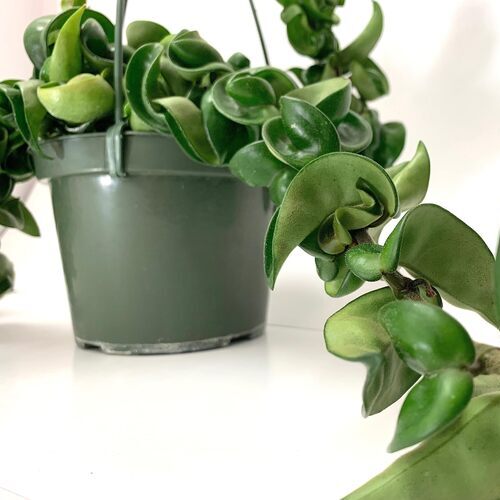
The Hindu Rope Plant is a distinctive cultivar of Hoya carnosa, prized for its thick, curled, and twisted succulent-like leaves that give the vine a rope-like or braided appearance. Unlike the flat-leaved species from which it originated, this cultivar developed its contorted foliage through a natural mutation, and it has since become one of the most sought-after Hoya varieties among collectors for its sculptural, low-maintenance charm. The leaves are dark green, glossy, and deeply curled inward along their length, sometimes described as resembling a coil of rope or a string of small green seashells.
Native to Southern India, parts of Southeast Asia, and Northern Australia, this Hoya grows naturally as an epiphyte in warm, humid forest environments, often clinging to trees and rock faces using aerial roots. In its native habitat it receives dappled sunlight filtered through a forest canopy, along with high ambient humidity and excellent drainage, conditions that horticulturists try to replicate indoors. Its epiphytic nature means it does not require deep soil to anchor itself, and it thrives in hanging baskets or on trellises where its vining stems can cascade or climb.
Beyond its unusual foliage, mature specimens produce clusters of small, star-shaped, waxy flowers with a sweet fragrance, typically pink or white with a contrasting center. These blooms, borne on spurs that persist and rebloom year after year, add to the plant’s appeal as both a foliage and flowering specimen. Slow-growing and long-lived, a well-cared-for specimen can survive for decades, often being passed down as a treasured heirloom houseplant.
Caring for this Hoya is straightforward once its basic preferences are understood, making it an excellent choice for both beginners and experienced plant keepers alike. As a succulent-leaved epiphyte, it stores water in its thick foliage, so its care regimen leans toward the drier side compared to many other tropical houseplants. Bright, indirect light, well-draining chunky soil, and a consistent but restrained watering schedule form the foundation of healthy growth.
Light is one of the most important factors for encouraging both vigorous growth and flowering. A spot near an east- or west-facing window, or a few feet back from a bright south-facing window, provides the bright indirect light this plant craves. Too little light results in slow growth and reluctance to flower, while direct, intense afternoon sun can scorch the curled leaves. Pairing appropriate light with a well-aerated potting mix, such as one amended with orchid bark, perlite, and coarse material, prevents the root rot that this plant is otherwise prone to when overwatered.
Beyond light and soil, attention to humidity, temperature stability, and a light feeding schedule during the growing season rounds out a solid care routine. This Hoya appreciates warm, stable temperatures, moderate to high humidity, and a rest period in winter with reduced watering and fertilizing. Repotting is rarely needed since the plant prefers being slightly pot-bound, and disturbing the roots unnecessarily can delay flowering. With patience, minimal intervention, and consistent conditions, this plant rewards its caretaker with dense, textural foliage and fragrant, long-lasting blooms.
 Soil
Soil
This Hoya requires a light, chunky, and extremely well-draining substrate rather than standard potting soil, reflecting its epiphytic origins where it grows on bark and organic debris rather than in dense earth. An ideal mix combines standard potting soil or coco coir with orchid bark, perlite, and a small amount of horticultural charcoal, creating a composition that holds a little moisture around the roots while allowing excess water to drain away quickly and air to reach the root zone. A slightly acidic to neutral pH range of about 6.0 to 6.5 supports optimal nutrient uptake without causing deficiencies.
Soil composition directly affects the plant’s susceptibility to root rot, one of the most common issues with this species; dense, water-retentive soil suffocates the fine roots and invites fungal pathogens, while an overly gritty mix without any organic matter can dry out too quickly and stress the plant. Amending the mix with sphagnum moss can help retain slight moisture in drier climates, while adding extra perlite or pumice benefits growers in humid environments prone to overwatering.
Common soil-related problems include poor drainage leading to root rot and yellowing leaves, soil compaction over time that restricts oxygen to roots and slows growth, an inappropriate pH that locks out nutrients and causes pale or stunted foliage, salt build-up from tap water or over-fertilizing that appears as a white crust on the soil surface, nutrient deficiencies from old, depleted potting mix, and root boundness, which this species actually tolerates well and which can even encourage blooming, though extreme root boundness eventually restricts water uptake and requires repotting.
 Fertilizer
During the active growing season from spring through early autumn, feed every four to six weeks with a balanced, water-soluble houseplant fertilizer diluted to half strength, or a fertilizer formulated specifically for flowering succulents or Hoyas, which often carries a slightly higher phosphorus content to encourage blooming. Suspend feeding entirely in the low-light winter months when growth naturally slows.
Over-fertilization presents as a white crust of salts on the soil surface, browned or crispy leaf tips and edges, and stunted new growth, while under-fertilization shows as pale, slow-growing foliage and a lack of flowering over multiple seasons.
Organic alternatives such as diluted fish emulsion, worm castings tea, or compost tea can supply gentler, slow-release nutrition, and this species particularly benefits from adequate potassium and phosphorus, along with trace micronutrients like magnesium, to support both its succulent foliage and its flowering spurs.
 Watering
Allow the top half to two-thirds of the potting mix to dry out completely between waterings, then water thoroughly until liquid runs from the drainage holes, discarding any excess collected in the saucer. This succulent-leaved vine stores water in its thick foliage and is considerably more drought-tolerant than moisture-loving houseplants, making underwatering far less damaging than overwatering. Room-temperature filtered, distilled, or rainwater is preferable to hard tap water, which can cause mineral salt build-up in the soil over time and lead to leaf tip browning.
Signs of overwatering include soft, mushy, or yellowing leaves, a sour smell from the soil, and blackened stems at the base, indicating root rot has set in. Underwatering, by contrast, shows up as wrinkled, deflated, or puckered leaves as the plant draws on its internal water reserves, though the plant usually plumps back up quickly once watered.
Watering frequency should be reduced significantly in autumn and winter when growth slows and light levels drop, often stretching to every three to four weeks, while spring and summer during active growth may call for watering every one to two weeks depending on home humidity and pot size.
Stop guessing. Most houseplant failures are caused by volumetric errors and improper moisture tension. Our deterministic calculator moves beyond "once-a-week" watering by analyzing the four critical pillars of root health:
Personalized for this plant
Disclaimer: Our calculator is pretty smart. We’ve crunched the numbers, but we’re not measuring the quantum state of your living room. Since we don’t know your exact indoor temperature, humidity, light, airflow, or whether your plant receives daily sweet nothings and motivational speeches, use this calculator as a guide—and always keep an eye on your plant.
 Lighting
Bright, indirect light is essential for healthy growth and reliable flowering. An east-facing window offering gentle morning sun, or a spot several feet from a south- or west-facing window, provides the ideal balance of intensity without risking leaf burn. Filtered light through a sheer curtain also works well.
Signs of insufficient light include elongated, leggy stems with wide spacing between leaves, pale or dull green coloring, and a persistent failure to flower even in mature plants. Excessive or direct light exposure, on the other hand, causes bleached, yellowish, or scorched patches on the leaves, particularly on the curled ridges most exposed to direct rays, and can cause the foliage to lose its glossy sheen.
If natural light is insufficient, supplementing with a full-spectrum LED grow light positioned twelve to eighteen inches above the foliage for ten to twelve hours daily can effectively replace or boost natural light, particularly in low-light apartments or during darker winter months.
 Temperature
This plant thrives in warm, stable indoor temperatures between 65°F and 85°F (18°C to 29°C), reflecting its tropical origins. It has little tolerance for cold and should be protected from temperatures below 50°F (10°C), which can cause leaf drop, tissue damage, or death in prolonged exposure.
It tolerates typical indoor temperature fluctuations reasonably well but should be kept away from cold drafts near doors and windows in winter, as well as away from hot or cold air currents from heating and cooling vents. During summer, avoid placing the plant outdoors if nighttime temperatures are expected to drop suddenly, and bring potted specimens indoors well before the first frost.
 Humidity
Moderate to high humidity in the range of 40 to 60 percent supports the lush, glossy appearance of the curled foliage, though this resilient plant can tolerate average indoor humidity levels found in most homes.
Low humidity stress presents as slightly wrinkled or dry-edged leaves and slower growth, while excessively high humidity combined with poor air circulation can encourage fungal issues on the leaves or in the soil.
Effective ways to raise humidity include grouping the plant with other houseplants, setting the pot on a pebble tray filled with water so evaporation raises local moisture without waterlogging the roots, or running a small humidifier nearby; misting is far less effective and can encourage fungal spotting on the curled leaf crevices where water tends to pool, so it is generally not recommended for this species.
 Propagation
Propagation is most commonly and successfully achieved through stem cuttings rooted in water or a well-draining media, with leaf-node cuttings offering the highest success rates and fastest establishment compared to leaf-only cuttings, which can be slow to root and sometimes fail to produce a viable new plant. Late spring through summer, during the active growing season, is the best time to take cuttings, as warmth and natural humidity encourage faster root development.
1. Select a healthy stem with at least two to three leaf nodes and no signs of disease.
2. Using clean, sharp scissors or pruning shears, cut just below a node, producing a cutting four to six inches long.
3. Allow the cut end to callus over for a few hours in a dry, shaded spot to reduce the risk of rot.
4. Place the cutting in a glass of room-temperature filtered water, or insert it into a moistened mix of perlite and sphagnum moss, ensuring at least one node is submerged or buried.
5. Position the cutting in bright, indirect light and maintain warmth around 70 to 80°F (21 to 27°C).
6. If rooting in water, change the water every five to seven days to prevent bacterial buildup.
7. Roots typically begin to appear within two to four weeks; once roots reach about one to two inches long, transplant into a well-draining potting mix.
8. Keep the newly potted cutting in consistently moist (not soggy) soil for the first few weeks to help it establish, then transition to the normal watering schedule.
9. New growth typically emerges within four to eight weeks after potting, with the young plant reaching a mature, well-established size within one to two years.
Water propagation tends to have a slightly higher visible success rate for beginners since root development can be monitored directly, while soil or moss propagation often produces sturdier root systems better adapted to transplant shock; overall success rates for healthy node cuttings taken in the growing season commonly exceed 70 to 80 percent.
 Potting
A shallow, well-draining pot with ample drainage holes, made of terracotta or unglazed ceramic to help wick away excess moisture, suits this plant’s preference for slightly dry, well-aerated roots. A hanging basket is particularly well-suited given its trailing growth habit. Repotting is only needed every two to three years, as this Hoya blooms more reliably when its roots are somewhat crowded within the pot.
Signs that repotting is needed include roots visibly growing out of the drainage holes, water running through the pot too quickly without being absorbed, stunted growth despite otherwise good care, or a potting mix that has broken down and become compacted and slow-draining after a couple of years.
Root pruning is rarely necessary for this species and should be approached conservatively; trimming only clearly dead, mushy, or rotted roots during repotting is sufficient. When transitioning to a new pot, choose one only one to two inches larger in diameter, gently loosen the root ball without aggressively disturbing healthy roots, and water lightly after repotting rather than heavily, allowing the plant a settling-in period of reduced fertilizing for about a month while it recovers from transplant stress.
 Pruning
Late winter to early spring, just before the active growing season begins, is ideal for pruning, allowing the plant to recover quickly and channel new energy into fresh growth.
Light, occasional pruning once or twice a year is generally sufficient, as this slow-growing vine does not require frequent trimming.
Pruning is primarily used to remove damaged, dead, or overly leggy stems, to control the length of trailing vines, and to encourage bushier, fuller growth from lower nodes.
Use clean, sharp bypass pruning shears or scissors sterilized with rubbing alcohol to prevent the spread of disease, and work over a surface that can be wiped clean, as the plant’s milky sap can stain fabric and irritate skin.
Keep the freshly pruned plant in its usual bright, indirect light spot, resume normal watering, and avoid fertilizing for about two weeks to let the plant recover before pushing new growth.
Never remove the short, woody flower spurs that remain after blooming, as these same spurs will continue to produce new flowers for years; cutting them off will delay or prevent future blooms.
 Blooming
Blooming typically occurs in late spring through summer, with established plants sometimes flowering intermittently into early autumn under stable indoor conditions. Each flowering event lasts one to two weeks per cluster, and the plant may produce several flushes across the season once mature, usually after two to three years of growth. Optimal blooming is triggered by bright indirect light, slight root-bound conditions, consistent warmth above 65°F (18°C), and a period of slightly reduced winter watering that mimics a natural dry season. Flowers form in dense, ball-shaped umbels of waxy, star-shaped blossoms, typically pale pink to white with a deep pink or red star-shaped corona at the center, and they emit a sweet, honey-like fragrance most noticeable in the evening. Flower spurs (peduncles) should never be removed after blooming, as the same spur will produce new flowers in subsequent seasons.
 Pests and Diseases
Name: Mealybugs
Symptoms: Small, white, cottony clusters found in leaf crevices and along stems, sticky honeydew residue, and yellowing leaves.
Treatment: Dab affected areas with a cotton swab dipped in isopropyl alcohol, follow with a thorough application of insecticidal soap or neem oil, and repeat weekly until the infestation clears.
Name: Spider Mites
Symptoms: Fine webbing on the undersides of leaves and between curled foliage, stippled or speckled discoloration on the leaf surface, and a general dulling of leaf color.
Treatment: Increase humidity, rinse the foliage under lukewarm water, and treat with insecticidal soap or a miticide, repeating every seven to ten days for two to three cycles.
Name: Aphids
Symptoms: Clusters of small green, black, or brown insects on new growth and flower buds, sticky residue, and distorted new leaves.
Treatment: Spray affected areas with a strong stream of water to dislodge insects, then apply insecticidal soap or neem oil, repeating every five to seven days.
Name: Scale Insects
Symptoms: Small, flat, brown or tan bumps adhered to stems and leaf undersides, sticky honeydew, and yellowing or dropping leaves.
Treatment: Scrape off visible scale with a fingernail or soft brush, treat with horticultural oil or neem oil, and repeat every two weeks until resolved.
Name: Root Rot
Symptoms: Mushy, blackened roots, yellowing and wilting leaves despite moist soil, and a foul odor from the potting mix.
Treatment: Remove the plant from its pot, trim away all rotted roots with sterilized scissors, allow the remaining roots to dry, and repot into fresh, well-draining mix; reduce watering frequency going forward.
Name: Botrytis (Gray Mold)
Symptoms: Fuzzy gray mold on flowers, buds, or damaged foliage, usually in cool, humid, poorly ventilated conditions.
Treatment: Remove and discard affected plant parts immediately, improve air circulation around the plant, avoid overhead watering, and apply a fungicide if the problem persists.
Name: Bacterial Leaf Spot
Symptoms: Water-soaked, dark, or black spots on leaves that may enlarge and merge, sometimes with a yellow halo.
Treatment: Isolate the plant, remove and discard infected leaves, avoid wetting the foliage during watering, and improve airflow; a copper-based bactericide can help in severe cases.
 Special Features
This Hoya’s most striking feature is its densely curled, rope-like foliage, a naturally occurring mutation that transforms the typically flat, oval leaves of its parent species into tight, glossy coils reminiscent of green seashells or braided cord, making it a standout textural specimen even without flowers. Mature plants produce clusters of small, waxy, star-shaped blossoms with a sweet, honey-like fragrance most noticeable in the evening, adding seasonal fragrant interest to its year-round sculptural foliage. Its slow growth rate and long lifespan mean a single specimen can be enjoyed and passed down for decades, and its tolerance for being pot-bound, combined with its low water needs, makes it an especially easy, low-maintenance choice for hanging baskets, shelves, or trellised displays in bright rooms.
 Plant Benefits
While not used in mainstream herbal medicine, various Hoya species, including relatives of this cultivar, have a history in traditional Southeast Asian and Ayurvedic folk medicine, where sap or leaf preparations were occasionally applied topically for minor skin ailments or used in small quantities as a folk remedy for coughs; however, these uses are largely anecdotal, not clinically validated, and are not a substitute for professional medical treatment. Its primary recognized benefit remains ornamental and psychological, contributing modestly to indoor greenery and the general wellbeing associated with houseplant care.
 Additional Information
This cultivar is sometimes confused with true Hoya compacta species names in older nursery catalogs, but it is most accurately classified as a cultivated variety of Hoya carnosa. A variegated form, often labeled Hoya carnosa ‘Compacta Variegata’ or ‘Krinkle Kurl Variegated,’ features cream or yellow leaf margins and tends to grow more slowly than the solid green form. Collectors often display it in hanging baskets to showcase its cascading, twisted stems, which can reach several feet in length over many years of growth.
 Life Cycle
As a slow-growing perennial epiphytic vine, this plant progresses from a rooted stem cutting through a juvenile vegetative stage focused on leaf and stem production, eventually reaching maturity after two to three years, at which point it begins producing flower spurs and blooming seasonally. Once established, the same flower spurs persist and rebloom year after year without needing to be replaced, and the plant can continue growing and flowering for decades under stable indoor conditions, making it one of the longer-lived common houseplants.
 Are Hindu Rope Plant Poisonous, Toxic
This Hoya is generally considered non-toxic but mildly irritating rather than seriously poisonous. The milky latex sap found in the leaves and stems contains compounds that can cause mild gastrointestinal upset if ingested by cats, dogs, or children, and may cause mild skin irritation on contact with sensitive skin. All parts of the plant, particularly the stems and leaves where the sap is concentrated, are considered the mildly toxic components. In pets, symptoms of ingestion may include mild vomiting, drooling, or lip-smacking; in children, mouthing the leaves may cause temporary mouth or throat discomfort. Severity is classified as low, with symptoms typically resolving on their own without medical intervention. As first aid, rinse the mouth or affected skin with water, offer small sips of water to pets or children who have ingested plant material, and monitor for any escalation of symptoms. Contact a veterinarian, poison control center, or physician if symptoms persist or worsen. As a preventive measure, place the plant in a hanging basket or elevated location out of reach of curious pets and small children, and wash hands after pruning or handling cut stems.
 Frequently Asked Questions
Water only after the top half to two-thirds of the soil has dried out, typically every one to two weeks in the growing season and every three to four weeks in winter.
It is considered generally non-toxic but may cause mild stomach upset or skin irritation from its milky sap if chewed or handled.
Lack of flowering usually stems from insufficient bright indirect light, a plant that is too young or recently repotted, or inconsistent temperatures; increasing light and allowing the plant to become slightly pot-bound often helps.
Take a stem cutting with at least two nodes, let it callus, then root it in water or moist perlite and sphagnum moss under bright indirect light until roots form.
A chunky, well-draining mix of potting soil, orchid bark, and perlite works best, mimicking the loose, airy conditions of its natural epiphytic habitat.
Wrinkled leaves usually indicate underwatering, as the plant draws on stored water in its succulent foliage; a thorough watering typically restores the leaves within a day or two.
No, the woody spurs left after flowering should be left intact, as the same spur will produce new blooms in future seasons.
It needs bright, indirect light, such as an east-facing window or a few feet back from a south-facing window, avoiding harsh direct midday sun.
Leaf drop is often caused by overwatering and root rot, sudden cold drafts, or a significant change in light conditions; check the roots and adjust watering and placement accordingly.
It typically remains small to medium in size, with trailing vines that can reach several feet in length over many years, though growth is slow.
 Can I grow Hindu Rope Plant in my indoor space
Difficulty: Easy
Size: Small to Medium
Light: Medium
Water: Low
Flowering: Yes
Pet Safe: Yes
Air Purifier: Low
 Hoya carnosa 'Compacta' botanical details
Common Name: Hindu Rope Plant
Other Common Names: Hindu Rope Hoya, Krinkle Kurl, Wax Plant (cultivar), Porcelain Flower (cultivar), Curly Hoya, Hoya Compacta Regalis (variegated form)
Botanical Name: Hoya carnosa 'Compacta'
Native Area: Southern India, Southeast Asia, and Northern Australia
Family Name: Apocynaceae
Plant Type: Perennial, epiphytic succulent vine
Genus: Hoya
Kingdom: Plantae
 Photo Gallery
 My Hindu Rope Plant Plant Care Recommendations
If you find the Houseplant Encyclopedia helpful and would like to support Healthy Houseplants, you can use the links below to shop for recommended plants, products, and plant-care supplies.
Some links are affiliate links, which means I may earn a small commission if you make a qualifying purchase through them, at no additional cost to you. Thank you for supporting Healthy Houseplants and helping me continue to provide free plant-care information!

Want even more personalized plant-care help? Check out my AI Julie Chatbot—trained on my 20 years of houseplant knowledge, not just information from the internet!  Try it now:Ask AI Julie
 Buy Hindu Rope Plant Online
✅ “Bring Home This Beauty Today”
✅ “Get Your Own Hindu Rope Plant Before It’s Gone”
✅ “Shop Trusted Sellers – Limited Availability”
✅ “Free Delivery”
As an Amazon Associate, I earn commission from qualifying purchases.
 Plant Puns and Jokes
Why did the Hindu Rope Plant refuse to compete in the garden talent show? It already knew it was tied for first place.
 Signup to our newsletter and download Hindu Rope Plant care guide

