


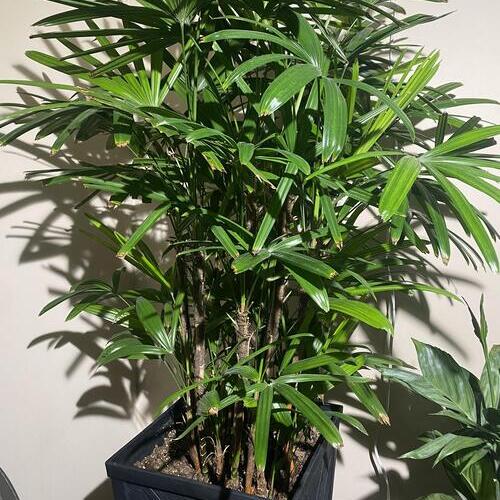
The Majesty Palm (Ravenea rivularis) is a striking feather-leaved palm native to the riverbanks and seasonally flooded forests of Madagascar, where it grows along waterways in the central and southwestern regions of the island. In its natural habitat, it can reach towering heights of 40 to 90 feet, developing a slender, gray-brown trunk topped with a dense crown of long, arching fronds. When cultivated indoors or in cooler climates, however, the Majesty Palm is typically kept much smaller, usually reaching 4 to 10 feet tall in a container, which makes it a popular choice for adding lush, tropical greenery to homes, offices, and patios.
The plant’s most notable feature is its graceful, pinnate foliage. Each frond is composed of dozens of narrow, deep green leaflets arranged symmetrically along a central rib, creating a soft, feathery silhouette that curves outward and downward as the plant matures. This dense canopy of foliage gives the Majesty Palm an elegant, fountain-like appearance that has made it a favorite for creating a resort-style or jungle aesthetic in interior spaces. The trunk is ringed with the scars of old leaf bases, a characteristic shared by many palms, and develops a slightly swollen base as the plant ages.
Despite its dramatic, statuesque appearance, the Majesty Palm is classified as an evergreen perennial and belongs to a relatively small genus of palms endemic to Madagascar. In the wild, it is considered vulnerable due to habitat loss along the rivers it depends on, which makes cultivated specimens an important way to enjoy this species without impacting wild populations. It is widely propagated commercially, particularly in Florida and other subtropical growing regions, for sale in the houseplant and landscape trade.
Caring for a Majesty Palm indoors requires closely mimicking the humid, consistently moist riverside conditions of its native Madagascar habitat. This palm is often considered more demanding than other common houseplant palms because it evolved growing directly along waterways, meaning it expects steady moisture and high humidity rather than the drier, more forgiving conditions many other indoor plants tolerate. Success with this species largely comes down to three consistent factors: bright, indirect light, evenly moist soil, and elevated humidity.
Light is one of the most important considerations. Majesty Palms need bright, indirect sunlight to maintain their rich green color and dense growth; in low light, the fronds will thin out, stretch, and lose their vibrant color, while direct harsh sun, especially through unfiltered west-facing windows, can scorch the delicate leaflets. Pairing the right light with a consistent watering routine is essential, since these palms do not tolerate the soil drying out completely between waterings the way many drought-tolerant houseplants do. At the same time, they are equally sensitive to sitting in waterlogged soil, so well-draining potting media and a pot with drainage holes are non-negotiable.
Beyond light and water, maintaining humidity above 50 percent, feeding lightly during the growing season, and periodically wiping down the fronds to prevent dust buildup and discourage spider mites will keep a Majesty Palm looking full and healthy. Many growers find that grouping the palm with other humidity-loving plants, using a pebble tray, or running a humidifier nearby makes a significant difference in the plant’s long-term vigor, especially in centrally heated or air-conditioned homes where ambient humidity tends to be low.
 Soil
Soil
Majesty Palms thrive in a rich, loose, well-draining potting mix that still retains enough moisture to keep the roots consistently damp, reflecting their native riverside habitat. A good blend combines standard peat-based or coco coir potting mix with perlite or coarse sand to improve drainage, along with some compost or well-rotted organic matter to boost fertility and moisture retention. The ideal soil pH is slightly acidic to neutral, generally in the range of 6.0 to 6.5, which supports optimal nutrient uptake, particularly of iron and manganese, both of which this species is prone to becoming deficient in if the pH drifts too far alkaline.
Drainage is critical despite the plant’s love of moisture: soil that is too dense or compacted will hold water around the roots for too long, leading to root rot, while soil that drains too quickly will cause the roots to dry out and the fronds to brown at the tips. Amending heavy potting mixes with perlite, orchid bark, or coarse sand helps strike this balance. A slow-release, balanced organic fertilizer or well-composted manure worked into the topsoil can also help maintain the steady nutrient supply this palm needs for its dense foliage.
Common soil-related problems include poor drainage, which suffocates roots and promotes fungal issues; soil compaction over time, which restricts oxygen and water flow to the roots and often necessitates repotting or gently aerating the topsoil; inappropriate pH, which locks out essential micronutrients and causes yellowing fronds even when fertilizer is applied; salt build-up from tap water or over-fertilizing, visible as a white crust on the soil surface and pot rim, which can burn root tips; nutrient deficiencies, especially of potassium, magnesium, and iron, which show up as yellowing, spotting, or browning of older fronds; and root boundness, where a palm left too long in the same pot develops a dense, circling root mass that limits water and nutrient uptake and eventually stunts growth, signaling that it is time to repot into a larger container.
 Fertilizer
Majesty Palms benefit from regular but light feeding during their active growing season in spring and summer, using a balanced, palm-specific fertilizer or a general liquid houseplant fertilizer diluted to half strength every 4 to 6 weeks. Palm-specific fertilizers are ideal because they typically contain extra magnesium, manganese, and potassium, three nutrients this species is particularly prone to running low on, which helps prevent the yellowing and frizzled new growth associated with those deficiencies. Feeding should be scaled back or stopped entirely in fall and winter when the plant’s growth naturally slows.
Signs of over-fertilization include a white, crusty salt buildup on the soil surface and pot rim, browned or burnt root tips, and scorched-looking leaf edges, while under-fertilization typically shows up as pale, yellowish new growth, weak or slow frond production, and an overall lack of vigor despite otherwise proper care. Because Majesty Palms are especially sensitive to potassium and magnesium deficiencies, which manifest as yellow or orange spotting on older fronds and a translucent, frizzled appearance on new leaves, choosing a fertilizer formulated with these micronutrients in mind can prevent common problems before they start.
For those preferring organic options, well-diluted fish emulsion, compost tea, or worked-in compost can supply a gentler, slower-release source of nutrients, though these may need to be applied slightly more frequently to match the nutrient availability of synthetic liquid fertilizers. Regardless of the fertilizer type chosen, always water the soil before applying fertilizer to prevent root burn, and flush the soil periodically with plain water to help dissolve and remove accumulated mineral salts.
 Watering
Majesty Palms prefer consistently moist soil that never fully dries out, a reflection of their native habitat along riverbanks with steady water access. In most indoor conditions, this typically means watering thoroughly once the top inch of soil begins to feel dry, often every 5 to 7 days, though this will vary based on pot size, light levels, and home humidity. The plant strongly prefers distilled water, rainwater, or water that has been left to sit out overnight to allow chlorine to dissipate, as it is notably sensitive to the fluoride, chlorine, and salt content found in many municipal tap water supplies, which can cause brown, burnt-looking leaflet tips.
Signs of underwatering include drooping or curling fronds, dry and crispy brown tips or edges, and an overall wilted appearance that usually rebounds within a day of thorough watering. Overwatering, on the other hand, tends to present as yellowing lower fronds, a mushy or foul-smelling base, and eventually root rot if the soil remains saturated for extended periods without adequate drainage; this is one of the most common causes of Majesty Palm decline, often ironically resulting from well-meaning owners keeping the soil too wet without sufficient drainage.
Watering needs shift with the seasons and growth stages: during the active growing season in spring and summer, the plant will drink more frequently and benefit from consistently moist soil, while in fall and winter, when growth slows and light levels drop, watering frequency should be reduced slightly to allow the top inch or so of soil to dry between waterings, preventing cold, waterlogged roots during the plant’s dormant period.
Stop guessing. Most houseplant failures are caused by volumetric errors and improper moisture tension. Our deterministic calculator moves beyond "once-a-week" watering by analyzing the four critical pillars of root health:
Personalized for this plant
Disclaimer: Our calculator is pretty smart. We’ve crunched the numbers, but we’re not measuring the quantum state of your living room. Since we don’t know your exact indoor temperature, humidity, light, airflow, or whether your plant receives daily sweet nothings and motivational speeches, use this calculator as a guide—and always keep an eye on your plant.
 Lighting
Majesty Palms grow best in bright, indirect light, ideally near an east-facing window or a few feet back from a south- or west-facing window where the light is filtered through a sheer curtain. Outdoors, they prefer partial shade to dappled sunlight, particularly when young, though mature specimens can tolerate more direct sun in humid, tropical climates. Consistent, bright ambient light is key to keeping the fronds a rich, deep green and encouraging full, dense growth.
Signs of insufficient light include pale or yellowing new growth, sparse and leggy frond production, and a general loss of the plant’s characteristically lush, full appearance as it stretches toward the nearest light source. Conversely, excessive direct sunlight, especially through unfiltered glass, can scorch the delicate leaflets, causing brown, crispy patches or bleached, faded coloring on the fronds facing the light.
If natural light is insufficient, particularly in darker interior spaces or during winter months, supplementing with a full-spectrum LED or fluorescent grow light for 10 to 12 hours a day can help maintain healthy growth. Rotating the pot periodically also ensures even light exposure on all sides of the plant, preventing it from growing lopsided as it reaches toward a single light source.
 Temperature
Majesty Palms prefer warm, stable temperatures between 65 and 85°F (18 to 29°C), reflecting their tropical Madagascar origins. They are not frost-tolerant and should be protected from any exposure to temperatures below 50°F (10°C), which can cause chilling damage, blackened fronds, or plant death in severe or prolonged cases.
This palm has relatively low tolerance for sudden temperature fluctuations or cold drafts, so it should be kept away from air conditioning vents, drafty windows and doors, and unheated porches or sunrooms during cooler months. Consistency is more important to this species than achieving a specific exact temperature, and sudden swings, even within a generally acceptable range, can stress the plant and lead to frond drop or discoloration.
To protect a Majesty Palm from extreme temperatures, keep it away from exterior doors in winter, avoid placing it directly against cold windowpanes, and bring outdoor or patio specimens indoors well before the first frost in climates with cold winters. In excessively hot conditions, particularly above 90°F with low humidity, increasing ambient moisture and ensuring the soil does not dry out will help the plant cope with heat stress.
 Humidity
Majesty Palms require high humidity, ideally 50 percent or above, to truly thrive, making them one of the more humidity-demanding common houseplants. In their native riverside habitat, ambient moisture in the air is nearly constant, and indoor environments, especially those with central heating or air conditioning, often fall well short of this, which is a leading cause of the browning frond tips and pest problems commonly seen in cultivated specimens.
Symptoms of low humidity stress include crispy, brown leaflet tips and edges, increased susceptibility to spider mites (which thrive in dry air), and an overall dull or crinkled appearance to the foliage. High humidity is rarely a problem for this species, though extremely stagnant, overly damp conditions combined with poor air circulation can occasionally encourage fungal issues on the foliage or soil surface.
To raise humidity around a Majesty Palm, a room humidifier placed nearby is the most effective and consistent method, particularly in dry climates or during winter heating season. Pebble trays filled with water placed beneath the pot can offer a modest, localized humidity boost as the water evaporates, though the effect is generally milder than a humidifier. Regular misting can provide temporary relief but is the least effective long-term solution and should be paired with good air circulation to avoid fostering fungal growth on the fronds; grouping the palm with other moisture-loving plants or placing it in a naturally humid room, such as a bathroom with adequate light, are also effective strategies.
 Propagation
Unlike many popular houseplants, Majesty Palms are not easily propagated at home through cuttings or division, because they grow from a single, solitary trunk with one central growing point and do not produce offsets, suckers, or pups the way clustering palms do. As a result, the only viable method of propagation is by seed, which is also how virtually all commercially available Majesty Palms are produced.
Step-by-step seed propagation guide:
1. Obtain fresh Ravenea rivularis seeds, ideally harvested from ripe orange-red fruit, since viability drops quickly as seeds age.
2. Clean the fleshy fruit pulp away from the seed, as it can inhibit germination or encourage mold.
3. Soak the cleaned seeds in warm water for 24 to 48 hours to soften the seed coat and improve germination odds.
4. Sow the seeds about half an inch deep in a well-draining seed-starting mix, such as a blend of peat and perlite.
5. Keep the growing medium consistently moist but not waterlogged throughout the germination process.
6. Maintain warm conditions, ideally 75 to 85°F, using a heat mat if necessary, since consistent warmth significantly speeds germination.
7. Cover the container with plastic wrap or a humidity dome to maintain high humidity around the seed.
8. Be patient, as germination is notoriously slow and irregular, often taking two to six months, and sometimes longer.
9. Once seedlings emerge and develop their first true leaf, transplant them into individual small pots with standard well-draining potting mix.
10. Grow young seedlings in bright, indirect light with high humidity for at least a year before treating them as an established houseplant.
Because seed propagation is slow, inconsistent, and requires specific warm, humid conditions, success rates for home growers are generally low to moderate, and most hobbyists find it far more practical to purchase an already-established nursery plant rather than attempt propagation themselves.
 Potting
Majesty Palms should be planted in a sturdy pot with ample drainage holes to prevent water from pooling around the root system, paired with a rich, well-draining potting mix amended with perlite or coarse sand as described in the soil section. Because these palms develop a fairly substantial root system relative to their pot size, a heavier ceramic or terracotta pot is often preferable to lightweight plastic, both for stability against the plant’s top-heavy foliage and for the added breathability terracotta provides to the root zone.
Repotting is generally needed every 1 to 2 years for younger, actively growing plants, or when roots are visibly circling the drainage holes, emerging from the soil surface, or when the plant seems to dry out unusually fast after watering, all signs that it has become root bound. When repotting, choose a new pot only 2 to 3 inches larger in diameter than the current one, since an oversized pot can hold excess moisture and increase the risk of root rot.
During repotting, gently loosen any tightly circling roots and trim away any that are clearly dead, mushy, or damaged, though heavy root pruning should be avoided since Majesty Palms can be sensitive to significant root disturbance. To minimize transplant stress, repot during the plant’s active growing season in spring or early summer, keep the plant well-watered before and after the move, and place it in a slightly shadier spot than usual for a week or two afterward to allow the roots to recover before resuming normal light exposure.
 Pruning
Majesty Palms need minimal pruning, and it should be done primarily to remove dead, yellowing, or damaged fronds rather than for shaping, since cutting healthy green fronds can stress the plant and slow its growth. The best time to prune is during the active growing season in spring or summer, when the plant is best equipped to recover quickly, though dead or clearly dying fronds can be removed at any time of year.
Use clean, sharp pruning shears or a sharp knife, sterilized with rubbing alcohol before and between cuts to prevent the spread of disease. Wear gloves, since the frond edges and stems can be mildly abrasive, and lay down a tarp or newspaper to make cleanup of the trimmed fronds easier.
After pruning, resume normal watering and light care, and avoid fertilizing immediately after a significant pruning session to give the plant time to recover. Never remove the central growing point or spear at the top of the trunk, as Majesty Palms have only one growth point and damage to it can be fatal to the plant.
 Blooming
Majesty Palms grown indoors or as young container plants rarely, if ever, bloom, as flowering typically only occurs on mature specimens grown outdoors in a suitable tropical or subtropical climate, often after 10 or more years of growth. When mature outdoor plants do flower, they produce small, inconspicuous cream to yellowish flowers clustered on branched inflorescences that emerge from among the leaf bases, usually in spring to summer under warm, humid conditions with consistent moisture. The blooms are not showy and are followed, on female or mature specimens, by small round orange-red fruits. Because indoor specimens are grown almost exclusively for their ornamental foliage rather than flowers, most growers will never observe this palm in bloom.
 Pests and Diseases
Name: Spider mites
Symptoms: Fine webbing on the undersides of fronds, stippled or speckled yellowing on the leaflets, and an overall dull, dusty appearance to the foliage, often worsened by low humidity
Treatment: Increase humidity, rinse the fronds thoroughly under lukewarm water, and treat with insecticidal soap or neem oil, repeating every 7 to 10 days until the infestation clears
Name: Scale insects
Symptoms: Small, brown or tan, dome-shaped bumps along the stems and undersides of leaflets, often accompanied by sticky honeydew residue and sooty mold
Treatment: Manually remove visible scale with a cotton swab dipped in rubbing alcohol, and follow up with horticultural oil or insecticidal soap applications to catch newly hatched crawlers
Name: Mealybugs
Symptoms: Cottony white clusters typically found in leaf joints and along the stems, along with sticky honeydew and possible sooty mold growth
Treatment: Dab visible mealybugs with rubbing alcohol on a cotton swab, then treat the whole plant with insecticidal soap or neem oil, repeating regularly until no new bugs appear
Name: Root rot
Symptoms: Yellowing and wilting fronds, a mushy or foul-smelling base or root system, and stunted or halted growth, usually resulting from overly wet, poorly draining soil
Treatment: Remove the plant from its pot, trim away any black or mushy roots with sterilized shears, repot into fresh, well-draining soil, and adjust watering habits to prevent recurrence
Name: Leaf spot fungal diseases
Symptoms: Brown, black, or yellow spots with defined edges scattered across the fronds, sometimes surrounded by a yellow halo, typically worsened by overly wet foliage and poor air circulation
Treatment: Remove and dispose of severely affected fronds, avoid overhead watering that wets the foliage, improve air circulation around the plant, and apply a copper-based fungicide if the problem persists
 Special Features
The Majesty Palm is prized above all for its lush, feathery, fountain-like fronds that bring an instant sense of tropical grandeur to any space, making it one of the most popular large statement palms in interior design. Its ability to grow into a tall, elegant specimen while still being manageable in a container makes it a favorite for filling empty corners, softening modern interiors, and creating a resort-like atmosphere in homes and commercial spaces alike. While it does not produce edible fruit or notable fragrance in cultivation, its dense, evergreen canopy provides year-round visual interest and a sense of permanence rarely matched by flowering houseplants, and its non-toxic nature makes it an especially appealing choice for households with curious pets or small children.
 Plant Benefits
The Majesty Palm has no established herbal, medicinal, or pharmaceutical uses and is grown almost exclusively as an ornamental plant. Its primary benefit lies in its air-purifying qualities as a large-leaved evergreen, along with the general wellbeing associated with indoor greenery, such as improved humidity in dry indoor environments and the psychological benefits of biophilic, nature-connected interior design.
 Additional Information
Majesty Palms are widely commercially grown in Florida for the houseplant trade, and while they are relatively easy to find in nurseries and big-box stores, they have a reputation among growers as one of the more finicky common indoor palms, largely due to their high humidity and consistent moisture requirements. In the wild, the species is considered vulnerable due to habitat degradation along the Madagascar rivers it depends on, making sustainably sourced nursery specimens an important alternative to wild collection. Outdoors, the plant is only reliably hardy in USDA zones 9b through 11, and in cooler climates it is grown strictly as a container plant that can be moved indoors before frost.
 Life Cycle
The Majesty Palm is a slow to moderately slow-growing, long-lived evergreen perennial that, in ideal outdoor tropical conditions, can live for many decades and eventually reach heights of 40 to 90 feet with a single unbranched trunk. It begins life as a seed that germinates slowly, often over two to six months, followed by a juvenile stage in which the plant produces smaller, simpler fronds close to the ground. As it matures over several years, the plant develops its characteristic tall trunk and full, arching crown of pinnate fronds, continuously shedding older lower fronds as new ones emerge from the central growing point. Because it has only one growth point and does not branch or produce offsets, damage to the crown is irreversible, and the plant’s growth is entirely dependent on that single apical meristem throughout its life. Indoors, growth is typically much slower and more restrained, with mature container specimens usually topping out around 6 to 10 feet.
 Are Majesty Palm Poisonous, Toxic
Non-toxic
None; all parts of the plant (fronds, stems, and fruit) are considered non-poisonous
Cats, dogs, horses, and humans are not poisoned by this plant
Because the plant is non-toxic, true poisoning symptoms do not occur; however, chewing on the fibrous fronds can occasionally cause mild, temporary gastrointestinal upset such as drooling, mild vomiting, or diarrhea in pets due to the physical irritation of plant fiber rather than any toxin
None to minimal; classified as pet-safe by the ASPCA
If a pet or child ingests plant material and shows any digestive discomfort, offer fresh water, monitor for a few hours, and contact a veterinarian or pediatrician if vomiting, diarrhea, or lethargy persists or worsens
While non-toxic, it is still wise to discourage pets and young children from chewing on houseplants to prevent choking hazards, digestive irritation from fibrous material, and to keep decorative soil additives (such as fertilizer granules or mulch) out of reach
 Frequently Asked Questions
Water when the top inch of soil starts to feel dry, typically every 5 to 7 days, keeping the soil consistently moist but never soggy or fully dried out.
Brown tips are usually caused by low humidity, inconsistent watering, or mineral buildup from tap water; increasing humidity and switching to distilled or filtered water often resolves the issue.
No, the Majesty Palm is considered non-toxic to cats, dogs, and humans, making it a popular pet-safe houseplant.
Majesty Palms need bright, indirect light; direct sun can scorch the fronds while too little light causes thin, pale growth.
Yellowing is commonly caused by overwatering and root rot, nutrient deficiencies such as low magnesium or potassium, or insufficient light.
Use a humidifier, group it with other plants, place it on a pebble tray, or position it in a naturally humid room such as a well-lit bathroom.
Indoors, Majesty Palms typically grow to about 6 to 10 feet tall, though in their native outdoor habitat they can reach 40 to 90 feet.
Majesty Palms can only be propagated from fresh seed, since they have a single growth point and do not produce offsets or cuttings.
Feed every 4 to 6 weeks during spring and summer with a diluted, balanced palm fertilizer, and reduce or stop feeding in fall and winter.
Repot every 1 to 2 years, or when roots are circling the drainage holes or the plant dries out unusually fast, moving up only 2 to 3 inches in pot size.
 Can I grow Majesty Palm in my indoor space
Difficulty: Intermediate
Size: Large
Light: Medium
Water: High
Flowering: No
Pet Safe: Yes
Air Purifier: Medium
 Ravenea rivularis botanical details
Common Name: Majesty Palm
Other Common Names: Majestic Palm, Madagascar Palm
Botanical Name: Ravenea rivularis
Native Area: Madagascar, primarily along riverbanks and in seasonally flooded forest areas of the central and southwestern parts of the island
Family Name: Arecaceae
Plant Type: Perennial evergreen palm (tree)
Genus: Ravenea
Kingdom: Plantae
 Photo Gallery
 My Majesty Palm Plant Care Recommendations
If you find the Houseplant Encyclopedia helpful and would like to support Healthy Houseplants, you can use the links below to shop for recommended plants, products, and plant-care supplies.
Some links are affiliate links, which means I may earn a small commission if you make a qualifying purchase through them, at no additional cost to you. Thank you for supporting Healthy Houseplants and helping me continue to provide free plant-care information!

Want even more personalized plant-care help? Check out my AI Julie Chatbot—trained on my 20 years of houseplant knowledge, not just information from the internet!  Try it now:Ask AI Julie
 Buy Majesty Palm Online
✅ “Bring Home This Beauty Today”
✅ “Get Your Own Majesty Palm Before It’s Gone”
✅ “Shop Trusted Sellers – Limited Availability”
✅ “Free Delivery”
As an Amazon Associate, I earn commission from qualifying purchases.
 Plant Puns and Jokes
Why did the Majesty Palm refuse to leave the spa? Because it heard the humidity there was simply fit for royalty.
 Signup to our newsletter and download Majesty Palm care guide

