


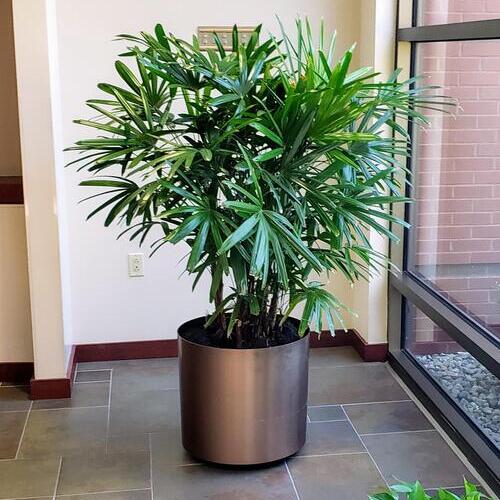
The Lady Palm (Rhapis excelsa) is a slow-growing, clumping fan palm native to the understory forests of southern China and Taiwan, where it thrives in the dappled shade beneath taller canopy trees. It has been cultivated in Asia for well over a thousand years, prized in Chinese and Japanese gardens as a symbol of resilience and refined elegance, and it was among the first palms introduced to Western horticulture during the 18th century. Unlike many palms that stretch skyward with a single trunk, Rhapis excelsa produces multiple slender, bamboo-like canes clothed in a coarse, fibrous sheath, giving the plant a dense, upright, clustering habit that rarely exceeds 4 to 5 metres even in ideal outdoor conditions.
The foliage is the plant’s most distinguishing feature: deep green, glossy, palmate leaves divided into 5 to 8 broad, blunt-tipped segments radiate from the top of each cane like an open hand or fan. The leaf texture is notably leathery and durable, which contributes to the plant’s outstanding tolerance of low light, dust, and general indoor neglect. Mature clumps develop a dense, bamboo-grove appearance that has made the species a mainstay of atrium plantings, hotel lobbies, and traditional Chinese courtyard gardens for centuries.
Rhapis excelsa is dioecious, meaning individual plants are either male or female, though flowering is rare and largely inconspicuous in cultivated specimens, especially those grown indoors. Because true seed is uncommon and slow to produce viable offspring, the plant is propagated almost exclusively by division of its offshoots, which has led to a long history of prized variegated cultivars being passed down and traded among collectors, particularly in Japan, where certain striped forms have historically commanded very high prices.
Lady Palm is widely regarded as one of the most forgiving ornamental palms available, making it an excellent choice for beginners as well as busy plant owners. It adapts readily to the lower light levels found in most homes and offices, tolerates periods of inconsistent watering better than most palms, and shows strong resistance to the common pests that plague other houseplants. Its greatest requirement is patience: this is a slow grower, and a small potted specimen may take several years to fill out into the lush, full clump most people associate with the species.
Successful care centres on replicating the palm’s native forest-floor conditions: bright, indirect light rather than direct sun, evenly moist but well-drained soil, and moderate to high humidity where possible. Overwatering and poor drainage are the most common causes of decline, so a well-aerated potting mix and a pot with adequate drainage holes are essential from the start. Regular but not excessive watering, paired with an occasional deep soak to flush accumulated salts from the soil, will keep the root system healthy over the long term.
Beyond the basics, Lady Palm benefits from a light feeding schedule during the growing season, periodic wiping or rinsing of the leaves to remove dust and keep pores clear for gas exchange, and repotting only when the clump has become genuinely root-bound, since it tolerates being slightly pot-bound better than many houseplants. With these fairly modest inputs, a healthy Lady Palm can live for decades, gradually multiplying its canes and becoming a genuine long-term companion plant rather than a short-lived decorative purchase.
 Soil
Soil
Lady Palm performs best in a loose, well-draining, slightly acidic to neutral potting mix, ideally with a pH range of about 6.0 to 6.5. A blend of standard peat-based or coco-coir potting mix combined with perlite, coarse sand, and a portion of pine bark fines creates the airy structure the roots need while still retaining enough moisture between waterings. Amending the mix with a small amount of compost or well-rotted organic matter provides a slow release of nutrients and encourages beneficial soil microbial activity that supports steady, healthy growth.
Good soil composition directly affects root respiration and nutrient uptake: because Rhapis excelsa roots are sensitive to prolonged wet, airless conditions, dense or compacted soils quickly lead to root suffocation and rot, while overly fast-draining, sandy mixes can leave the plant chronically underfed and drought-stressed. The ideal medium holds moisture briefly after watering, then drains and aerates well within a day or two. Common soil problems to watch for include poor drainage from heavy, compacted mixes or clogged drainage holes, soil compaction from repeated watering without repotting, inappropriate pH that locks out micronutrients such as iron and manganese, salt build-up from tap water and fertilizer residues that shows as white crust on the soil surface or pot rim, general nutrient deficiencies in old, depleted potting mix, and root-boundness in mature clumps that have outgrown their container. Flushing the pot thoroughly with water every few months helps prevent salt accumulation, and refreshing or replacing the top few inches of soil annually keeps nutrition and structure in good condition between full repottings.
 Fertilizer
During the active growing season from spring through early autumn, feed Lady Palm every 4 to 6 weeks with a balanced, diluted liquid fertilizer formulated for palms or general houseplants, ideally one containing micronutrients such as magnesium, manganese, and iron, since palms are particularly prone to deficiencies in these elements. A slow-release granular palm fertilizer applied once or twice during the growing season is also an effective, lower-maintenance option. Feeding should be reduced to once every couple of months, or paused entirely, during the slower-growth winter months.
Over-fertilization typically shows as browned, burnt-looking leaf tips and margins, a crust of mineral salts on the soil surface, and stunted or distorted new growth, while under-fertilization or specific nutrient deficiencies present as pale yellowing between the veins of older leaves in the case of magnesium deficiency, overall pale or yellow-green new growth with potassium deficiency, or necrotic, translucent spotting on older fronds in the case of manganese deficiency, sometimes called ‘frizzle top’ in palms. Organic alternatives such as fish emulsion, diluted seaweed or kelp extract, and well-aged compost top-dressings can supply a gentler, slow nutrient source and are generally well tolerated. Always water the soil before applying any fertilizer to avoid root burn, and flush the pot periodically with plain water to prevent salt accumulation from repeated feeding.
 Watering
Lady Palm prefers evenly moist soil that is never allowed to become fully waterlogged nor bone dry for extended periods. A practical approach is to water thoroughly whenever the top inch or two of soil has dried out, allowing excess water to drain freely from the pot’s base rather than letting the plant sit in a saucer of standing water. Rainwater, distilled water, or water that has been left to sit uncovered overnight is preferable to straight tap water, since Rhapis excelsa can be sensitive over time to the chlorine, fluoride, and mineral salts commonly found in municipal tap supplies, which may cause brown leaf-tip burn.
Overwatering typically presents as yellowing lower leaves, a sour or musty smell from the soil, soft or blackened stem bases, and eventually root rot if the condition persists. Underwatering shows up as dry, crispy brown leaf tips and margins, dull or folded leaflets, and a generally wilted, deflated appearance to the fan-shaped fronds. Watering needs shift with the seasons: during the active spring and summer growth period the plant drinks more frequently and benefits from consistently moist soil, while in autumn and winter, when growth slows and light levels drop, watering should be reduced to allow the topsoil to dry out further between sessions, preventing cold, soggy roots during the dormant season.
Stop guessing. Most houseplant failures are caused by volumetric errors and improper moisture tension. Our deterministic calculator moves beyond "once-a-week" watering by analyzing the four critical pillars of root health:
Personalized for this plant
Disclaimer: Our calculator is pretty smart. We’ve crunched the numbers, but we’re not measuring the quantum state of your living room. Since we don’t know your exact indoor temperature, humidity, light, airflow, or whether your plant receives daily sweet nothings and motivational speeches, use this calculator as a guide—and always keep an eye on your plant.
 Lighting
In its native habitat, Lady Palm grows beneath a forest canopy, so it is naturally adapted to bright, filtered, indirect light rather than intense direct sun. Indoors, an east-facing window, a spot a few feet back from a bright south or west window, or dappled shade outdoors in warm climates all suit it well. It is one of the few palms genuinely capable of tolerating low to medium light situations, such as interior office corners or north-facing rooms, though growth will slow considerably in very dim conditions.
Signs of insufficient light include pale, stretched, or sparse new growth, unusually long gaps between leaf segments, and a generally leggy, thin appearance as the plant reaches toward the nearest light source. Excessive or direct sun exposure, on the other hand, tends to scorch the leaf tips and margins, causing brown, crispy patches and a bleached, yellowish cast to the once deep-green foliage. If natural light is suboptimal, rotating the pot regularly ensures even growth, moving the plant closer to an unobstructed window can help in low-light rooms, and sheer curtains or partial shade cloth can soften harsh afternoon sun for plants kept near very bright exposures. Supplemental grow lights are also an effective option for interior spaces with minimal natural daylight.
 Temperature
Lady Palm thrives in average indoor and warm outdoor temperatures between roughly 16°C and 27°C (60°F to 80°F), and it performs best when kept within a fairly stable range without frequent sharp swings. It shows good tolerance of brief dips into cooler conditions, surviving occasional short exposure down to around 4-7°C (40-45°F), which is part of why it has long been valued as one of the hardier palms for temperate-climate sunrooms and mild outdoor microclimates, but it is not frost-hardy and sustained temperatures below freezing will cause serious, often fatal damage.
Prolonged exposure to temperatures above roughly 32°C (90°F), especially combined with low humidity and direct sun, can cause heat stress, leaf scorch, and accelerated moisture loss from the foliage. To protect the plant from extremes, keep it away from cold drafts, single-pane windows, and air-conditioning vents in winter, bring outdoor or patio specimens indoors before the first frost in temperate climates, and provide light afternoon shade or extra watering during unusually hot summer spells to offset heat stress.
 Humidity
As an understory plant from humid subtropical forests, Lady Palm appreciates moderate to high ambient humidity, ideally in the range of 40 to 60 percent, though it is notably more tolerant of average indoor humidity than many other tropical palms. In excessively dry air, such as heated homes in winter, the plant may develop brown, crispy leaf-tip and margin burn, and can become more susceptible to spider mite infestations, which thrive in low-humidity environments.
Symptoms of low-humidity stress include curling or crisping leaflet edges and a generally dull, less glossy leaf surface, while excessively high humidity combined with poor air circulation can occasionally encourage fungal leaf-spot diseases, so good airflow should accompany any humidity-boosting efforts. Effective ways to raise humidity include grouping the palm with other houseplants to create a shared humid microclimate, setting the pot on a pebble tray filled with water so evaporation raises local humidity without waterlogging the roots, running a small room humidifier nearby, and occasionally misting the foliage, though misting alone provides only a brief, minor humidity boost compared to a humidifier or pebble tray and works best as a supplementary measure rather than a primary strategy.
 Propagation
Rhapis excelsa is propagated almost exclusively by division, since it produces seed infrequently in cultivation and named cultivars will not come true from seed. Division is most successful when performed on a mature, well-established clump with multiple canes and its own independent root mass. The best time to divide is in spring or early summer, at the start of the active growing season, which gives new divisions the longest possible window to re-establish roots before the following winter.
Division has a notably higher and more reliable success rate than seed propagation, which is slow, often takes one to several months just to germinate, and is complicated by the plant’s dioecious nature requiring both male and female parents for viable seed. For this reason, virtually all commercially propagated and hobbyist-shared Lady Palms, particularly variegated cultivars, are produced through division rather than seed.
 Potting
Lady Palm does best in a sturdy pot with generous drainage holes, since standing water around the roots is one of the leading causes of decline in this species. Terracotta or other porous materials can help excess moisture evaporate, which is particularly useful in humid climates or for growers prone to overwatering, while plastic or glazed pots retain moisture longer and may suit drier indoor environments. A well-draining mix, as described in the soil section, combining potting soil with perlite, bark, and coarse sand should be used at potting or repotting time.
Because Lady Palm actually prefers being slightly pot-bound and grows slowly, repotting is generally only needed every 2 to 3 years, or whenever roots are visibly circling densely at the pot’s base, emerging through drainage holes, or pushing the plant upward out of the soil. Other signs it is time to repot include water running straight through the pot without being absorbed, indicating the root mass has displaced most of the soil, and noticeably stalled growth despite otherwise good care. When repotting, choose a new container only one to two inches larger in diameter to avoid overpotting, which can lead to waterlogged soil the roots cannot yet use. Minimal root pruning is usually necessary or advisable for this species; if any is done, only damaged or clearly dead roots should be trimmed. To minimize transplant stress, repot in spring, water the plant a day beforehand, handle the root ball gently, keep the plant at the same soil depth it was previously growing, and provide a period of bright indirect light and consistent watering afterward while it adjusts.
 Pruning
Pruning Lady Palm is mostly a matter of cosmetic maintenance rather than a requirement for plant health, since the species naturally sheds and replaces older fronds over time. The best time to prune is whenever a frond has become significantly yellowed, browned, or damaged, with light maintenance pruning suited to any time of year, though larger structural thinning is best done in spring as new growth begins.
Use clean, sharp bypass pruners or scissors sterilized with rubbing alcohol to prevent the spread of disease between cuts. Wear gloves if desired, as the coarse leaf-sheath fibers can be mildly irritating to sensitive skin.
Water normally after pruning and avoid fertilizing immediately afterward to prevent stressing freshly cut tissue. Because canes do not regenerate once removed, prune conservatively and only remove healthy canes if actively propagating or deliberately controlling the clump’s size and density.
 Blooming
Flowering is rare and largely insignificant in cultivated specimens, especially those grown indoors, since mature plants may take many years to reach flowering age and often never bloom in typical container culture. When it does occur, flowering generally happens in spring to early summer on mature outdoor clumps grown in warm, humid, near-native conditions. Small, pale yellow, ball-like clusters of flowers emerge from among the leaf sheaths and persist for only a few weeks. Because Rhapis excelsa is dioecious, a plant will produce either male or female flowers, and fruit set requires both sexes to be present, which is uncommon in cultivation. The blooms are not showy and are grown for foliage rather than floral display.
 Pests and Diseases
Name: Spider mites
Symptoms: Fine webbing on leaf undersides, tiny stippled yellow or bronze speckling across the foliage, and an overall dull, dusty appearance, most common in dry indoor air.
Treatment: Increase humidity, rinse foliage thoroughly under lukewarm water, and treat with insecticidal soap or horticultural oil, repeating every 7 to 10 days until resolved.
Name: Mealybugs
Symptoms: Small, cottony white clusters typically found at leaf bases and in the crevices of the leaf sheaths, often accompanied by sticky honeydew residue.
Treatment: Dab visible clusters with rubbing alcohol on a cotton swab, then treat the whole plant with insecticidal soap or neem oil, repeating at 7 to 14 day intervals.
Name: Scale insects
Symptoms: Small, immobile brown or tan bumps along stems and the undersides of leaves, sticky honeydew, and sometimes accompanying sooty mold.
Treatment: Scrape off visible scale by hand or with a soft brush, then apply horticultural oil or systemic insecticide, monitoring for several weeks for reinfestation.
Name: Root rot
Symptoms: Yellowing and wilting fronds, blackened or mushy stem bases, and a foul odor from waterlogged soil.
Treatment: Remove the plant from its pot, trim away rotten roots with sterilized tools, repot into fresh well-draining soil, and reduce watering frequency going forward.
Name: Leaf spot (fungal or bacterial)
Symptoms: Brown, black, or water-soaked circular spots on the fronds, sometimes with a yellow halo, that can spread in humid, poorly ventilated conditions.
Treatment: Remove and discard affected fronds, improve air circulation, avoid overhead watering, and apply a copper-based fungicide if the problem persists.
 Special Features
Lady Palm is prized for its lush, hand-shaped, glossy fan foliage and dense, bamboo-like clumping habit, which give it an elegant, architectural presence unlike almost any other easy-care houseplant. It is exceptionally tolerant of low light, dust, and the fluctuating conditions of indoor life, and its slow growth rate means a mature clump can remain a striking, low-maintenance centerpiece for many years without needing frequent repotting or aggressive pruning. Certain variegated cultivars, prized in Japanese horticultural tradition, display striking white or yellow striping on the leaves and have historically been highly collectible. The species also carries centuries of cultural significance in Chinese and Japanese gardens, where it has long symbolized resilience, quiet elegance, and good fortune.
 Plant Benefits
Lady Palm has no established significant herbal or pharmaceutical use in traditional or modern medicine; its primary documented benefits are ornamental and general indoor air-quality contributions common to many broad-leaved houseplants, including modest uptake of some airborne pollutants and the general well-documented psychological benefits of indoor greenery, such as reduced stress and improved perceived air quality.
 Additional Information
Lady Palm is CITES-monitored in some regions due to historical over-collection of rare variegated forms in the wild, though cultivated nursery stock is unaffected. It is also one of the palms most commonly used in NASA’s classic clean air studies era of research into houseplants and indoor air quality, contributing to its long-standing reputation as a beneficial interior plant.
 Life Cycle
As a slow-growing, clumping perennial palm, Rhapis excelsa does not follow an annual life cycle but instead grows continuously and indefinitely under suitable conditions, producing new canes from underground rhizomes over a period of years to decades. Each individual cane matures over several years, eventually reaching a stable height and producing fan-shaped fronds indefinitely until old age, damage, or removal. Because the plant spreads primarily through rhizome offshoots rather than relying on seed for continuation, a single clump can theoretically persist and expand for many decades, or even generations, under good care, making it one of the more genuinely long-lived common houseplants.
 Are Lady Palm Poisonous, Toxic
Rhapis excelsa is classified as non-toxic to cats, dogs, and humans, including children, according to the ASPCA’s list of non-toxic plants and most horticultural toxicity references. No part of the plant, including the leaves, canes, or roots, is known to contain compounds that cause systemic poisoning if chewed or ingested. The main hazard is mechanical rather than chemical: the coarse, fibrous leaf edges and sharp leaf-sheath fibers can cause mild physical irritation, scratching, or gastrointestinal upset if a pet or child chews and swallows a large amount of fibrous material. Mild symptoms such as drooling, mouth irritation, or minor stomach upset from indigestible fiber may occur but are not signs of toxic poisoning. Because Lady Palm is not a true toxic species, no specific antidote or emergency toxicological first aid is required. As a general precaution with any houseplant, it is still wise to discourage pets and small children from chewing on foliage, keep the base of the pot free of dropped leaf litter, and contact a veterinarian or pediatrician if unusual symptoms persist after ingestion of any plant material.
 Frequently Asked Questions
No, Lady Palm (Rhapis excelsa) is considered non-toxic to cats, dogs, and humans according to the ASPCA.
Water when the top inch or two of soil has dried out, allowing excess water to drain fully, and reduce frequency in winter when growth slows.
Lady Palm thrives in bright, indirect light but tolerates low to medium light better than most palms, making it suitable for interior rooms.
Brown leaf tips are usually caused by low humidity, mineral buildup from tap water, underwatering, or inconsistent watering.
Lady Palm is a slow grower, often taking several years to fill out into a full, mature clump.
Lady Palm is propagated by dividing mature clumps into sections that each retain roots and at least two to three canes, ideally in spring.
Lady Palm prefers moderate to high humidity around 40 to 60 percent but tolerates average indoor humidity better than most palms.
Repotting is typically needed only every 2 to 3 years, since Lady Palm tolerates being slightly pot-bound.
Lady Palm thrives between about 16°C and 27°C (60°F to 80°F) and is not frost-hardy.
Flowering is rare and insignificant in cultivated Lady Palms, which are grown primarily for their foliage.
 Can I grow Lady Palm in my indoor space
Difficulty: Easy
Size: Medium
Light: Low to Medium
Water: Medium
Flowering: No
Pet Safe: Yes
Air Purifier: Medium
 Rhapis excelsa botanical details
Common Name: Lady Palm
Other Common Names: Bamboo Palm, Broadleaf Lady Palm, Ground Rattan, Rhapis Palm, Miniature Fan Palm
Botanical Name: Rhapis excelsa
Native Area: Southern China (Guangdong, Guangxi, Yunnan) and Taiwan, in the shaded understory of subtropical and tropical forests; long naturalized and cultivated throughout Southeast Asia and Japan.
Family Name: Arecaceae
Plant Type: Perennial evergreen palm (shrub-like, clumping)
Genus: Rhapis
Kingdom: Plantae
 Photo Gallery
 My Lady Palm Plant Care Recommendations
If you find the Houseplant Encyclopedia helpful and would like to support Healthy Houseplants, you can use the links below to shop for recommended plants, products, and plant-care supplies.
Some links are affiliate links, which means I may earn a small commission if you make a qualifying purchase through them, at no additional cost to you. Thank you for supporting Healthy Houseplants and helping me continue to provide free plant-care information!

Want even more personalized plant-care help? Check out my AI Julie Chatbot—trained on my 20 years of houseplant knowledge, not just information from the internet!  Try it now:Ask AI Julie
 Buy Lady Palm Online
✅ “Bring Home This Beauty Today”
✅ “Get Your Own Lady Palm Before It’s Gone”
✅ “Shop Trusted Sellers – Limited Availability”
✅ “Free Delivery”
As an Amazon Associate, I earn commission from qualifying purchases.
 Plant Puns and Jokes
Why did the Lady Palm refuse to compete in the garden race? It preferred to win slowly, one frond at a time.
 Signup to our newsletter and download Lady Palm care guide

