


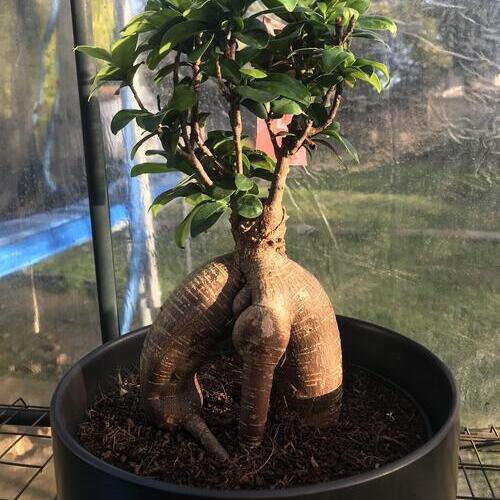
The Ginseng Ficus is a cultivated form of Ficus microcarpa, a species of fig tree native to South and Southeast Asia, as well as parts of Australasia. It is prized in the houseplant and bonsai trade for its thick, gnarled, above-ground root system, which is intentionally exposed during cultivation to resemble the swollen root of a ginseng plant, giving rise to its common name. In its natural habitat, Ficus microcarpa grows into a large evergreen tree with a broad, spreading canopy and aerial roots that descend from its branches, eventually thickening into secondary trunks. This banyan-like growth habit is part of what makes the species such a popular subject for bonsai artists.
The leaves of the Ginseng Ficus are small, glossy, dark green, and oval to elliptical in shape, growing densely along woody stems. The bark is smooth and pale grey, and the trunk often develops an attractive twisted or braided form when trained by growers. Because it is regularly pruned and shaped as a bonsai or tabletop specimen, most indoor Ginseng Ficus plants are kept quite compact, though the species can reach heights of over 20 meters (65 feet) in the wild.
Ginseng Ficus is valued not only for its ornamental appeal but also for its resilience as a houseplant. It tolerates a range of indoor conditions better than many other ficus species, adapts well to pruning and root restriction, and can live for decades with proper care, making it a long-term companion plant for collectors and casual growers alike.
The Ginseng Ficus is considered one of the more forgiving members of the ficus family, making it a popular choice for beginner bonsai enthusiasts and houseplant collectors. It thrives in bright, indirect light and appreciates consistent conditions; while it can tolerate some direct morning sun, harsh afternoon rays can scorch its glossy leaves. Placing it near an east- or south-facing window with filtered light is generally ideal. Like most ficus species, it can be sensitive to sudden changes in its environment, and may drop leaves in response to drafts, relocation, or fluctuating temperatures, though it typically recovers once conditions stabilize.
Watering should be done thoroughly but infrequently, allowing the top inch or two of soil to dry out between waterings. The thick, water-storing roots make the Ginseng Ficus somewhat drought tolerant, and it is far more forgiving of underwatering than overwatering, which can lead to root rot. A well-draining, slightly acidic potting mix, combined with a pot that has adequate drainage holes, will help maintain the right moisture balance. Regular misting or a nearby humidity tray can help replicate the humid tropical conditions the species prefers, especially in dry indoor environments.
Ongoing maintenance includes periodic pruning to maintain its shape, occasional wiping of the leaves to keep them dust-free and photosynthesizing efficiently, and feeding with a balanced liquid fertilizer during the active growing season. Repotting every two to three years, along with light root pruning, helps keep the plant healthy and its signature exposed root system attractive. With consistent light, moderate watering, and stable temperatures, the Ginseng Ficus can thrive indoors for many years, developing an increasingly sculptural and characterful form over time.
 Soil
Soil
Ginseng Ficus prefers a well-draining, slightly acidic to neutral soil mix, ideally with a pH range of about 6.0 to 6.5. A blend formulated for bonsai or succulents works well, typically combining regular potting soil with perlite, coarse sand, or pumice to improve drainage and aeration around the thick root system. Good drainage is essential, as the fleshy roots are prone to rot if left in waterlogged soil for extended periods. Soil amendments such as composted bark or a small amount of organic compost can support nutrient availability without compacting the mix.
Soil composition directly affects root health and, by extension, the vigor of the foliage; overly dense or compacted soil restricts oxygen to the roots and can stunt growth, while soil that is too loose may dry out too quickly and stress the plant. Common soil problems to watch for include poor drainage, which leads to root rot and yellowing leaves; compaction, which suffocates roots and slows growth; inappropriate pH, which can lock out nutrients even when fertilizer is applied; salt build-up from tap water or over-fertilizing, visible as a white crust on the soil surface; nutrient deficiencies, often showing as pale or discolored leaves; and root boundness, where a plant left too long in the same pot develops a dense, circling root mass that limits water and nutrient uptake and signals the need for repotting.
 Fertilizer
Feed the Ginseng Ficus with a balanced, water-soluble liquid fertilizer (such as a 10-10-10 or similar N-P-K ratio) diluted to about half strength, applied every 2 to 4 weeks during the active growing season in spring and summer. Fertilization should be reduced to once every 6 to 8 weeks, or paused entirely, during fall and winter when growth naturally slows. Over-fertilizing can cause a visible white or crusty salt build-up on the soil surface, along with leaf tip burn, dark or blackened root tips, and stunted or distorted new growth, while under-fertilization typically results in pale, small, or sparse leaves and slow, weak growth over time. For growers who prefer organic options, well-diluted fish emulsion, seaweed extract, or worm castings worked into the topsoil can provide a gentler, slower-release nutrient source. Ginseng Ficus can also be particularly sensitive to nitrogen deficiency, which shows up as overall pale foliage, so a fertilizer with adequate nitrogen content is generally beneficial during the growing months.
 Watering
Water the Ginseng Ficus thoroughly when the top 1 to 2 inches of soil feel dry to the touch, then allow excess water to drain completely from the pot. Room-temperature filtered, distilled, or rainwater is preferable to tap water, which can contain chlorine, fluoride, and mineral salts that may accumulate in the soil and cause leaf tip burn over time; if only tap water is available, letting it sit out for 24 hours before use can help dissipate some chlorine. Overwatering is one of the most common issues and shows up as yellowing leaves, a mushy or foul-smelling base, and eventual root rot, while underwatering causes leaves to curl, become dull, and drop, along with dry, shrinking soil pulling away from the pot’s edges. During the active growing season in spring and summer, the plant will typically need more frequent watering, while in fall and winter, growth slows and watering should be reduced accordingly to prevent waterlogging in cooler, lower-light conditions.
Stop guessing. Most houseplant failures are caused by volumetric errors and improper moisture tension. Our deterministic calculator moves beyond "once-a-week" watering by analyzing the four critical pillars of root health:
Personalized for this plant
Disclaimer: Our calculator is pretty smart. We’ve crunched the numbers, but we’re not measuring the quantum state of your living room. Since we don’t know your exact indoor temperature, humidity, light, airflow, or whether your plant receives daily sweet nothings and motivational speeches, use this calculator as a guide—and always keep an eye on your plant.
 Lighting
Ginseng Ficus thrives in bright, indirect light, ideally receiving several hours of filtered sunlight per day. An east-facing window is often ideal, while a south- or west-facing window works well if the plant is set back from the glass or shielded with a sheer curtain during the most intense afternoon sun. Some direct morning sun is tolerated and can encourage denser, more compact growth. Insufficient light often causes leggy stem growth, sparse foliage, smaller leaves, and leaf drop as the plant tries to conserve energy. Excessive, harsh direct light, particularly through unfiltered glass, can scorch the leaves, causing brown, crispy patches or bleached spots. If natural light is limited, a full-spectrum grow light positioned 12 to 24 inches above the plant for 10 to 12 hours a day can supplement or replace sunlight effectively; rotating the plant periodically also helps ensure even growth on all sides.
 Temperature
The ideal temperature range for Ginseng Ficus is between 65 and 80°F (18 to 27°C), reflecting its preference for warm, stable, tropical-like conditions. It has little tolerance for cold and can suffer leaf drop or damage if temperatures fall below 55°F (13°C) for extended periods, and it should never be exposed to frost. Sudden temperature swings, cold drafts from doors or windows, and proximity to heating or air conditioning vents can all stress the plant and trigger leaf loss, even if the average temperature is otherwise suitable. To protect it from temperature extremes, keep the plant away from exterior doors in winter, avoid placing it directly against cold window glass, and shield it from hot, direct blasts of air from HVAC systems; moving it gradually between environments, rather than abruptly, also helps it adjust with minimal stress.
 Humidity
Ginseng Ficus prefers moderate to high humidity, ideally in the range of 50 to 60 percent, reflecting its native tropical origins. In typical indoor environments, especially during winter when heating systems dry out the air, humidity can drop well below this range and cause stress. Low humidity stress often presents as browning or crisping leaf edges, increased leaf drop, and a generally dull appearance to the foliage, while excessively high humidity combined with poor air circulation can encourage fungal issues on the leaves and soil surface. Effective ways to raise humidity include placing the pot on a pebble tray filled with water (ensuring the pot base sits above the waterline, not in it), grouping it with other plants to create a favorable microclimate, running a room humidifier nearby, or occasionally misting the foliage, though misting alone provides only a brief, minor boost compared to a humidifier or pebble tray, which offer more sustained results.
 Propagation
Ginseng Ficus can be propagated through stem cuttings, air layering, or, less commonly, seed, with stem cuttings being the most popular and reliable method for home growers. Air layering tends to produce a plant with a more developed root structure faster, while stem cuttings are simpler but may take longer to establish a strong root system; seed propagation is slow and rarely used outside of specialized breeding.
Step-by-step guide for stem cutting propagation:
1. Select a healthy, semi-hardwood stem, about 4 to 6 inches long, with several leaf nodes, in spring or early summer when the plant is actively growing.
2. Using clean, sharp shears, cut the stem just below a leaf node at a slight angle.
3. Allow the cut end to sit exposed for a few minutes to let the milky sap seal slightly, reducing sap loss and mess.
4. Remove the lower leaves, leaving just 2 to 3 leaves at the top of the cutting.
5. Optionally dip the cut end in a rooting hormone powder or gel to encourage faster root development.
6. Insert the cutting into a well-draining rooting medium, such as a mix of perlite and peat or a light bonsai soil blend.
7. Water lightly to settle the medium and place the cutting in a warm spot with bright, indirect light.
8. Cover loosely with a plastic bag or place in a propagation dome to maintain humidity, venting occasionally to prevent mold.
9. Keep the medium consistently moist but not soggy, and check for root development after 4 to 6 weeks by gently tugging the cutting for resistance.
10. Once roots are established, transplant the cutting into a standard well-draining potting mix and gradually acclimate it to normal humidity and light conditions.
Stem cuttings typically show a moderate success rate, while air layering generally has a higher success rate because the new roots form before the section is separated from the parent plant, at the cost of a longer, more involved process. Spring and early summer are the best times to propagate, and newly rooted cuttings usually take 2 to 3 months to establish as independent, stable plants.
 Potting
Choose a pot with ample drainage holes and only slightly larger than the current root mass, since Ginseng Ficus, especially when grown as bonsai, benefits from being somewhat root-bound to maintain its compact form and encourage the thick, sculptural root growth it is known for. A well-draining bonsai or general houseplant soil mix, amended with perlite or coarse sand, supports healthy root function. Repotting is generally needed every 2 to 3 years for younger plants, and less frequently, every 3 to 5 years, for mature, well-established specimens.
Signs that a Ginseng Ficus needs repotting include roots visibly circling the pot’s interior or emerging from drainage holes, water running through the pot too quickly without being absorbed, slowed growth despite proper care, and the plant becoming top-heavy or unstable in its container. When repotting, light root pruning can be done by trimming no more than 20 to 30 percent of the root mass to encourage healthy new root growth and maintain the plant’s proportions, which is a common technique in bonsai cultivation. To minimize stress during the transition, repot in spring at the start of the growing season, gently loosen the root ball, remove old, depleted soil, place fresh soil in the new container, and water thoroughly afterward while keeping the plant in stable, indirect light for a few weeks to recover.
 Pruning
Late winter to early spring, just before the active growing season begins, is the ideal time to prune a Ginseng Ficus, though light maintenance trimming can be done throughout the year as needed.
Light pruning every 4 to 6 weeks during the growing season helps maintain shape, while more significant structural pruning is typically done once a year.
Pruning controls the plant’s size and silhouette, encourages denser branching and foliage, removes dead or damaged growth, and helps maintain the classic bonsai form many growers cultivate.
Use clean, sharp bonsai shears or pruning scissors, sterilized with rubbing alcohol before and between cuts to prevent disease spread. Wearing gloves is recommended since the plant’s sap can irritate skin.
After pruning, keep the plant in stable, bright indirect light, maintain normal watering, and avoid fertilizing for about 2 weeks to allow the plant to recover before resuming feeding.
The milky sap released from cuts can be messy and mildly irritating, so work in a well-ventilated area and wipe cut tools clean after use; wounds generally callous over on their own without needing sealant.
 Blooming
Ficus microcarpa produces inconspicuous flowers enclosed within its fig-like fruit structures called syconia, rather than showy blooms. In its native tropical range, fruiting can occur throughout the year given warm, stable conditions, but indoor specimens rarely flower or fruit due to the absence of the specific pollinating wasp species and the controlled indoor environment. When flowering does occur outdoors, it is generally tied to warm, humid seasons and does not depend on typical day-length triggers. The flowers themselves are tiny and hidden inside the developing fruit, so they are not a feature grown for ornamental display; the plant is valued instead for its foliage and root/trunk form.
 Pests and Diseases
Name: Spider mites
Symptoms: Fine webbing on leaves and stems, stippled or speckled yellowing on leaf surfaces, and overall leaf dullness or decline.
Treatment: Wipe down leaves with a damp cloth, increase humidity, and treat with insecticidal soap or neem oil, repeating every 7 to 10 days until resolved.
Name: Scale insects
Symptoms: Small brown or tan bumps on stems and leaf undersides, sticky honeydew residue, and yellowing or dropping leaves.
Treatment: Scrape off visible scale manually, then apply horticultural oil or insecticidal soap to affected areas, repeating treatments over several weeks.
Name: Mealybugs
Symptoms: White, cottony clusters in leaf axils and along stems, sticky residue, and stunted or distorted new growth.
Treatment: Dab visible mealybugs with a cotton swab dipped in rubbing alcohol, then treat the whole plant with insecticidal soap or neem oil.
Name: Aphids
Symptoms: Clusters of small green, black, or brown insects on new growth, curling leaves, and sticky honeydew.
Treatment: Rinse the plant with a strong stream of water to dislodge aphids, then apply insecticidal soap or neem oil as needed.
Name: Root rot
Symptoms: Yellowing or wilting leaves, a mushy or blackened base, foul odor from the soil, and stunted growth.
Treatment: Remove the plant from its pot, trim away rotted roots with sterilized shears, repot into fresh, well-draining soil, and reduce watering frequency going forward.
Name: Leaf spot (fungal or bacterial)
Symptoms: Brown or black spots on leaves, sometimes with yellow halos, and premature leaf drop.
Treatment: Remove affected leaves, improve air circulation, avoid overhead watering, and apply a copper-based fungicide if the issue persists.
Name: Sooty mold
Symptoms: A black, powdery coating on leaves, usually developing on honeydew left by pests like scale or aphids.
Treatment: Treat the underlying pest infestation first, then gently wipe the sooty mold from leaves with a damp cloth.
 Special Features
The Ginseng Ficus is best known for its dramatic, exposed root system, which is trained and shaped by growers to resemble the swollen, gnarled root of a ginseng plant, giving it a distinctive sculptural quality unlike most other houseplants. Its glossy, compact foliage and tolerance for pruning and shaping make it one of the most popular and accessible entry points into the art of bonsai cultivation, appealing to both beginners and experienced growers. While it does not offer fragrance or edible fruit in typical indoor conditions, its year-round evergreen foliage provides consistent visual interest, and its long lifespan means a well-cared-for specimen can become an increasingly characterful, living piece of art over many years, often passed down or displayed as a centerpiece in a home or office setting.
 Plant Benefits
While the Ginseng Ficus is primarily grown for ornamental and bonsai purposes rather than herbal or pharmaceutical use, related Ficus species have a history in traditional medicine for uses such as treating skin ailments, digestive issues, and inflammation using bark, leaf, or latex extracts. However, the Ginseng Ficus itself is not typically recommended or used for human medicinal consumption, as its sap can be irritating, and any traditional uses of related fig species should not be assumed to apply safely to this ornamental cultivar without professional guidance.
 Additional Information
Ginseng Ficus is one of the most widely available bonsai-style houseplants in nurseries and garden centers, largely because of its adaptability to indoor conditions and its tolerance for the frequent pruning and root restriction involved in bonsai cultivation. In outdoor tropical and subtropical climates, Ficus microcarpa is sometimes considered invasive due to its aggressive root system and prolific seed dispersal by birds, so it is generally grown in containers rather than planted directly in the ground outside its native range. The species is also notable for its use as a street and shade tree in many warm-climate cities worldwide, where its extensive aerial root system and dense canopy provide significant shade coverage.
 Life Cycle
As a long-lived evergreen tree, Ficus microcarpa follows a perennial life cycle without a defined dormancy period in tropical climates, though indoor and cooler-climate specimens experience a noticeable slowdown in growth during shorter, darker winter days. Growth begins with root and stem development from a cutting, air layering, or seed, followed by a juvenile phase of steady leaf and stem growth over the first few years. As the plant matures, secondary aerial roots may develop and thicken, especially in humid conditions, contributing to the characteristic banyan-like root structure. With consistent care, a Ginseng Ficus can live for many decades, and bonsai specimens in particular are often cultivated and refined over a lifetime, becoming more intricate and established with age.
 Are Ginseng Ficus Poisonous, Toxic
The Ginseng Ficus, like other Ficus species, contains a milky latex sap in its leaves and stems that is mildly toxic and can cause irritation if ingested or if it contacts the skin. Toxic parts: primarily the leaves and stems, which contain the irritant sap. Organisms affected: cats, dogs, and other pets, as well as children if ingested. Symptoms: oral irritation, drooling, vomiting, diarrhea, and skin redness or a rash-like reaction upon contact with the sap; some individuals may experience more pronounced allergic skin reactions. Severity: generally classified as mild to moderate toxicity, rarely life-threatening, but can cause significant discomfort. First aid: rinse any sap contact from skin or mouth with water, remove access to the plant, offer water to dilute if ingested, and contact a veterinarian, pediatrician, or poison control center if symptoms are severe or persistent. Preventive measures: place the plant out of reach of pets and small children, promptly clean up any dropped leaves, and consider wearing gloves when pruning to avoid skin contact with the sap.
 Frequently Asked Questions
Water when the top 1 to 2 inches of soil feel dry, typically every 1 to 2 weeks depending on light, temperature, and humidity levels.
Yes, the milky sap in its leaves and stems is mildly toxic to pets and can cause oral irritation, drooling, and gastrointestinal upset if ingested.
Leaf drop is often caused by sudden changes in light, temperature, drafts, or watering, and the plant typically recovers once conditions stabilize.
It needs bright, indirect light for several hours a day, with tolerance for some gentle direct morning sun.
Consistent warmth, humidity, bright light, and periodic light root pruning during repotting encourage the exposed roots to thicken over time.
It can tolerate lower light for short periods, but prolonged low light leads to leggy growth, sparse foliage, and leaf drop, so bright indirect light is recommended.
Repot young plants every 2 to 3 years and mature specimens every 3 to 5 years, ideally in spring.
A well-draining, slightly acidic soil mix, such as a bonsai blend with added perlite or coarse sand, works best, with an ideal pH of 6.0 to 6.5.
It rarely flowers indoors, as its tiny flowers form inside fig-like structures and typically require specific pollinators and tropical outdoor conditions.
It is most commonly propagated from stem cuttings rooted in a well-draining medium, or through air layering for faster root establishment.
 Can I grow Ginseng Ficus in my indoor space
Difficulty: Easy
Size: Small
Light: Medium
Water: Medium
Flowering: No
Pet Safe: No
Air Purifier: Medium
 Ficus microcarpa botanical details
Common Name: Ginseng Ficus
Other Common Names: Ginseng fig, Taiwan Ginseng fig, Chinese banyan, Curtain fig, Indian laurel fig, Malayan banyan, Ficus bonsai
Botanical Name: Ficus microcarpa
Native Area: South and Southeast Asia, including India, southern China, Taiwan, Malaysia, and Indonesia, as well as parts of Australasia including northern Australia and various Pacific islands.
Family Name: Moraceae
Plant Type: Evergreen tree (grown as an indoor bonsai/houseplant)
Genus: Ficus
Kingdom: Plantae
 Photo Gallery
 My Ginseng Ficus Plant Care Recommendations
If you find the Houseplant Encyclopedia helpful and would like to support Healthy Houseplants, you can use the links below to shop for recommended plants, products, and plant-care supplies.
Some links are affiliate links, which means I may earn a small commission if you make a qualifying purchase through them, at no additional cost to you. Thank you for supporting Healthy Houseplants and helping me continue to provide free plant-care information!

Want even more personalized plant-care help? Check out my AI Julie Chatbot—trained on my 20 years of houseplant knowledge, not just information from the internet!  Try it now:Ask AI Julie
 Buy Ginseng Ficus Online
✅ “Bring Home This Beauty Today”
✅ “Get Your Own Ginseng Ficus Before It’s Gone”
✅ “Shop Trusted Sellers – Limited Availability”
✅ “Free Delivery”
As an Amazon Associate, I earn commission from qualifying purchases.
 Plant Puns and Jokes
Why did the Ginseng Ficus refuse to compete in the root vegetable contest? Because it knew it wasn’t really a root, it just had really good roots for the job.
 Signup to our newsletter and download Ginseng Ficus care guide

