


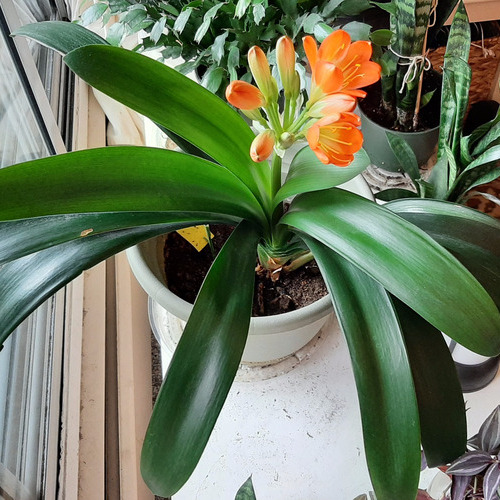
Clivia miniata, most commonly sold under the name Kaffir Lily (though many growers and retailers now favor the alternative names Bush Lily or Natal Lily due to the historically offensive connotations of the term “Kaffir” in South Africa), is an evergreen, clump-forming perennial in the family Amaryllidaceae. It is native to the shaded forest understories, rocky ravines, and coastal scrub of South Africa and Eswatini (Swaziland), particularly along the eastern regions of KwaZulu-Natal, Mpumalanga, and the Eastern Cape. In its native habitat, it typically grows in dappled shade beneath tree canopies, often in leaf litter and humus-rich, well-drained soil on slopes, which explains its strong preference for indirect light and its tolerance of somewhat neglectful watering as a houseplant.
The plant forms broad, strap-shaped, deep green leaves arranged in two opposite ranks that arch outward from a thickened, fleshy base resembling a bulb, though botanically Clivia does not produce a true bulb but rather a rhizome with fleshy, water-storing roots. Mature clumps can reach 45 to 60 centimeters (18 to 24 inches) in height and width, with individual leaves often 30 to 45 centimeters long and several centimeters wide, giving the plant a bold, architectural presence even when not in bloom. The foliage is glossy, leathery, and long-lived, persisting for years and providing structural interest in shaded gardens or interior spaces year-round.
The most celebrated feature of Clivia miniata is its dramatic late winter to spring flowering display, when a thick, sturdy flower stalk emerges from the center of the leaf fan bearing an umbel of 12 to 20 (occasionally more) funnel-shaped, trumpet-like flowers in shades of vivid orange, though cultivated varieties now range from pale yellow and cream to deep red-orange. The genus Clivia was named in honor of Lady Charlotte Florentia Clive, Duchess of Northumberland, who first cultivated the plant to flowering in England in the 1820s from material collected in South Africa, and it has since become a prized specimen among collectors, particularly in Japan, China, and among specialty growers who breed for unusual flower colors, variegated foliage, and compact or “interspecific” hybrid forms.
Kaffir Lily is widely regarded as one of the more forgiving flowering houseplants for both beginners and experienced growers, largely because its native forest-floor habitat has equipped it to tolerate the low, indirect light levels typical of indoor environments. Success with this plant hinges on replicating a few key aspects of its natural cycle: bright but indirect light, a distinct cool, dry rest period in autumn and early winter to trigger bud formation, and a well-draining, slightly gritty potting medium that mimics the leaf-litter substrate it grows in naturally. Unlike many flowering houseplants, Clivia actually prefers to be somewhat pot-bound, and disturbing its roots too frequently can delay or suppress blooming for a year or more.
Day-to-day maintenance is minimal. During the active growing season from spring through early autumn, the plant benefits from regular watering once the top few centimeters of soil have dried, along with monthly balanced fertilizing to support leaf growth and flower stalk development. As temperatures cool in autumn, watering should be reduced significantly and temperatures kept cooler (ideally 10-13°C/50-55°F for six to eight weeks) without fertilizer, which mimics the dry, cool conditions of the Southern Hemisphere winter and is the single most important step in reliably inducing the following season’s bloom. Skipping this rest period is the most common reason home growers find their Clivia produces abundant leaves but few or no flowers.
Beyond its light, water, and dormancy needs, Kaffir Lily asks for very little: pests and diseases are uncommon when the plant is not overwatered, pruning is limited to removing spent flower stalks and old leaves, and repotting is only necessary every three to five years. Its long-lived nature means a well-cared-for specimen can live and bloom reliably for decades, often being passed down as a treasured plant between generations of gardeners, and its tolerance of low light and container culture makes it an excellent choice for offices, north-facing windows, and shaded patios or verandas in frost-free climates.
 Soil
Soil
Kaffir Lily thrives in a loose, well-draining, slightly acidic to neutral soil mix that replicates the humus-rich leaf litter of its native forest floor. An ideal blend combines standard potting soil with generous additions of coarse perlite, orchid bark, or coarse sand to ensure excellent drainage and aeration around the fleshy, water-storing roots, which are highly susceptible to rot in dense or waterlogged media. A pH range of approximately 6.0 to 6.5 is optimal, though the plant tolerates a modest range on either side. Amendments such as compost or well-rotted leaf mold can be worked in at potting time to boost organic content and mimic natural conditions, while a thin layer of coarse material at the pot base further improves drainage. Because Clivia is sensitive to root disturbance, soil composition has an outsized effect on long-term health: compacted or poorly draining soil quickly leads to root and rhizome rot, while overly light, fast-draining mixes may require more frequent watering. Common soil-related problems include poor drainage leading to root rot and yellowing leaves, soil compaction over time as organic matter breaks down (best remedied at repotting rather than by disturbing an established root ball), inappropriate pH causing nutrient lockout and pale foliage, salt build-up from fertilizer or hard tap water manifesting as leaf-tip browning (addressed by periodic thorough flushing), nutrient deficiencies from old, depleted potting mix, and root-boundness, which for this species is actually tolerated well and even beneficial for bloom production, so repotting should be infrequent and only when roots are severely congested or breaking the pot.
 Fertilizer
During the active growing season from spring through late summer, Kaffir Lily benefits from a balanced, water-soluble fertilizer (such as a 20-20-20 formula, or one slightly higher in phosphorus and potassium to support blooming) applied at half strength every 4 weeks. Fertilizing should cease entirely during the autumn/winter dormancy period, as feeding during rest can interfere with the cold-and-dry signal the plant needs to set flower buds, and resume only once new growth or a flower stalk appears in late winter. Over-fertilization presents as crusty white salt deposits on the soil surface, browned or burnt leaf tips and margins, and stunted or distorted new growth, while under-fertilization typically shows as pale, yellowish leaves, weak growth, and reduced flowering over successive seasons. Organic alternatives such as diluted fish emulsion, compost tea, or a light top-dressing of well-aged compost applied in spring can effectively supplement or replace synthetic feeding, and Clivia has no unusual or specialized nutrient requirements beyond standard balanced feeding, though it does appreciate the periodic addition of a phosphorus-supporting amendment (such as bone meal) to encourage strong flower stalk development.
 Watering
During the active growing season (spring through early autumn), Kaffir Lily should be watered thoroughly whenever the top 3-5 cm of soil has dried out, allowing excess water to drain freely from the pot and never letting the plant sit in standing water. Room-temperature rainwater, distilled water, or filtered water is preferable to hard tap water, as the plant can be somewhat sensitive to the mineral and salt build-up associated with prolonged use of untreated tap water, which may cause leaf-tip browning over time. Signs of overwatering include yellowing lower leaves, soft or mushy rhizome tissue, a sour smell from the soil, and root or crown rot in severe cases, while underwatering presents as limp, drooping, or slightly wrinkled leaves and dry, pulling-away soil. Watering needs shift markedly with the seasons: during the autumn-to-winter dormancy period that is essential for bloom induction, watering should be reduced dramatically to roughly once every 4-6 weeks, just enough to prevent the roots from fully desiccating, and resumed at normal frequency only once new flower stalk growth is visible or spring warmth returns.
Stop guessing. Most houseplant failures are caused by volumetric errors and improper moisture tension. Our deterministic calculator moves beyond "once-a-week" watering by analyzing the four critical pillars of root health:
Personalized for this plant
Disclaimer: Our calculator is pretty smart. We’ve crunched the numbers, but we’re not measuring the quantum state of your living room. Since we don’t know your exact indoor temperature, humidity, light, airflow, or whether your plant receives daily sweet nothings and motivational speeches, use this calculator as a guide—and always keep an eye on your plant.
 Lighting
Kaffir Lily prefers bright, indirect light, such as that found a few feet back from an east- or north-facing window, or filtered light beneath a shade structure outdoors; this closely mirrors the dappled forest-floor light of its native habitat. It tolerates lower light levels better than most flowering houseplants, making it suitable for offices and interior rooms, though prolonged deep shade will reduce or prevent flowering even as the foliage remains healthy. Direct, intense sunlight, particularly through south- or west-facing windows or unshaded outdoor exposure, can scorch the leaves, causing pale, bleached, or brown patches and a washed-out, yellow-green leaf color. Conversely, insufficient light produces dark green but thin, floppy, or stretched leaves and a marked reluctance to bloom. If natural light is inadequate, the plant can be supplemented with a full-spectrum grow light positioned 30-60 cm above the foliage for 10-12 hours daily, or gradually acclimated to slightly brighter conditions over several weeks to avoid shock; conversely, plants receiving too much direct sun should be moved back from the window or given sheer curtain filtration.
 Temperature
Clivia miniata grows best in typical indoor temperatures of 18-24°C (65-75°F) during its active growing and blooming season, and it tolerates brief dips or rises outside this range without significant stress. The plant has a notable cold sensitivity below roughly 4°C (40°F) and should never be exposed to frost, which will cause severe leaf damage or death; conversely, sustained heat above 29°C (85°F), especially combined with direct sun, can stress the plant and cause leaf scorching. Critically, the plant benefits from and essentially requires a cooler autumn/winter rest period of 10-13°C (50-55°F) for six to eight weeks to reliably initiate flower bud formation, making an unheated porch, garage, or cool room ideal for this dormancy phase. To protect the plant from temperature extremes, keep it away from cold drafts, exterior doors, and heating vents, bring outdoor specimens indoors well before the first frost, and avoid placing it directly against cold window glass in winter.
 Humidity
Kaffir Lily is adaptable and performs well across a fairly broad humidity range, generally thriving in average household humidity of 40-50% without special intervention, though it appreciates slightly elevated humidity of 50-60% for the lushest foliage. Low humidity stress typically shows as dry, browning leaf tips or margins, while excessively high humidity combined with poor air circulation can encourage fungal issues such as leaf spot. To raise humidity, a pebble tray filled with water positioned beneath (not touching) the pot is an effective, low-maintenance option, as is grouping the plant with other houseplants or running a small room humidifier nearby; occasional light misting can help in very dry climates but is less effective long-term and should be avoided if fungal problems have occurred. In most temperate indoor environments, however, no additional humidity measures are strictly necessary for this resilient species.
 Propagation
Clivia miniata can be propagated by two primary methods: division of offsets (the more reliable and faster route to a flowering-size plant) and seed (slower, taking several years to reach maturity but useful for breeding new color forms). Division success rates are considerably higher and more predictable than seed propagation, typically nearing 90% or better when offsets already have their own roots, whereas seed germination and subsequent growth to flowering can take three to five years with more variable outcomes. The best time to propagate by division is in spring, just after flowering and before the peak of active growth. Step-by-step division guide: 1) Select a mature clump that has produced several offsets (pups) with at least 4-5 leaves and visible independent roots. 2) Carefully remove the plant from its pot and gently brush or rinse away excess soil to expose the root mass. 3) Identify natural separations between the main plant and offsets, ensuring each offset has its own roots attached. 4) Using a clean, sharp knife or pruning shears, cut through the connecting rhizome tissue to separate the offset from the parent plant. 5) Allow the cut surfaces on both the offset and parent plant to air-dry and callus for several hours to a full day in a shaded, well-ventilated spot. 6) Optionally dust the cut surfaces with a fungicidal powder or cinnamon to reduce infection risk. 7) Pot the offset into a small container with fresh, well-draining Clivia potting mix, burying only the roots and rhizome base while keeping the leaf fan above the soil line. 8) Water sparingly for the first 2-3 weeks to encourage root establishment without risking rot, then resume normal watering once new growth is observed. New divisions typically establish within 4-8 weeks and may reach flowering size within one to two years, considerably faster than seed-grown plants.
 Potting
Kaffir Lily should be potted in a container only slightly larger than its root mass, ideally a heavier terracotta or ceramic pot with ample drainage holes, since the plant actually blooms best when moderately root-bound and a container that is too large can lead to excess soil moisture retention and rot. The ideal soil composition is a well-draining mix of standard potting soil, coarse perlite or orchid bark, and a small amount of compost, as detailed in the soil section. Repotting is only necessary every three to five years, and signs that repotting is needed include roots visibly circling or emerging from drainage holes, the rhizome pushing the plant up out of the soil, water running through too quickly without being absorbed, or noticeably reduced vigor and blooming despite otherwise good care. When repotting, minimal root pruning is recommended, limited to trimming away any clearly dead, mushy, or rotted roots, since Clivia’s thick roots are easily damaged and excessive pruning can shock the plant and delay flowering for a season or more. To transition the plant with minimal stress, repot in spring after flowering has finished, handle the rootball gently, water lightly immediately after repotting, and keep the plant in stable, indirect light and moderate temperatures for several weeks while it re-establishes.
 Pruning
Prune Kaffir Lily primarily in late spring after flowering has finished, and remove damaged or dead foliage as needed throughout the year.
Pruning is infrequent and largely maintenance-focused: removing spent flower stalks redirects the plant’s energy into leaf and root growth rather than seed production, while removing old, yellowed, or damaged leaves keeps the plant tidy and reduces the risk of fungal issues.
Use clean, sharp pruning shears or a sharp knife, wiping the blade with rubbing alcohol before and between cuts to prevent the spread of disease. Wear gloves, as plant sap can cause mild skin irritation in sensitive individuals.
After pruning, resume normal watering and light fertilizing to support new growth, and avoid cutting healthy green leaves purely for aesthetic reasons, as each leaf contributes energy reserves the plant needs for future blooming.
 Blooming
Clivia miniata typically blooms in late winter through mid-spring (roughly February to April in the Northern Hemisphere, or August to October in its native Southern Hemisphere range), with each bloom cycle lasting several weeks per flower stalk and individual flower umbels remaining attractive for two to four weeks. Blooming frequency is once annually under proper care, though a stressed or interrupted dormancy can cause skipped years. Optimal blooming is triggered by a cool, dry rest period of six to ten weeks in autumn/early winter (around 10-13°C/50-55°F) followed by a gradual return to warmth, light, and watering in late winter. Flowers are borne in dense, rounded umbels atop a thick, upright stalk (scape) that can reach 30-45 cm tall, with each umbel containing 12-20+ funnel- or trumpet-shaped blooms in shades of orange, red-orange, yellow, peach, or cream depending on cultivar, each flower having six tepals and a mildly sweet, subtle fragrance.
 Pests and Diseases
Name: Mealybugs
Symptoms: Small, white, cottony clusters in leaf axils and along leaf undersides; sticky honeydew residue; sooty mold development; weakened or yellowing leaves.
Treatment: Isolate the affected plant, wipe visible pests away with a cotton swab dipped in rubbing alcohol, and treat the entire plant with insecticidal soap or neem oil every 7-10 days until the infestation clears.
Name: Scale insects
Symptoms: Small, brown or tan, dome-shaped bumps attached to leaves and stems; sticky honeydew; yellowing or weakened foliage.
Treatment: Scrape off visible scale gently with a fingernail or soft brush, then apply horticultural oil or insecticidal soap, repeating treatments every 2 weeks until resolved.
Name: Spider mites
Symptoms: Fine webbing on the undersides of leaves, stippled or speckled yellowing on leaf surfaces, dry or dusty-looking foliage; thrives in dry indoor air.
Treatment: Increase humidity, rinse leaves thoroughly with lukewarm water, and apply insecticidal soap or neem oil, repeating every 5-7 days for several cycles.
Name: Mealy root aphids
Symptoms: Stunted growth, wilting despite adequate watering, white waxy residue visible on roots when unpotted.
Treatment: Remove the plant from its pot, rinse roots thoroughly, discard old soil, drench roots in insecticidal soap solution, and repot in fresh, sterile potting mix.
Name: Root and crown rot
Symptoms: Soft, mushy, discolored rhizome tissue; foul odor from soil; wilting or yellowing despite moist soil; leaves pulling away easily from the base.
Treatment: Remove the plant from its pot, trim away all rotted tissue with a sterilized blade, allow cut surfaces to dry, and repot in fresh, well-draining soil while reducing watering frequency going forward.
Name: Leaf spot (fungal or bacterial)
Symptoms: Small, dark brown or black spots on leaves, sometimes with yellow halos, that may enlarge and merge over time.
Treatment: Remove and dispose of affected leaves, improve air circulation, avoid overhead watering and misting, and apply a copper-based fungicide if the problem persists.
Name: Botrytis (gray mold)
Symptoms: Fuzzy gray-brown mold on flowers, flower stalks, or damaged leaf tissue, particularly in cool, humid, poorly ventilated conditions.
Treatment: Remove affected plant material immediately, increase airflow and reduce humidity around the plant, and apply a fungicide labeled for botrytis if the infection is widespread.
 Special Features
Beyond its striking floral display, Kaffir Lily offers a rare combination of low-maintenance resilience and dramatic seasonal interest that few other flowering houseplants can match. Its tolerance for low light and infrequent repotting makes it an excellent choice for offices, hallways, and shaded outdoor patios in mild climates, while its long-lived nature means a single well-cared-for specimen can remain a treasured, blooming fixture in a household for decades. The plant’s thick, glossy, strap-like foliage provides year-round textural and structural interest even outside of bloom, and its subtly fragrant orange, yellow, or red flower umbels attract pollinators such as sunbirds and butterflies in its native range. Collectors particularly prize rare variegated-leaf forms and unusual flower colors, and the plant holds cultural significance in parts of South Africa, where it has occasionally been used in traditional medicine, though such uses are not recommended given its toxic alkaloid content.
 Plant Benefits
Clivia miniata has a history of use in traditional South African herbal medicine, where extracts of the rhizome and roots have historically been used in small, carefully prepared doses for purposes such as easing childbirth or treating certain ailments; however, because the plant contains toxic alkaloids including lycorine, such uses carry significant risk and are not supported by modern clinical evidence or recommended for home use. There are no established, safe pharmaceutical or supplement applications of this plant for general consumers, and any medicinal use should be regarded as a matter of historical ethnobotany rather than a practical benefit.
 Additional Information
Clivia miniata is a member of a small genus (Clivia) comprising just a handful of species native to southern Africa, and it has become an important subject of horticultural breeding, particularly in Japan and China, where interspecific hybrids and rare variegated or yellow-flowered cultivars can command very high prices among collectors. Because the seeds take so long to mature and germinate, and because desirable traits like flower color and leaf variegation are often not true-to-type from seed, division remains the preferred method for preserving named cultivars. The plant is also notably long-lived, with some specimens in cultivation known to survive and bloom reliably for 50 years or more under consistent care.
 Life Cycle
As an evergreen perennial, Kaffir Lily follows an annual cycle rather than dying back completely: active vegetative growth and root development occur in spring and summer, supported by regular water and fertilizer, followed by a critical cool, dry autumn/early-winter dormancy period that triggers flower bud formation within the rhizome. As winter transitions to late winter/early spring, a thick flower stalk emerges from the center of the leaf fan, elongating and opening into a full umbel of blooms over several weeks, after which the flowers fade and, if left unpruned, may develop into berry-like seed capsules that ripen over many months. The plant then returns to vegetative growth, gradually producing new leaves and, over successive years, new basal offsets that can eventually be divided into new plants; a single specimen may live and rebloom for decades under proper care.
 Are Kaffir Lily Poisonous, Toxic
Clivia miniata is considered toxic to cats, dogs, and humans (including children) if ingested. All parts of the plant contain toxic alkaloids, primarily lycorine and related Amaryllidaceae alkaloids, with the highest concentrations typically found in the bulb-like rhizome and roots, though leaves and flowers also contain lower levels of these compounds. In pets (cats and dogs) and in children, ingestion can cause gastrointestinal symptoms including drooling, vomiting, diarrhea, and abdominal discomfort; in larger ingested quantities, effects may extend to lethargy, tremors, or low blood pressure, though severe systemic poisoning is uncommon with typical accidental ingestion. Overall severity is generally classified as mild to moderate rather than life-threatening, but any ingestion should be taken seriously and monitored. First aid steps include removing any remaining plant material from the mouth, rinsing the mouth with water, and contacting a veterinarian (for pets) or poison control/physician (for humans) promptly; do not induce vomiting unless specifically directed by a medical professional. Preventive measures include placing the plant out of reach of curious pets and small children, supervising young children around houseplants, wearing gloves when repotting or dividing the rhizome to avoid skin irritation, and washing hands after handling plant material.
 Frequently Asked Questions
 Can I grow Kaffir Lily in my indoor space
Difficulty: Easy
Size: Medium
Light: Medium
Water: Medium
Flowering: Yes
Pet Safe: No
Air Purifier: Low
 Clivia miniata botanical details
Common Name: Kaffir Lily
Other Common Names: Bush Lily, Natal Lily, Fire Lily, Boslelie
Botanical Name: Clivia miniata
Native Area: South Africa (KwaZulu-Natal, Mpumalanga, Eastern Cape) and Eswatini (Swaziland), typically in shaded forest understories and rocky, wooded ravines.
Family Name: Amaryllidaceae
Plant Type: Evergreen perennial (rhizomatous)
Genus: Clivia
Kingdom: Plantae
 Photo Gallery
 My Kaffir Lily Plant Care Recommendations
If you find the Houseplant Encyclopedia helpful and would like to support Healthy Houseplants, you can use the links below to shop for recommended plants, products, and plant-care supplies.
Some links are affiliate links, which means I may earn a small commission if you make a qualifying purchase through them, at no additional cost to you. Thank you for supporting Healthy Houseplants and helping me continue to provide free plant-care information!

Want even more personalized plant-care help? Check out my AI Julie Chatbot—trained on my 20 years of houseplant knowledge, not just information from the internet!  Try it now:Ask AI Julie
 Buy Kaffir Lily Online
✅ “Bring Home This Beauty Today”
✅ “Get Your Own Kaffir Lily Before It’s Gone”
✅ “Shop Trusted Sellers – Limited Availability”
✅ “Free Delivery”
As an Amazon Associate, I earn commission from qualifying purchases.
 Plant Puns and Jokes
Why did the Kaffir Lily refuse to bloom on schedule? It said it needed some time to chill first!
 Signup to our newsletter and download Kaffir Lily care guide

