


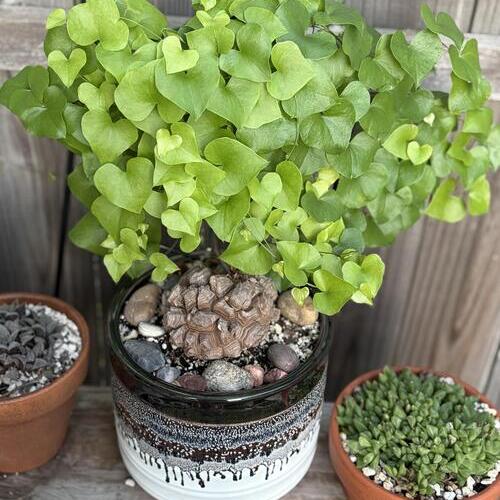
The Elephant’s Foot, botanically classified as Dioscorea elephantipes, is one of the most extraordinary caudiciform plants grown in cultivation, prized for its massive, above-ground, corky caudex that resembles a giant tortoise shell or the weathered foot of an elephant, hence its common name. It belongs to the yam family, Dioscoreaceae, and is native to the semi-arid, rocky slopes of South Africa’s Eastern and Western Cape provinces, a winter-rainfall region where the plant has evolved a highly specialized survival strategy suited to long, dry summers and cool, wet winters.
The defining feature of this remarkable species is its enormous, segmented caudex, a swollen, water- and nutrient-storing structure covered in a deeply fissured, hexagonal, cork-like bark that continues to expand and become more sculptural with age. In habitat, mature caudices can grow to three feet or more in diameter over the course of many decades, and specimens are known to live for well over a hundred years, making the Elephant’s Foot one of the longest-lived succulent plants cultivated by collectors. From the top of the caudex, the plant sends out slender, twining, herbaceous vines bearing heart-shaped leaves, which climb via tendril-like growth during its active growing season.
What makes Dioscorea elephantipes particularly fascinating to grow is its reversed, Mediterranean-style growth cycle: unlike many succulents that grow in summer and rest in winter, this species is winter-growing and summer-dormant, sending out vigorous vine growth and small, inconspicuous flowers during the cooler months and dropping its foliage entirely to rest through the heat of summer. This unusual rhythm, combined with its slow growth and striking sculptural form, has made the Elephant’s Foot a highly sought-after specimen among caudiciform and succulent collectors worldwide.
Caring for an Elephant’s Foot successfully requires understanding and working with its unusual reversed growing season rather than fighting against it. This plant is winter-active and summer-dormant, meaning it should be watered and fertilized during the cooler months when vines are actively growing and leaves are present, and largely left dry and undisturbed during summer dormancy when the vines die back and the caudex rests. A fast-draining, mineral-rich potting mix designed for cacti and caudiciform succulents is essential, since the corky caudex is highly susceptible to rot if kept excessively moist, particularly outside its active growing period.
During the active winter growing season, the Elephant’s Foot should receive bright light, ideally several hours of direct or very bright indirect sun, along with regular but moderate watering that allows the soil to dry between applications. Light monthly feeding with a diluted, balanced fertilizer during this period supports healthy vine growth and gradual caudex expansion. As spring transitions into summer and the vines begin to yellow and die back naturally, watering should be reduced and eventually withheld almost entirely, allowing the plant to rest.
Throughout summer dormancy, the bare caudex can typically tolerate full, bright sun and should be kept largely dry, with only very occasional light misting or minimal watering to prevent excessive shriveling in extremely arid conditions. As temperatures cool again in autumn, watering should gradually resume to signal the plant to break dormancy and begin a new season of vine growth. With patience and attentiveness to this reversed seasonal rhythm, the Elephant’s Foot rewards growers with a slow-growing, increasingly impressive caudex that can become a true living heirloom over many decades.
 Soil
Soil
Elephant’s Foot requires an exceptionally well-draining, mineral-based soil that mimics the rocky, sharply drained slopes of its native South African habitat. A recommended mix combines a standard cactus and succulent potting soil with substantial additions of coarse sand, perlite, and pumice or fine gravel, often in a ratio that leans even grittier than typical succulent mixes, to ensure water passes through quickly without pooling around the caudex. The ideal soil pH is slightly acidic to neutral, generally between 6.0 and 7.0.
Soil composition is critical to this species’ long-term health because the caudex, though corky and somewhat protected by its bark-like exterior, can still suffer rot at the base or on the underlying root system if kept in consistently damp soil, particularly during summer dormancy. Adding horticultural charcoal to the mix helps absorb excess moisture and reduce fungal risk, while a topdressing of coarse grit around the caudex base improves surface drainage and keeps moisture away from direct contact with the corky bark.
Common soil problems to watch for include poor drainage, which is especially dangerous during the dormant season and can quickly lead to caudex or root rot; soil compaction over time, which restricts aeration and should be corrected with periodic repotting into fresh, loose mix; inappropriate pH, which can hinder nutrient uptake; salt build-up from tap water or fertilizer residue, visible as a white crust on the soil surface and best remedied by flushing thoroughly with water during the active growing season; and nutrient deficiencies, often presenting as pale, weak vine growth and correctable with light, appropriately timed fertilization. Root-boundness is less of a concern for this slow-growing species than for many other succulents, but if roots become excessively dense and circling, repotting into a slightly larger container with fresh, gritty soil during the active growing season is advisable.
 Fertilizer
Elephant’s Foot has modest fertilization needs and should be fed only during its active winter growing season, using a balanced or slightly phosphorus-forward fertilizer formulated for cacti and succulents, diluted to half strength and applied every four to six weeks while vines are actively growing. Fertilization should be suspended entirely during summer dormancy, when the plant has dropped its foliage and is not actively taking up nutrients, as feeding during this period serves no benefit and can lead to salt buildup in the soil. Signs of over-fertilization include white, crusty salt deposits on the soil surface, leaf tip burn, and unusually soft or distorted new vine growth, while under-fertilization typically presents as pale, weak vines and minimal seasonal growth. Organic alternatives such as diluted fish emulsion or compost tea can be used during the active growing season for growers preferring a more natural approach, though nitrogen should be kept moderate, since this species’ natural growth rate is inherently slow and excessive feeding does not meaningfully accelerate caudex development.
 Watering
Watering the Elephant’s Foot must follow its reversed seasonal growth cycle closely, as this is the single most important factor in its long-term health. During the active winter growing season, when vines are producing leaves, water the plant regularly, allowing the soil to dry out between waterings, typically every seven to ten days depending on climate and pot size. Rainwater or distilled water is preferred over hard tap water, which can lead to mineral and salt accumulation in the gritty soil over time; if using tap water, letting it sit for 24 hours helps dissipate chlorine.
As the vines naturally yellow and die back in spring, signaling the onset of summer dormancy, watering should be gradually reduced and then withheld almost entirely, with the caudex kept largely dry throughout the summer rest period; overwatering during dormancy is a leading cause of caudex and root rot in this species. Signs of overwatering include a soft or discolored caudex, a foul odor from the soil, and rot at the base, while underwatering during the active growing season causes wilting vines and stunted leaf growth, though the caudex itself is remarkably drought-tolerant and can withstand extended dry periods without lasting harm. As temperatures cool in autumn and new growth begins to emerge from the caudex, watering should gradually resume to support the plant’s transition back into its active growing phase.
Stop guessing. Most houseplant failures are caused by volumetric errors and improper moisture tension. Our deterministic calculator moves beyond "once-a-week" watering by analyzing the four critical pillars of root health:
Personalized for this plant
Disclaimer: Our calculator is pretty smart. We’ve crunched the numbers, but we’re not measuring the quantum state of your living room. Since we don’t know your exact indoor temperature, humidity, light, airflow, or whether your plant receives daily sweet nothings and motivational speeches, use this calculator as a guide—and always keep an eye on your plant.
 Lighting
Elephant’s Foot thrives in bright light and benefits from several hours of direct or very bright, filtered sun daily, particularly during its active winter growing season when vine and leaf growth are most vigorous. A south- or west-facing window is ideal for indoor specimens during the growing period, while outdoor plants in suitable climates do well in bright, open positions with some protection from the most intense midday sun in very hot regions. Insufficient light during the growing season causes weak, etiolated vine growth, pale leaves, and reduced vigor, while the bare caudex during summer dormancy is generally quite tolerant of intense, direct sun exposure. Signs of excessive light stress are more likely to appear on the tender vines and leaves during active growth, manifesting as scorched or bleached patches, and a plant moved abruptly into much brighter conditions should be acclimated gradually over one to two weeks. If natural light is inadequate during the winter growing season, supplement with a full-spectrum LED or fluorescent grow light for twelve to fourteen hours daily to support healthy vine development.
 Temperature
Elephant’s Foot prefers moderate, Mediterranean-style temperatures, thriving between 50°F and 75°F (10°C to 24°C) during its active winter growing season, and tolerating warmer conditions up to around 90°F (32°C) during its dormant summer rest. It is more cold-tolerant than many caudiciform succulents, able to withstand brief dips to just above freezing without significant damage, though prolonged exposure to temperatures below 40°F (4°C) should be avoided, and hard frost can damage or kill the plant. The plant handles moderate temperature fluctuations well within its growing season but benefits from consistency during active growth to support steady vine development. To protect it from temperature extremes, bring container specimens indoors or into a greenhouse ahead of any hard frost, and provide light shade or afternoon protection in regions with extremely intense summer heat, even though the dormant caudex is generally quite heat-tolerant.
 Humidity
Elephant’s Foot prefers low to moderate humidity levels, generally in the range of 30 to 50 percent, consistent with the dry, Mediterranean-type climate of its native habitat. High humidity, especially when combined with cool temperatures or poor air circulation, increases the risk of fungal issues and rot, particularly around the caudex, making good ventilation more important than elevated ambient moisture. Symptoms of excess humidity stress include soft spots or discoloration on the caudex, fungal spotting on leaves, and a musty odor near the soil. Low humidity is rarely problematic for this drought-adapted species, though very dry indoor air during the active winter growing season can occasionally cause minor leaf-edge browning on the delicate vine foliage. Because misting and pebble trays raise humidity, they are generally unnecessary for this species and should be avoided, particularly near the caudex; instead, prioritize good airflow and avoid overcrowding the plant with humidity-loving companions.
 Propagation
Elephant’s Foot is propagated almost exclusively from seed, as it does not produce offsets or readily root from cuttings in the way many other caudiciform succulents do; seed propagation, while slow, is the standard and most reliable method for producing new plants. Because the species is dioecious, with separate male and female plants, seed production in cultivation requires both sexes flowering in proximity during the winter growing season. The best time to sow seed is in autumn or early winter, coinciding with the species’ natural start of active growth.
Compared to methods like cuttings used for other caudiciform plants, seed propagation of Dioscorea elephantipes has a relatively high success rate when fresh seed and appropriate cool, moist conditions are provided, though the process is inherently slow. Seedlings typically establish a small, visible caudex within their first one to two years, but reaching a substantial, ornamentally significant caudex size can take a decade or more, reflecting this species’ famously slow and long-lived growth pattern.
 Potting
Elephant’s Foot should be planted in a wide, shallow to moderately deep pot with ample drainage holes, allowing the caudex to sit partially or fully exposed above the soil line, as is customary for this and other caudiciform species, both for aesthetic display and to reduce moisture contact with the corky bark. Unglazed terracotta or other porous materials are well-suited, as they help wick away excess moisture from the root zone. Repotting is needed infrequently, typically every three to five years for mature specimens, given the plant’s slow growth rate, and should be done during the active winter growing season using a fresh, gritty cactus and caudiciform mix. Signs that repotting is needed include roots visibly circling the pot’s interior or emerging from drainage holes, water passing through too quickly without being absorbed, and a caudex that has outgrown its container’s proportions. When repotting, handle the caudex and root system gently, as the corky exterior, while tough, protects a more delicate interior structure; any necessary root trimming should be done with clean, sterilized tools, allowing cuts to callus briefly before repotting. To minimize transplant stress, repot only during active growth, avoid disturbing a dormant plant, and withhold heavy watering for several days after repotting to allow the root system to settle.
 Pruning
Elephant’s Foot requires minimal pruning, and any necessary trimming is best performed during the active winter growing season when the vines are producing new growth, or as the vines naturally die back at the start of summer dormancy. Pruning primarily serves to remove spent, dead, or damaged vine growth, manage the length or direction of climbing stems for aesthetic or spatial reasons, and occasionally to encourage a tidier appearance around the caudex.
Use a clean, sharp pair of small pruning shears or scissors, sterilized with rubbing alcohol before and between cuts to reduce the risk of disease transmission. Light gloves are recommended when handling cut vines, as the plant’s saponin-containing sap can occasionally cause mild skin irritation in sensitive individuals.
After pruning during active growth, resume normal watering and light care as usual, since the plant continues photosynthesizing through remaining foliage. When removing vines at the end of the growing season, no special aftercare is needed beyond transitioning the plant into its typical dry summer dormancy routine. Because the exposed caudex is the plant’s most valuable ornamental feature, avoid any cutting or scraping of the caudex itself, reserving all pruning strictly for the herbaceous vine growth above it.
 Blooming
Elephant’s Foot produces small, inconspicuous, greenish-yellow flowers during its active winter growing season, typically appearing among the climbing vines from late autumn through winter, with individual blooms lasting only a few days each. Flowering is more a botanical curiosity than a showy ornamental feature, as the flowers are quite small and easily overlooked among the foliage; male and female flowers occur on separate plants, meaning fruit and seed production require both a male and female specimen grown in proximity. Optimal flowering conditions include bright light, cool winter temperatures between 50°F and 70°F (10°C to 21°C), and consistent moisture during the active growing period. The flowers themselves are tiny, star-shaped, and clustered along slender racemes emerging from the vine’s leaf axils.
 Pests and Diseases
Name: Mealybugs
Symptoms: Cottony white masses at leaf axils, along vines, and occasionally at the base of the caudex, accompanied by sticky honeydew residue and weakened new growth.
Treatment: Dab visible clusters with rubbing alcohol on a cotton swab, then treat the plant with insecticidal soap or neem oil, repeating every seven to ten days until the infestation is resolved.
Name: Spider Mites
Symptoms: Fine webbing on vines and leaf undersides, stippled or bronzed leaf coloring, and general decline particularly in hot, dry indoor conditions during active growth.
Treatment: Rinse foliage with water to dislodge mites, increase air circulation, and apply a miticide or insecticidal soap as needed for persistent infestations.
Name: Aphids
Symptoms: Small clusters of green or black insects on new vine growth and leaf tips, causing curling or distorted leaf development.
Treatment: Dislodge aphids with a strong stream of water and follow with insecticidal soap or neem oil applications until the population is under control.
Name: Scale Insects
Symptoms: Small, brown, shell-like bumps along vines and occasionally on the caudex surface, accompanied by sticky residue and yellowing foliage.
Treatment: Scrape off visible scale by hand where accessible and treat with horticultural oil or a systemic insecticide for widespread infestations.
Name: Caudex and Root Rot
Symptoms: Soft, discolored, or mushy patches on the caudex surface, a foul odor from the soil, and wilting or collapse of vine growth despite otherwise adequate care.
Treatment: Remove the plant from its pot, cut away all soft or discolored tissue using a sterilized blade, allow the remaining healthy caudex to dry and callus thoroughly, and repot in fresh, dry, fast-draining mix; significantly reduce watering going forward, especially outside the active growing season.
Name: Fungal Leaf Spot
Symptoms: Brown or black spots, sometimes with a yellow halo, appearing on the leaves during humid or poorly ventilated conditions in the active growing season.
Treatment: Remove affected leaves promptly, improve air circulation, avoid wetting foliage during watering, and apply a copper-based fungicide if the problem persists or spreads.
Name: Powdery Mildew
Symptoms: A white, powdery coating on leaves and young vine growth, typically appearing in humid conditions with poor airflow during the active growing season.
Treatment: Improve ventilation around the plant, remove heavily affected foliage, and apply a fungicide labeled for powdery mildew if the infection is widespread.
 Special Features
The Elephant’s Foot is celebrated above all for its extraordinary caudex, a massive, corky, deeply fissured structure that resembles a giant turtle shell or weathered elephant’s foot and continues to expand and become more visually striking with each passing decade, making mature specimens genuine living sculptures. Its unusual reversed growing season, active in winter and dormant in summer, offers a fascinating contrast to typical houseplant care and adds seasonal interest as delicate, twining vines emerge each autumn only to die back again by late spring. Renowned for its extreme longevity, with specimens known to live well over a century, the Elephant’s Foot is treasured by caudiciform and succulent collectors as a slow-growing, generational plant that can be passed down and appreciated for its increasingly dramatic form over a lifetime of cultivation.
 Plant Benefits
Dioscorea elephantipes belongs to a genus, Dioscorea, that includes several species historically significant in traditional medicine and as sources of diosgenin, a plant steroid once used as a precursor in early pharmaceutical steroid and hormone synthesis; however, Dioscorea elephantipes itself is grown almost exclusively as an ornamental caudiciform specimen rather than for medicinal or herbal use, and given its toxic saponin content, it is not recommended for home herbal applications. Any interest in this species’ bioactive compounds remains within the scope of botanical or pharmacological research rather than practical home remedy use, and consuming any part of the plant should be strictly avoided.
 Additional Information
Elephant’s Foot belongs to the Dioscoreaceae, or yam family, which includes numerous species cultivated for edible tubers in tropical regions, though Dioscorea elephantipes itself is grown strictly as an ornamental rather than a food crop. Its unusual, reversed winter-growing habit sets it apart from the more commonly encountered summer-growing succulents and caudiciforms, making it a rewarding but somewhat specialized plant for collectors familiar with its needs. In its native South Africa, wild populations have faced pressure from over-collection and habitat loss, and the species is subject to conservation concern, making responsibly sourced, nursery-propagated specimens the preferred choice for ethical cultivation.
 Life Cycle
Elephant’s Foot follows a highly distinctive, reversed growth cycle and is exceptionally long-lived, with cultivated and wild specimens known to survive for well over a hundred years. It begins life as a seed, germinating within two to six weeks under cool, moist conditions during the natural winter growing season, and spends its early years slowly developing a small, visible caudex alongside its first climbing vines. Each year thereafter, the plant follows a consistent seasonal rhythm: autumn and winter bring renewed vine growth, leaf production, and occasional flowering, while spring signals the vines to yellow and die back, ushering in a dry, dormant summer rest period during which the bare caudex simply persists without active growth. Over many years and decades, the caudex steadily thickens and develops its characteristic deeply fissured, cork-like bark, with the most mature, impressive specimens representing accumulated growth from a lifetime, or even multiple human lifetimes, of patient seasonal cycling.
 Are Elephant's Foot Poisonous, Toxic
Dioscorea elephantipes contains toxic compounds, primarily saponins and diosgenin-related alkaloids, throughout its tuber and caudex tissue, and it is considered toxic to cats, dogs, and humans, particularly children, if ingested, though it is generally regarded as less acutely dangerous than some other caudiciform species. The caudex and underground portions are the most concentrated with toxic compounds, and ingestion can cause gastrointestinal upset in pets and people, with symptoms including drooling, vomiting, diarrhea, and abdominal discomfort; in more significant ingestions, dizziness or lethargy may occur due to the plant’s saponin content, which can be irritating to mucous membranes and disruptive to red blood cells in large quantities. Severity is generally mild to moderate with typical accidental exposure, though larger ingestions, especially by small pets or children, warrant prompt medical attention. If ingestion occurs, rinse the mouth with water, do not induce vomiting unless directed by a professional, and contact a veterinarian, pediatrician, or poison control center for guidance, bringing a plant sample or photo if possible. Preventive measures include keeping the plant, especially its exposed caudex, out of reach of curious pets and young children, and supervising interactions with the plant given its accessible, above-ground tuberous structure.
 Frequently Asked Questions
Yes, the plant contains saponins that are toxic to cats, dogs, and humans if ingested, and can cause gastrointestinal upset such as vomiting and diarrhea.
Dioscorea elephantipes evolved in a winter-rainfall region of South Africa, so it follows a reversed growth cycle, actively growing vines and leaves during cool, moist winters and going dormant during hot, dry summers.
Water regularly, allowing the soil to dry between waterings, during the active winter growing season, and withhold water almost entirely during summer dormancy when the vines die back.
It needs bright light, ideally several hours of direct or very bright indirect sun daily, especially during its active winter growing season.
Vines naturally yellow and die back each spring as the plant enters its normal summer dormancy, which is expected behavior rather than a sign of a problem.
It requires a very fast-draining, gritty mix such as a cactus and succulent blend enriched with extra perlite, pumice, or coarse sand, with a soil pH between 6.0 and 7.0.
Elephant’s Foot is propagated almost exclusively from fresh seed sown in cool, moist conditions during autumn or early winter, since it does not readily produce offsets or root from cuttings.
Reaching a substantial, ornamentally impressive caudex size typically takes a decade or more, and the species is known for its exceptionally slow growth and remarkable longevity of over a century.
Yes, it can be grown indoors near a bright window, though growers should replicate its natural winter-growing, summer-dormant cycle for best results.
A soft or discolored caudex usually indicates rot caused by overwatering, particularly during dormancy, and requires removing affected tissue and repotting in dry, fast-draining soil.
 Can I grow Elephant's Foot in my indoor space
Difficulty: Advanced
Size: Small to Medium
Light: High
Water: Low
Flowering: Yes
Pet Safe: No
Air Purifier: Low
 Dioscorea elephantipes botanical details
Common Name: Elephant's Foot
Other Common Names: Turtle Back Plant, Hottentot Bread, Tortoise Plant, Elephant's Foot Yam Vine
Botanical Name: Dioscorea elephantipes
Native Area: South Africa, primarily the semi-arid, rocky, winter-rainfall regions of the Eastern and Western Cape provinces
Family Name: Dioscoreaceae
Plant Type: Deciduous caudiciform vine/perennial succulent
Genus: Dioscorea
Kingdom: Plantae
 Photo Gallery
 My Elephant's Foot Plant Care Recommendations
If you find the Houseplant Encyclopedia helpful and would like to support Healthy Houseplants, you can use the links below to shop for recommended plants, products, and plant-care supplies.
Some links are affiliate links, which means I may earn a small commission if you make a qualifying purchase through them, at no additional cost to you. Thank you for supporting Healthy Houseplants and helping me continue to provide free plant-care information!

Want even more personalized plant-care help? Check out my AI Julie Chatbot—trained on my 20 years of houseplant knowledge, not just information from the internet!  Try it now:Ask AI Julie
 Buy Elephant's Foot Online
✅ “Bring Home This Beauty Today”
✅ “Get Your Own Elephant’s Foot Before It’s Gone”
✅ “Shop Trusted Sellers – Limited Availability”
✅ “Free Delivery”
As an Amazon Associate, I earn commission from qualifying purchases.
 Plant Puns and Jokes
Why did the Elephant’s Foot refuse to join the summer pool party? It said it was already deep into its dry season and preferred to nap through the heat in peace!
 Signup to our newsletter and download Elephant's Foot care guide

