


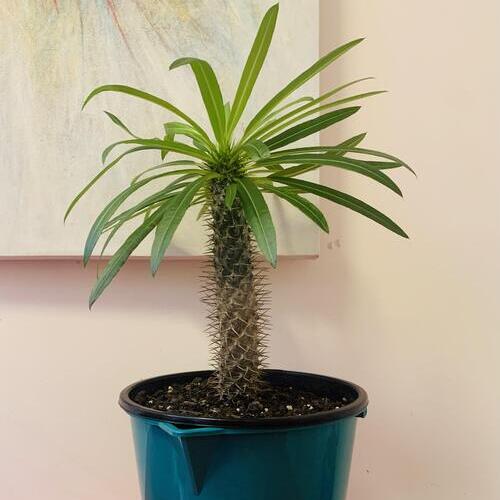
Despite its common name, the Madagascar Palm is not a true palm at all, but rather a spiny, succulent tree in the dogbane family, Apocynaceae, closely related to oleander and the desert rose. Pachypodium lameri is native to the dry forests and rocky coastal scrublands of southern and southeastern Madagascar, an island renowned for its extraordinary botanical diversity and high rate of plant endemism. In the wild, this striking species can grow into an impressive tree reaching twenty feet or more, with a thick, silvery-gray, spine-covered trunk topped by a rosette of long, glossy, dark green leaves that resembles a palm crown, hence its evocative common name.
The most distinctive feature of Pachypodium lameri is its swollen, water-storing trunk, an adaptation that allows the plant to survive Madagascar’s prolonged dry seasons by storing moisture within its succulent tissue. The trunk is densely armed with sharp, three-pronged spines arranged in clusters, a defense mechanism that historically deterred herbivory from the island’s now largely extinct megafauna. As the plant matures, it may branch into multiple trunks, each capped with its own crown of strap-like leaves, giving older specimens a sculptural, almost prehistoric appearance.
When grown in cultivation, particularly as a container or houseplant specimen, Madagascar Palm is typically kept much smaller than its wild counterparts, often reaching just two to six feet indoors over many years due to its slow growth rate. It occasionally produces clusters of fragrant, white to pale pink, five-petaled flowers at the crown, particularly on mature specimens grown in bright, warm conditions. Prized by succulent collectors and xeriscape gardeners alike, the Madagascar Palm brings a bold, architectural, tropical-desert aesthetic to sunrooms, greenhouses, and warm-climate landscapes.
Successfully growing a Madagascar Palm requires replicating the bright, warm, and well-drained conditions of its native Madagascar habitat. This plant demands maximum sunlight, ideally six or more hours of direct sun daily, and performs best in a fast-draining, mineral-rich soil that allows its water-storing trunk to avoid prolonged moisture exposure. Because Pachypodium lameri is highly susceptible to rot, disciplined watering practices that favor a thorough soak followed by complete drying out are essential to long-term success.
A cactus and succulent potting mix amended with extra perlite, pumice, or coarse sand creates the ideal fast-draining substrate, and a pot with generous drainage holes is non-negotiable. During the warm growing months of spring and summer, the plant benefits from regular watering and monthly feeding with a diluted, balanced fertilizer to support steady growth. Handle this plant with care and heavy-duty gloves, since its trunk is covered in sharp, rigid spines capable of causing painful puncture wounds.
As autumn and winter approach and temperatures cool, Madagascar Palm often sheds some or all of its leaves and enters a dormant period during which watering should be reduced drastically, sometimes to almost none, since a leafless dormant plant that is overwatered is highly prone to trunk rot. This species is intolerant of cold and should be kept above 50°F (10°C) at all times, making it best suited to container culture in temperate climates where it can be moved indoors for winter. With bright light, careful watering discipline, and warmth, the Madagascar Palm rewards patient growers with a slow-growing, strikingly architectural specimen that can live for many decades.
 Soil
Soil
Madagascar Palm requires a highly porous, fast-draining, mineral-based soil that mirrors the rocky, well-aerated substrates of its native Madagascar habitat. An ideal mix combines a standard cactus and succulent potting soil with extra coarse sand, perlite, and pumice or lava rock, roughly in equal parts, to ensure rapid water movement away from the trunk and root zone. The preferred soil pH is slightly acidic to neutral, generally in the range of 6.0 to 7.0.
Soil composition has an outsized impact on this plant’s health because its succulent trunk and root system are extremely prone to rot in soil that stays wet for extended periods. Incorporating horticultural charcoal into the mix can help absorb excess moisture and inhibit fungal and bacterial pathogens, while a layer of coarse grit or gravel at the pot’s base and as a topdressing further improves drainage and reduces moisture retention at the crucial trunk base.
Common soil problems to guard against include poor drainage, which is the leading cause of trunk and root rot in this species; soil compaction over time, which suffocates roots and should be corrected by repotting into fresh, loose mix every couple of years; inappropriate pH, which can interfere with nutrient uptake; salt build-up from tap water or fertilizer residue, seen as a white crust on the soil surface and remedied by flushing the pot thoroughly with water; and nutrient deficiencies, which typically present as pale or yellowing leaves and respond well to a balanced, diluted fertilizer. Root-boundness, in which roots become densely tangled and circle the pot, restricts water uptake and growth and signals that the plant should be moved to a slightly larger container with fresh, gritty soil.
 Fertilizer
Madagascar Palm benefits from light, regular feeding during its active growing season in spring and summer, using a balanced or slightly phosphorus-forward fertilizer formulated for cacti and succulents, diluted to half strength and applied every four to six weeks. Fertilization should be suspended entirely during autumn and winter dormancy, when the plant’s growth slows or stops and excess nutrients can accumulate unused in the soil. Signs of over-fertilization include white, crusty salt deposits on the soil surface, leaf tip or margin burn, and stunted or distorted new growth, while under-fertilization typically manifests as pale, slow, or minimal growth and weak leaf color. Organic alternatives such as diluted fish emulsion or compost tea can be used in place of synthetic fertilizers for growers preferring a more natural approach, though nitrogen levels should still be monitored, since excess nitrogen can promote soft, weak growth that is more susceptible to rot. This species generally has modest nutrient requirements overall and responds well to a light-handed, infrequent feeding approach rather than heavy fertilization.
 Watering
Watering is the most decisive factor in the long-term health of a Madagascar Palm, and the fundamental rule is to water deeply and then allow the soil to dry out completely before watering again. During the active growing season in spring and summer, this typically means watering thoroughly every seven to fourteen days, adjusting for climate, pot size, and how quickly the soil dries. Rainwater or distilled water is preferred, as hard tap water can lead to mineral and salt accumulation in the soil over time; if only tap water is available, letting it sit for 24 hours before use helps dissipate chlorine.
Overwatering symptoms include a soft, mushy, or discolored trunk base, yellowing and dropping leaves, and a musty or foul odor from the soil signaling root or trunk rot, which can be fatal if not addressed quickly. Underwatering, by contrast, causes the trunk to appear slightly shriveled or wrinkled and leaves to droop or curl, though established plants tolerate drought remarkably well and rebound quickly once watered. During the cooler autumn and winter months, especially if the plant drops its leaves and enters dormancy, watering should be reduced dramatically, sometimes to just once every four to six weeks or withheld almost entirely, since a dormant, leafless plant has minimal water demand and wet, cold soil during this period is a leading cause of fatal rot.
Stop guessing. Most houseplant failures are caused by volumetric errors and improper moisture tension. Our deterministic calculator moves beyond "once-a-week" watering by analyzing the four critical pillars of root health:
Personalized for this plant
Disclaimer: Our calculator is pretty smart. We’ve crunched the numbers, but we’re not measuring the quantum state of your living room. Since we don’t know your exact indoor temperature, humidity, light, airflow, or whether your plant receives daily sweet nothings and motivational speeches, use this calculator as a guide—and always keep an eye on your plant.
 Lighting
Madagascar Palm is an intensely sun-loving plant that requires bright, direct light for at least six hours a day to maintain compact, healthy growth and encourage flowering. A south- or west-facing window is ideal for indoor cultivation, and outdoor plants should be positioned in full, unobstructed sun. Insufficient light causes the plant to stretch and etiolate, producing weak, elongated growth, sparse or pale leaves, and a trunk that fails to develop its characteristic sturdy, tapered form. Excessive light is rarely harmful to established, acclimated specimens given their desert-adapted nature, but a plant transitioned too abruptly from low light to intense direct sun, particularly after winter dormancy, can experience leaf scorch or bleached patches and should be hardened off gradually over one to two weeks. If natural light is inadequate, especially during shorter winter days, supplement with a full-spectrum LED or fluorescent grow light positioned close to the plant for twelve to fourteen hours daily to sustain healthy, compact growth.
 Temperature
Madagascar Palm thrives in warm temperatures between 65°F and 95°F (18°C to 35°C) and grows most actively when daytime temperatures remain above 70°F (21°C). It is highly sensitive to cold and can sustain serious, sometimes fatal, damage when exposed to temperatures below 50°F (10°C) for extended periods, with frost being lethal to the plant. While it tolerates moderate temperature swings during the active growing season without issue, it should be moved indoors or into a heated greenhouse well before autumn nighttime temperatures begin to drop. To protect it from cold exposure, avoid placing container specimens near drafty windows, unheated garages, or exterior doors in cool weather, and if grown outdoors in borderline climates, provide frost cloth protection or bring the plant inside ahead of any forecasted cold snap. Stable warmth, particularly at the root and trunk zone, supports healthy, uninterrupted growth.
 Humidity
Madagascar Palm prefers low to moderate humidity levels, generally in the range of 30 to 50 percent, consistent with the relatively dry conditions of its native scrubland habitat. High humidity, particularly when paired with cool temperatures or stagnant air, increases the risk of fungal disease and trunk rot, making good air circulation more valuable than elevated ambient moisture. Symptoms of excess humidity stress include soft, discolored trunk tissue, fungal spotting on leaves, and a musty smell near the soil surface. Low humidity rarely causes problems for this desert-adapted species, though very dry indoor heating in winter can occasionally cause minor leaf-tip browning on the crown foliage. Because misting and pebble trays raise humidity, they are generally unnecessary and potentially counterproductive for this plant; instead, prioritize good ventilation and avoid overcrowding it with humidity-loving companion plants.
 Propagation
Madagascar Palm is most commonly propagated from seed, as stem cuttings are difficult to root successfully and often fail to develop the plant’s characteristic swollen trunk; seed propagation, while slower, produces the most naturally proportioned, healthy specimens. Late spring through summer, when temperatures are consistently warm, is the best time to propagate, whether from seed or from an offset if one has formed at the base of a mature plant.
Seed-grown plants generally take several weeks to establish visible growth but require years, often five to ten, to develop a substantial trunk and reach a mature size, reflecting this species’ naturally slow growth rate. Offsets, when available, tend to establish more quickly than seedlings since they already possess some root and trunk development, though true offsets are relatively uncommon on this species compared to other succulents.
 Potting
Madagascar Palm should be planted in a sturdy, well-anchored pot with generous drainage holes, since its top-heavy, spine-covered crown can make lightweight containers prone to tipping as the plant matures. Terracotta or other heavy, porous materials are ideal, as they help wick away excess moisture and provide stability. Repotting is generally needed every two to three years for established plants, or slightly more often for fast-growing younger specimens, and should be done in spring as the plant enters active growth, using a fresh, gritty cactus and succulent mix. Signs indicating a need to repot include roots emerging from drainage holes or circling visibly at the soil surface, water passing through the pot too quickly to be absorbed, and a noticeable slowdown in growth despite otherwise good care. When repotting, wear thick gloves to protect against the sharp trunk spines, and if necessary, trim any excessively long or circling roots with clean, sterilized tools, allowing cuts to callus briefly before repotting. To minimize transplant stress, repot during warm weather, handle the trunk and root ball gently, and withhold water for several days after repotting to allow any root disturbance to heal before resuming normal watering.
 Pruning
Madagascar Palm requires minimal pruning compared to many other houseplants, and the best time for any necessary pruning is late winter to early spring, just before the plant resumes active growth. Pruning is primarily used to remove dead, damaged, or diseased leaves and, occasionally, to manage the size or shape of a specimen that has outgrown its space; light maintenance can be performed throughout the growing season as needed.
Use a clean, sharp pair of pruning shears or a grafting knife, sterilized with rubbing alcohol before and between cuts to prevent the spread of disease. Given the plant’s sharp spines and irritant sap, always wear thick, puncture-resistant gloves and, ideally, eye protection when working near the trunk.
After pruning, keep the plant in bright light and avoid heavy watering for a few days to allow cut surfaces to callus and reduce infection risk. Because Pachypodium lameri grows slowly, any structural pruning should be approached conservatively, as the plant may take years to regenerate lost growth. Winter pruning beyond removing clearly dead material should generally be avoided, since the plant heals more slowly during its dormant, low-light period.
 Blooming
Madagascar Palm blooms most reliably on mature specimens, typically those several years old and at least a few feet tall, with flowering occurring intermittently during the warm growing season from late spring through summer. Each flush of blooms may last one to two weeks, and flowering frequency increases with plant age, sun exposure, and overall vigor. Optimal blooming conditions include at least six hours of direct sun daily, warm temperatures above 70°F (21°C), and a phosphorus-supportive feeding regimen during active growth. The fragrant flowers are white to soft pink, star-shaped with five petals, roughly one to two inches across, and appear in small clusters at the crown among the leaves.
 Pests and Diseases
Name: Mealybugs
Symptoms: Cottony white masses clustered at leaf bases, in the crown, and along the trunk, accompanied by sticky honeydew residue and weakened new growth.
Treatment: Dab visible clusters with rubbing alcohol on a cotton swab, then treat the entire plant with insecticidal soap or neem oil, repeating every seven to ten days until the infestation clears.
Name: Spider Mites
Symptoms: Fine webbing near the crown and leaf undersides, stippled or bronzed leaf coloring, and general decline in hot, dry indoor conditions.
Treatment: Rinse the crown foliage with water to dislodge mites, increase air circulation, and apply a miticide or insecticidal soap as needed for persistent infestations.
Name: Scale Insects
Symptoms: Small, brown or tan, shell-like bumps on the trunk and leaf midribs, accompanied by sticky residue and yellowing foliage.
Treatment: Scrape off visible scale by hand where possible and treat with horticultural oil or a systemic insecticide for widespread infestations.
Name: Aphids
Symptoms: Small clusters of green or black insects on new leaves and emerging growth at the crown, causing curling or distorted leaf development.
Treatment: Dislodge aphids with a strong stream of water and follow up with insecticidal soap or neem oil applications until the population is controlled.
Name: Trunk and Root Rot
Symptoms: Soft, mushy, discolored tissue at the trunk base or roots, a foul odor, and collapse or wilting of the crown despite adequate soil moisture.
Treatment: Remove the plant from its pot, cut away all soft or discolored tissue using a sterilized blade, allow the remaining healthy trunk to dry and callus thoroughly, and repot in fresh, dry, fast-draining mix; reduce future watering frequency significantly.
Name: Fungal Leaf Spot
Symptoms: Brown or black spots, sometimes with a yellow halo, appearing on leaves, particularly in humid or poorly ventilated conditions.
Treatment: Remove affected leaves promptly, improve air circulation around the plant, avoid wetting foliage during watering, and apply a copper-based fungicide if spotting continues to spread.
Name: Bacterial Soft Rot
Symptoms: Rapid, watery softening and dark discoloration of the trunk, often accompanied by a strong, unpleasant odor and quick tissue collapse.
Treatment: Immediately excise all infected tissue with sterilized tools, treat the remaining wound with fungicide or sulfur powder, and allow it to dry completely before resuming any watering.
 Special Features
The Madagascar Palm’s most striking feature is its bold, architectural silhouette: a thick, spine-armored trunk crowned with a burst of long, glossy leaves that creates a dramatic tropical-desert focal point wherever it is displayed. Its slow growth and sculptural form make it a favorite among succulent and caudex plant collectors, who prize older specimens for their increasingly substantial, character-filled trunks. The plant’s remarkable drought tolerance and minimal water needs make it well-suited to xeriscape gardens in warm climates, while its compact growth habit in cultivation allows it to serve as a striking, low-maintenance container specimen for sunrooms, greenhouses, and patios. Mature plants may also produce fragrant, star-shaped flowers, adding seasonal interest to an already visually commanding plant.
 Plant Benefits
Pachypodium lameri is grown almost exclusively as an ornamental specimen rather than for any herbal or pharmaceutical use, and given its toxic, irritant sap and significant physical hazard from spines, it is not recommended for home medicinal or herbal applications. While related Apocynaceae species have a history of use in traditional medicine in various cultures, Madagascar Palm itself is not commonly documented for therapeutic use, and any interest in its bioactive compounds remains within the realm of botanical or pharmacological research rather than home remedy practice.
 Additional Information
Despite its common name and palm-like silhouette, Madagascar Palm is entirely unrelated to true palms (family Arecaceae) and is instead a member of the dogbane family alongside oleander, plumeria, and desert rose. It is one of numerous Pachypodium species endemic to Madagascar, an island famous for its high degree of plant endemism due to millions of years of isolated evolution. The plant is not frost-hardy and is best suited to cultivation as a container or greenhouse specimen outside of USDA hardiness zones 10 and 11, where it can be grown outdoors year-round in suitable, well-drained sites.
 Life Cycle
Madagascar Palm is a slow-growing, long-lived succulent tree that can live for many decades, developing increasingly impressive trunk girth and height with age. It begins life as a seed, germinating within one to three weeks under warm, moist conditions, and spends its early years developing a small caudex-like base and its first cluster of leaves. Over subsequent years, the trunk thickens steadily and the plant may eventually branch, particularly as it matures and, in ideal conditions, begins to flower. Growth is notably slower in cultivation than in its native habitat, and container-grown specimens may take a decade or more to reach a substantial size. The plant follows a seasonal rhythm of active growth and leaf production during warm months, followed by partial or complete leaf drop and dormancy during cooler periods, a cycle that repeats annually throughout its long lifespan.
 Are Madagascar Palm Poisonous, Toxic
Pachypodium lameri is considered toxic to cats, dogs, and humans, particularly children, if ingested, and its sap can cause significant skin and eye irritation on contact. All parts of the plant, especially the milky latex sap, contain cardiac glycosides and other irritant compounds similar to those found in related Apocynaceae species such as oleander and desert rose. Ingestion can affect the gastrointestinal and cardiovascular systems, with symptoms including drooling, vomiting, diarrhea, abdominal discomfort, and in more serious cases, irregular heart rhythm. Additionally, the sharp spines covering the trunk pose a significant physical hazard, capable of causing deep puncture wounds in pets or people who brush against the plant. Severity of internal toxicity ranges from mild gastrointestinal upset to more serious cardiac symptoms with substantial ingestion, while sap contact typically causes localized irritation, redness, or a burning sensation on skin and eyes. If ingestion occurs, rinse the mouth with water and contact a veterinarian, pediatrician, or poison control center promptly; for skin or eye contact with sap, flush the area thoroughly with water for several minutes. Preventive measures include placing the plant well out of reach of pets and children, always wearing thick gloves and eye protection when pruning or repotting, and situating the plant away from high-traffic areas where the spines could cause accidental injury.
 Frequently Asked Questions
No, despite its common name, Pachypodium lameri is not a true palm but a spiny succulent tree in the dogbane family, related to oleander and desert rose.
Yes, the plant’s sap contains cardiac glycosides that are toxic to cats and dogs if ingested, and its sharp trunk spines also pose a physical injury risk to curious pets.
Water thoroughly and allow the soil to dry out completely between waterings, typically every seven to fourteen days during the growing season, with much less frequent watering during winter dormancy.
It needs at least six hours of bright, direct sunlight daily to maintain compact growth and support flowering.
Leaf drop is commonly a normal response to cooler temperatures and reduced light as the plant enters winter dormancy, though it can also signal overwatering or cold stress if it happens unexpectedly during warm weather.
It requires a fast-draining, gritty mix such as a cactus and succulent blend amended with perlite, pumice, or coarse sand, with a soil pH between 6.0 and 7.0.
Madagascar Palm is most reliably propagated from fresh seed, which germinates within one to three weeks under warm, moist conditions, since stem cuttings root poorly and rarely form a proper trunk.
It thrives between 65°F and 95°F and is highly cold-sensitive, suffering serious damage below 50°F, so it should be protected from frost and cold drafts.
A soft, mushy trunk typically indicates rot caused by overwatering or poor drainage, and requires removing affected tissue and repotting in dry, fast-draining soil.
Yes, it grows well indoors near a bright, south- or west-facing window and is commonly kept as a container houseplant in climates cooler than USDA zones 10 and 11.
 Can I grow Madagascar Palm in my indoor space
Difficulty: Intermediate
Size: Medium to Large
Light: High
Water: Low
Flowering: Yes
Pet Safe: No
Air Purifier: Low
 Pachypodium lameri botanical details
Common Name: Madagascar Palm
Other Common Names: Club Foot, Thick Foot, Lamer's Pachypodium
Botanical Name: Pachypodium lameri
Native Area: Southern and southeastern Madagascar, where it grows in dry, rocky forests and scrubland
Family Name: Apocynaceae
Plant Type: Succulent tree/shrub (caudiciform, pachycaul)
Genus: Pachypodium
Kingdom: Plantae
 Photo Gallery
 My Madagascar Palm Plant Care Recommendations
If you find the Houseplant Encyclopedia helpful and would like to support Healthy Houseplants, you can use the links below to shop for recommended plants, products, and plant-care supplies.
Some links are affiliate links, which means I may earn a small commission if you make a qualifying purchase through them, at no additional cost to you. Thank you for supporting Healthy Houseplants and helping me continue to provide free plant-care information!

Want even more personalized plant-care help? Check out my AI Julie Chatbot—trained on my 20 years of houseplant knowledge, not just information from the internet!  Try it now:Ask AI Julie
 Buy Madagascar Palm Online
✅ “Bring Home This Beauty Today”
✅ “Get Your Own Madagascar Palm Before It’s Gone”
✅ “Shop Trusted Sellers – Limited Availability”
✅ “Free Delivery”
As an Amazon Associate, I earn commission from qualifying purchases.
 Plant Puns and Jokes
Why did the Madagascar Palm refuse to give anyone a hug? It said it was far too pointed about personal space!
 Signup to our newsletter and download Madagascar Palm care guide

