


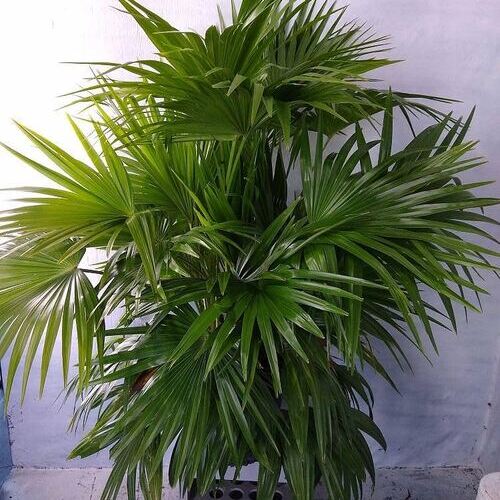
The Chinese Fan Palm (Livistona chinensis) is a slow-growing, single-trunked palm in the family Arecaceae, prized for its broad, glossy, fan-shaped (palmate) fronds that arch gracefully and droop at the tips, giving the crown a fountain-like silhouette. Despite its common name, the species is not native to mainland China in the strict botanical sense of origin; it is believed to be native to the Ogasawara (Bonin) and Ryukyu Islands of Japan, as well as Taiwan and parts of southern China, and has been cultivated in China for centuries, which is how it acquired its familiar English name. In cultivation it has become one of the most widely planted ornamental palms in subtropical and tropical regions worldwide, valued for its elegant form and relative tolerance of a range of conditions.
In its natural and landscape form, Livistona chinensis develops a stout, solitary gray-brown trunk ringed with old leaf-base scars, eventually reaching heights of 25 to 40 feet outdoors over many decades, though it grows much more slowly and stays considerably smaller when kept as a container or indoor specimen. The leaves are costapalmate, meaning the blade is fan-shaped but with a slight downward curve along a short extension of the leaf stalk into the blade, and can span 3 to 6 feet across in mature outdoor specimens. The leaf segments are pleated and split partway to the base, with the outer segments drooping distinctively, a feature that helps distinguish it from other fan palms such as Washingtonia or Trachycarpus.
Mature plants produce inconspicuous, creamy yellow-white flowers on branched inflorescences that emerge from among the leaves, followed by olive-shaped fruits that ripen from green to blue-black. While flowering and fruiting are uncommon in juvenile or indoor specimens, outdoor landscape palms in favorable climates will eventually bloom once they reach sufficient maturity, often after ten or more years. The species is popular both as a striking specimen tree in parks, streetscapes, and gardens in USDA zones 9 through 11, and as a durable, long-lived houseplant or patio plant in cooler climates, where its slow growth rate makes it well suited to container culture for many years before it outgrows an indoor space.
Chinese Fan Palm is considered a relatively easy, forgiving palm for both experienced and novice growers, making it a popular choice for homes, offices, and landscapes. It performs best with bright, indirect light indoors or partial to full sun outdoors, well-draining soil, and consistent but moderate watering that allows the top layer of soil to dry slightly between waterings. Because it is naturally slow-growing, it does not require frequent repotting or heavy feeding, and it tolerates brief periods of neglect better than many other palm species, which contributes to its reputation as a low-maintenance choice.
Successful long-term care centers on mimicking the plant’s native subtropical woodland-edge habitat: filtered to bright light, humidity that is moderate to high, and temperatures that stay above 40 to 45 degrees Fahrenheit. Indoors, place the palm near an east- or south-facing window with sheer curtains to diffuse harsh midday sun, and rotate the pot periodically so growth remains even on all sides. Outdoors, young palms benefit from partial shade until established, after which they tolerate full sun quite well, especially in humid coastal climates. Regular monitoring for browning frond tips, which often signals low humidity or fluoride/salt buildup from tap water, helps keep the plant looking its best.
Routine maintenance includes light feeding during the growing season with a palm-specific fertilizer, periodic removal of fully brown or dead fronds, and occasional flushing of the soil to prevent mineral salt accumulation. Because Chinese Fan Palm has a sensitive, fibrous root system, it should be repotted only when clearly root-bound and handled gently during the process to avoid transplant shock. With consistent, moderate care, this palm can live for many decades, slowly maturing from a compact houseplant into an impressive architectural specimen.
 Soil
Soil
Chinese Fan Palm prefers well-draining, loamy soil enriched with organic matter, ideally a mix formulated for palms that combines standard potting soil with coarse sand or perlite to improve drainage. It tolerates a fairly wide pH range but grows best in slightly acidic to neutral soil, roughly pH 6.0 to 7.5. Good drainage is essential, as the fibrous root system is prone to rot in soggy, compacted, or heavy clay soils; raised beds or amended planting holes are recommended in landscapes with dense native soil.
Amending soil with compost, well-rotted manure, or a slow-release palm fertilizer at planting time supports steady, healthy growth, since soil composition directly affects nutrient availability and root aeration. Poor drainage leads to root rot and yellowing fronds, while compacted soil restricts root expansion and can stunt growth. Inappropriate pH can lock out key micronutrients such as iron and manganese, producing chlorotic (yellowed) new growth, and salt build-up from fertilizer or hard tap water can cause leaf tip burn. Watch for root-boundness in container specimens, indicated by roots circling the pot’s interior or emerging from drainage holes, which signals it is time to repot into fresh, well-aerated soil.
 Fertilizer
Feed Chinese Fan Palm during the active growing season, roughly spring through early fall, with a balanced, slow-release granular palm fertilizer containing micronutrients such as magnesium, manganese, and iron, applied according to package directions, typically every 6 to 8 weeks for container plants and two to three times a year for landscape specimens. Reduce or halt feeding in fall and winter when growth naturally slows. Over-fertilization can cause leaf-tip burn, a white or brown crust on the soil surface, and salt stress, while under-fertilization or nutrient deficiency often shows as pale, yellowing fronds, particularly a condition called frizzle top caused by manganese deficiency, or potassium deficiency spotting on older fronds. Organic alternatives such as diluted fish emulsion, compost tea, or well-rotted compost worked into the topsoil can supplement or replace synthetic fertilizer for growers preferring a more natural feeding regimen.
 Watering
Water Chinese Fan Palm thoroughly, then allow the top one to two inches of soil to dry before watering again, keeping the soil consistently moist but never waterlogged. It generally does well with tap water in most municipal systems, though it can be sensitive to high fluoride or chlorine levels and heavy mineral salts over time, so occasional use of filtered, distilled, or rainwater can help prevent leaf-tip burn in sensitive plants. Underwatering shows up as drooping, folding, or crisping fronds and slowed growth, while overwatering leads to yellowing lower fronds, a mushy trunk base, fungal issues, or root rot from persistently soggy soil. During the active growing season in spring and summer, the palm typically needs more frequent watering, while in fall and winter, when growth slows and temperatures drop, watering frequency should be reduced to match the plant’s lower water uptake.
Stop guessing. Most houseplant failures are caused by volumetric errors and improper moisture tension. Our deterministic calculator moves beyond "once-a-week" watering by analyzing the four critical pillars of root health:
Personalized for this plant
Disclaimer: Our calculator is pretty smart. We’ve crunched the numbers, but we’re not measuring the quantum state of your living room. Since we don’t know your exact indoor temperature, humidity, light, airflow, or whether your plant receives daily sweet nothings and motivational speeches, use this calculator as a guide—and always keep an eye on your plant.
 Lighting
Chinese Fan Palm thrives in bright, indirect light indoors and tolerates partial shade to full sun outdoors, especially once established. Young or indoor plants generally prefer filtered or dappled light, such as that from an east-facing window or beneath taller landscape trees, while mature outdoor specimens can handle full sun exposure, particularly in humid climates. Insufficient light causes slow, leggy growth, sparse or pale fronds, and a stretched appearance as the plant reaches for a light source, while excessive direct sun on an unacclimated indoor plant can scorch fronds, producing brown, crispy patches or bleached-looking foliage. If natural light indoors is limited, supplementing with a full-spectrum grow light for several hours a day can help maintain healthy, compact growth; outdoors, gradually acclimating a shade-grown palm to full sun over several weeks prevents sunburn.
 Temperature
This palm grows best in average temperatures between 65 and 85 degrees Fahrenheit and is hardy outdoors in USDA zones 9 through 11, tolerating brief dips to around 15 to 20 degrees Fahrenheit once mature, though foliage damage can occur at those extremes. It has poor tolerance for prolonged frost or freezing conditions, especially in young plants, and should be protected with frost cloth or moved indoors/into a sheltered spot when temperatures are expected to drop below 40 degrees Fahrenheit for extended periods. Sudden temperature swings, cold drafts near doors and windows, or hot air from heating vents can also stress the plant, so keeping it away from these microclimates indoors helps maintain steady, healthy growth.
 Humidity
Chinese Fan Palm appreciates moderate to high humidity, ideally in the range of 50 percent or higher, though it is more tolerant of average indoor humidity than many tropical houseplants. In excessively dry air, fronds may develop brown, crispy tips or edges and can become more susceptible to spider mites, while unusually high humidity combined with poor air circulation can encourage fungal leaf spot. Effective ways to raise humidity include grouping plants together, placing the pot on a pebble tray filled with water so the pot sits above the waterline, regular light misting of the foliage, or running a room humidifier nearby; of these, a humidifier tends to provide the most consistent and effective humidity increase, while pebble trays and misting offer more modest, localized benefits.
 Propagation
Chinese Fan Palm is propagated almost exclusively from seed, as it is a solitary-trunked palm that does not produce offsets or suckers, making division impractical. Seed propagation has a moderate success rate and requires patience, as germination can be slow and uneven.
1. Collect ripe, blue-black fruit from a mature palm, or purchase fresh viable seed, since seed viability declines quickly with age.
2. Clean the fleshy fruit pulp from the seed and soak the cleaned seeds in warm water for 24 to 48 hours to soften the seed coat and improve germination rates.
3. Fill a seed tray or small pots with a well-draining germination mix, such as a blend of perlite and peat or coco coir.
4. Sow seeds about half an inch deep, spacing them to allow room for initial root development.
5. Keep the growing medium consistently moist but not waterlogged, and maintain warm temperatures between 75 and 85 degrees Fahrenheit, using a heat mat if needed.
6. Place the tray in bright, indirect light and cover loosely with plastic wrap or a humidity dome to retain moisture and warmth.
7. Expect germination within 1 to 3 months, though it can occasionally take longer; check periodically for sprouting and remove the cover once seedlings emerge.
8. Once seedlings have developed a few true leaves and a stable root system, transplant them into individual pots with standard palm potting mix.
9. Grow seedlings on in bright, filtered light with regular watering for at least a year before considering transplanting to a permanent outdoor location or larger container.
Seed propagation is the only reliable method for this species and, while success rates vary with seed freshness and consistent warmth and moisture, healthy seed batches often achieve reasonably good germination. New plants typically take one to two years to become established, sturdy specimens ready for garden planting or larger pots.
 Potting
Choose a sturdy pot with ample drainage holes, ideally only slightly larger than the current root ball, since Chinese Fan Palm generally prefers being somewhat snug in its container and does not need frequent upsizing. Use a well-draining palm or general potting mix amended with perlite or coarse sand to prevent waterlogging. Because it is a slow grower, this palm typically only needs repotting every 2 to 3 years, or when clearly root-bound.
Signs that repotting is needed include roots visibly circling the surface or growing out of the drainage holes, water running straight through the pot without being absorbed, stunted or slowed growth despite the growing season, or the pot tipping easily due to a disproportionately large root mass. Because the roots are fibrous and somewhat sensitive to disturbance, avoid aggressive root pruning; if roots are extremely dense, only trim minimally and just before repotting. When transitioning to a new pot, water the plant a day or two beforehand to reduce stress, gently loosen the root ball without tearing major roots, position it at the same soil depth as before, backfill with fresh mix, and water thoroughly, then keep the palm in stable, indirect light for a couple of weeks while it adjusts.
 Pruning
Prune Chinese Fan Palm primarily in spring or summer during active growth, removing only fully brown, dead, or clearly damaged fronds rather than cutting healthy green or yellowing-but-still-green foliage, which the palm is still drawing nutrients from.
Pruning improves the plant’s appearance, removes potential habitat for pests and disease, and can reduce the risk of falling dead fronds on outdoor landscape specimens.
Use clean, sharp pruning shears or a pruning saw for thicker outdoor petioles, and disinfect blades with rubbing alcohol before and between cuts to avoid spreading disease between plants.
After pruning, resume normal watering and fertilizing; avoid pruning right before a cold snap, since remaining fronds help protect the growing point (bud) from temperature stress.
 Blooming
Mature outdoor specimens typically bloom in late spring to summer once the palm reaches reproductive maturity, which can take a decade or more from seed. Flowering is infrequent to nonexistent on juvenile, container-grown, or indoor plants. When it occurs, the palm produces branched, spike-like inflorescences bearing many small, creamy yellow-white, fragrant flowers that emerge from among the crown of leaves and can persist for several weeks. Optimal blooming is favored by full sun to partial shade, warm temperatures, and an established, healthy root system; flowers are followed by olive-shaped fruits that ripen to a blue-black color over several months.
 Pests and Diseases
Name: Spider mites
Symptoms: Fine webbing on the undersides of fronds, stippled or speckled yellowing on leaf surfaces, and overall dull or bronzed appearance, especially in dry indoor conditions.
Treatment: Increase humidity, rinse foliage periodically with lukewarm water, and treat with insecticidal soap or horticultural oil, repeating applications every 7 to 10 days until resolved.
Name: Scale insects
Symptoms: Small brown, tan, or white bumps along stems and the undersides of fronds, sticky honeydew residue, and sooty mold developing on affected leaves.
Treatment: Manually remove visible scale with a soft cloth or cotton swab dipped in rubbing alcohol, then apply horticultural oil or a systemic insecticide for persistent infestations.
Name: Mealybugs
Symptoms: Cottony white masses clustered in leaf axils and along stems, sticky residue, and stunted new growth.
Treatment: Dab visible mealybugs with alcohol-soaked cotton swabs and treat the whole plant with insecticidal soap or neem oil, repeating every one to two weeks.
Name: Leaf spot (fungal or bacterial)
Symptoms: Brown, black, or yellow-haloed spots scattered across fronds, sometimes merging into larger dead patches.
Treatment: Remove and dispose of severely affected fronds, avoid overhead watering and wetting foliage, improve air circulation, and apply a copper-based fungicide if the problem persists.
Name: Root rot
Symptoms: Wilting despite moist soil, yellowing lower fronds, a soft or mushy trunk base, and a foul odor from the soil.
Treatment: Reduce watering frequency, improve drainage by repotting into fresh, well-draining soil, trim away visibly rotted roots with sterilized tools, and avoid letting the pot sit in standing water.
Name: Nutrient deficiency disorders (frizzle top / potassium deficiency)
Symptoms: Frizzled, stunted, or discolored new growth (manganese deficiency), or yellow-orange spotting and necrotic tips on older fronds (potassium deficiency).
Treatment: Apply a palm-specific fertilizer containing manganese and potassium according to label directions, and correct soil pH if it is contributing to nutrient lockout.
 Special Features
Chinese Fan Palm is notable for its graceful, fountain-like crown of large, glossy, fan-shaped fronds with distinctively drooping segment tips, a feature that sets it apart visually from stiffer-leaved fan palms and makes it a favorite architectural and framing plant in gardens, courtyards, and streetscapes. It offers year-round evergreen interest, a slow and manageable growth rate that suits long-term container culture, and a reputation for being relatively pest- and disease-resistant compared to many other ornamental palms. While not typically grown for fragrance or edible fruit, its subtle seasonal blooms and ornamental blue-black fruit add mild seasonal interest, and its tolerance of coastal conditions, wind, and moderate drought once established makes it a versatile and low-fuss landscape and houseplant choice.
 Plant Benefits
Chinese Fan Palm is not widely recognized in mainstream herbal medicine or pharmacology, and it is grown primarily for ornamental and landscaping purposes rather than medicinal use. As with many broad-leaved houseplants, it contributes modestly to indoor greenery and visual well-being, but it lacks the well-documented herbal or pharmaceutical applications associated with some other traditional medicinal plants.
 Additional Information
Chinese Fan Palm is widely planted as a street and park tree in warm coastal cities due to its wind tolerance, salt tolerance, and manageable size compared to larger palm species. It has naturalized in some subtropical regions outside its native range and, in a few areas such as parts of Florida, is monitored for its potential to spread via bird-dispersed seed, so gardeners in warm climates may want to check regional invasive plant guidance before planting it outdoors. Indoors, it is often sold as a small, multi-trunked-looking specimen (actually several individual seedlings potted together) for a fuller display in its early years.
 Life Cycle
Chinese Fan Palm begins life as a seed that germinates over one to three months under warm, moist conditions, developing first a strap-like juvenile leaf before producing its characteristic fan-shaped foliage as it matures. It spends its early years, often five to ten or more, in a slow-growing juvenile phase focused on trunk and root establishment rather than height, which is why it remains well-suited to container life for a long time. As it matures, typically after a decade or more depending on conditions, it develops a visible trunk and eventually reaches reproductive maturity, at which point healthy outdoor specimens can flower and set fruit seasonally. As a long-lived perennial palm, it can continue growing and producing new fronds for many decades, with old fronds naturally browning, dying back, and being replaced by new growth from the central crown throughout its life.
 Are Chinese Fan Palm Poisonous, Toxic
Livistona chinensis is generally regarded as non-toxic to cats and dogs according to the ASPCA’s listing of pet-safe plants, and it is not classified among plants known to cause serious poisoning in children. However, as with many palms, the fruit, seeds, or fibrous leaf material could pose a mechanical choking or minor gastrointestinal irritation risk if chewed and swallowed in quantity by a small child or pet, rather than a chemical toxicity risk. The sharp, spined leaf petiole edges on some specimens can also cause physical scratches or minor puncture wounds. If a pet or child ingests plant material and shows vomiting, drooling, or discomfort, it is sensible to contact a veterinarian, pediatrician, or poison control center for guidance, and to keep the plant’s cut fronds and spined stalks out of reach of curious pets and small children as a general precaution.
 Frequently Asked Questions
Chinese Fan Palm is a slow-growing species, often adding only a modest amount of height per year, which makes it well suited to container culture for many years before it needs a larger space.
Yes, Livistona chinensis is generally considered non-toxic to cats and dogs, though ingesting plant material in large amounts could still cause mild digestive upset or a mechanical injury risk from fibrous parts.
It prefers bright, indirect light indoors and tolerates partial shade to full sun outdoors once established, with insufficient light leading to leggy, sparse growth.
Water when the top one to two inches of soil have dried out, adjusting frequency seasonally, with more frequent watering in the active growing season and less in cooler, slower-growth months.
Mature outdoor plants can tolerate brief cold snaps down to around 15 to 20 degrees Fahrenheit, but they have poor tolerance for prolonged frost or freezing conditions, especially when young.
Browning frond tips are commonly caused by low humidity, mineral or fluoride buildup from tap water, underwatering, or occasionally over-fertilization causing salt stress.
Chinese Fan Palm is propagated from seed, since it does not produce offsets; seeds are cleaned, soaked, sown in warm, moist, well-draining medium, and typically germinate within one to three months.
Outdoors in ideal conditions it can eventually reach 25 to 40 feet tall over many decades, while indoor or container specimens generally stay much smaller and more compact for years.
It appreciates moderate to high humidity around 50 percent or more but is more tolerant of average indoor humidity than many tropical houseplants, making it fairly adaptable indoors.
It prefers well-draining, loamy soil enriched with organic matter, ideally slightly acidic to neutral in pH, amended with sand or perlite to prevent waterlogging and root rot.
 Can I grow Chinese Fan Palm in my indoor space
Difficulty: Easy
Size: Medium
Light: Medium
Water: Medium
Flowering: Yes
Pet Safe: Yes
Air Purifier: Low
 Livistona chinensis botanical details
Common Name: Chinese Fan Palm
Other Common Names: Fountain Palm, Chinese Fountain Palm, Fan Palm
Botanical Name: Livistona chinensis
Native Area: Ogasawara (Bonin) Islands and Ryukyu Islands of Japan, Taiwan, and Hainan and other parts of southern China
Family Name: Arecaceae
Plant Type: Palm (evergreen perennial tree)
Genus: Livistona
Kingdom: Plantae
 Photo Gallery
 My Chinese Fan Palm Plant Care Recommendations
If you find the Houseplant Encyclopedia helpful and would like to support Healthy Houseplants, you can use the links below to shop for recommended plants, products, and plant-care supplies.
Some links are affiliate links, which means I may earn a small commission if you make a qualifying purchase through them, at no additional cost to you. Thank you for supporting Healthy Houseplants and helping me continue to provide free plant-care information!

Want even more personalized plant-care help? Check out my AI Julie Chatbot—trained on my 20 years of houseplant knowledge, not just information from the internet!  Try it now:Ask AI Julie
 Buy Chinese Fan Palm Online
✅ “Bring Home This Beauty Today”
✅ “Get Your Own Chinese Fan Palm Before It’s Gone”
✅ “Shop Trusted Sellers – Limited Availability”
✅ “Free Delivery”
As an Amazon Associate, I earn commission from qualifying purchases.
 Plant Puns and Jokes
Why did the Chinese Fan Palm refuse to rush through life? It preferred to take things one frond at a time.
 Signup to our newsletter and download Chinese Fan Palm care guide

