


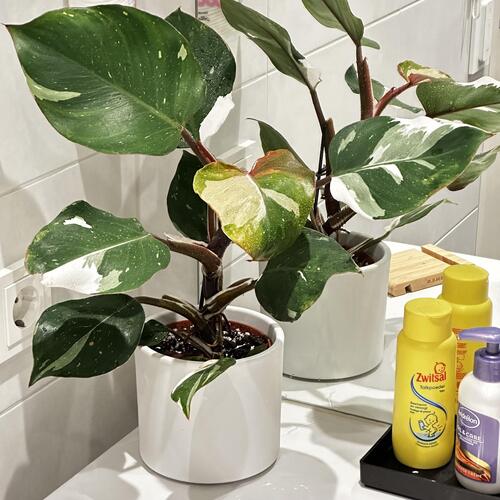
Philodendron ‘White Knight’ and Philodendron ‘White Princess’ are two closely related, highly sought-after variegated cultivars in the aroid family (Araceae). Both are generally attributed to Philodendron erubescens lineage, a climbing species native to the humid tropical forests of Colombia. Neither cultivar occurs in the wild; they are products of horticultural selection and tissue culture, prized for their bold, unpredictable white variegation splashed and marbled across glossy green leaves.
‘White Knight’ is the more dramatic of the two. Its stems, petioles, and new leaf sheaths are a deep burgundy to near-black purple, creating a striking contrast with the dark green leaves and crisp white variegation. Leaves are heart-shaped to elongated and can grow fairly large on a mature, supported plant, often 15–30 cm (6–12 in) long indoors. Variegation appears as speckles, broad sectors, or occasionally fully white leaves. It is often confused with ‘White Wizard’, which has green stems and a more robust habit.
‘White Princess’ is more compact and refined, with narrower, sharply pointed leaves, green stems that can carry a pinkish blush, and white variegation that sometimes shows small pink streaks or splashes, a trait that sets it apart from ‘White Knight’. Both cultivars are hemiepiphytic climbers that grow more vigorously and produce larger leaves when given a moss pole. Because each leaf’s variegation is unique and cannot be fully controlled, no two plants look exactly alike, which has made them collectible favorites among houseplant enthusiasts.
Caring for ‘White Knight’ and ‘White Princess’ is very similar to caring for other climbing philodendrons, with extra attention to the needs of their white variegation. Give them bright, indirect light to maintain strong variegation, but protect them from harsh direct sun, which scorches the delicate white sections. An east-facing window or a spot near (but not in) a south- or west-facing window is ideal, and a full-spectrum grow light is an excellent supplement in darker homes.
Plant them in a chunky, well-draining aroid mix made of potting soil, orchid bark, perlite, and a little horticultural charcoal or worm castings. Water thoroughly when the top 2–3 cm (1 inch) of soil is dry, and never let the plant sit in waterlogged soil, since root rot is the most common cause of decline. Keep temperatures between 18–29°C (65–85°F), shield the plant from cold drafts, and aim for 60–80% humidity to prevent browning on white leaf areas.
Feed monthly in spring and summer with a balanced liquid fertilizer at half strength, reducing to every 6–8 weeks or pausing in winter. Provide a moss pole or coir pole so the plant can climb, which results in larger, more mature leaves. Prune reverted all-green stems back to the last well-variegated node, wipe leaves occasionally to remove dust, and check regularly for pests such as thrips, spider mites, and mealybugs. Repot every 1–2 years in spring, and always keep the plant away from pets and children, as it is toxic if chewed.
 Soil
Soil
Best soil type: ‘White Knight’ and ‘White Princess’ thrive in a loose, chunky, airy aroid mix that holds some moisture but drains quickly. A reliable recipe is roughly 40% quality potting soil or coco coir, 25% fine to medium orchid bark, 20% perlite or pumice, 10% horticultural charcoal, and 5% worm castings.
pH range: Slightly acidic to neutral, about 5.5–6.5 (tolerating up to 7.0). In this range nutrients such as iron, manganese, and magnesium remain available to the roots.
Drainage: Excellent drainage is essential. As hemiepiphytes, their roots are adapted to cling to bark and receive frequent but brief moisture, not to sit in soggy soil. Always use a pot with drainage holes.
Beneficial amendments: Orchid bark (aeration and structure), perlite or pumice (drainage), horticultural charcoal (reduces odor and buildup of impurities), worm castings (gentle slow-release nutrients and beneficial microbes), coco coir (moisture retention without compaction), and a small amount of sphagnum moss for plants in very dry environments.
How soil affects health: A well-aerated mix allows oxygen to reach the roots, which prevents root rot and supports the strong root system needed for vigorous, well-variegated growth. Dense or soggy soil suffocates roots, leading to yellowing, wilting, and fungal problems, while overly fast-draining mixes in a dry home can cause the white leaf sections to crisp.
Common soil problems:
Poor drainage: Causes waterlogging, root rot, yellow leaves, and a sour smell. Fix by repotting into a chunkier mix and a pot with drainage holes.
Compaction: Over time, organic components break down and compress, reducing airflow. Refresh or replace the mix every 1–2 years and avoid pressing soil down firmly when potting.
Inappropriate pH: Overly alkaline soil (often from hard tap water) can cause interveinal chlorosis from iron or manganese deficiency. Use rainwater or filtered water and a peat- or coir-based mix to bring pH back down.
Salt build-up: White crust on the soil surface or pot rim and brown leaf tips indicate fertilizer or mineral accumulation. Flush the soil with plenty of clean water every 1–2 months and fertilize at half strength.
Nutrient deficiencies: Pale new growth, yellowing older leaves (nitrogen), or yellowing between veins (magnesium or iron) indicate deficiency. Feed regularly during the growing season and add worm castings at repotting.
Root boundness: Roots circling the pot, growing from drainage holes, or soil drying out very quickly signal the plant needs a larger pot. Move up only one pot size (2–5 cm / 1–2 in wider) to avoid excess wet soil.
 Fertilizer
Fertilization needs: Moderate feeders during active growth. Regular feeding supports steady growth and strong leaves without pushing excessive soft growth.
Recommended mixture: A balanced liquid fertilizer such as 20-20-20 or a foliage-focused formula like 3-1-2, diluted to half strength. Fertilizers that include micronutrients (magnesium, calcium, iron) are especially helpful.
Schedule: Every 4 weeks in spring and summer. Reduce to every 6–8 weeks in autumn, and pause or feed very lightly in winter unless the plant is actively growing under grow lights. Always water first and fertilize moist soil, never bone-dry soil.
Signs of over-fertilization: White crust on the soil or pot rim, burnt or brown leaf tips and edges, yellowing lower leaves, wilting despite moist soil, and damaged roots. Flush the soil with plenty of water and pause feeding for a month.
Signs of under-fertilization: Slow or stalled growth, small new leaves, pale or yellowing older leaves, and weak stems.
Organic alternatives: Worm castings mixed into the topsoil, diluted fish emulsion, seaweed or kelp extract, compost tea, and slow-release organic granular fertilizers.
Specific nutrient needs: Philodendrons commonly show magnesium deficiency (yellowing between veins of older leaves), which can be corrected with a fertilizer containing magnesium or a very dilute Epsom salt solution used occasionally. Calcium supports strong cell walls and healthy new leaves, while iron deficiency appears as yellowing on new growth, often caused by high soil pH. Because white leaf tissue is sensitive, avoid strong feeds that can scorch it.
 Watering
Watering requirements: Water thoroughly when the top 2–3 cm (about 1 inch) of soil is dry. Pour water slowly until it runs from the drainage holes, then empty the saucer so the pot never sits in water. In the growing season this is often every 7–10 days, depending on light, temperature, pot size, and soil mix.
Water quality: Rainwater, distilled water, or filtered water is ideal, especially in hard-water areas, as mineral and chlorine buildup can cause brown tips on the sensitive white leaf areas. If using tap water, let it sit out overnight to allow some chlorine to dissipate, and use water at room temperature, since cold water can shock tropical roots.
Signs of underwatering: Drooping or limp leaves, dry and crispy leaf edges, curling leaves, browning white sections, soil pulling away from the pot edge, and a very light pot.
Signs of overwatering: Yellowing lower leaves, soft or mushy stems, black or brown patches with a yellow halo, a musty or sour soil smell, fungus gnats, and wilting despite wet soil (a sign of root rot).
Seasonal and growth-stage changes: Water more often in spring and summer during active growth and in warm, bright conditions. In autumn and winter, growth slows, so allow the soil to dry a bit more deeply between waterings. Newly propagated cuttings and freshly repotted plants need consistent light moisture but are especially vulnerable to rot, so avoid soggy conditions. Plants in terracotta pots, small pots, or under grow lights dry out faster than those in plastic or ceramic pots.
Stop guessing. Most houseplant failures are caused by volumetric errors and improper moisture tension. Our deterministic calculator moves beyond "once-a-week" watering by analyzing the four critical pillars of root health:
Personalized for this plant
Disclaimer: Our calculator is pretty smart. We’ve crunched the numbers, but we’re not measuring the quantum state of your living room. Since we don’t know your exact indoor temperature, humidity, light, airflow, or whether your plant receives daily sweet nothings and motivational speeches, use this calculator as a guide—and always keep an eye on your plant.
 Lighting
Ideal lighting: Bright, indirect light for most of the day, roughly 400–800 foot-candles. Good light is critical for these cultivars because the green portions of each leaf must produce energy for the entire plant, including the non-photosynthesizing white areas. An east-facing window with gentle morning sun, or a spot 1–2 m (3–6 ft) back from a south- or west-facing window, works well. Sheer curtains are useful for diffusing strong afternoon light.
Signs of insufficient light: Leggy stems with long gaps between leaves, smaller new leaves, slow or stalled growth, reduced variegation or reversion to solid green leaves, leaning strongly toward the light source, and soil that stays wet for too long.
Signs of excessive light: Scorched, crispy, brown, or bleached patches, especially on white sections; yellowing leaves; faded or washed-out green coloring; and leaf edges that curl.
Adjusting lighting: Move the plant closer to or farther from windows as seasons change, rotate the pot a quarter turn every week or two for even growth, filter harsh sun with sheer curtains, and use a full-spectrum LED grow light positioned 30–60 cm (12–24 in) above the plant for 10–12 hours a day in low-light homes or during darker months.
 Temperature
Ideal range: 18–29°C (65–85°F) during the day, with nighttime temperatures not lower than about 15°C (60°F).
Tolerance to fluctuations: Moderate. The plants tolerate gradual changes but react to sudden swings with drooping, yellowing, or browning leaves.
Cold sensitivity: Growth slows significantly below 15°C (60°F). Prolonged exposure below 13°C (55°F) can cause leaf damage, and temperatures below 10°C (50°F) may cause serious cold injury. They are not frost tolerant and are hardy outdoors only in USDA zones 10–12 or similar tropical climates.
Heat sensitivity: They handle warm temperatures up to around 32°C (90°F) if humidity is high and they are shaded, but hot, dry air causes wilting and browning on white sections.
Protection tips: Keep plants away from cold drafts, exterior doors, single-pane windows in winter, and air-conditioning vents. Do not place them directly next to heaters, radiators, or fireplaces. Move outdoor plants indoors well before nighttime temperatures drop below 15°C (60°F). In heat waves, increase humidity, provide shade, and check soil moisture more often.
 Humidity
Preferred humidity: 60–80% is ideal. The plants tolerate average household humidity of around 40–50%, but the white variegated areas brown and crisp much more readily in dry air.
Symptoms of low humidity: Brown, crispy leaf edges and tips, browning or papery white sections, new leaves that tear or get stuck while unfurling, curling leaves, and higher susceptibility to spider mites.
Symptoms of high humidity: Fungal or bacterial leaf spots, mold on the soil surface, and rot when humidity is very high and airflow is poor.
Ways to increase humidity (and effectiveness):
Humidifier: The most effective and consistent method; place it near the plant and aim for 60–70%.
Grouping plants: Moderately effective; plants release moisture through transpiration, creating a humid microclimate.
Pebble trays: Mildly effective; fill a tray with pebbles and water, keeping the pot base above the waterline.
Greenhouse cabinet or terrarium: Very effective for young plants or cuttings, but requires good ventilation.
Misting: Least effective; it raises humidity only for minutes and can encourage leaf diseases if water sits on leaves. Use sparingly, early in the day.
Ways to decrease humidity: Improve airflow with a small fan, space plants apart, open a window or run a dehumidifier in very humid rooms, and avoid misting.
 Propagation
Methods: Stem cuttings (most common and reliable), air layering, and tissue culture (used commercially).
Necessary conditions: Warm temperatures of 21–29°C (70–85°F), humidity of 70% or higher, bright indirect light, and a cutting with at least one healthy node, ideally with an aerial root.
Step-by-step stem cutting guide:
1. Choose a healthy stem with good variegation; leaves that are roughly half green and half white root best and keep the variegation going.
2. Sterilize sharp pruners or scissors with isopropyl alcohol and wear gloves.
3. Cut just below a node, leaving 1–2 cm (about 1/2 inch) of stem below it. Each cutting should have at least one node and one leaf.
4. Remove any leaves that would sit below the waterline or rooting medium.
5. Let the cut end air-dry for 30–60 minutes to form a slight callus (optional but helpful).
6. Optionally dip the cut end in rooting hormone.
7. Place the cutting in water, damp sphagnum moss, moist perlite, or a light aroid mix, making sure the node is in contact with the medium.
8. Put the cutting in a warm, bright spot out of direct sun and keep humidity high, using a clear bag or propagation box if needed.
9. Change water every 3–5 days, or keep moss or perlite lightly moist but not soggy.
10. Once roots are 3–5 cm (1–2 in) long, pot the cutting into a small pot with a chunky aroid mix.
11. Keep the soil lightly moist and humidity high for the first 2–4 weeks while the plant adjusts.
Air layering steps:
1. Choose a node on a healthy stem still attached to the mother plant.
2. Wrap the node in damp sphagnum moss and cover it with plastic wrap secured at both ends.
3. Keep the moss moist and wait for roots to form inside the wrap (usually 3–6 weeks).
4. Cut below the new roots and pot the new plant.
Success rate comparison:
Stem cuttings in sphagnum moss or perlite: High (about 80–90%), with lower rot risk.
Stem cuttings in water: High (about 75–90%), easy to monitor roots, but roots need time to adapt to soil.
Air layering: Very high (90%+), as the cutting stays nourished by the mother plant, though slower and more hands-on.
Leaf without node or fully white cutting: Very low to zero; fully white cuttings lack chlorophyll and usually fail.
Best time of year: Spring through early summer, when growth is most active.
Timing: Roots typically appear in 2–4 weeks, a new leaf in 4–8 weeks, and a cutting becomes a well-established plant in about 2–4 months.
 Potting
Pot type: Use a pot with drainage holes. Plastic and glazed ceramic retain moisture longer, while terracotta dries faster and is a good choice for heavy-handed waterers. Clear orchid pots or nursery pots with plenty of side vents let you monitor roots and improve airflow.
Drainage needs: Excellent drainage is essential. Never plant directly into a pot without holes; if using a decorative cachepot, keep the plant in a nursery pot inside and empty excess water.
Repotting frequency: Every 1–2 years, ideally in spring or early summer.
Ideal soil composition: A chunky aroid mix of roughly 40% potting soil or coco coir, 25% orchid bark, 20% perlite or pumice, 10% horticultural charcoal, and 5% worm castings.
Signs repotting is needed: Roots growing out of drainage holes or circling the pot, soil drying out within a couple of days, water running straight through without soaking in, the plant becoming top-heavy, slowed growth despite good care, and soil that has broken down or become compacted.
Root pruning: Generally only needed when removing dead, mushy, or rotting roots, or when a plant is severely root-bound and must stay in the same pot. Trim damaged roots with sterilized scissors and remove no more than about 20% of healthy roots.
Transitioning with minimal stress:
1. Water the plant the day before to reduce shock.
2. Choose a pot only 2–5 cm (1–2 in) wider than the current one.
3. Gently slide the plant out and loosen circling roots with your fingers.
4. Check for rot and trim any damaged roots.
5. Add fresh mix to the new pot, set the plant at the same depth, and fill around it without packing the soil tightly.
6. Install a moss pole at this time if desired.
7. Water lightly and return the plant to its usual spot in bright, indirect light.
8. Hold off fertilizing for 3–4 weeks and keep humidity steady while the roots settle. Mild drooping for a few days is normal.
 Pruning
Pruning keeps ‘White Knight’ and ‘White Princess’ compact and full, removes damaged or diseased growth, and, most importantly for these cultivars, helps manage variegation. Cutting back stems that revert to solid green, or that produce too many fully white leaves, steers new growth toward balanced green-and-white foliage.
Do major pruning in spring or early summer, when the plant is actively growing and recovers quickly. Light maintenance, such as removing yellow or brown leaves, can be done any time of year. Most plants only need a significant prune once a year, with minor tidying every few weeks.
Water the plant a day before pruning so it is well hydrated, and work in a well-lit area so you can clearly see nodes and variegation patterns.
Return the plant to bright, indirect light and keep humidity steady. Hold off on fertilizing for 2–3 weeks to allow the plant to recover, then resume your normal schedule. Water only when the top 2–3 cm (1 inch) of soil is dry, since a smaller leaf mass uses less water. New growth typically appears within 2–6 weeks.
 Blooming
Season(s): In their native-style tropical conditions, philodendrons may bloom in spring through summer, but ‘White Knight’ and ‘White Princess’ very rarely flower indoors.
Duration: When an inflorescence does appear, it typically lasts several days to about two weeks.
Frequency: Rare to non-existent in home cultivation; flowering generally requires a large, mature plant several years old.
Optimal conditions: Consistently warm temperatures (24–29°C / 75–85°F), high humidity (70%+), very bright indirect light, regular feeding, and a mature, well-established climbing plant.
Flower characteristics: Like all aroids, the “flower” is an inflorescence consisting of a spadix (a fleshy spike covered in tiny flowers) partly enclosed by a hooded spathe. In P. erubescens types the spathe is often reddish-burgundy outside and cream to pinkish inside. The blooms are not fragrant in any significant way, and the plant is grown for its foliage rather than its flowers.
 Pests and Diseases
Name: Spider mites
Symptoms: Fine webbing under leaves and at petiole joints, tiny yellow or white stippling on foliage, dull or bronzed leaves. Most common in dry air.
Treatment: Rinse the plant in the shower, wipe leaves, raise humidity, and treat with insecticidal soap or neem oil every 5–7 days for at least 3 weeks. Predatory mites are an effective biological control.
Name: Thrips
Symptoms: Silvery streaks, black specks of excrement, distorted or scarred new leaves, and tiny slender insects on leaf surfaces.
Treatment: Isolate the plant, rinse thoroughly, apply spinosad or insecticidal soap weekly, and use blue or yellow sticky traps. Systemic treatments may be needed for persistent infestations where legally available.
Name: Mealybugs
Symptoms: White cottony clusters in leaf axils, along stems, and under leaves; sticky honeydew; yellowing and weak growth.
Treatment: Dab insects with a cotton swab soaked in 70% isopropyl alcohol, then spray with insecticidal soap or neem oil weekly until gone. Check roots for root mealybugs when repotting.
Name: Scale insects
Symptoms: Small brown or tan bumps on stems and leaf undersides, sticky honeydew, sooty mold, and yellowing leaves.
Treatment: Scrape off scale with a fingernail or soft brush, wipe with alcohol, and apply horticultural oil or neem oil every 7–10 days.
Name: Aphids
Symptoms: Clusters of small green, black, or brown insects on new growth; curled or distorted leaves; honeydew.
Treatment: Spray off with water and treat with insecticidal soap or neem oil every 5–7 days.
Name: Fungus gnats
Symptoms: Small black flies around the soil; larvae in the soil may damage fine roots of young plants and cuttings.
Treatment: Let the topsoil dry out between waterings, use yellow sticky traps, and apply Bacillus thuringiensis israelensis (BTI) as a soil drench.
Name: Root rot (Pythium, Phytophthora, Fusarium)
Symptoms: Yellowing and wilting leaves despite wet soil, mushy brown or black roots, foul smell, and a soft base of the stem.
Treatment: Remove the plant, cut away all rotten roots with sterilized tools, rinse the healthy roots, and repot in fresh, chunky mix with a clean pot. Water sparingly while it recovers. Propagate healthy stem sections if rot is severe.
Name: Bacterial leaf spot and blight (Xanthomonas, Erwinia)
Symptoms: Water-soaked, translucent spots that turn brown or black with yellow halos; rapid spread and a foul odor in severe cases.
Treatment: Remove affected leaves immediately, avoid wetting the foliage, improve airflow, and isolate the plant. Copper-based bactericides may slow spread, but badly infected plants may need to be discarded or propagated from clean cuttings.
Name: Fungal leaf spot
Symptoms: Brown, tan, or black circular spots, sometimes with concentric rings or yellow margins.
Treatment: Remove infected leaves, reduce misting, water at soil level, improve ventilation, and apply a fungicide such as copper fungicide or a neem-based product if needed.
Name: Sooty mold
Symptoms: Black, powdery coating on leaves, usually following honeydew-producing pests.
Treatment: Treat the underlying pest problem, then wipe leaves with a damp cloth and mild soapy water.
Name: Browning of white variegation (physiological)
Symptoms: Crispy brown edges or patches on white sections, often spreading.
Treatment: Not a disease, but a common issue. Increase humidity, avoid direct sun, use filtered or rainwater, water consistently, and flush soil to remove salt buildup.
Name: Reversion (physiological)
Symptoms: New leaves emerging solid green with little or no white variegation.
Treatment: Increase bright indirect light and prune the stem back to the last node with good variegation.
 Special Features
The standout feature of ‘White Knight’ and ‘White Princess’ is their dramatic white variegation, which appears as fine speckles, marbling, bold sectors, or occasionally entire white leaves, so that every leaf is unique. ‘White Knight’ adds striking contrast with deep burgundy to nearly black stems and petioles, while ‘White Princess’ offers a daintier, more compact form with slender pointed leaves and occasional pink streaks in its variegation. Both are climbing plants that develop larger, more impressive leaves when grown on a moss pole, making them excellent living sculptures and statement pieces for interiors. They are not grown for fragrance, flowers, or edible fruit; their appeal is purely ornamental, collectible foliage that brings year-round interest.
 Plant Benefits
Neither ‘White Knight’ nor ‘White Princess’ has any recognized herbal or pharmaceutical uses, and they should never be eaten or used medicinally, as all parts are toxic due to calcium oxalate crystals. Their benefits are ornamental and environmental: like other philodendrons, they release oxygen and add moisture to indoor air through transpiration, and caring for houseplants has been associated with reduced stress, improved mood, and a greater sense of well-being. Note that while early laboratory studies (such as NASA’s 1989 Clean Air Study, which included Philodendron species) showed some removal of airborne compounds like formaldehyde in sealed chambers, a few houseplants have only a minimal effect on air quality in a typical ventilated home.
 Additional Information
Pricing and availability: Both cultivars were once rare and expensive collector’s plants. Widespread tissue culture production has made them far more available and affordable, though plants with high, well-balanced variegation still command premium prices.
Tissue culture variability: Tissue-cultured plants can show varied variegation, and some may revert or develop less white over time. Buying a plant with visible, stable variegation on several leaves is the best indicator of future performance.
Look-alikes: ‘White Knight’ is often confused with ‘White Wizard’ (green stems, more vigorous, larger leaves) and ‘White Princess’ with ‘Pink Princess’ (dark burgundy leaves with pink variegation). ‘White Princess’ plants can occasionally show pink splashes, which adds to the confusion.
Growth rate: Moderate. Expect several new leaves per growing season under good conditions, with faster growth when given a moss pole, warmth, humidity, and strong indirect light.
Outdoor growing: Suitable year-round outdoors only in warm tropical or subtropical climates (roughly USDA zones 10–12), in a shaded, humid location protected from direct sun and strong wind.
Cleaning: Wipe leaves gently with a soft, damp cloth every few weeks to remove dust and improve photosynthesis. Avoid leaf-shine products, which can clog pores and damage white tissue.
 Life Cycle
‘White Knight’ and ‘White Princess’ are evergreen perennials that can live for many years, often well over a decade, with proper care. Because they are cultivars, they are propagated vegetatively (by cuttings and tissue culture) rather than from seed, so each new plant is a genetic clone of its parent.
Establishment stage: A newly rooted cutting or tissue-culture plantlet develops roots and its first few leaves over 2–4 months. It needs warmth, high humidity, bright indirect light, and consistent light moisture.
Juvenile stage: The plant produces smaller leaves on a short, compact stem. Without support it may sprawl or lean; with a moss pole it begins to climb using aerial roots.
Mature stage: When climbing and well-fed, the plant produces noticeably larger, more elongated leaves and thicker stems. Growth is most active in spring and summer and slows in autumn and winter.
Reproductive stage: Under ideal conditions a very mature plant may occasionally produce a spathe-and-spadix inflorescence, though this is rare indoors.
Growth requirements across all stages: bright indirect light, a chunky well-draining aroid mix, temperatures of 18–29°C (65–85°F), humidity of 60–80%, regular feeding during active growth, and periodic pruning and repotting to maintain vigor and variegation.
 Are White Knight Philodendron & White Princess Philodendron Poisonous, Toxic
Toxic parts: All parts of the plant, including leaves, stems, petioles, roots, and sap, contain insoluble calcium oxalate crystals (raphides).
Organisms affected: Cats, dogs, rabbits, birds, other pets, and humans, especially young children.
Symptoms: Immediate burning or stinging of the mouth, lips, and tongue; excessive drooling; pawing at the mouth; swelling of the mouth, tongue, or lips; difficulty swallowing; vomiting; and decreased appetite. Sap on skin can cause redness, itching, or dermatitis, and sap in the eyes can cause pain and irritation.
Severity: Usually mild to moderate. The intense oral pain typically limits how much is eaten. Rarely, significant swelling of the mouth or throat can affect breathing, which is an emergency.
First aid steps:
1. Remove any plant pieces from the mouth.
2. Gently rinse the mouth with water; for pets, offer a small amount of water, milk, or yogurt to help soothe irritation.
3. For skin contact, wash the area with soap and water. For eye contact, flush with clean water for 10–15 minutes.
4. Contact your veterinarian, doctor, or local poison control center for guidance.
5. Seek emergency care immediately if there is difficulty breathing, severe swelling, or persistent vomiting.
Preventive measures: Place plants out of reach on high shelves or in rooms pets cannot access, use hanging planters or plant stands, promptly clean up fallen leaves and trimmings, wear gloves when pruning or repotting, wash hands afterward, and teach children not to touch or eat houseplants.
 Frequently Asked Questions
‘White Knight’ has deep burgundy to dark purple stems and petioles, larger heart-shaped to elongated leaves, and white variegation on dark green foliage. ‘White Princess’ has narrower, more pointed leaves, green or pinkish-tinged stems, a more compact habit, and occasionally shows small pink streaks alongside the white variegation.
Yes. Both contain insoluble calcium oxalate crystals in all parts of the plant. Chewing causes mouth irritation, drooling, pawing at the mouth, vomiting, and difficulty swallowing. Keep them out of reach of pets and children and contact a veterinarian if ingestion occurs.
They need bright, indirect light, roughly 400–800 foot-candles. Strong light supports the white variegation, but direct midday sun can scorch the white sections. An east-facing window or a spot a short distance from a south- or west-facing window works well, and a full-spectrum grow light is a good supplement.
Water when the top 2–3 cm (about 1 inch) of soil has dried out, usually every 7–10 days in the growing season and less often in cooler months. Water thoroughly until it drains from the bottom, and never let the pot sit in standing water.
Loss of variegation, or reversion to solid green leaves, is most often caused by insufficient light. Move the plant to brighter indirect light and prune reverted stems back to the last node with good variegation. Some reversion is natural and occurs randomly in variegated cultivars.
White tissue lacks chlorophyll and is more delicate, so it browns easily from low humidity, direct sun, inconsistent watering, or fertilizer and mineral buildup. Raise humidity to 60% or more, provide bright indirect light without harsh sun, water consistently, and flush the soil periodically.
Fully white leaves cannot photosynthesize, so they usually brown and die within weeks to a few months. They do not harm the plant, but if a stem keeps producing all-white leaves, prune back to a node with balanced variegation.
Yes, both are climbing cultivars. Providing a moss pole or coir pole encourages larger leaves, stronger stems, and a more upright, attractive shape. ‘White Princess’ stays more compact than ‘White Knight’.
Take stem cuttings with at least one node and one leaf, choosing pieces with good variegation. Root them in water, damp sphagnum moss, or a chunky aroid mix in warm, humid conditions with bright indirect light. Roots usually form in 2–4 weeks.
Indoors, ‘White Knight’ commonly reaches 1–2 m (3–6 ft) with support, with leaves around 15–30 cm (6–12 in) long on mature plants. ‘White Princess’ is more compact, usually 0.6–1.2 m (2–4 ft), with smaller, slimmer leaves.
 Can I grow White Knight Philodendron & White Princess Philodendron in my indoor space
Difficulty: Intermediate
Size: Medium
Light: Medium
Water: Medium
Flowering: Yes
Pet Safe: No
Air Purifier: Medium
 Philodendron erubescens 'White Knight' and Philodendron erubescens 'White Princess' botanical details
Common Name: White Knight Philodendron & White Princess Philodendron
Other Common Names: White Knight Philodendron, White Princess Philodendron, Variegated Philodendron, White Variegated Philodendron, Philodendron erubescens 'White Knight', Philodendron erubescens 'White Princess'
Botanical Name: Philodendron erubescens 'White Knight' and Philodendron erubescens 'White Princess'
Native Area: Cultivated hybrids with no wild range. The parent species, Philodendron erubescens, is native to the tropical rainforests of Colombia in northwestern South America.
Family Name: Araceae
Plant Type: Evergreen perennial; climbing hemiepiphytic tropical houseplant
Genus: Philodendron
Kingdom: Plantae
 Photo Gallery
 My White Knight Philodendron & White Princess Philodendron Plant Care Recommendations
If you find the Houseplant Encyclopedia helpful and would like to support Healthy Houseplants, you can use the links below to shop for recommended plants, products, and plant-care supplies.
Some links are affiliate links, which means I may earn a small commission if you make a qualifying purchase through them, at no additional cost to you. Thank you for supporting Healthy Houseplants and helping me continue to provide free plant-care information!

Want even more personalized plant-care help? Check out my AI Julie Chatbot—trained on my 20 years of houseplant knowledge, not just information from the internet!  Try it now:Ask AI Julie
 Buy White Knight Philodendron & White Princess Philodendron Online
✅ “Bring Home This Beauty Today”
✅ “Get Your Own White Knight Philodendron & White Princess Philodendron Before It’s Gone”
✅ “Shop Trusted Sellers – Limited Availability”
✅ “Free Delivery”
As an Amazon Associate, I earn commission from qualifying purchases.
 Plant Puns and Jokes
Why did the White Knight Philodendron refuse to fight the dragon? Because it heard it should always stay out of direct fire and stick to bright, indirect light!
 Signup to our newsletter and download White Knight Philodendron & White Princess Philodendron care guide

