In February the windows stay shut, the heat runs all day, and the shelf of pothos in the living room looks much the same as it did in October. Nothing about the plants suggests that anything has changed around them.
Two things have. The air in that room may be moving less, and it is carrying more than it was in the fall—fibers, crumbs of potting mix, and whatever drifts in from the rest of the house. A leaf is a flat surface in a slow-moving room, and much of what floats past it eventually settles. Neither problem will necessarily show up in how you water. Both are about the air.
A Leaf Sits Inside Its Own Pocket of Air
Air does not behave the same way everywhere in a room. Right against a leaf is a thin boundary layer of air that moves more slowly than the surrounding air, and whatever the plant gives off enters that layer first.
Plants transpire. Moisture leaves through pores in the foliage, many of them on the undersides of leaves. In a room with little air movement, that moisture can remain concentrated near the leaf surface longer before being carried into the surrounding air.
In still conditions, that thin layer is replaced more slowly. On its own that is a subtle change, and it is the kind of thing that can go unnoticed for an entire winter.
You will not see it happening, which is why it gets overlooked. The plant may not droop, and the soil may still dry on its usual schedule. What has quietly changed is the immediate environment around the foliage.
What Slow Air Leaves Behind
Wet foliage is one place this can become noticeable. Water may end up on leaves from misting, splashing during watering, or other sources. In moving air, that moisture generally evaporates more quickly. In still air, leaves can remain wet longer, creating conditions that may favor certain fungal and bacterial diseases.
The same principle can apply at soil level. Still air can slow evaporation from the surface of the potting mix, especially when plants are grouped closely together.
Groups of plants can make all of this more pronounced. A cluster of pots placed shoulder to shoulder can hold its own small pocket of humid, slow-moving air. When foliage overlaps, the air between leaves moves less freely, and wet surfaces in the middle of the group may dry more slowly than those at the edges.
A quiet tower fan on its lowest setting for a few hours at a time can help keep air moving around your plants. The reason the quiet part matters is that this is not necessarily a device you switch on for only a few minutes. Gentle air movement can be useful for longer stretches in a room you are also using, at a speed you can comfortably live with. A fan that gets switched off because it is too loud is unlikely to be much help.
This does not change the advice about keeping plants out of the direct path of heating and air-conditioning vents. Concentrated hot or cold airflow can increase moisture loss from foliage and expose plants to temperature stress. What helps is gentle air movement through the room rather than a steady blast aimed at one plant.
Dust in a home is not a one-time event. It arrives continuously from fabric and paper, cooking, outdoor air, pets, potting mix, and ordinary household activity. Much of it eventually settles on whatever surfaces are available.
Leaves are excellent dust collectors. They are broad, numerous, and stationary. A shelf of plants is, among other things, a collection of surfaces that also depend on receiving light.
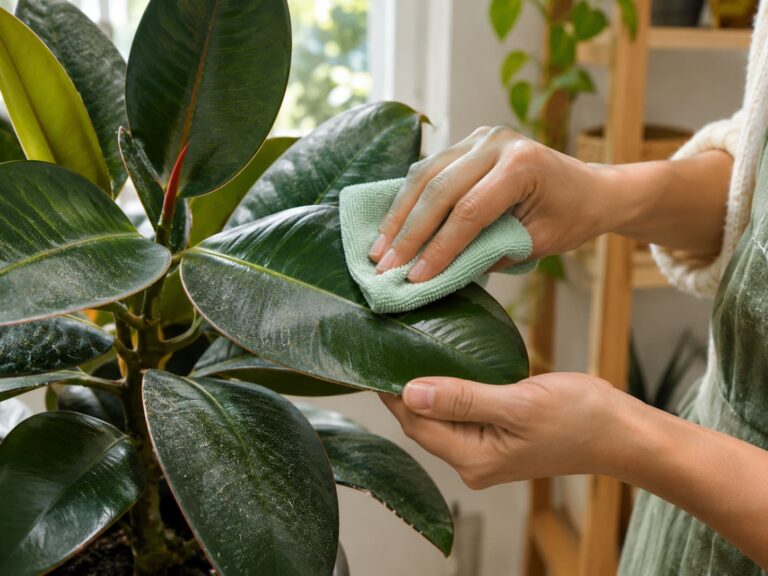
Some of what settles is coarse enough to notice once it collects. More of it is fine enough to appear as a general dullness on the foliage rather than obvious dust. That is why a plant can look noticeably brighter after its leaves are wiped clean.
Heavy dust buildup can reduce the amount of light reaching the leaf surface and may interfere with normal leaf function. Cleaning the leaves helps remove dust that has already settled, but it does not stop new airborne particles from landing afterward. Reducing what is floating around is a different job, and the particles that have not yet settled are the ones air purifiers for the home can work on. A filter does not wipe a leaf, and it will not make a dull plant glossy, but it can reduce some of the fine material circulating in the room. This may slow how quickly dust accumulates between cleanings.
Two Jobs in the Same Room
Movement and filtration are easy to confuse because both involve the air in a room and both are handled by devices that move air. They are not doing the same work, however.
Moving air helps reduce stagnant pockets around foliage and can help wet leaf surfaces dry more quickly. Filtered air contains fewer airborne particles, depending on the type and effectiveness of the filter.
There is some overlap—a purifier moves air as it runs, and a fan redistributes air already in the room—but that overlap is not a reason to treat them as the same thing. The practical question is which condition your room actually has.
Reading Your Own Home
Some areas of a home naturally experience more air movement than others. Hallways, rooms with frequently opened doors, and spaces near active ventilation may have more circulation than a closed bedroom or a quiet corner.
Plants often end up in places where air moves less freely, such as on shelves, in corners, or grouped closely together. Take a look around your home and notice where air may be especially still. Check closed rooms in winter, corners behind furniture, and areas where pots are packed closely enough that the leaves overlap.
Then look at where dust tends to collect—the top of a bookcase, the rim of a large pot, or nearby furniture. Those surfaces can give you a good indication of how much dust may also be settling on your plant foliage.
Where you place plants can matter as much as the devices you use. Moving a shelf out of a stagnant corner or giving crowded plants a little more space may improve conditions without requiring additional equipment.
Common Questions
Does a fan dry out houseplants?
It can if strong airflow is directed continuously at one plant from close range. A low, indirect or oscillating setting creates different conditions by encouraging gentle circulation without constantly blasting the foliage.
Do air purifiers clean houseplants?
Not directly. A filter works on what is in the air and does not clean foliage that is already dusty. Its potential benefit is indirect: reducing some airborne particles may slow the rate at which fine dust settles on leaves and other surfaces.
Should the air in a plant room move at night?
Gentle air movement at night is generally fine. A low setting is usually enough if you choose to run a fan overnight.
Does moving the air make a room drier?
Not necessarily. Moving air does not remove moisture from the room itself, although it can increase evaporation from leaf and soil surfaces. Room humidity and air circulation are related but separate conditions.
 Plant ParentNovember 10, 2026