


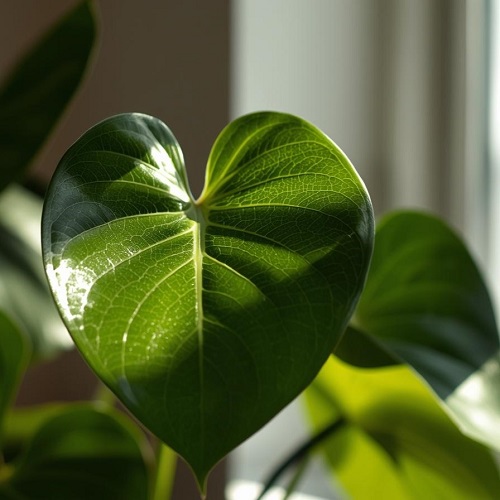
Philodendron micans, commonly known as the Velvet-Leaf Philodendron, is a stunning tropical vining plant native to the Caribbean, particularly the islands of Dominica and Tobago, as well as parts of Mexico and Central America. In its natural habitat, it grows as an epiphytic or hemi-epiphytic climber, scrambling up the trunks and branches of rainforest trees in the understorey, where it thrives in dappled, indirect light beneath the forest canopy. Its natural environment is characterized by high humidity, warm temperatures, and rich, well-draining organic soils — conditions that growers replicate when cultivating this plant indoors.
The most striking feature of Philodendron micans is undoubtedly its foliage. The leaves are heart-shaped (cordate) and exhibit a remarkable iridescent, velvety texture caused by tiny microscopic hairs called trichomes on the leaf surface. Juvenile leaves emerge in shades of burnt orange, copper, or bronze before maturing into a deep, rich forest green with a subtle purple or bronze iridescent sheen on the upper surface. The undersides of the leaves are a contrasting deep reddish-purple, making the plant visually captivating from multiple angles. This interplay of colour and texture makes it one of the most visually distinctive members of the Philodendron genus.
As a climbing or trailing vine, Philodendron micans produces slender, flexible stems with internodes spaced several centimetres apart. The petioles are often tinged with a reddish or pinkish hue that complements the foliage beautifully. When grown with a moss pole or trellis, the leaves increase in size significantly, rewarding the grower with more pronounced iridescence and larger heart-shaped forms. When allowed to trail, the plant produces slightly smaller, equally beautiful leaves that cascade gracefully from shelves or hanging baskets. It is a vigorous grower under appropriate conditions and can extend its vines by several feet in a single growing season.
Caring for Philodendron micans is a genuinely rewarding experience, particularly for beginner and intermediate plant enthusiasts. Its relatively forgiving nature, combined with its extraordinary visual appeal, makes it one of the most recommended foliage houseplants for indoor cultivation. The foundation of good care lies in replicating the warm, humid, low-to-medium light conditions of its tropical rainforest origins. When these core requirements are met consistently, the plant rewards its keeper with vigorous growth, brilliant iridescent foliage, and an impressive trailing or climbing habit.
Watering discipline is perhaps the most critical element of Velvet-Leaf Philodendron care. The plant prefers to dry out partially between waterings — allowing the top one to two inches of soil to dry before rewatering. It is far more susceptible to root rot from overwatering than to drought stress. The soil medium must be well-aerated and fast-draining to support this watering regime. Similarly, humidity levels should ideally remain above 50%, though the plant will tolerate standard household humidity levels with minimal stress. Supplementing humidity through pebble trays, regular misting, or a nearby humidifier will noticeably improve leaf size, texture, and iridescence.
Fertilization, lighting, and periodic pruning round out the essential care regime. A balanced liquid fertilizer applied monthly during the growing season provides the nutrients needed for lush, healthy foliage. Indirect bright light is the sweet spot — too little light and the rich colouring fades, too much direct sun and the velvet leaves scorch and bleach. Pruning not only keeps the plant tidy and compact but encourages bushy, dense growth and can be used to propagate new plants easily. Overall, with attentive but not demanding care, Philodendron micans will thrive as a long-lived, ever-beautiful indoor companion.
 Soil
Soil
Philodendron micans thrives in a loose, well-aerated, organically rich potting mix that closely mimics the epiphytic substrate conditions of its native tropical habitat. The ideal mix promotes excellent drainage while retaining just enough moisture to keep the roots hydrated between watering intervals. A standard tropical houseplant potting mix alone is often too dense and moisture-retentive, so amendments are strongly recommended.
A recommended mix consists of 40% high-quality peat-free potting mix or coco coir, 30% perlite or pumice for drainage and aeration, 20% orchid bark or chunky horticultural bark for structure and air pockets, and 10% worm castings or compost for slow-release nutrients and microbial activity.
Ideal soil pH is between 5.5 and 6.5 (mildly acidic). This range supports optimal nutrient availability and mimics the slightly acidic forest floor soils of the plant’s native range.
Drainage is non-negotiable. Waterlogged soil is the primary cause of root rot in Philodendron micans. The mix must allow water to flow through freely while holding moderate moisture.
Additions of horticultural charcoal help prevent bacterial and fungal build-up in the root zone. Biochar and mycorrhizal inoculants can enhance root health and nutrient uptake. Slow-release fertilizer granules blended into the mix provide a baseline nutrient supply.
Standing water in the pot or soil that remains soggy for more than 48 hours after watering leads to anaerobic conditions, root suffocation, and Pythium root rot. Solution: amend with perlite or pumice and ensure pots have drainage holes.
Over time, organic components of the potting mix break down and compact, reducing aeration and drainage. Signs include stunted growth and water pooling on the surface. Solution: repot into fresh mix every 1–2 years.
Soil that is too alkaline (pH above 7.0) locks out iron and manganese, causing interveinal chlorosis. Too acidic (below 5.0) can cause nutrient toxicity. Test soil pH annually with a soil pH meter.
Accumulation of mineral salts from tap water and synthetic fertilizers manifests as white crusty deposits on the soil surface and pot rim, accompanied by leaf tip burn. Flush the soil thoroughly with clean water every 2–3 months.
Yellowing older leaves may indicate nitrogen deficiency. Pale new growth may suggest iron or magnesium deficiency. Use a balanced fertilizer and ensure appropriate pH for nutrient uptake.
When roots circulate the base of the pot or emerge from drainage holes, the plant is pot-bound, leading to stunted growth and rapid soil drying. Repot into a container 1–2 inches larger in diameter.
 Fertilizer
Philodendron micans is a moderate feeder that benefits from regular fertilization during its active growing season (spring through early autumn). Fertilization supports the production of large, richly coloured, iridescent leaves and vigorous stem extension.
A balanced, water-soluble fertilizer with an NPK ratio of 20-20-20 or 10-10-10, diluted to half the recommended strength, is ideal. Alternatively, a fertilizer formulated for foliage houseplants with a slightly higher nitrogen content (e.g., 3-1-2 ratio) promotes rich green leaf production.
Apply every 2–4 weeks during spring and summer. Reduce to once every 6–8 weeks in autumn. Cease fertilization entirely in winter when the plant’s metabolic activity slows.
Always water the plant before applying liquid fertilizer to avoid root burn on dry roots. Apply the diluted solution evenly across the soil surface. Never apply fertilizer to drought-stressed or recently repotted plants.
Brown or burnt leaf tips and margins; white crusty salt deposits on the soil surface or pot edges; yellowing leaves despite adequate watering and light; wilting despite moist soil; root damage visible upon inspection.
Pale, light green or yellowing foliage; small new leaves; slow or stunted growth; lack of the characteristic rich bronze-green iridescence.
Worm castings worked into the top layer of soil provide a gentle, slow-release source of balanced nutrients with excellent microbial benefits. Liquid seaweed or kelp extract (applied monthly) supports micronutrient availability and root health. Compost teas are also effective for maintaining a healthy soil microbiome.
Philodendron micans particularly benefits from magnesium supplementation (via Epsom salts — 1 teaspoon per gallon of water, monthly) to support chlorophyll production and maintain the deep green, iridescent foliage. Iron chelate supplements can address interveinal chlorosis if it develops.
 Watering
Philodendron micans prefers a ‘moist but not wet’ watering regime. The ideal approach is to water thoroughly when the top 1–2 inches of soil have dried out, then allow the excess water to drain completely from the drainage holes. Empty saucers after 30 minutes to prevent the roots from sitting in standing water.
Approximately every 7–10 days in spring and summer during active growth; reduce to every 14–21 days in autumn and winter when growth slows and evaporation rates decrease.
Philodendron micans is sensitive to fluoride, chlorine, and dissolved salts commonly found in municipal tap water. These can cause leaf tip browning. Filtered water, rainwater, or water that has been left to sit overnight (to off-gas chlorine) is preferred. Distilled water is suitable but should be supplemented with dilute fertilizer as it lacks minerals.
Drooping, limp stems and leaves; dry, pulling-away-from-pot-edge soil; yellowing older leaves; crispy leaf edges; slowed growth.
Yellowing leaves (especially lower leaves); soft, mushy stems at the base; soggy, perpetually wet soil; dark brown mushy root tips upon inspection; foul odour from the soil; fungus gnats hovering around the soil surface.
During active growth (spring–summer), water more frequently and include liquid fertilizer every 2–4 weeks. In winter dormancy, reduce watering significantly and cease fertilization. Always check the soil moisture with a finger or moisture meter before watering rather than following a rigid schedule.
Stop guessing. Most houseplant failures are caused by volumetric errors and improper moisture tension. Our deterministic calculator moves beyond "once-a-week" watering by analyzing the four critical pillars of root health:
Personalized for this plant
Disclaimer: Our calculator is pretty smart. We’ve crunched the numbers, but we’re not measuring the quantum state of your living room. Since we don’t know your exact indoor temperature, humidity, light, airflow, or whether your plant receives daily sweet nothings and motivational speeches, use this calculator as a guide—and always keep an eye on your plant.
 Lighting
Philodendron micans thrives in bright, indirect light — ideally 500 to 1,000 foot-candles. It performs best positioned near an east-facing window where it receives gentle morning sun, or a few feet back from a bright south- or west-facing window filtered by a sheer curtain. The iridescent quality and deep colouration of the foliage are most vivid under bright indirect light.
This species demonstrates reasonable light adaptability. It will survive in medium indirect light (200–500 foot-candles), but growth will slow and the signature bronze-green iridescence will diminish, with leaves becoming a more uniform flat green.
Pale, uniformly green leaves lacking iridescence; long, leggy stems with widely spaced internodes (etiolation); small new leaves; slow or stalled growth; petioles reaching toward light sources.
Bleached, washed-out, or scorched leaves; brown crispy patches or margins; curling or wilting during peak light hours; loss of deep green and bronze colouration.
If natural light is insufficient, supplement with a full-spectrum LED grow light positioned 12–18 inches above the plant for 12–14 hours per day. Use a timer for consistency. If light is too intense, move the plant further from the window or apply a sheer curtain to diffuse direct rays. Rotate the pot quarterly to ensure even growth on all sides.
 Temperature
Philodendron micans thrives at temperatures between 65°F–85°F (18°C–29°C). This mirrors the stable warmth of its tropical origin and is well within the comfort range of most indoor environments.
This species is cold-sensitive and cannot tolerate temperatures below 50°F (10°C). Brief exposure to cold drafts from windows, air conditioning vents, or open doors can cause darkening, blackening, or mushy patches on leaves. Frost is fatal.
The plant handles warm temperatures well, provided humidity levels are maintained and it is not placed in direct scorching sun. Temperatures above 95°F (35°C) combined with low humidity can cause heat stress, manifesting as leaf curl, wilting, and dry leaf edges.
Sudden temperature swings — even within the acceptable range — can cause leaf drop or slowed growth. Avoid placing the plant near heating or cooling vents, exterior doors, or draughty windows.
In winter, move the plant away from cold windowpanes. Insulate windowsill plants with felt or bubble wrap behind them during cold snaps. During summer, ensure the plant is not in the direct path of air conditioning vents. A consistent temperature is far preferable to a variable one.
 Humidity
Philodendron micans prefers relative humidity levels of 50–70% to produce its finest foliage. However, it will tolerate typical household humidity levels of 30–50% without significant stress — making it more adaptable than many tropical aroids.
Crispy brown leaf tips and margins; curling or cupping leaf edges; dull, less iridescent foliage; accelerated soil drying; stunted leaf development.
Excessive moisture above 80% combined with poor air circulation can promote fungal diseases such as leaf spot and botrytis. Leaves may develop dark water-soaked patches. Ensure good air circulation in high-humidity environments.
The most effective and consistent method. A cool-mist ultrasonic humidifier placed within 3–5 feet of the plant maintains steady ambient humidity. Highly recommended for achieving the 60–70% range that produces the most vibrant foliage.
Place the pot on a tray filled with pebbles and water, ensuring the pot base sits above the waterline. As water evaporates, it creates a localised humidity microclimate around the plant. Moderately effective — useful as a supplement to other methods.
Lightly misting the foliage with room-temperature water 2–3 times per week provides a short-term humidity boost. Less consistent than a humidifier, and excess moisture on velvet leaves can encourage fungal spotting if airflow is poor. Use sparingly and in the morning to allow foliage to dry.
Grouping Philodendron micans with other tropical houseplants creates a localised humid microclimate through collective transpiration. A natural and aesthetically pleasing approach.
If humidity is excessive, increase air circulation with a small fan, reduce misting, and ensure the potting mix is well-draining. Avoid placing the plant in bathrooms with very high steam levels if adequate airflow is absent.
 Propagation
Philodendron micans is one of the easiest aroids to propagate, and new plants can be produced reliably through stem cuttings. Both water propagation and soil propagation are highly successful with this species. The best time to propagate is late spring through summer when the plant is in its active growth phase and warm temperatures accelerate rooting.
Success Rate: High (85–95%)
Description: The most popular and visually trackable method. Roots develop in water before the cutting is transferred to soil.
Steps:
Success Rate: High (80–90%)
Description: Direct soil propagation skips the water-to-soil transition stress and can produce slightly more robust root systems.
Steps:
Success Rate: Moderate (70–80%)
Description: Air layering or encouraging aerial root development directly on the parent plant before separation — suitable for more advanced growers.
Steps:
Late spring to mid-summer. Warm temperatures (above 68°F / 20°C) and longer daylight hours accelerate rooting significantly.
Under optimal conditions, cuttings typically establish into independently growing plants within 6–10 weeks from the time of cutting.
 Potting
Terracotta pots are excellent for Philodendron micans as their porous walls allow excess moisture to evaporate, reducing the risk of root rot. Plastic pots retain moisture longer, which may be appropriate in drier environments or climates. Hanging baskets and standard nursery pots with drainage holes are all suitable.
Drainage holes are absolutely mandatory. Never pot Philodendron micans in a container without drainage. A layer of coarse perlite or small stones at the pot base can further improve drainage, though modern horticultural guidance suggests a well-amended mix alone is more effective than a drainage layer.
Choose a pot 1–2 inches larger in diameter than the current root ball when repotting. Oversized pots hold excess moisture relative to root volume, significantly increasing root rot risk.
Every 1–2 years in spring, or when the plant shows signs of being root-bound. Spring repotting aligns with the onset of active growth, allowing the plant to recover and establish quickly.
Roots circling the base of the pot or emerging from drainage holes; rapid soil drying after watering (roots have displaced most of the soil); slowed growth despite optimal care; the plant becoming top-heavy and unstable; visible root crowding when the plant is gently removed from the pot.
Water the plant 24–48 hours before repotting to reduce transplant stress. Gently remove the plant from its pot and shake away old soil from the roots. Inspect roots and trim any that are dead (black/mushy) with sterile scissors. Place fresh amended mix in the new pot, position the plant at the same depth as before, fill in with fresh mix, and water gently. Avoid fertilizing for 4–6 weeks after repotting.
Root pruning is not routinely required but may be performed on severely root-bound specimens. Trim no more than 20–25% of the root mass at one time. Allow the plant to recover in a shaded, humid location for 2 weeks post-pruning before returning to normal care.
After repotting, maintain consistently warm temperatures and higher-than-normal humidity for 2 weeks. Avoid full sun exposure during recovery. Minor leaf droop or slowed growth in the first 1–2 weeks post-repotting is normal.
 Pruning
Philodendron micans benefits from regular pruning to maintain a tidy, full appearance, encourage branching, and remove damaged or ageing foliage. As a vining plant, unpruned specimens can develop long, leggy stems with reduced leaf density. Pruning is non-damaging when performed correctly and can be used productively to generate propagation material.
The ideal time to prune is in early spring, just as the plant enters its active growth phase. This timing ensures the fastest recovery and regrowth. Minor tidying — removing yellowed or damaged leaves — can be carried out at any time of year.
A light prune once or twice per year is sufficient for most indoor specimens. More frequent trimming may be desired if the plant is growing particularly vigorously or if a bushier, more compact habit is preferred.
Pruning serves to remove dead, dying, or damaged leaves; reduce the length of overly long vines; redirect energy to new growth; encourage branching at nodes below the cut; and provide healthy cuttings for propagation.
Use clean, sharp scissors, pruning shears, or a blade. It is essential that cutting tools are sterilized with isopropyl alcohol (70%) before use to prevent the transmission of bacterial or fungal pathogens between plants.
The milky sap that exudes from cut stems can irritate skin and eyes. Always wash hands thoroughly after pruning, even if gloves were worn. In humid conditions, applying a small amount of powdered cinnamon or horticultural sulphur to fresh cut surfaces can help prevent fungal ingress. Avoid heavy pruning in autumn or winter when the plant’s growth rate and healing capacity are reduced.
 Blooming
Philodendron micans rarely blooms when grown as an indoor houseplant, and flowering is considered exceptional rather than a regular occurrence. In the wild or in ideal greenhouse conditions, mature specimens may produce an inflorescence typical of the Araceae family: a spathe-and-spadix structure. The spathe is a modified leaf-like bract that encloses the spadix — a slender spike bearing the true tiny flowers. The spathe of Philodendron micans is typically greenish-white and relatively modest in size and ornamental value compared to related genera such as Anthurium or Spathiphyllum.
Indoor blooming, when it does occur, typically takes place in late spring through summer when temperatures are warm and light levels are at their seasonal peak. Plants must reach a level of maturity — generally several years of growth — before any reproductive activity is triggered. The inflorescence lasts a relatively short period, often only one to two weeks, before fading. Because the flowers are not particularly showy, most growers cultivate Philodendron micans exclusively for its outstanding foliage rather than any floral display. No special action is typically required to trigger blooming, and attempting to force flowering is generally unnecessary and ill-advised for indoor specimens.
 Pests and Diseases
Symptoms: Tiny dark flies hovering around the soil surface; larvae visible in the top layer of moist soil; yellowing or wilting seedlings or young plants as larvae feed on fine root hairs.
Treatment: Allow the soil surface to dry out thoroughly between waterings to disrupt the larval life cycle. Apply a layer of coarse horticultural sand or grit over the soil surface as a physical deterrent. Use yellow sticky traps to monitor and reduce adult populations. Drench the soil with a diluted neem oil solution or Bacillus thuringiensis var. israelensis (Bti) biological larvicide for persistent infestations. Hydrogen peroxide soil drench (1 part 3% H2O2 to 4 parts water) can kill larvae on contact.
Symptoms: Fine webbing on the undersides of leaves and between stems; tiny moving dots (mites) on leaf undersides; stippled, pale, or bronzed leaf appearance; leaf drop in severe cases. Most common in low-humidity, warm, dry environments.
Treatment: Increase ambient humidity immediately, as spider mites thrive in dry conditions. Wipe leaves with a damp cloth to remove mites physically. Spray the plant thoroughly — including leaf undersides — with insecticidal soap solution, neem oil dilution (2 tsp neem oil + 1 tsp dish soap per litre of water), or a diluted rubbing alcohol solution (70% isopropyl, diluted 1:1 with water). Repeat every 5–7 days for 3–4 cycles to break the mite life cycle.
Symptoms: White, cottony, waxy clusters in leaf axils, along stems, and at the base of petioles; sticky honeydew residue on leaves; sooty mould developing on honeydew deposits; stunted or distorted new growth.
Treatment: Remove visible mealybug clusters with a cotton swab or soft cloth soaked in 70% isopropyl alcohol. Spray the entire plant — including all crevices — with neem oil solution or insecticidal soap. For severe infestations, systemic insecticide (imidacloprid) applied as a soil drench is highly effective. Isolate the affected plant immediately to prevent spread to neighbouring plants.
Symptoms: Small, flat, oval, brownish or yellowish shell-like bumps adhered to stems and petioles; sticky honeydew residue; yellowing leaves and weakened growth.
Treatment: Scrape scale physically from stems with a soft toothbrush or cotton swab dipped in alcohol. Apply neem oil or horticultural oil spray to smother remaining crawlers. Systemic insecticides may be required for heavy infestations.
Symptoms: Silvery streaking or bronzing on the leaf surface (feeding scars); distorted or curled new growth; tiny, slender insects visible on leaves and flowers; black faecal specks on leaf undersides.
Treatment: Remove heavily infested leaves. Spray with insecticidal soap, pyrethrin-based spray, or spinosad solution. Repeat at 5-day intervals. Blue sticky traps help monitor thrip populations.
Symptoms: Wilting, yellowing, and drooping leaves despite moist soil; soft, darkened, malodorous stems at the base; brown or black, mushy roots revealed upon inspection; plant collapse in severe cases.
Treatment: Remove the plant from its pot immediately and inspect the roots. Trim all affected (black, mushy, foul-smelling) roots with sterile scissors. Allow the root ball to air-dry for 1–2 hours. Dust trimmed root ends with powdered cinnamon (natural antifungal) or a systemic fungicide such as thiophanate-methyl. Repot into fresh, dry, well-draining mix in a clean pot. Do not water for 48–72 hours after repotting. Address the underlying cause — typically overwatering or poor drainage.
Symptoms: Water-soaked, dark brown to black irregular spots on the leaves, often with a yellow halo; spots may enlarge and coalesce in humid conditions; affected tissue may become papery and fall out, leaving holes.
Treatment: Remove and dispose of all affected leaves. Avoid overhead watering or misting, which spreads bacterial pathogens. Improve air circulation around the plant. Apply a copper-based bactericide as a preventive and curative treatment. Sterilize any tools used on the affected plant.
Symptoms: Circular to irregular dark spots with concentric rings or yellow margins on the leaves; spots may have a tan or grey centre; primarily affects older or lower leaves first.
Treatment: Remove affected foliage promptly. Ensure adequate air circulation and avoid wetting leaves during watering. Apply a broad-spectrum fungicide such as neem oil, copper fungicide, or chlorothalonil according to label directions.
Symptoms: Rapid blackening and collapse of stems from the base upward; extremely foul odour; water-soaked lesions; typically progresses very quickly.
Treatment: This bacterial disease progresses rapidly and is difficult to reverse. Remove and destroy severely affected plants to prevent spread. For partially affected specimens, cut well above the diseased tissue with sterile tools, treat with bactericide, and attempt propagation from healthy stem sections.
 Special Features
Philodendron micans is distinguished above all else by the extraordinary tactile and visual quality of its foliage. The velvety, iridescent leaves — shimmering with bronze, copper, and deep forest green — create an almost jewel-like effect that shifts with changing light angles. This iridescence is produced by a layer of specialised epidermal cells that act similarly to structural colour mechanisms found in butterfly wings, making each leaf uniquely luminous. Beyond its visual appeal, Philodendron micans has the notable ability to grow in two distinct habits: as an elegant trailing vine when left to cascade from a shelf or hanging basket, or as an impressive climbing specimen when trained up a moss pole, where the leaves increase markedly in size and the iridescent quality intensifies. The plant also has documented moderate air-purifying properties, with the capacity to absorb volatile organic compounds such as formaldehyde and benzene from indoor air. Its compact growth habit in trailing mode makes it ideal for small spaces, while its climbing mode suits larger rooms where a dramatic vertical display is desired. The contrast between the iridescent upper leaf surface and the deep reddish-purple undersides adds a further dimension of visual interest rarely found in other common houseplant species.
 Plant Benefits
While Philodendron micans is not an edible or medicinal plant and should not be consumed due to its calcium oxalate toxicity, its benefits are primarily psychological and environmental. Studies in environmental psychology consistently demonstrate that the presence of tropical foliage plants such as Philodendron micans in indoor spaces reduces cortisol levels, lowers perceived stress, improves mood, and enhances concentration and productivity. Its moderate VOC-absorbing capacity contributes to better indoor air quality. In therapeutic horticulture and biophilic design contexts, the tactile quality of the velvety leaves provides a unique sensory engagement that supports mindfulness and stress reduction practices. The plant is also widely used in interior design for its ability to introduce organic texture, warmth, and natural colour depth to living and working spaces.
 Additional Information
Philodendron micans is sometimes confused with Philodendron hederaceum (the standard Heart-Leaf Philodendron), from which it is distinguished by its distinctively velvety leaf texture, iridescent colouration, and smaller leaf size. It is occasionally mislabelled in nurseries. The genus name ‘Philodendron’ derives from the Greek words philo (love) and dendron (tree), reflecting its tree-climbing habit in nature. Philodendron micans belongs to the subgenus Philodendron and is classified within the informal ‘scandent’ (climbing) group. It is a relatively recent introduction to widespread cultivation and has surged in popularity as part of the global houseplant boom of the 2010s and 2020s, becoming a staple of interior plant collections worldwide. It holds the Royal Horticultural Society’s Award of Garden Merit consideration in suitable climates.
 Life Cycle
Philodendron micans is a perennial tropical vining aroid with no true dormancy in its native tropical habitat. In cultivation, it undergoes a relative seasonal slowdown in growth during autumn and winter in response to reduced light and cooler temperatures, but does not die back. New growth emerges from nodes along the stem as a small, tightly rolled bronze-orange leaf bud (cataphyll), which unfurls over several days to reveal the new leaf. In active growing conditions, a new leaf may emerge every 2–4 weeks. The plant’s vines extend indefinitely under favourable conditions, with the oldest leaves naturally yellowing and dropping as the plant matures and redirects energy to new growth. Under optimal conditions indoors, Philodendron micans is an essentially indefinite-lived perennial. Outdoors in USDA hardiness zones 10–12, it can grow as a true perennial with year-round active growth.
 Are Velvet-Leaf Philodendron Poisonous, Toxic
Philodendron micans is toxic to humans, cats, dogs, and other pets. Like all members of the Araceae family, it contains insoluble calcium oxalate crystals within its plant tissues — specifically in the leaves, stems, and petioles. These needle-like crystals, known as raphides, are released upon chewing or crushing the plant tissue, causing immediate mechanical irritation to soft tissues in the mouth, throat, and gastrointestinal tract.
All parts of the plant are considered toxic, including the leaves, stems, petioles, and sap. The greatest concentration of calcium oxalate crystals is found in the leaves and stems.
Intense burning and irritation of the mouth, lips, tongue, and throat; excessive drooling or salivation; pawing at the mouth (in animals).
Nausea, vomiting, difficulty swallowing (dysphagia), swelling of the oral tissues, gastrointestinal upset, and loss of appetite. In rare cases, significant swelling of the throat can cause breathing difficulty.
The sap may cause contact dermatitis — redness, itching, and irritation — particularly in sensitive individuals.
If sap contacts the eyes, significant irritation, redness, tearing, and pain may result.
Moderate. Fatalities are extremely rare, but significant discomfort and distress are common following ingestion. Veterinary or medical attention should be sought promptly.
Remove any plant material from the animal’s mouth. Rinse the mouth thoroughly with water. Offer fresh water or milk to help dilute the crystals. Contact a veterinarian or the ASPCA Animal Poison Control Center immediately.
Rinse the mouth with water thoroughly. Do not induce vomiting. Contact Poison Control (1-800-222-1222 in the US) or seek emergency medical care if symptoms are severe.
Wash the affected area with soap and water for at least 15 minutes.
Flush eyes with clean, lukewarm water for 15–20 minutes and seek medical attention.
Keep the plant out of reach of children, cats, and dogs. Place on high shelves, use hanging planters, or confine to rooms inaccessible to pets. Always wash hands after handling. Consider pet-safe alternatives such as Calathea, Peperomia, or Maranta if pets habitually chew on houseplants.
 Frequently Asked Questions
Water Philodendron micans when the top 1–2 inches of soil have dried out, approximately every 7–10 days during spring and summer, and every 14–21 days in autumn and winter. Always ensure the pot has drainage holes and that excess water can escape freely to prevent root rot.
Yes, Philodendron micans is toxic to cats, dogs, and humans. It contains insoluble calcium oxalate crystals in its leaves, stems, and sap. Ingestion causes burning and irritation of the mouth and throat, excessive drooling, vomiting, and difficulty swallowing. Contact a veterinarian or Poison Control immediately if ingestion occurs.
Loss of iridescence in Philodendron micans is most commonly caused by insufficient light. Move the plant to a brighter location with bright indirect light (500–1,000 foot-candles). Low humidity and underfeeding can also dull the foliage. Ensure humidity is above 50% and fertilize monthly during the growing season.
Philodendron micans is easily propagated from stem cuttings. Take a cutting with at least 2–3 nodes and one leaf, remove any leaves that would sit in water, and place in a jar of clean water or in a moist propagation mix of perlite and coco coir. Roots typically develop within 2–4 weeks in warm, bright conditions. The best time to propagate is in late spring or summer.
Philodendron micans prefers relative humidity of 50–70%. It will tolerate typical household levels of 30–50% but may show brown leaf tips at lower humidity. To increase humidity, use a cool-mist humidifier near the plant, place the pot on a pebble tray with water, group it with other plants, or mist the leaves lightly 2–3 times per week.
Philodendron micans thrives in bright indirect light — ideally 500–1,000 foot-candles. It performs best near an east-facing window or a few feet back from a south- or west-facing window filtered by a sheer curtain. Avoid direct midday sun, which will scorch and bleach the velvety leaves. Insufficient light causes leggy growth and loss of the characteristic bronze iridescence.
Yellowing leaves in Philodendron micans are most commonly caused by overwatering or root rot. Allow the soil to dry out more between waterings and check the roots for signs of rot. Other causes include underwatering, low light, nutrient deficiency, or natural ageing of older leaves. Identify the specific cause by examining the soil moisture, light conditions, and fertilization schedule.
Under optimal conditions — bright indirect light, temperatures of 65–85°F (18–29°C), adequate humidity, and regular fertilization — Philodendron micans is a vigorous grower that can produce a new leaf every 2–4 weeks during the spring and summer growing season. Vines can extend by several feet within a single growing season.
A moss pole is not essential, but it significantly enhances the growth and appearance of Philodendron micans. When given a climbing structure such as a moss pole, coir pole, or trellis, the plant produces notably larger leaves with more pronounced iridescence. Without support, it trails gracefully and produces slightly smaller but equally beautiful leaves.
Philodendron micans requires a loose, well-draining, aerated potting mix with a slightly acidic pH of 5.5–6.5. An ideal mix combines 40% peat-free potting mix or coco coir, 30% perlite or pumice, 20% orchid bark, and 10% worm castings. This replicates the epiphytic growing conditions of its tropical origin and prevents the root rot that is the most common cause of decline in this species.
 Can I grow Velvet-Leaf Philodendron in my indoor space
Difficulty: Easy
Size: Medium
Light: Medium
Water: Medium
Flowering: No
Pet Safe: No
Air Purifier: Medium
 Philodendron micans botanical details
Common Name: Velvet-Leaf Philodendron
Other Common Names: Micans Philodendron, Heart-Leaf Philodendron Micans, Velvet Philodendron
Botanical Name: Philodendron micans
Native Area: Caribbean islands (Dominica, Tobago), Mexico, Central America, and parts of northern South America. Found naturally in tropical rainforest understorey environments.
Family Name: Araceae
Plant Type: Perennial vining plant
Genus: Philodendron
Kingdom: Plantae
 Photo Gallery
✅ “Bring Home This Beauty Today”
✅ “Get Your Own Velvet-Leaf Philodendron Before It’s Gone”
✅ “Shop Trusted Sellers – Limited Availability”
✅ “Free Delivery”
As an Amazon Associate, I earn commission from qualifying purchases.
 Plant Puns and Jokes
Why did the Philodendron micans refuse to play cards with the other houseplants? Because every time someone said ‘deal,’ it just kept reaching for the moss pole — it’s always climbing, never settling!
 Signup to our newsletter and download Velvet-Leaf Philodendron care guide
 My Velvet-Leaf Philodendron Plant Care Recommendations
 Buy Velvet-Leaf Philodendron Online
