Houseplants That Thrive in Glass Towers: A Care Guide for High-Rise Homes
 Julie Bawden-DavisJuly 28, 2026


 Julie Bawden-DavisJuly 28, 2026
Most houseplant advice assumes you are growing in a house featuring rooms containing windows, a bit of shade from trees outside, a back door you can carry a pot through, and outdoor soil a few steps away.
A high-rise apartment has none of these features. Forty floors up behind a wall of glass, your plants live in a place with its own rules. The houseplants that survive such an environment are not always the ones the care tags recommend.
I get a version of this question often from readers who have moved into towers. The conditions they describe in their indoor environments are remarkably consistent, whether the building is in Chicago, Singapore, or the Persian Gulf.
To keep this concrete, I am going to use Dubai Marina as the running example throughout. It is the archetype: a waterfront district of more than 200 residential towers wrapped around a canal, almost entirely floor-to-ceiling glass, sealed windows, and air-conditioning running most of the year. If you can keep a plant happy there, you can keep it happy in any glass tower.
Before you pick a single plant, understand the environment you are growing in. High-rise homes create three specific stressors, and every good decision downstream comes from respecting them.
To see how these conditions play out in a real layout, it helps to look at actual floor plans rather than imagine them. Browse a few apartments for sale in dubai marina and notice the pattern: single-aspect living rooms with one long glass wall, kitchens set deep in the interior with almost no natural light, and balconies oriented toward the water and the late sun.
Demand for these towers has stayed strong even as the wider market cooled, with Dubai Marina remaining one of the fastest-renting established districts in the city, which is why so many new plant owners are inheriting exactly this environment at once.
Each such apartment routinely contains a scorching hot zone by the glass, a bright but comfortable zone a few feet back, and a genuinely dim zone in the core. Your job is to match plants to those zones instead of fighting them.
To succeed in growing high-rise houseplants, group your picks by where they will go in your space, not by what looks nice on the shelf at the store.
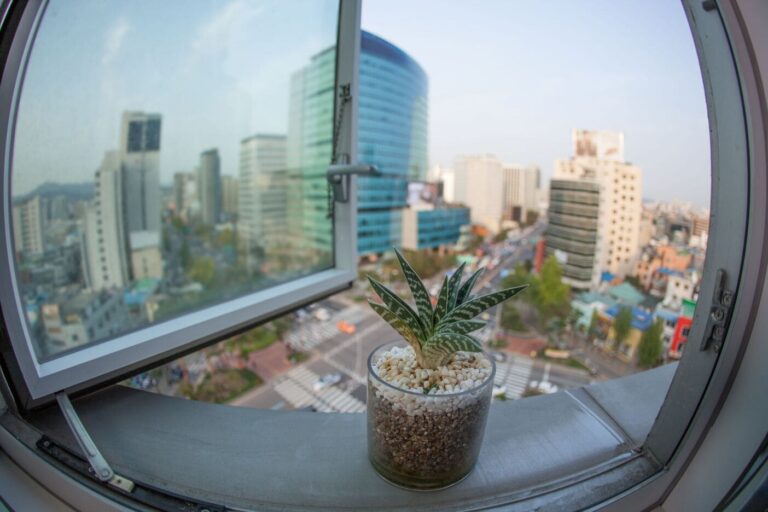
This is where most tropicals fail and where desert and Mediterranean plants shine. The latter plants evolved in climates with strong light and dry air. Snake plant (Sansevieria) is the workhorse. This popular houseplant takes direct sun, shrugs off dry air, and forgives you if you forget it for a month.
Add jade plant, aloe, echeveria and other rosette succulents, a ponytail palm (Beaucarnea), and true cacti to a sunny sill. If you want something architectural, a bird of paradise (Strelitzia) will take all the bright light a glass wall can give it. Hoyas also do beautifully in bright light and dry air—and reward you with flowers.
A few feet back from the hot glass is prime real estate for popular houseplants such as Pothos, heartleaf philodendron, and Monstera deliciosa, which all do well in bright indirect light. A rubber plant (Ficus elastica) or a dracaena adds height. The ZZ plant (Zamioculcas) belongs here too. This houseplant tolerates a wide range of light and serious neglect, making it ideal for busy tower dwellers.
Kitchens and hallways set deep in the floor plan get very little natural light. Aspidistra, commonly known as the cast-iron plant, earns its name here. ZZ plant and snake plant will also hold on in low light, though they will grow slowly. Chinese evergreen (Aglaonema) is a good-looking option for a bright corner of an otherwise dim room.
The humidity-loving crowd struggles in dry tower air without help. This includes calatheas, marantas, most ferns, fittonia, and many alocasias, which will all brown and crisp. These houseplants are not impossible, but they only work if you are willing to run a humidifier for them. Do not buy them expecting them to coast.
Choosing the right houseplants is half the battle. The other half is adjusting your care to the building.
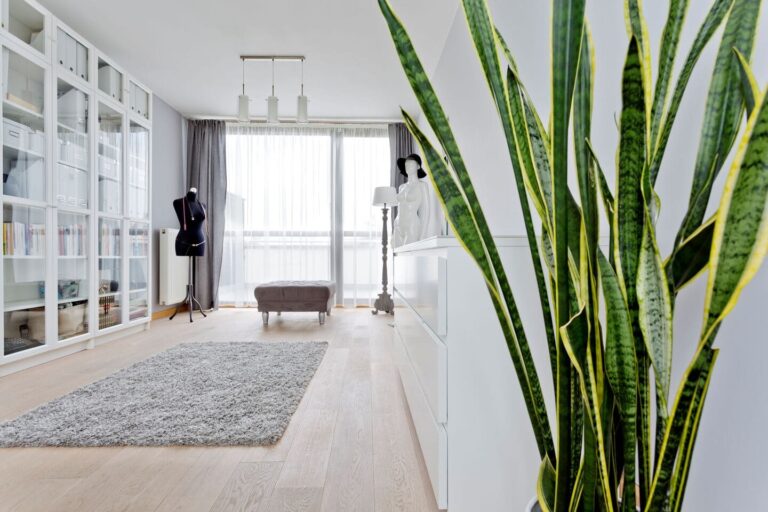
If you are furnishing a glass-walled apartment from scratch and want a houseplant set that will simply work, start with the following plan. Try a snake plant or a cluster of cacti for the hot corner by the glass, a ZZ plant for the dim hallway, a pothos trailing off a shelf in the bright zone, a hoya on the brightest windowsill for eventual flowers, and a rubber plant or dracaena for height a few feet back from the pane.
Every one of these tolerates dry air, none of them minds strong light, and all of them forgive a missed watering. Once you have kept those alive through a full season, branch out.
Glass towers have a bad reputation among indoor gardeners, and it is undeserved. The truth is that a high-rise apartment offers something most ground-floor homes cannot: an abundance of light. The trick is not to force shade-and-humidity tropicals into a desert-bright, air-conditioned box, but to lean into what the space actually is and offers.
Choose plants built for sun and dry air, curtain the worst of the glare, run a humidifier for anything fussy, and stay ahead of spider mites. Do that, and forty floors up behind a wall of glass turns out to be one of the best growing environments you will ever have.