


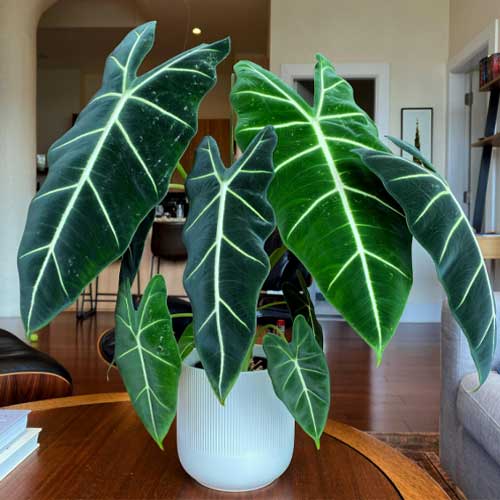
Alocasia Frydek, botanically known as Alocasia micholitziana ‘Frydek,’ is a striking rhizomatous aroid prized for its deep, velvety green leaves and bold ivory-white venation. Native to the humid, shaded understory of tropical Southeast Asia, particularly regions of the Philippines, the species thrives in the dappled light and consistently moist air found beneath a dense rainforest canopy. The cultivar name ‘Frydek’ is widely believed to honor a location or nursery associated with its early cultivation, though its exact origin story has become somewhat blurred over decades of commercial propagation, and the plant is now grown and hybridized worldwide as a premier ornamental foliage specimen.
Unlike many of its larger, more architectural Alocasia relatives, Alocasia Frydek maintains a comparatively compact, clumping growth habit, with broad, arrow- or heart-shaped leaves that can reach up to a foot or more in length under favorable conditions. The leaf surface has a distinctive suede-like, velvety texture that catches light in a way few other houseplants can replicate, and the contrast between the near-black-green blade and the crisp white veins running through it has made the plant enormously popular among collectors seeking a dramatic, jewel-toned statement piece. A variegated form of this cultivar, showing patches of white or cream alongside the deep green, is also in circulation and commands even higher demand among enthusiasts.
In its native habitat, Alocasia Frydek grows from a central rhizome that occasionally produces offsets, or ‘pups,’ allowing the plant to slowly form a small clump over time. It is not a climbing or trailing species; instead, it maintains an upright, rosette-like form with leaves emerging directly from the rhizome on long, upright petioles. While it can occasionally flower, producing a typical aroid spathe-and-spadix inflorescence, most home growers cultivate it exclusively for its exceptional foliage, as the flowers are relatively unremarkable compared to the dramatic leaves. Because it is somewhat more demanding of consistent humidity and warmth than many common houseplants, Alocasia Frydek is generally regarded as a plant for intermediate to experienced growers rather than an absolute beginner’s choice.
Successfully growing Alocasia Frydek comes down to consistently replicating the warm, humid, filtered-light conditions of its native rainforest understory, since this species is considerably less forgiving of neglect or environmental swings than many other popular aroids. Bright, indirect light is essential for maintaining the plant’s rich leaf color and preventing legginess, while protecting it from direct sun, which can scorch the delicate, velvety leaf surface. A location near an east-facing window, or a few feet back from a brighter south- or west-facing one, generally provides the right balance.
Watering and humidity are the two areas where most growers run into trouble. Alocasia Frydek prefers evenly moist, never soggy, soil, allowing the top inch of the growing medium to dry out slightly between waterings, since both prolonged drought and waterlogged roots can cause rapid decline. High humidity, ideally 60 percent or above, is just as important as watering itself, and many growers find that a humidifier, humidity tray, or even a partially enclosed grow cabinet dramatically improves the plant’s overall vigor and leaf quality compared to average indoor air. A chunky, well-draining aroid mix that still retains some moisture helps strike the right balance between hydration and aeration for the rhizome and root system.
Beyond light, water, and humidity, Alocasia Frydek benefits from consistently warm temperatures, regular light feeding during the growing season, and periodic cleaning of its broad leaves to keep the pores clear of dust and better able to photosynthesize efficiently. Like many Alocasia species, it may also go through a period of partial or total dormancy, particularly in lower light or cooler months, during which growth slows and some older leaves may die back; this is generally normal and not necessarily a sign of a problem, provided the rhizome itself remains firm and healthy.
 Soil
Soil
Alocasia Frydek grows from a rhizome that is highly sensitive to excess moisture, so it requires a loose, well-draining, yet moisture-retentive growing medium that supports both healthy root development and adequate aeration around the rhizome itself.
A chunky aroid mix combining standard potting soil or coco coir with perlite, orchid bark, and a portion of sphagnum moss in roughly equal parts creates the airy, well-draining texture this species needs while still holding enough moisture to prevent the roots from drying out too quickly.
A mildly acidic pH between 5.5 and 6.5 supports healthy nutrient uptake and vigorous, richly colored foliage.
Excellent drainage is critical to prevent rhizome and root rot; the pot must have ample drainage holes, and the plant should never be left standing in a saucer of collected water for any extended period.
Horticultural charcoal added at 5 to 10 percent by volume helps keep the mix fresh and reduces the risk of anaerobic, sour soil conditions around the sensitive rhizome. A light top-dressing of worm castings at potting time provides a gentle, slow-release source of nutrients.
Waterlogged soil is one of the most common causes of decline in this species, quickly leading to rhizome rot, yellowing leaves, and a mushy stem base. Repot into fresh, well-draining medium and trim away any rotted tissue if this occurs.
Dense, compacted soil restricts oxygen to the rhizome and roots and slows overall growth; refresh the potting mix every 1 to 2 years to prevent this.
Alkaline conditions caused by hard tap water can lead to micronutrient deficiencies, visible as pale or yellowing new growth; using filtered water or rainwater helps maintain the appropriate pH range.
Fertilizer salts can accumulate with regular feeding, appearing as brown leaf tip and margin burn or a white crust on the soil surface; flush the soil thoroughly with clean water every couple of months to leach out excess salts.
Pale, small, or slow-to-unfurl new leaves during the growing season can indicate a need for more regular light feeding and may also signal an underlying soil or root health issue.
A root-bound plant shows roots circling densely at the surface or emerging from drainage holes, along with soil that dries out unusually quickly and a rhizome that appears crowded; repot into a slightly larger container when this is observed.
 Fertilizer
Alocasia Frydek is a moderately fast grower during its active season and benefits from light, regular feeding to support vigorous new leaf production and maintain its characteristic rich leaf color.
A balanced, water-soluble houseplant fertilizer diluted to half strength, or a fertilizer formulated specifically for aroids or foliage plants, applied during the growing season.
Feed every 3 to 4 weeks from spring through summer, and reduce or stop fertilizing entirely in autumn and winter when growth slows or the plant enters partial dormancy.
Apply the diluted fertilizer solution to already-moist soil rather than dry soil to reduce the risk of root and rhizome burn, and avoid splashing fertilizer directly onto the velvety foliage.
Brown, crispy leaf tips and margins, along with a visible white salt crust on the soil surface, are signs of overfertilization.
Pale, small new leaves, slowed growth during the active growing season, and a general dulling of the plant’s normally rich, dark leaf color suggest the plant would benefit from more regular light feeding.
Worm castings top-dressed onto the soil surface, or a diluted liquid seaweed or fish emulsion fertilizer applied monthly, offer a gentler, slow-release alternative to synthetic fertilizers.
 Watering
Alocasia Frydek prefers evenly moist, but never waterlogged, soil, allowing only the top inch of the growing medium to dry out between waterings, reflecting its adaptation to the consistently damp, well-drained forest floor of its native habitat.
Roughly every 5 to 7 days during the active growing season in most indoor conditions, extending to every 10 to 14 days in cooler, lower-light winter conditions when growth and water uptake slow.
This species can be sensitive to the chlorine, fluoride, and mineral salts in hard tap water, so filtered water, rainwater, or tap water left to stand uncovered overnight are preferable, especially for growers who notice brown leaf tip burn over time.
Leaves that droop dramatically, curl inward, or feel thin and papery, along with soil that pulls away from the edges of the pot.
Yellowing leaves, a soft or mushy rhizome, a foul smell from the soil, and sudden, unexplained leaf collapse are signs of overwatering and potential rhizome rot in this species.
Reduce watering frequency in autumn and winter as growth slows and the plant may enter a period of partial dormancy, and resume a more regular schedule in spring and summer as active growth resumes and new leaves begin to unfurl.
Stop guessing. Most houseplant failures are caused by volumetric errors and improper moisture tension. Our deterministic calculator moves beyond "once-a-week" watering by analyzing the four critical pillars of root health:
Personalized for this plant
Disclaimer: Our calculator is pretty smart. We’ve crunched the numbers, but we’re not measuring the quantum state of your living room. Since we don’t know your exact indoor temperature, humidity, light, airflow, or whether your plant receives daily sweet nothings and motivational speeches, use this calculator as a guide—and always keep an eye on your plant.
 Lighting
Bright, indirect light, roughly 300 to 700 foot-candles, is ideal for Alocasia Frydek and supports the richest, darkest leaf color along with the crispest white venation.
Slower growth, smaller and paler new leaves, long gaps between new leaf emergence, and a general loss of the plant’s characteristic deep, velvety leaf color.
Direct, intense sun, especially through unfiltered south- or west-facing glass, can quickly scorch the delicate, velvety foliage, causing bleached, brown, or crispy patches.
If natural light is limited, a full-spectrum grow light positioned above the plant for 10 to 12 hours a day can support healthy growth and rich leaf coloration in a dim room. If light is too intense, move the plant back from the window or filter direct rays with a sheer curtain.
 Temperature
Alocasia Frydek thrives at typical indoor temperatures between 65 and 85°F (18 to 29°C), reflecting the warm, stable conditions of its native tropical range.
This species is notably sensitive to cold and should not be exposed to temperatures below 60°F (15°C) for extended periods, with cold exposure causing dark, water-soaked patches on the leaves and potential dieback of the rhizome.
The plant tolerates warm indoor conditions well, handling temperatures into the high 80s°F (around 30°C) provided humidity and watering are kept adequate.
Keep the plant away from cold drafts near exterior doors and windows in winter, and away from direct heating vents and air conditioning units, both of which can cause rapid, stressful fluctuations in leaf moisture and encourage leaf edge browning.
 Humidity
High humidity, ideally 60 to 80 percent, is strongly preferred by Alocasia Frydek, reflecting the consistently damp air of its native tropical understory habitat, and this species is notably less tolerant of average indoor humidity than many common houseplants.
Dry indoor air commonly causes crispy, browning leaf edges, curling leaf margins, and slowed or stalled new growth, and can also increase susceptibility to spider mites.
Excessive humidity combined with poor air circulation can encourage fungal or bacterial leaf spot; ensure adequate airflow around the plant even in very humid environments.
A humidifier positioned nearby is one of the most effective and reliable ways to raise ambient humidity for this species, particularly in dry, centrally heated rooms during winter.
A wide tray of pebbles and water placed beneath the pot provides only a modest, localized humidity boost and is generally insufficient on its own for this humidity-loving species.
Light misting of the foliage every few days can offer brief, temporary humidity relief, though it should be paired with other methods and done in the morning so leaves can dry before evening.
If fungal or bacterial leaf spot appears in an overly humid, poorly ventilated environment, increase air circulation with a small fan and allow slightly more time between waterings.
 Propagation
Alocasia Frydek is most commonly propagated through rhizome division, since it grows from a clumping rhizome rather than a vining stem, and this method allows growers to create genetically identical new plants with relatively high reliability.
Success Rate: High (80–90%) when divisions include healthy roots and at least one growth point
Description: The standard method, in which an offset or a section of the parent rhizome bearing its own roots and at least one leaf or growth point is carefully separated and potted independently.
Steps:
Spring through summer, during repotting and the plant’s active growing season, offers the fastest and most reliable establishment for new divisions, though it can be attempted at other times if the plant is otherwise healthy.
Divisions typically establish as independently growing plants within 4 to 8 weeks, with new leaf growth confirming successful establishment.
 Potting
A relatively wide but not overly deep pot with good drainage suits Alocasia Frydek’s clumping rhizome and root system well; unglazed terracotta can help wick away excess moisture for growers prone to overwatering.
Drainage holes are essential, along with a well-draining potting mix, to prevent the waterlogged conditions that quickly lead to rhizome rot in this species.
Choose a pot only slightly larger than the current root ball when repotting, generally 1 to 2 inches (2.5 to 5 cm) wider in diameter, to avoid excess soil that retains more moisture than the roots can use.
Every 1 to 2 years, or when the plant has clearly outgrown its current container, since offsets forming around the base of the rhizome will eventually crowd the pot and benefit from division or a larger home.
Roots visibly circling at the soil surface or emerging from drainage holes, water running through the pot unusually quickly without being absorbed, and a rhizome that appears crowded or is pushing itself up out of the soil.
Gently remove the plant from its current pot, loosen the outer roots, trim away any dead or rotted roots or rhizome tissue with sterile scissors, and repot into fresh, well-draining mix in a slightly larger container at the same soil depth as before.
Light root pruning, trimming no more than 10 to 20 percent of the root mass, can be done at repotting time if the roots are densely circling, to encourage healthier new root growth into the fresh soil.
Water the plant lightly immediately after repotting and keep it in a slightly shadier, more humid, sheltered spot for a week or two afterward to reduce transplant stress before returning it to its normal display location.
 Pruning
Alocasia Frydek requires relatively little pruning beyond routine maintenance, which is used primarily to remove spent, damaged, or yellowing leaves and to manage offsets as the clump matures.
Light maintenance trimming of damaged or yellowing leaves can be done at any time of year, though any more significant pruning or division is best carried out during spring through summer, when the plant can recover and produce new growth most quickly.
Remove yellowing, damaged, or fully spent leaves as needed throughout the year to keep the plant tidy and to redirect energy toward healthy new growth. Older leaves naturally die back periodically as the plant produces new ones, which is a normal part of its growth cycle rather than a sign of poor health.
Use clean, sharp scissors or small pruning shears sterilized with rubbing alcohol before use to prevent introducing pathogens to the plant’s sensitive rhizome.
After removing leaves, keep humidity elevated and avoid fertilizing for a week or two to allow the plant to recover. Because Alocasia Frydek channels significant energy into each individual leaf, avoid excessive or unnecessary pruning, and focus instead on removing only leaves that are clearly damaged, diseased, or fully spent.
 Blooming
Alocasia Frydek can flower, though blooming is uncommon in typical indoor cultivation and more likely to occur in mature, well-established specimens grown in consistently warm, humid, greenhouse-like conditions. When flowering does occur, it typically happens during the warmer months of spring and summer, coinciding with the plant’s most active growth period, though it is not tied to a strict or predictable seasonal schedule indoors. As with other aroids, the inflorescence is not a conventional flower but a specialized structure consisting of a pale green to cream-colored spathe wrapped around a slender central spadix bearing tiny true flowers. Individual blooms are relatively short-lived, generally lasting only a week or two, and the unremarkable appearance of the inflorescence means most growers value the plant for its foliage rather than its flowers. Because indoor specimens rarely reach the size, maturity, and sustained ideal conditions needed to reliably trigger blooming, flowering should be regarded as an infrequent bonus rather than an expected feature of home cultivation.
 Pests and Diseases
Name: Spider Mites
Symptoms: Fine webbing on the undersides of leaves, along with stippled, dull, or bronzed foliage, most common in warm, dry indoor conditions.
Treatment: Increase humidity, rinse the foliage under lukewarm water to dislodge mites, and treat with insecticidal soap or neem oil, repeating every 5 to 7 days for several cycles.
Name: Mealybugs
Symptoms: White, cottony clusters at leaf joints and along the petioles, often accompanied by sticky honeydew residue.
Treatment: Dab visible clusters with a cotton swab dipped in isopropyl alcohol and follow up with an insecticidal soap spray, repeating as needed until the infestation clears.
Name: Aphids
Symptoms: Small, soft-bodied insects clustering on new growth and the undersides of young leaves, often accompanied by sticky residue and curling new foliage.
Treatment: Rinse affected areas with a strong stream of water, then apply insecticidal soap or neem oil, repeating every 5 to 7 days until the population is under control.
Name: Rhizome or Root Rot
Symptoms: Yellowing leaves, a soft or mushy rhizome, a foul odor from the soil, and sudden leaf collapse, typically caused by overwatering or poor drainage.
Treatment: Remove the plant from its pot, trim away all soft, dark, or foul-smelling rhizome and root tissue with sterile scissors, and repot into fresh, well-draining medium, reducing watering frequency going forward.
Name: Bacterial Leaf Spot
Symptoms: Small, water-soaked spots on the leaves that enlarge and may develop yellow halos, often spreading in overly wet, poorly ventilated conditions.
Treatment: Remove affected leaves, improve air circulation around the plant, avoid overhead watering that wets the foliage, and avoid handling the plant while its leaves are wet.
Name: Fungal Leaf Spot
Symptoms: Small, irregular brown spots on the leaves, sometimes with a yellow halo, most common in overly humid conditions with poor air circulation.
Treatment: Remove affected leaves, improve air circulation, avoid wetting the foliage during watering, and apply a copper-based fungicide if the issue persists or spreads.
 Special Features
Alocasia Frydek’s defining feature is its extraordinary, velvet-textured foliage: deep, near-black-green leaves crossed with crisp, ivory-white veins create a jewel-like, almost architectural quality that few other houseplants can match, making the plant a striking focal point in any shaded interior display. The suede-like sheen of the leaf surface catches ambient light in subtly shifting ways throughout the day, while the plant’s relatively compact, clumping growth habit makes it well suited to shelves, plant stands, and grouped displays rather than requiring the large floor footprint of some of its larger Alocasia relatives. Its slow but steady offset production also means a single specimen can, over time, be divided into several new plants, making it a rewarding long-term addition for collectors who enjoy watching a clump develop and expand.
 Plant Benefits
Alocasia Frydek has no established culinary or pharmaceutical use in modern practice, and given its toxicity from calcium oxalate crystals, it is not suitable for any home remedy or edible application. Its primary benefits to the home grower are aesthetic and psychological: as with many houseplants, caring for a visually striking, texturally rich plant like Alocasia Frydek is associated with general wellbeing benefits documented in environmental psychology research, including stress reduction and an enhanced sense of connection to nature in indoor spaces. Its broad leaves also contribute modestly to the wider air-purifying qualities associated with many houseplants in the Araceae family.
 Additional Information
Alocasia Frydek is frequently confused in the trade with Alocasia micholitziana ‘Green Velvet,’ a closely related and visually similar cultivar, as well as with Alocasia reginula (Black Velvet), which shares a similar dark, velvety leaf texture but has a more compact, rounded leaf shape; buyers seeking the true Frydek cultivar are advised to purchase from reputable specialty nurseries. A rarer variegated form, showing patches of white or cream alongside the deep green, is also in circulation among collectors and commands a significant price premium due to its slower growth rate and lower propagation success. As with other aroids, the plant’s broad, glossy leaves are believed to help it capture as much of the limited, filtered light available on the shaded forest floor as possible.
 Life Cycle
Alocasia Frydek grows from a central rhizome, from which broad, arrow-shaped leaves emerge one at a time on long, upright petioles, with older leaves gradually dying back as new ones unfurl. Over time, the rhizome may produce offsets, or pups, at its base, allowing the plant to slowly form a small clump that can eventually be divided into separate specimens. Growth is most active during the warm, humid months of spring and summer, while the plant may slow considerably or enter a period of partial dormancy during cooler, lower-light months, sometimes shedding a portion of its foliage before resuming growth. Under good care, a mature specimen may occasionally flower and, if pollinated, produce seed, though this stage of the life cycle is uncommon in indoor cultivation. With consistent warmth, humidity, and appropriate repotting, individual specimens can remain healthy and continue producing new leaves and offsets for many years.
 Are Alocasia Frydek Poisonous, Toxic
Alocasia Frydek, like all members of the genus Alocasia, is toxic to cats, dogs, and humans if ingested. The ASPCA lists Alocasia species as toxic to both cats and dogs, and this cultivar carries the same risk profile as other commonly grown Alocasia varieties.
All parts of the plant, especially the leaves and stems, contain insoluble calcium oxalate crystals, which pose the greatest risk if chewed, bitten into, or ingested.
Chewing or ingesting plant material releases needle-like calcium oxalate crystals that cause immediate and intense oral irritation, including burning of the mouth and tongue, excessive drooling, difficulty swallowing, and vomiting.
Contact with the plant’s sap, particularly from a cut leaf or stem, can cause localized skin irritation, redness, and itching in sensitive individuals.
Mild to Moderate. Symptoms are typically painful and distressing rather than life-threatening, though significant ingestion or any swelling of the mouth, tongue, or throat warrants prompt veterinary or medical attention.
Rinse the mouth with water, offer a small amount of milk to help soothe irritation, and contact a veterinarian, physician, or poison control center if symptoms persist, worsen, or involve swelling.
Wash any irritated skin area thoroughly with soap and water and avoid further contact with the plant’s sap until irritation subsides.
Keep the plant well out of reach of curious pets and small children, place it in a stable location where leaves cannot be easily pulled or chewed, and promptly clean up and dispose of any dropped or trimmed leaf material rather than leaving it accessible.
 Frequently Asked Questions
Yes, like other Alocasia species, Alocasia Frydek is toxic to cats and dogs due to calcium oxalate crystals and can cause oral irritation, drooling, and vomiting if ingested.
Drooping most commonly results from underwatering or low humidity, though it can also indicate root or rhizome rot from overwatering, so check the soil moisture and rhizome firmness before adjusting care.
Water when the top inch of soil has dried out, generally every 5 to 7 days during the growing season and less often in winter, allowing the pot to drain fully each time.
Fading or paler leaf color usually indicates insufficient light, since bright, indirect light is needed to maintain the plant’s characteristic deep green, velvety foliage.
Divide an offset or rhizome section that has its own roots and at least one growth point, pot it into a chunky aroid mix, and keep it warm, humid, and evenly moist until new leaf growth confirms establishment, typically within 4 to 8 weeks.
Bright, indirect light is ideal, supporting rich leaf color and steady growth while direct sun should be avoided to prevent scorching the velvety foliage.
Alocasia Frydek can enter a period of partial dormancy in cooler, lower-light months, during which growth slows and some older leaves may die back, which is generally normal as long as the rhizome stays firm.
Yellowing leaves most commonly indicate overwatering and the early stages of rhizome rot, though occasional lower leaf yellowing as older leaves die back can also be a normal part of growth.
Alocasia Frydek is a medium-sized houseplant, with individual leaves reaching up to a foot or more in length and the overall clump slowly widening over time as new offsets form.
High humidity of 60 to 80 percent is strongly preferred, and this species is generally less tolerant of average indoor humidity than many other common houseplants.
 Can I grow Alocasia Frydek in my indoor space
Difficulty: Intermediate
Size: Medium
Light: Medium
Water: Medium
Flowering: Yes
Pet Safe: No
Air Purifier: Medium
 Alocasia micholitziana 'Frydek' botanical details
Common Name: Alocasia Frydek
Other Common Names: Green Velvet Alocasia, Green Velvet Elephant Ear, Frydek Alocasia, Velvet Alocasia
Botanical Name: Alocasia micholitziana 'Frydek'
Native Area: Humid tropical understory forests of Southeast Asia, particularly the Philippines, where the species and its parent form grow naturally in shaded, consistently moist lowland habitats.
Family Name: Araceae
Plant Type: Rhizomatous evergreen perennial
Genus: Alocasia
Kingdom: Plantae
 Photo Gallery
 My Alocasia Frydek Plant Care Recommendations
If you find the Houseplant Encyclopedia helpful and would like to support Healthy Houseplants, you can use the links below to shop for recommended plants, products, and plant-care supplies.
Some links are affiliate links, which means I may earn a small commission if you make a qualifying purchase through them, at no additional cost to you. Thank you for supporting Healthy Houseplants and helping me continue to provide free plant-care information!

Want even more personalized plant-care help? Check out my AI Julie Chatbot—trained on my 20 years of houseplant knowledge, not just information from the internet!  Try it now:Ask AI Julie
 Buy Alocasia Frydek Online
✅ “Bring Home This Beauty Today”
✅ “Get Your Own Alocasia Frydek Before It’s Gone”
✅ “Shop Trusted Sellers – Limited Availability”
✅ “Free Delivery”
As an Amazon Associate, I earn commission from qualifying purchases.
 Plant Puns and Jokes
Why did Alocasia Frydek refuse to leave the shade? Because with velvet this good, it wasn’t about to risk fading in the spotlight.
 Signup to our newsletter and download Alocasia Frydek care guide

