


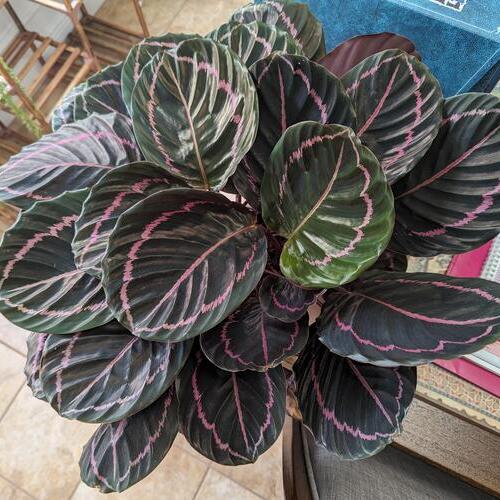
Calathea Dottie is a striking cultivar of Goeppertia roseopicta, a species in the prayer-plant family Marantaceae that is prized almost entirely for its foliage rather than its blooms. The leaves are deep, near-black green with a velvety texture and are edged in a vivid, irregular band of hot pink or magenta that fades to a softer rose tone as the leaf matures. The undersides of the leaves carry a deep burgundy-purple hue, creating a dramatic two-toned effect whenever the leaves move or fold. This variety was selectively bred from wild populations of the species for its exceptionally saturated pink margins, making it one of the more sought-after cultivars within the roseopicta group.
In its native range, Goeppertia roseopicta grows on the shaded floor of Brazilian tropical rainforests, where it receives dappled, filtered light beneath a dense forest canopy and benefits from the consistently warm, humid conditions typical of understory plant life. This native habitat explains much of the plant’s behavior in cultivation: it evolved to thrive in low, indirect light, high ambient humidity, and stable warmth, and it is intolerant of the direct sun, dry air, and temperature swings common in many indoor environments. Like other members of the Marantaceae family, Calathea Dottie exhibits nyctinasty, commonly called the ‘prayer plant’ movement, in which the leaves fold upward at night and unfurl again with the morning light, a rhythmic response driven by a specialized joint at the base of each leaf called a pulvinus.
Calathea Dottie typically stays compact, reaching a mature height and spread of around 12 to 18 inches, which makes it well suited to tabletops, shelves, and terrariums as well as floor displays in smaller groupings. It grows from a clumping rhizomatous rootstock and produces new leaves from the center of the rosette in a slow, steady flush rather than rapid vining growth. While it is capable of producing small flowers, most home growers value the plant exclusively for its foliage, and flowering indoors is uncommon.
Calathea Dottie has a reputation as a rewarding but demanding houseplant, and success with it comes down to consistently replicating its rainforest-floor origins rather than treating it like a typical low-maintenance foliage plant. The single most important factor is humidity: this cultivar wants ambient moisture in the 60% range and will visibly protest with crispy leaf edges and curling foliage if the air around it is too dry, which is the most common reason growers struggle with it in centrally heated or air-conditioned homes. Grouping it with other humidity-loving plants, running a humidifier nearby, or growing it in an enclosed cabinet or terrarium setup are all effective ways to keep it happy.
Light and water go hand in hand for this plant. It prefers bright, indirect light and will tolerate medium light reasonably well, but direct sun will scorch the delicate pink variegation and bleach the deep green background color. Watering should be done with care as well, since Calathea Dottie is notably sensitive to the minerals, chlorine, and fluoride commonly found in tap water; brown, crispy leaf margins are frequently a sign of mineral buildup rather than under- or overwatering. Using filtered, distilled, or rainwater, and keeping the soil evenly and consistently moist without letting it become waterlogged or fully dry out, will keep the plant looking its best.
Beyond humidity and water quality, the plant appreciates warm, draft-free conditions, a loose and well-draining potting mix rich in organic matter, and light, infrequent feeding during the active growing season. It is not a fast grower, and it does not need frequent repotting or heavy pruning, but it does reward attentive owners with lush, richly patterned foliage and the charming daily leaf movement that gives prayer plants their name. New growers are often advised to start with a hardier Calathea relative, such as a Calathea Rattlesnake or a Calathea Orbifolia, before taking on Dottie, since its color intensity is closely tied to how precisely its environmental needs are met.
 Soil
Soil
Calathea Dottie needs a light, airy, well-draining potting mix that still retains enough moisture to keep the roots consistently damp, since both waterlogging and drying out are damaging to this species. A good baseline blend combines standard peat-free or peat-based potting soil with perlite or orchid bark for drainage and a portion of coco coir or compost for moisture retention and organic content; a ratio of roughly two parts potting mix, one part perlite, and one part orchid bark or coco coir works well for many growers. The ideal soil pH is slightly acidic, generally in the range of 6.0 to 6.5, which mirrors the acidic leaf-litter soils of its native rainforest floor.
Soil composition directly affects the plant’s overall vigor: a mix that is too dense or compacted restricts oxygen to the roots and encourages root rot, while a mix that drains too quickly causes the fine root system to dry out between waterings, leading to crispy leaf tips even when watering frequency seems adequate. Amendments such as horticultural charcoal can help keep the mix fresh and reduce the risk of fungal issues in a consistently moist environment, and a small amount of worm castings or well-aged compost can supply a gentle, steady nutrient source.
Common soil problems to watch for include poor drainage, which shows up as yellowing lower leaves and a sour smell from the pot; compaction over time, which can be corrected by repotting into fresh mix every one to two years; inappropriate pH, which can lock out nutrients even when fertilizer is applied correctly; salt and mineral build-up from tap water or fertilizer, visible as a white crust on the soil surface and linked to leaf-edge browning; and general nutrient deficiencies from old, spent potting mix. Root-boundness, where roots circle tightly at the base of the pot and growth stalls, is another sign that a soil refresh and larger container are needed.
 Fertilizer
Calathea Dottie is a light feeder and benefits from a diluted, balanced liquid houseplant fertilizer applied roughly once every four to six weeks during the active growing season in spring and summer, generally at half the strength recommended on the product label. Feeding should be paused entirely, or reduced to once every couple of months at most, during fall and winter when the plant’s growth naturally slows. A fertilizer with a balanced or slightly nitrogen-forward ratio supports healthy leaf growth and vibrant coloration without pushing the plant beyond what its modest root system can use.
Over-fertilizing is a common problem with this species and typically shows up as brown, crispy leaf tips and margins, a white or crusty mineral buildup on the soil surface, and in more severe cases, wilting or leaf drop as salt concentrations in the soil damage the roots. Under-fertilizing is less common but can appear as pale, smaller new leaves, slow growth, and gradually fading variegation over successive growth cycles as the plant runs low on available nutrients. Because the plant is already sensitive to mineral buildup from water, growers often find that using a gentle organic option, such as diluted worm-casting tea or a mild fish or seaweed emulsion, is easier to manage than synthetic fertilizers, since organic sources release nutrients more slowly and are less likely to cause salt burn. Flushing the soil with distilled or filtered water every couple of months helps prevent fertilizer salts from accumulating to damaging levels.
 Watering
Calathea Dottie prefers evenly moist soil at all times, watered thoroughly whenever the top inch or so of soil has begun to dry out, then allowed to drain fully so the roots are never sitting in standing water. This species is notably sensitive to water quality, and using distilled water, rainwater, or filtered water is strongly recommended over untreated tap water, which often contains chlorine, chloramine, fluoride, and dissolved minerals that build up in the soil and leaf tissue over time and cause the characteristic crispy, brown leaf margins associated with this plant.
Overwatering typically shows up as yellowing leaves, a mushy or soft stem base, and a sour smell from the soil, and it can quickly progress to root rot if the soil is kept saturated for extended periods. Underwatering, by contrast, causes the leaves to curl inward, droop, or feel thin and papery, with the prayer-plant folding response becoming more pronounced and slower to reverse than the normal nightly movement. Because Calathea Dottie is more forgiving of slightly-too-moist soil than of drying out completely, most growers find it easier to err on the side of consistent moisture rather than letting the pot dry between waterings.
Watering needs shift with the seasons and growth stage: during the active growing months of spring and summer, the plant uses water more quickly and may need watering every five to seven days depending on light, humidity, and pot size, while in fall and winter, growth slows and watering frequency should be reduced to roughly every ten to fourteen days to avoid waterlogging a plant that is using far less moisture.
Stop guessing. Most houseplant failures are caused by volumetric errors and improper moisture tension. Our deterministic calculator moves beyond "once-a-week" watering by analyzing the four critical pillars of root health:
Personalized for this plant
Disclaimer: Our calculator is pretty smart. We’ve crunched the numbers, but we’re not measuring the quantum state of your living room. Since we don’t know your exact indoor temperature, humidity, light, airflow, or whether your plant receives daily sweet nothings and motivational speeches, use this calculator as a guide—and always keep an eye on your plant.
 Lighting
Calathea Dottie does best in bright, indirect light, similar to what it would receive on a shaded rainforest floor beneath a dense canopy. An east-facing window with gentle morning sun, or a spot several feet back from a south- or west-facing window, is typically ideal. The plant will also tolerate medium indirect light, though its vivid pink variegation tends to be less intense and growth slows when light is on the dimmer side. Direct, unfiltered sunlight, particularly midday or afternoon sun, is the fastest way to damage this cultivar, since it scorches the thin leaf tissue and fades or bleaches the pink pigmentation into a dull, washed-out color.
Signs of insufficient light include slow or stalled growth, smaller new leaves, and a loss of the rich contrast between the dark green base color and the pink markings, as the plant tries to conserve energy. Signs of excessive light include pale or bleached patches, curled or crispy leaf edges concentrated on the side facing the light source, and a generally faded or washed-out appearance to the variegation. If natural light is too intense, moving the plant further from the window, adding a sheer curtain, or relocating it to a spot with filtered light will help; if natural light is too low, moving it closer to a bright window or supplementing with a full-spectrum grow light for eight to ten hours a day can restore stronger growth and coloration.
 Temperature
Calathea Dottie thrives in consistently warm conditions between about 65 and 80°F (18 to 27°C), with the upper end of that range generally encouraging the most active growth. The plant has little tolerance for cold and should never be exposed to temperatures below roughly 60°F (15°C), which can cause chilling damage, leaf drop, and slowed metabolism even without frost. It is also sensitive to sudden fluctuations and drafts, whether from an air conditioning vent, a heating register, an open window, or an exterior door, all of which can stress the plant and trigger leaf curling or edge browning independent of watering or humidity issues.
Because of this sensitivity, Calathea Dottie is best kept in a stable interior location away from drafty windows and doors, and away from direct contact with cold glass in winter. If temperatures threaten to drop, moving the plant further into the room’s interior, away from exterior walls, is usually enough protection; in more extreme cold snaps, a portable heater set at a safe distance, or temporarily relocating the plant to a warmer room, can prevent cold damage. In summer, extreme heat paired with low humidity is equally stressful, so keeping the plant out of hot, direct sun and maintaining humidity alongside warmth will help it stay healthy through temperature extremes in either direction.
 Humidity
High humidity is arguably the single most important factor in growing a healthy Calathea Dottie, with an ideal range of 60% or higher closely mirroring the moist rainforest floor conditions of its native habitat. Most homes sit well below this level, especially with heating or air conditioning running, which is the leading cause of the crispy brown leaf edges, curling foliage, and stalled growth so commonly reported with this plant. Low humidity stress typically shows up first as browning along the leaf margins and tips, followed by curling or drooping leaves and a general loss of leaf sheen, while excessively high humidity combined with poor airflow can occasionally encourage fungal issues such as leaf spot.
Several humidifying methods can help close the gap between typical indoor humidity and the plant’s preferences. A cool-mist humidifier placed nearby is the most effective and consistent option, since it can reliably maintain 50 to 60% humidity in the immediate area. Pebble trays, where the pot sits on a tray of water and gravel without the roots touching the water directly, offer a mild, modest humidity boost through evaporation but are generally not sufficient on their own for this cultivar. Misting the leaves can offer very brief, short-term relief but evaporates quickly and is not a reliable long-term solution; if used, it should be done in the morning so foliage can dry before evening to reduce fungal risk. Grouping several humidity-loving plants together, or growing the plant in a greenhouse cabinet, enclosed shelf unit, or terrarium, tends to be the most effective long-term strategy for keeping Calathea Dottie’s humidity needs consistently met.
 Propagation
Calathea Dottie is propagated almost exclusively through division of its rhizomatous root clumps, since it does not readily propagate from leaf or stem cuttings the way many other houseplants do; a cutting without a piece of rhizome and root attached will not root into a new plant. Division works best in spring or early summer when the plant is entering active growth, giving the divided sections the strongest chance to recover and establish before the slower winter months.
Step-by-step division guide:
1. Water the parent plant thoroughly a day or two before dividing, which softens the soil and reduces root stress during the process.
2. Carefully remove the entire plant from its pot and gently loosen the soil away from the root ball by hand or with a light stream of water.
3. Identify natural separations in the clump where multiple rosettes are growing from distinct rhizome sections, each with its own roots attached.
4. Using a clean, sharp knife or your hands, separate the clump into sections, making sure each division retains a healthy portion of rhizome, roots, and at least two to three leaves.
5. Trim away any damaged, mushy, or rotten roots with sterilized scissors or shears.
6. Pot each division into a small container filled with a light, well-draining Calathea mix, and water thoroughly.
7. Place the newly potted divisions in warm, humid, indirect light and keep the soil consistently moist while they establish.
8. Expect new growth to appear within four to eight weeks as a sign that the division has successfully rooted and settled in.
Compared to division, other propagation methods such as stem cuttings have essentially no success rate with this species because Calathea Dottie lacks the nodal structure needed to root from a cut stem alone; division is therefore both the primary and the most reliable method, typically boasting a high success rate when done carefully with healthy parent plants and adequate humidity during the recovery period. Newly divided plants generally take two to three months to fully re-establish a strong root system and resume vigorous, steady growth.
 Potting
Calathea Dottie does best in a pot that is only slightly larger than its current root ball, since it prefers being modestly snug rather than swimming in excess soil, which can hold too much moisture and increase the risk of root rot. A pot with ample drainage holes is essential, and many growers favor plastic or glazed ceramic pots over unglazed terracotta, since terracotta wicks moisture away too quickly for a plant that prefers consistently moist soil. A well-draining, organically rich mix, similar to the blend described in the soil section, should be used at potting or repotting time.
Repotting is generally needed every one to two years, or whenever the plant shows signs such as roots circling densely at the bottom of the pot, roots emerging from the drainage holes, water running straight through without being absorbed, or noticeably slowed growth despite otherwise good care. When repotting, it is best to move up only one pot size at a time rather than jumping to a significantly larger container. Root pruning is rarely necessary for this species, but any mushy, blackened, or clearly rotten roots encountered during repotting should be trimmed away with sterilized scissors before repotting into fresh mix.
To transition the plant with minimal stress, repot during the growing season, water the plant a day or two beforehand, handle the root ball gently to avoid unnecessary breakage, and keep the newly repotted plant out of direct light and in a warm, humid spot for one to two weeks while it adjusts, watering normally throughout that recovery window.
 Pruning
The best time to prune Calathea Dottie is during the active growing season in spring or summer, when the plant recovers most quickly, though damaged or dead leaves can be removed at any time of year.
Pruning is done as needed rather than on a strict schedule, primarily to remove yellowing, browning, or damaged leaves and to keep the plant tidy and focused on healthy new growth rather than maintaining spent foliage.
Use clean, sharp pruning snips or scissors, and wipe the blades with rubbing alcohol before and after use to avoid spreading pathogens between plants.
After pruning, keep the plant in its usual warm, humid, indirect-light spot and maintain consistent watering; avoid fertilizing immediately after a heavy pruning session to give the plant time to recover.
Avoid removing more than a quarter of the plant’s foliage at one time, since Calathea Dottie recovers slowly, and always prune with sterilized tools to reduce the risk of introducing disease through open cuts.
 Blooming
Calathea Dottie can produce small, inconspicuous flowers, typically in spring through summer under favorable conditions, though blooming indoors is rare and the plant is grown almost exclusively for its foliage. When flowers do appear, they emerge from a short spike near the base of the plant and are pale, cup-shaped, and largely hidden beneath the foliage; they are not fragrant and last only a few days before fading. Bloom frequency is inconsistent and unpredictable indoors, and optimal conditions for flowering (very high humidity, warm stable temperatures, and bright indirect light) are difficult to sustain in a typical home, so flowering should be treated as a rare bonus rather than an expected feature.
 Pests and Diseases
Name: Spider mites
Symptoms: Fine webbing on the undersides of leaves, tiny stippled or speckled discoloration on the foliage, and an overall dull or dusty appearance to the leaves.
Treatment: Isolate the plant, rinse foliage thoroughly under lukewarm water, increase humidity to discourage mites (which prefer dry conditions), and treat with insecticidal soap or neem oil applied to all leaf surfaces every seven to ten days until resolved.
Name: Mealybugs
Symptoms: Small, white, cottony clusters in leaf axils and along stems, along with sticky honeydew residue and possible sooty mold growth.
Treatment: Dab visible clusters with a cotton swab dipped in rubbing alcohol, then treat the whole plant with insecticidal soap or neem oil, repeating every one to two weeks until no new bugs appear.
Name: Aphids
Symptoms: Small green, black, or brown insects clustered on new growth and flower spikes, causing distorted or curled new leaves and sticky honeydew residue.
Treatment: Spray affected areas with a strong stream of water to dislodge aphids, then apply insecticidal soap or neem oil weekly until the population is controlled.
Name: Thrips
Symptoms: Silvery streaking or stippling on leaf surfaces, black speckled droppings, and distorted new growth.
Treatment: Isolate the plant, remove heavily affected leaves, and apply insecticidal soap or a targeted thrips treatment, repeating applications to catch developing larvae.
Name: Root rot
Symptoms: Yellowing leaves, a mushy or blackened stem base, foul soil odor, and stunted or collapsing growth caused by prolonged waterlogged soil.
Treatment: Remove the plant from its pot, trim away all rotten roots with sterilized scissors, and repot into fresh, well-draining mix; reduce watering frequency and ensure the pot has adequate drainage going forward.
Name: Leaf spot (fungal or bacterial)
Symptoms: Water-soaked or dark brown/black spots on the leaves, sometimes with a yellow halo, that can spread if conditions remain damp and poorly ventilated.
Treatment: Remove and discard affected leaves, avoid overhead watering or misting that leaves foliage wet for long periods, improve airflow around the plant, and apply a copper-based fungicide if the spread continues.
Name: Powdery mildew
Symptoms: A white, powdery coating on the surface of the leaves, typically in conditions with high humidity but poor air circulation.
Treatment: Increase airflow around the plant, remove heavily affected leaves, and treat with a fungicide labeled for powdery mildew if the issue persists.
 Special Features
Calathea Dottie stands out among houseplants for its unusually intense, almost hand-painted variegation, pairing near-black green leaves with bold, irregular bands of hot pink that give it a striking, jewel-toned appearance unlike almost any other common foliage plant. Its dramatic burgundy leaf undersides add a second layer of visual interest whenever the plant’s leaves fold or shift, and like all members of the prayer-plant family, it performs a gentle, rhythmic daily movement, folding its leaves upward at dusk and reopening them each morning in response to changing light, a behavior that many growers find genuinely captivating to watch over time. Combined with its compact size, non-toxic nature, and reputation as a rewarding challenge for more experienced plant keepers, Calathea Dottie has become a favorite statement plant for shelves, terrariums, and humid bathroom or kitchen displays where its color and movement can be fully appreciated.
 Plant Benefits
Calathea Dottie does not have established herbal, medicinal, or pharmaceutical uses and is grown strictly as an ornamental foliage houseplant; it is not used in traditional or modern herbal medicine. Its primary benefit is aesthetic and, like many leafy houseplants, a modest contribution to indoor air quality through general foliage transpiration, though it has not been specifically studied for notable air-purifying properties beyond typical houseplant contributions.
 Additional Information
Calathea Dottie was previously classified under the genus Calathea, but in 2020 many former Calathea species, including the roseopicta group, were reclassified into the genus Goeppertia following updated botanical research into the Marantaceae family; the name ‘Calathea’ remains in widespread use in the houseplant trade even though ‘Goeppertia’ is now the botanically accurate genus. The plant is sometimes confused with other roseopicta cultivars, such as ‘Medallion’ or ‘Rosy’, which share the family’s rounded leaf shape but differ in their specific variegation pattern and color intensity.
 Life Cycle
Calathea Dottie is a herbaceous perennial that grows from a clumping rhizome rather than from a single central stem, producing new leaves individually from the base of the plant in a slow, continuous cycle rather than in seasonal flushes tied to dormancy. Under favorable warm, humid, indirect-light conditions, the plant grows year-round at a modest, steady pace, with growth slowing noticeably in lower light and cooler temperatures during fall and winter. As the rhizome matures, it naturally produces multiple growing points, allowing the plant to be divided into new individual plants once it has filled out its pot. Individual leaves typically persist for many months before naturally yellowing and dying back, at which point they are replaced by new growth from the center of the plant, and under good care the plant can live and continue producing new foliage indoors for many years.
 Are Calathea Dottie Poisonous, Toxic
Calathea Dottie is considered non-toxic to cats, dogs, and humans, including children, according to the ASPCA’s list of pet-safe plants. It contains no known toxic alkaloids, oxalates, or other harmful compounds in its leaves, stems, or roots. That said, ingestion of any large quantity of plant material, even non-toxic species, can cause mild digestive upset in pets or children, including symptoms such as mild vomiting, drooling, or gastrointestinal discomfort, generally as a mechanical irritant response rather than true poisoning. Severity is typically very low to none. If a pet or child does ingest a significant amount of the plant and shows signs of distress, it is reasonable to offer water, monitor the individual, and contact a veterinarian, pediatrician, or poison control center if symptoms persist or worsen. As a preventive measure, it is still good practice to discourage pets and young children from chewing on houseplants generally, since soil, fertilizer residue, or pest treatments applied to the plant could pose a separate risk even when the plant tissue itself is safe.
 Frequently Asked Questions
Calathea Dottie is considered an advanced-level houseplant because it requires consistently high humidity, filtered or distilled water, and stable warmth, making it more demanding than many common foliage plants.
Brown, crispy leaf edges are most often caused by low humidity or mineral buildup from tap water, and can also result from over-fertilizing or inconsistent watering.
Water when the top inch of soil feels dry, generally every five to seven days in the growing season and every ten to fourteen days in fall and winter, using filtered or distilled water.
No, Calathea Dottie is considered non-toxic to cats, dogs, and humans according to the ASPCA.
It needs bright, indirect light and tolerates medium indirect light, but direct sunlight will scorch the leaves and fade the pink variegation.
Leaf curling is typically a response to low humidity, underwatering, or temperature stress, and is the plant’s natural way of reducing moisture loss.
Calathea Dottie is propagated by dividing the rhizome into sections that each include roots and leaves, ideally done in spring or summer.
It thrives at 60% humidity or higher, which can be achieved with a humidifier, plant grouping, or an enclosed growing space.
It can produce small, inconspicuous flowers, but blooming indoors is rare, and the plant is grown mainly for its foliage.
It stays fairly compact, typically reaching 12 to 18 inches in both height and spread at maturity.
 Can I grow Calathea Dottie in my indoor space
Difficulty: Advanced
Size: Small
Light: Medium
Water: Medium
Flowering: Yes
Pet Safe: Yes
Air Purifier: Medium
 Goeppertia roseopicta 'Dottie' (formerly Calathea roseopicta 'Dottie') botanical details
Common Name: Calathea Dottie
Other Common Names: Prayer Plant 'Dottie', Peacock Plant 'Dottie', Rose Painted Calathea 'Dottie'
Botanical Name: Goeppertia roseopicta 'Dottie' (formerly Calathea roseopicta 'Dottie')
Native Area: Tropical rainforests of Brazil, South America
Family Name: Marantaceae
Plant Type: Herbaceous perennial, grown as a houseplant
Genus: Goeppertia
Kingdom: Plantae
 Photo Gallery
 My Calathea Dottie Plant Care Recommendations
If you find the Houseplant Encyclopedia helpful and would like to support Healthy Houseplants, you can use the links below to shop for recommended plants, products, and plant-care supplies.
Some links are affiliate links, which means I may earn a small commission if you make a qualifying purchase through them, at no additional cost to you. Thank you for supporting Healthy Houseplants and helping me continue to provide free plant-care information!

Want even more personalized plant-care help? Check out my AI Julie Chatbot—trained on my 20 years of houseplant knowledge, not just information from the internet!  Try it now:Ask AI Julie
 Buy Calathea Dottie Online
✅ “Bring Home This Beauty Today”
✅ “Get Your Own Calathea Dottie Before It’s Gone”
✅ “Shop Trusted Sellers – Limited Availability”
✅ “Free Delivery”
As an Amazon Associate, I earn commission from qualifying purchases.
 Plant Puns and Jokes
Why did the Calathea Dottie refuse to stay up past sunset? Because, like every good prayer plant, it knew it was time to fold.
 Signup to our newsletter and download Calathea Dottie care guide

