


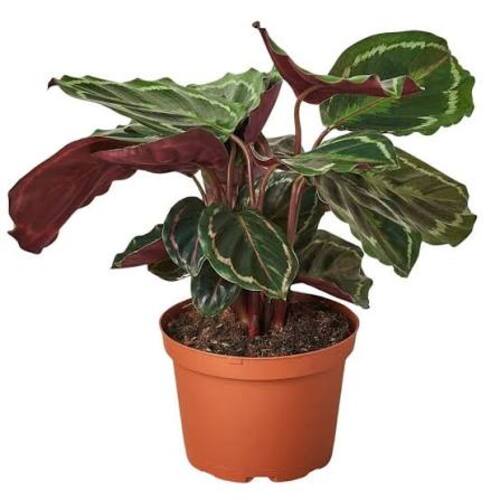
Calathea Medallion (Goeppertia roseopicta ‘Medallion’) is a cultivar prized for its large, round, dark green leaves marked with a symmetrical, feather-like pattern of silvery-white to pale green brushstrokes radiating from the central midrib. The underside of each leaf carries a deep maroon-purple hue, creating a dramatic contrast whenever the foliage curls or moves. The leaves grow on slender petioles from a clumping, rhizomatous base, giving the plant a tidy, rosette-like silhouette that rarely exceeds two feet in height indoors.
This cultivar is derived from Goeppertia roseopicta, a species native to the understory of tropical rainforests in northeastern Brazil, where it grows in the dappled, filtered light beneath the forest canopy. Like many of its Marantaceae relatives, Calathea Medallion exhibits nyctinasty, the rhythmic rising and folding of its leaves in response to daylight, a behavior so pronounced in the family that these plants are commonly nicknamed ‘prayer plants.’ In the wild, this movement helps the plant channel rainfall toward its roots and regulate light exposure.
Calathea Medallion has become one of the most recognizable houseplants for its ornamental foliage rather than its flowers, which are inconspicuous and rarely produced indoors. It is often grouped with other Calathea and Goeppertia species as a ‘reader’s plant’ or collector’s favorite, valued for the visual texture it brings to shaded rooms, though it also has a reputation for being somewhat particular about humidity and water quality compared to sturdier houseplants.
Calathea Medallion thrives when its indoor environment approximates the humid, warm, and softly lit conditions of a tropical forest floor. Success with this plant hinges on three consistent factors: bright indirect light (never direct sun), evenly moist but never soggy soil, and elevated humidity of 50% or higher. Meeting these baseline needs prevents the crispy leaf edges and curling that this species is notorious for when conditions fall short.
Water quality matters more for Calathea Medallion than for most houseplants, as it is sensitive to the chlorine, fluoride, and mineral salts found in tap water. Many growers find success using filtered, distilled, or rainwater, and allowing tap water to sit uncovered for 24 hours to off-gas chlorine before use. The growing medium should be kept lightly moist at all times, watered thoroughly when the top inch of soil dries, and never allowed to become waterlogged, as root rot is a common cause of decline in this species.
Beyond light, water, and humidity, Calathea Medallion benefits from warm, draft-free placement away from heating and cooling vents, a light monthly feeding during the growing season, and periodic dusting or gentle showering of the leaves to keep pores clear for respiration and to discourage spider mites, which favor dry, dusty foliage. With attentive but not excessive care, this plant rewards growers with vigorous new growth and consistently striking leaf patterning throughout the warmer months.
 Soil
Soil
Calathea Medallion prefers a light, loose, well-draining potting mix that retains moisture without becoming compacted or waterlogged. A good base recipe combines standard peat-free or peat-based potting soil with perlite and orchid bark in roughly equal parts, sometimes with a handful of coco coir added to improve moisture retention while keeping the mix airy. The ideal pH range is slightly acidic, between 6.0 and 6.5, which supports healthy nutrient uptake for this species.
Drainage is critical: the mix should hold moisture evenly but allow excess water to pass through quickly, since standing water around the roots leads rapidly to root rot in this moisture-sensitive plant. Amendments such as horticultural charcoal can help keep the soil sweet-smelling and reduce fungal buildup, while worm castings or a small amount of compost mixed in at potting time provide a gentle, slow-release nutrient base.
Common soil-related problems include poor drainage, which causes yellowing leaves and root rot; compaction over time, which restricts oxygen to the roots and leads to stunted growth; inappropriate pH, which can lock out nutrients even when fertilizer is applied; salt build-up from tap water or over-fertilizing, visible as a white crust on the soil surface and leaf-tip browning; and nutrient deficiencies, which often show as pale or yellowing foliage between the veins. Root-bound plants, recognizable by roots circling the pot’s interior or emerging from drainage holes, need repotting into fresh, aerated soil to continue thriving.
 Fertilizer
Calathea Medallion is a light feeder that benefits from a balanced, diluted liquid fertilizer (such as a 20-20-20 or similar houseplant formula diluted to half or quarter strength) applied every 4–6 weeks during the active growing season from spring through early fall. Feeding should be paused entirely in fall and winter when growth naturally slows, since fertilizer applied during dormancy can build up in the soil and damage the roots.
Over-fertilization shows up as crusty white salt deposits on the soil surface, brown and crispy leaf tips or margins, and in severe cases wilting despite moist soil, a sign of fertilizer burn on the roots. Under-fertilization is harder to spot but may present as pale green or yellowing leaves, slow growth, and smaller new leaves that lack the usual vibrant patterning.
Organic alternatives such as diluted worm castings tea, fish emulsion, or a light top-dressing of compost can provide a gentler, slow-release nutrient source that is less likely to cause salt burn. Calathea Medallion has no unusual nutrient requirements beyond the standard nitrogen-phosphorus-potassium balance most houseplants need, though it is particularly sensitive to fertilizer salt build-up, so flushing the soil with plain water every couple of months during the growing season helps prevent mineral accumulation.
 Watering
Calathea Medallion likes consistently moist, never soggy, soil. Water thoroughly when the top inch of the potting mix feels dry to the touch, allowing excess water to drain completely from the pot rather than letting the plant sit in a saucer of standing water. This species is notably sensitive to water quality; the chlorine, fluoride, and dissolved salts in most tap water can cause brown, crispy leaf margins over time, so distilled water, filtered water, or rainwater is preferred, and tap water should ideally be left to sit uncovered for a day before use.
Underwatering shows up as curling, drooping leaves and dry, crispy edges, while overwatering presents as yellowing lower leaves, a mushy stem base, or a sour smell from the soil indicating root rot. Because the plant’s fine roots do not tolerate prolonged drought or prolonged saturation well, a consistent watering rhythm matters more than any single watering technique.
Watering needs shift with the seasons: during the active growing period in spring and summer, the soil dries out faster and may need water every 5–7 days, while in fall and winter, when growth slows and light levels drop, the interval often stretches to every 10–14 days. Always check soil moisture by feel rather than by the calendar, since light, temperature, and pot size all affect how quickly the mix dries.
Stop guessing. Most houseplant failures are caused by volumetric errors and improper moisture tension. Our deterministic calculator moves beyond "once-a-week" watering by analyzing the four critical pillars of root health:
Personalized for this plant
Disclaimer: Our calculator is pretty smart. We’ve crunched the numbers, but we’re not measuring the quantum state of your living room. Since we don’t know your exact indoor temperature, humidity, light, airflow, or whether your plant receives daily sweet nothings and motivational speeches, use this calculator as a guide—and always keep an eye on your plant.
 Lighting
Calathea Medallion grows best in medium to bright indirect light, mimicking the filtered light it would receive beneath a rainforest canopy. An east-facing window with gentle morning sun, or a spot a few feet back from a south- or west-facing window, is typically ideal. Direct sunlight should always be avoided, as it quickly scorches the thin leaves, causing bleached patches, faded coloration, and crispy brown edges.
Signs of insufficient light include slow or leggy growth, smaller-than-normal new leaves, and a loss of the vivid pattern contrast on the foliage as the plant tries to maximize light absorption with more uniform green pigment. Excessive light exposure shows up as pale, washed-out leaf color, curling or drooping leaves during the day, and visible sunburn in the form of dry, papery brown patches.
If natural light is suboptimal, a sheer curtain can soften direct sun in bright windows, while a full-spectrum LED grow light placed 12–18 inches above the plant for 10–12 hours a day can supplement low-light rooms. Rotating the pot every couple of weeks also encourages even growth on all sides.
 Temperature
Calathea Medallion prefers consistently warm conditions between 65–80°F (18–27°C), with 70–75°F being close to ideal for active growth. It has little tolerance for cold and will show stress, including leaf curling, blackened patches, or dropped leaves, when temperatures fall below 60°F (15°C) for extended periods. Sudden temperature swings and cold drafts from windows, doors, or air conditioning are just as damaging as sustained cold, since this plant evolved in a climate with little daily temperature fluctuation.
During winter, keep the plant away from drafty windows and exterior doors, and avoid placing it near radiators or heating vents, as dry, hot air is just as harmful as cold air. In climates with cold winters, moving the plant away from window glass on frosty nights helps prevent chilling injury even if the room itself stays warm. Consistency, more than any single ideal number, is the key to keeping this plant’s foliage undamaged year-round.
 Humidity
Calathea Medallion is a humidity-loving plant that performs best at 50–60% relative humidity or higher, well above the 30–40% typical of most indoor homes, especially in winter when heating systems dry the air. Low humidity stress shows up as crispy, browning leaf edges, curling foliage, and leaves that fail to fully unfurl. Excessively high humidity combined with poor airflow, on the other hand, can encourage fungal issues, so ventilation matters alongside moisture in the air.
Several methods can raise ambient humidity around the plant. A pebble tray filled with water placed beneath the pot (without letting the pot sit directly in water) offers modest, localized humidity through evaporation. Grouping plants together creates a beneficial microclimate through collective transpiration. Regular light misting can offer brief humidity boosts but is not a substitute for ambient moisture and can encourage fungal spotting if leaves stay wet too long, so it should be done sparingly and in the morning to allow foliage to dry. The most reliable and effective solution is a small electric humidifier placed nearby, which can maintain steady humidity levels far better than pebble trays or misting alone; growers who keep multiple Calathea or other tropical foliage plants often find a humidifier well worth the investment.
 Propagation
Calathea Medallion is propagated almost exclusively through division of its rhizomatous root clumps, since it does not produce viable seed readily indoors and stem or leaf cuttings will not root, as the plant lacks nodes capable of generating new roots from a single leaf. Division is the standard and most reliable method, typically performed when repotting an established, multi-stemmed plant in spring or early summer when the plant is actively growing.
Step-by-step division guide:
1. Water the plant a day before dividing to soften the soil and reduce root stress.
2. Gently remove the plant from its pot and shake or rinse away excess soil to expose the root and rhizome structure.
3. Identify natural separations in the clump where multiple stems arise from distinct rhizome sections with their own root systems.
4. Using a clean, sharp knife or your hands, carefully separate one or more sections, ensuring each division retains healthy roots and at least two to three leaves.
5. Trim away any damaged, mushy, or rotten roots with sterilized scissors.
6. Pot each division into a small container with fresh, well-draining Calathea potting mix.
7. Water thoroughly and place the new divisions in a warm spot with bright indirect light and high humidity, using a humidity dome or plastic bag loosely tented over the pot if ambient humidity is low.
8. Keep the soil consistently moist (not soggy) for the first few weeks while new roots establish.
9. Reduce humidity tenting gradually over two to three weeks as the division shows signs of new growth.
Division has a high success rate, often above 80–90%, when performed on a healthy, well-rooted parent plant with proper aftercare, compared to the near-zero success rate of attempting leaf or stem cuttings. New divisions typically show the first signs of new leaf growth within 3–6 weeks and are considered well-established, resuming a normal growth rate, within two to three months. Late spring through midsummer, when the plant is in active growth and ambient warmth is naturally higher, is the best window for propagation.
 Potting
Calathea Medallion does well in a pot only slightly larger than its root ball, as excess soil volume around the roots retains more moisture than the plant can use and raises the risk of root rot. A pot with ample drainage holes is essential; unglazed terracotta can help wick away excess moisture for growers who tend to overwater, while plastic or glazed ceramic pots retain moisture longer and may suit those in especially dry climates. The potting mix should be the same light, well-draining, slightly acidic blend described in the soil section — typically potting soil combined with perlite and orchid bark.
Repotting is generally needed every 1–2 years, or when the plant shows signs of being root-bound: roots circling visibly at the soil surface or emerging from drainage holes, water running straight through the pot without being absorbed, noticeably slowed growth, or a plant that seems too large and top-heavy for its container. The best time to repot is spring or early summer, aligning with the plant’s natural growth surge.
During repotting, gently loosen circling roots by hand and trim away any that are dead, mushy, or excessively long, which encourages healthier new root growth rather than continued circling. Move the plant into a pot only one size up (roughly 1–2 inches in diameter larger) rather than a dramatically larger container. To minimize transition stress, repot on a mild day, water the plant a day beforehand, keep the plant out of direct sun for a week or two afterward, and maintain slightly higher humidity while new roots adjust to the fresh soil.
 Pruning
The best time to prune is during the active growing season in spring or summer, when the plant recovers quickly from cuts, though damaged or dead leaves can be removed at any time of year.
Pruning Calathea Medallion is mainly about maintenance rather than shaping: removing yellowed, browned, or damaged leaves improves appearance, redirects the plant’s energy toward healthy new growth, and reduces the risk of pests or fungal issues taking hold in decaying tissue.
Use a clean pair of sharp scissors or pruning shears, sterilized with rubbing alcohol before and after use to prevent spreading disease between plants. Prepare a clean surface or tray to catch trimmed foliage.
Water lightly if the soil has dried, keep the plant in its usual bright indirect light and warm, humid environment, and avoid fertilizing immediately after a heavy pruning session to give the plant time to recover before pushing new growth.
Avoid removing more than a third of the plant’s foliage at one time, as Calathea Medallion recovers slowly from heavy pruning. Always prune reactively based on leaf condition rather than on a fixed schedule.
 Blooming
Calathea Medallion is grown almost exclusively for its foliage and flowers very rarely in cultivation. When blooming does occur, typically in late spring or summer under near-ideal warmth, humidity, and light, it produces small, inconspicuous clusters of white to pale purple flowers near the base of the plant, often partially hidden by the foliage. Blooms are short-lived, lasting only a few days to about a week, and are not the plant’s primary ornamental feature. Indoor specimens frequently never flower at all, as the energy and stable tropical conditions required for bud formation are difficult to replicate in a home setting.
 Pests and Diseases
Name: Spider Mites
Common Issues: The most frequent pest problem for Calathea Medallion, especially in dry indoor air.
Symptoms: Fine webbing on leaf undersides and between leaves, tiny yellow or bronze speckling (stippling) on leaf surfaces, and an overall dusty or dull appearance to the foliage.
Treatment: Isolate the plant immediately, rinse leaves thoroughly under lukewarm water, treat with insecticidal soap or neem oil applied to all leaf surfaces every 5–7 days until mites are gone, and raise humidity around the plant, since spider mites thrive in dry conditions.
Name: Mealybugs
Common Issues: Occasional infestations, particularly around leaf joints and the base of petioles.
Symptoms: Small, cottony white clusters at leaf axils and stem joints, sticky honeydew residue on leaves, and sooty mold developing on the honeydew.
Treatment: Dab visible mealybugs with a cotton swab dipped in isopropyl alcohol, follow up with insecticidal soap sprayed on all plant surfaces weekly for several weeks, and isolate the plant from others until fully clear.
Name: Fungus Gnats
Common Issues: Common in consistently moist soil, more of a nuisance than a serious threat but can indicate overwatering.
Symptoms: Small dark flies hovering around the soil surface and pot rim, and occasionally larvae visible in the top layer of soil.
Treatment: Allow the soil surface to dry out more between waterings, use yellow sticky traps to catch adult gnats, and apply a mosquito-bit (Bacillus thuringiensis israelensis) soil drench to eliminate larvae.
Name: Root Rot
Common Issues: The most serious disease risk, caused by overwatering or poorly draining soil.
Symptoms: Yellowing and wilting leaves despite moist soil, a mushy, dark, foul-smelling stem base, and blackened, soft roots when the plant is removed from its pot.
Treatment: Remove the plant from its pot, trim away all blackened and mushy roots with sterilized scissors, repot into fresh, well-draining soil, reduce watering frequency going forward, and ensure the pot has adequate drainage holes.
Name: Bacterial Leaf Spot / Blight
Common Issues: Occurs in overly wet, poorly ventilated conditions, often spread by water splashing on foliage.
Symptoms: Water-soaked, dark brown to black spots on leaves that may have a yellow halo, and spots that can merge into larger blighted patches.
Treatment: Remove and discard affected leaves, avoid overhead watering and misting directly onto foliage, increase airflow around the plant, and apply a copper-based bactericide if the spread continues.
Name: Fungal Leaf Spot
Common Issues: Develops in overly humid conditions with poor air circulation.
Symptoms: Circular brown or tan spots with defined edges, sometimes with a yellow ring, that may grow and merge over time.
Treatment: Remove affected leaves, improve air circulation around the plant, avoid wetting foliage when watering, and treat with a fungicide labeled for houseplant leaf spot if the issue persists.
 Special Features
Calathea Medallion is best known for its dramatic, hand-painted appearance: broad, dark green leaves marked with a radiating pattern of silvery-green brushstrokes on top and a rich burgundy-purple underside that shows through beautifully when the leaves fold upward at night, an effect that has earned it and its relatives the nickname ‘prayer plants.’ This ongoing leaf movement, following the daily rhythm of light, makes it a uniquely dynamic houseplant compared to more static foliage varieties, and its non-toxic nature makes it a popular choice for households with curious pets or small children who might otherwise be restricted to a narrower selection of statement houseplants.
 Plant Benefits
Calathea Medallion has no established herbal, medicinal, or pharmaceutical uses and is not used in traditional or modern herbal medicine. Its value is purely ornamental and, more broadly, tied to the general psychological benefits associated with indoor greenery, such as reduced stress and improved mood in living and working spaces, though these are benefits shared with houseplants generally rather than unique properties of this species.
 Additional Information
Calathea Medallion was reclassified from the genus Calathea to Goeppertia following a 2012 taxonomic revision based on molecular phylogenetic research, though the older name Calathea remains in widespread use in the horticultural trade and among home growers. The plant is not frost-hardy and is grown outdoors year-round only in tropical to subtropical climates roughly corresponding to USDA hardiness zones 10–12; elsewhere it is grown strictly as a houseplant.
 Life Cycle
Calathea Medallion is a herbaceous, rhizomatous perennial with an indefinite lifespan under proper care, continually producing new leaves from its underground rhizome while older leaves senesce and are shed. Growth is most active in spring and summer when warmth and light are highest, slowing considerably in fall and winter as the plant enters a semi-dormant resting phase with reduced water and nutrient needs. Over years, a healthy plant will produce multiple offshoot stems from its spreading rhizome, which is what makes division-based propagation possible, effectively allowing a single plant to be multiplied indefinitely as it matures.
 Are Calathea Medallion Poisonous, Toxic
Calathea Medallion is considered non-toxic. No part of the plant — leaves, stems, or roots — contains compounds known to be poisonous to cats, dogs, or children according to the ASPCA’s plant toxicity database. Accidental ingestion of leaf or stem material may occasionally cause mild, transient gastrointestinal upset such as drooling or slight stomach discomfort simply due to the physical act of chewing fibrous plant matter, not from any toxic compound. If a pet or child ingests a large quantity of leaf material and shows signs of persistent vomiting, diarrhea, or unusual lethargy, contact a veterinarian or pediatrician to rule out other causes. As a general precaution with any houseplant, discourage chewing on foliage and keep the soil free of fertilizer residue that pets could lick.
 Frequently Asked Questions
 Can I grow Calathea Medallion in my indoor space
Difficulty: Intermediate to Advanced
Size: Medium
Light: Medium
Water: Medium-High
Flowering: No
Pet Safe: Yes
Air Purifier: Low
 Goeppertia roseopicta 'Medallion' botanical details
Common Name: Calathea Medallion
Other Common Names: Medallion Prayer Plant, Peacock Plant (broader Calathea group), Rose-Painted Calathea
Botanical Name: Goeppertia roseopicta 'Medallion'
Native Area: Tropical rainforests of northeastern Brazil, particularly the understory regions of the Atlantic Forest biome
Family Name: Marantaceae
Plant Type: Herbaceous perennial (rhizomatous foliage plant)
Genus: Goeppertia
Kingdom: Plantae
 Photo Gallery
 My Calathea Medallion Plant Care Recommendations
If you find the Houseplant Encyclopedia helpful and would like to support Healthy Houseplants, you can use the links below to shop for recommended plants, products, and plant-care supplies.
Some links are affiliate links, which means I may earn a small commission if you make a qualifying purchase through them, at no additional cost to you. Thank you for supporting Healthy Houseplants and helping me continue to provide free plant-care information!

Want even more personalized plant-care help? Check out my AI Julie Chatbot—trained on my 20 years of houseplant knowledge, not just information from the internet!  Try it now:Ask AI Julie
 Buy Calathea Medallion Online
✅ “Bring Home This Beauty Today”
✅ “Get Your Own Calathea Medallion Before It’s Gone”
✅ “Shop Trusted Sellers – Limited Availability”
✅ “Free Delivery”
As an Amazon Associate, I earn commission from qualifying purchases.
 Plant Puns and Jokes
Why did the Calathea Medallion refuse to argue with the other houseplants? Because it always knew when to fold.
 Signup to our newsletter and download Calathea Medallion care guide

