


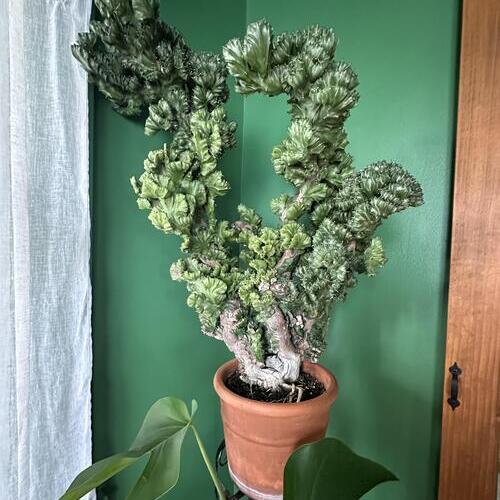
Crested Coral Cactus, botanically known as Euphorbia lactea ‘Cristata’, is a striking cultivated form of the milk-striped euphorbia, a succulent shrub native to tropical and subtropical parts of India and Sri Lanka, though the crested form itself is a mutation that has never been documented growing naturally in the wild and exists today only through deliberate propagation by growers. Despite its common name and cactus-like spiny appearance, this plant belongs to the family Euphorbiaceae rather than Cactaceae, and it is more accurately described as an angular, columnar succulent whose thick, milky, latex-rich sap is a hallmark of the genus Euphorbia and a key identifying feature separating it from true cacti, which never produce this irritating white latex.
The defining characteristic of this cultivar is ‘cristation,’ a genetic mutation in which the normally linear, upward-growing tip of the plant loses its typical polarity and instead grows outward in a widening, fan-shaped band of tissue, producing the wavy, folded, coral- or brain-like ridges that give the plant its evocative common name. Because this mutated tissue is often too fragile or metabolically limited to sustain itself on its own root system, nurseries typically propagate Crested Coral Cactus by grafting a section of crested tissue onto the sturdy, fast-growing rootstock of a related, non-crested Euphorbia, most commonly Euphorbia neriifolia, resulting in the commercially available specimens with a straight green stem topped by a dramatically rippled, often reddish-edged crest.
What makes Euphorbia lactea ‘Cristata’ particularly appealing to succulent and cactus collectors is the sheer novelty and unpredictability of its form: no two crests develop identically, and the plant’s slow but steady widening growth over years creates an ever-evolving living sculpture that rewards patient, attentive growers. Its relatively compact size, tolerance for the dry air and inconsistent watering common in indoor environments, and striking visual impact even as a single specimen in a small pot have made it a long-standing favorite in succulent nurseries, botanical garden displays, and the collections of enthusiasts drawn to unusual, architectural plant forms.
Caring for Crested Coral Cactus is relatively straightforward once its core needs are understood, making it a rewarding choice for growers with some prior succulent experience who are drawn to its bizarre, sculptural silhouette. This plant thrives with strong, bright light, a fast-draining, mineral-based cactus or succulent potting mix, and an infrequent, deep watering routine that allows the soil to dry out substantially between waterings, since like most euphorbias, it is highly susceptible to root and stem rot in soil that stays damp for extended periods.
During the active growing season in spring and summer, Crested Coral Cactus benefits from as much bright direct or strong indirect light as can be provided, whether on a sunny windowsill or under supplemental grow lights, along with watering roughly every one to two weeks once the soil has dried completely, and light, infrequent feeding to support new crest tissue development. Growers should routinely inspect the base of the crest and the rootstock below the graft union for any reversion growth, meaning normal, non-crested columnar shoots emerging from the rootstock, and prune these away promptly, since if left unchecked, the vigorous normal growth can outcompete and eventually smother the slower-growing, more ornamental crest.
As temperatures drop in autumn and winter, watering should be reduced significantly, often to once every three to four weeks or less, to accommodate the plant’s dormant period and reduce the risk of rot in cooler, slower-draining conditions, though the plant should still be kept in a bright location away from cold drafts. Because the milky latex sap exuded from any cut or damaged tissue is a skin and eye irritant, gloves and eye protection are strongly recommended during any handling, pruning, or repotting, and with attentive light exposure, careful watering discipline, and periodic removal of reverted growth, Crested Coral Cactus will reward growers with slow, steady widening of its distinctive coral-like crest for many years.
 Soil
Soil
Crested Coral Cactus requires a fast-draining, mineral-heavy potting mix specifically formulated for cacti and succulents, since its thick, water-storing tissue is highly vulnerable to rot in any soil that retains moisture for extended periods. A recommended mix combines standard cactus potting soil with generous amounts of coarse sand, perlite, and pumice or fine gravel, creating a gritty, well-aerated substrate that allows water to move through quickly while still providing enough structure to anchor the plant’s root system. The ideal soil pH is slightly acidic to neutral, generally between 6.0 and 7.0.
Soil composition plays a critical role in this plant’s long-term health, since even brief periods of waterlogged or compacted soil can quickly lead to root and stem rot in a species so strongly adapted to arid, sharply draining conditions. Adding extra pumice or coarse perlite improves aeration and prevents the fine particles in standard potting soil from compacting around the roots over time, while avoiding excessive organic matter such as compost helps keep the mix appropriately lean, since this species has relatively modest nutrient needs compared to many other ornamental houseplants.
Common soil problems to watch for include poor drainage, which can rapidly cause root and stem rot given this species’ strong intolerance of consistently moist conditions; soil compaction over time, which restricts root aeration and should be corrected with periodic repotting into fresh, gritty mix; inappropriate pH, which can hinder nutrient uptake and weaken overall vigor; salt build-up from tap water or fertilizer residue, visible as a white crust on the soil surface and best remedied by flushing thoroughly with water during the growing season; and nutrient deficiencies, which are relatively uncommon in this low-feeding species but can present as pale or stalled crest growth if soil has been depleted over many years without repotting. Because this plant’s grafted structure means its overall stability depends partly on a well-anchored root system, mild root-boundness is generally tolerated well, though a container that has become significantly overcrowded with roots should be sized up to maintain stability and healthy growth.
 Fertilizer
Crested Coral Cactus has relatively low fertilization needs and benefits from light feeding only during its active spring and summer growing season, using a balanced, water-soluble fertilizer formulated for cacti and succulents, diluted to half or even quarter strength and applied roughly once every four to six weeks while the plant is actively producing new crest tissue. Fertilization should be suspended entirely during the cooler autumn and winter months, when the plant is dormant or semi-dormant and unable to use additional nutrients, since feeding during this period offers no benefit and can lead to harmful salt buildup in the soil. Signs of over-fertilization include white, crusty salt deposits on the soil surface, soft or discolored new growth, and stunted or distorted crest development, while under-fertilization is uncommon in this species but may present as slow, minimal new crest growth over several consecutive growing seasons. Organic alternatives such as a well-diluted fish emulsion or a light top-dressing of worm castings can be used sparingly during the growing season for growers preferring a more natural approach, though because this species evolved in relatively lean, well-draining soils, restraint with fertilizer is generally more beneficial than frequent or heavy feeding.
 Watering
Watering Crested Coral Cactus follows the classic succulent principle of thorough soaking followed by complete drying, reflecting this plant’s strong adaptation to tolerate periods of drought and its correspondingly low tolerance for consistently moist soil. During the active growing season in spring and summer, water deeply enough that excess moisture drains freely from the pot, then allow the soil to dry out completely, typically checking every one to two weeks depending on light, temperature, and pot size, before watering again. Distilled water, rainwater, or tap water left to sit for twenty-four hours to dissipate chlorine is generally preferred, as sensitive succulent roots can be affected over time by heavy mineral or chemical content in hard tap water.
During the cooler months of autumn and winter, watering should be reduced substantially, often to once every three to four weeks or even less, allowing the plant to rest in mostly dry soil, since overwatering during this dormant period is one of the most common causes of stem and root rot in this species. Signs of overwatering include soft, mushy, discolored, or blackened tissue at the base of the crest or along the rootstock, along with a sour or rotten odor from the soil, all of which require immediate intervention such as removing the plant from wet soil and cutting away affected tissue, while signs of underwatering include a slightly shriveled, deflated, or dull appearance to the crest that typically plumps back up readily once watering resumes. Because this species is far more likely to suffer from overwatering than drought, erring on the side of underwatering, especially during dormancy, is the safer approach for long-term plant health.
Stop guessing. Most houseplant failures are caused by volumetric errors and improper moisture tension. Our deterministic calculator moves beyond "once-a-week" watering by analyzing the four critical pillars of root health:
Personalized for this plant
Disclaimer: Our calculator is pretty smart. We’ve crunched the numbers, but we’re not measuring the quantum state of your living room. Since we don’t know your exact indoor temperature, humidity, light, airflow, or whether your plant receives daily sweet nothings and motivational speeches, use this calculator as a guide—and always keep an eye on your plant.
 Lighting
Crested Coral Cactus requires strong, bright light to maintain compact, healthy growth and vivid coloration along its ridged crest, thriving best in a south- or west-facing window that receives several hours of direct or very strong indirect sunlight daily, conditions that closely mimic the intense light exposure of its parent species’ native tropical range. Insufficient light causes the plant to etiolate, producing weak, pale, stretched growth at the crest margins and a loss of the compact, tightly rippled form that makes the plant visually appealing, along with a tendency for the rootstock to lean or stretch toward available light sources. Excessive, sudden exposure to intense, unfiltered summer sun, particularly after a period of lower light, can cause sunscald, appearing as bleached, yellowish, or brownish patches on the crest’s surface, so any transition to a brighter location should be done gradually over one to two weeks to allow the plant to acclimate. If natural light is inadequate, particularly in winter or in rooms without strong southern exposure, supplement with a full-spectrum LED grow light positioned relatively close to the plant for ten to twelve hours daily to maintain compact, healthy growth and prevent stretching.
 Temperature
Crested Coral Cactus prefers warm temperatures, thriving between 65°F and 85°F (18°C to 29°C) during its active growing season, and tolerating a cooler winter rest period down to around 55°F (13°C) without harm, provided the soil is kept quite dry during this cooler phase. It has very limited cold tolerance and should be protected from any temperature below 50°F (10°C), with prolonged exposure to near-freezing conditions being potentially fatal to both the crest and its supporting rootstock, making this strictly an indoor or warm-climate outdoor plant in all but the mildest, frost-free regions. The plant tolerates typical indoor temperature fluctuations well but should be kept away from cold drafts near winter windows or doors, as well as away from sudden blasts of hot or cold air from heating and air conditioning vents, both of which can stress the plant over time. To protect it from temperature extremes, bring any outdoor container specimens indoors well before the first cool autumn nights, and avoid placing the plant directly against cold glass in winter, where nighttime window temperatures can drop well below the surrounding room temperature.
 Humidity
Crested Coral Cactus is well adapted to average to low indoor humidity levels, generally thriving comfortably in the 30 to 50 percent range, and unlike many tropical houseplants, it does not require elevated humidity to grow well, making it particularly well suited to dry indoor climates, air-conditioned offices, or arid regional environments. Excessively high humidity combined with poor air circulation is actually more likely to cause problems for this plant than low humidity, as persistently damp air around the crest’s folds and crevices can encourage fungal growth or rot, particularly if water collects in the ridges after misting or rainfall. Because of this, active humidifying methods such as pebble trays or frequent misting are generally unnecessary and not recommended for this species; instead, growers should prioritize good airflow around the plant, achieved through adequate spacing from other plants and, if grown in a particularly stagnant indoor environment, a small fan on a low setting to keep air moving across the crest’s surface and reduce the risk of moisture-related disease.
 Propagation
Crested Coral Cactus can be propagated primarily through two methods: taking a cutting of crested tissue and either rooting it directly, which is often slow and unreliable given the tissue’s altered growth form, or grafting the cutting onto a vigorous, non-crested Euphorbia rootstock, which is by far the more common and successful approach used by both commercial growers and experienced hobbyists. Because direct rooting of crested tissue frequently results in weak, slow-growing, or non-viable plants, grafting is generally recommended for anyone seeking a healthy, long-term specimen, while direct cuttings may be attempted by advanced growers experimenting with own-root crested forms. The best time to propagate is during the warm, active growing months of spring or early summer, when both cutting and rootstock heal and unite most readily.
Compared to grafting, direct rooting of an unsupported crested cutting is considerably less reliable, often resulting in slower establishment, weaker overall vigor, and a higher failure rate, making it a less practical choice for most growers seeking a robust, long-lived specimen. Successfully grafted plants typically show visible signs of union and new crest growth within four to six weeks, though it may take another full growing season before the plant is vigorous enough to be considered a well-established specimen.
 Potting
Crested Coral Cactus should be planted in a sturdy, heavier pot such as terracotta or ceramic with ample drainage holes, since the plant’s often top-heavy, wide crest can make lightweight plastic containers prone to tipping as the crest widens over time. Excellent drainage is essential regardless of pot material, and a shallow to medium-depth pot is generally preferable to an overly deep one, since this species’ root system is relatively modest relative to its visible top growth. Repotting is typically needed every two to three years for actively growing specimens, and should be done in spring or early summer using a fresh, fast-draining cactus and succulent mix, taking care to handle the graft union gently throughout the process. Signs that repotting is needed include roots visibly emerging from drainage holes or densely circling the pot’s interior, water passing through too quickly without being absorbed by the surrounding soil, and a plant that has become noticeably unstable or top-heavy relative to its current container. When repotting, wear gloves to protect against latex sap exposure, handle the root system gently, and if roots are extremely dense or circling, light root pruning with clean, sterilized tools can help refresh the root system, though this should be done conservatively to avoid stressing the plant. To minimize transplant stress, repot during active growth when possible, and withhold watering for about a week after repotting to allow any disturbed roots to callus and settle into the new soil.
 Pruning
Crested Coral Cactus is pruned primarily to remove reverted, non-crested growth emerging from the rootstock below the graft union, since this normal columnar growth is more vigorous than the crest and will eventually overtake and shade it out if left unaddressed. Pruning is best performed during the active growing season in spring or summer, when the plant heals and calluses most efficiently, though reversion shoots can be removed as soon as they are noticed at any time of year.
Use a clean, sharp knife or pruning shears, sterilized with rubbing alcohol before and between cuts to prevent disease transmission, and always wear protective gloves and eye protection before beginning any cutting, since the plant’s milky latex sap is a significant skin and eye irritant that can cause burning, redness, or more serious injury on contact, particularly with the eyes. Working in a well-ventilated area and having a rinse of clean water on hand for accidental skin or eye contact is a sensible precaution.
After pruning, keep the plant in bright, indirect light and withhold water for several days to a week to allow all cut surfaces to callus fully and reduce the risk of rot or infection at the wound sites. Because the latex sap can take some time to stop seeping from a fresh cut, checking back periodically to blot any continued oozing helps the wound seal cleanly and minimizes mess or irritation risk. Regular monitoring and prompt removal of reversion growth is one of the most important recurring maintenance tasks for this plant, as it directly determines whether the ornamental crest remains the dominant, visible feature over time.
 Blooming
Crested Coral Cactus, as commonly grown, is prized entirely for its sculptural form rather than for flowers, and most specimens available to collectors are grafted cristate tops that do not produce the small, inconspicuous cyathia (Euphorbia’s specialized flower-like structures) with any regularity or ornamental effect. On the rare occasions when a parent Euphorbia lactea rootstock beneath the crest flowers, the blooms are tiny, greenish-yellow, and largely unremarkable, appearing intermittently during the warm growing months of spring and summer under strong light and vigorous growth conditions. Because the crested growth itself is a genetic mutation resulting from irregular, fan-like proliferation of the growing tip rather than typical reproductive tissue, it essentially never flowers, and collectors should not expect or seek out blooming as a feature of this plant. Instead, the visual interest and ‘seasonal display’ of Crested Coral Cactus comes from its undulating, brain-like or coral-like ridges, which may deepen in color or produce new frilled growth flushes most noticeably during periods of strong sun and warm temperatures in late spring through summer.
 Pests and Diseases
Name: Mealybugs
Symptoms: Cottony white masses nestled in the folds and crevices of the crest, often accompanied by sticky honeydew residue and localized discoloration or stunted growth in affected areas.
Treatment: Dab visible clusters with rubbing alcohol on a cotton swab, then treat the plant with insecticidal soap or diluted neem oil, repeating every seven to ten days until the infestation is resolved, taking care to avoid excessive moisture pooling in the crest’s ridges during treatment.
Name: Scale Insects
Symptoms: Small, brown or tan, shell-like bumps along the rootstock or crest surface, accompanied by sticky residue and occasional yellowing or discoloration of affected tissue.
Treatment: Scrape off visible scale by hand where accessible and treat with horticultural oil or a systemic insecticide for widespread infestations.
Name: Spider Mites
Symptoms: Fine webbing in the crest’s crevices, stippled or bronzed discoloration on the surface, and general decline, particularly in hot, dry indoor conditions with poor air circulation.
Treatment: Rinse the crest carefully with water to dislodge mites, avoiding prolonged moisture retention in the ridges, and apply a miticide or insecticidal soap as needed for persistent infestations.
Name: Fungus Gnats
Symptoms: Small flying insects around the soil surface, most often a sign of soil that is staying too moist for too long, occasionally accompanied by weakened root growth.
Treatment: Allow the soil to dry out more thoroughly between waterings, use yellow sticky traps to reduce the adult population, and consider a top layer of coarse sand or grit to reduce breeding sites at the soil surface.
Name: Stem and Root Rot
Symptoms: Soft, mushy, blackened, or discolored tissue at the base of the crest, along the rootstock, or at the graft union, along with a foul odor from the soil and general decline despite otherwise adequate light.
Treatment: Remove the plant from its pot, cut away all soft or discolored tissue using a sterilized blade while wearing gloves, allow the remaining healthy tissue to dry and callus thoroughly, and repot in fresh, fast-draining mix, significantly reducing watering going forward.
Name: Graft Rejection or Failure
Symptoms: The crest appears to shrink, discolor, or separate slightly from the rootstock at the graft union, sometimes accompanied by a soft or mushy texture right at the junction point.
Treatment: Keep the plant dry and in bright, stable conditions to slow further decline, and if the crest tissue remains firm, consider having an experienced grower attempt a re-graft onto fresh rootstock before the crest tissue deteriorates further.
Name: Fungal or Bacterial Soft Rot
Symptoms: Water-soaked, discolored patches on the crest surface that may spread rapidly in warm, humid conditions, sometimes accompanied by an unpleasant odor.
Treatment: Isolate the affected plant, cut away infected tissue well into healthy material using sterilized tools, improve air circulation, reduce watering frequency, and apply a fungicide labeled for succulents if the problem persists.
 Special Features
Crested Coral Cactus is grown almost exclusively for its bizarre and captivating sculptural form, a rippling, undulating mass of blue-green to jade-colored ridges edged in reddish-pink or coral-toned margins that resembles a piece of ocean coral, a folded brain, or an abstract sea fan more than a typical plant, making it a favorite focal point for succulent arrangements, dish gardens, and modern minimalist interiors. Because true cristation is an unstable and unpredictable mutation, no two crests grow in quite the same pattern, giving each specimen a one-of-a-kind, living-sculpture quality that appeals strongly to collectors of unusual and architectural succulents. The plant is typically sold as a grafted specimen atop a straight, columnar green rootstock, and this dramatic visual contrast between the stiff, upright host stem and the wildly convoluted crest above it adds further ornamental interest, while its compact size, tolerance of dry indoor air, and minimal watering needs make it a low-maintenance conversation piece for bright windowsills, offices, and succulent collections.
 Plant Benefits
Euphorbia lactea and related species have a documented history of use in traditional folk medicine in parts of South and Southeast Asia, where the latex sap has been applied externally in extremely diluted or processed preparations for skin conditions, though this practice carries significant risk and is not supported by robust clinical evidence, and the raw sap itself is a known skin, eye, and mucous membrane irritant that should never be handled without protection or ingested under any circumstances. Modern herbal or pharmaceutical use of this plant is essentially nonexistent among reputable practitioners due to its toxicity profile, and any interest in its chemical constituents, which include diterpene esters common to many Euphorbia species, remains confined to phytochemical and toxicological research rather than practical home remedies. Unlike some succulents grown for both ornamental and culinary or medicinal value, Crested Coral Cactus offers no edible or safe topical benefit to home growers and should be treated strictly as an ornamental, architecturally striking display plant kept out of reach of children and pets.
 Additional Information
Crested Coral Cactus belongs to the enormous and diverse genus Euphorbia, which contains thousands of species ranging from tiny annual weeds to massive African tree euphorbias that convergently resemble true cacti despite being entirely unrelated, a striking example of parallel evolution between the Euphorbiaceae and Cactaceae families in arid environments worldwide. The ‘Cristata’ designation refers specifically to the crested growth mutation rather than to a distinct species, meaning growers may encounter crested forms of several other Euphorbia species and cultivars sold under similar common names, so confirming the specific botanical name and rootstock type is useful for collectors seeking a particular growth habit or color pattern. Because virtually all commercially available specimens are grafted, the long-term health and longevity of a given plant depends heavily on the compatibility and vigor of the graft union between crest and rootstock, and growers should be aware that a failing or incompatible graft can sometimes cause the crest to decline even when watering and light conditions are otherwise appropriate. The plant’s unusual, almost alien appearance has made it a popular subject in modern succulent design, terrariums, and minimalist interior styling, where its sculptural quality is often showcased as a solitary statement plant rather than combined densely with other species.
 Life Cycle
Crested Coral Cactus begins its cultivated life not as a seedling but almost always as a small cutting of crested tissue grafted onto a sturdy, fast-growing Euphorbia neriifolia or similar rootstock, since the cristate mutation is often too weak or slow to sustain vigorous root growth on its own. Once grafted and successfully unified with the rootstock, the crest draws water and nutrients through the host plant’s vascular system, allowing it to expand outward in a wavy, convoluted pattern of ridges and folds that thickens and elaborates with each subsequent growing season. Growth is most active during the warm months of spring through early autumn, when the plant produces new frilled tissue at the growing edges of the crest and the rootstock beneath may also thicken or occasionally sucker with normal, non-crested columnar growth that should be removed to preserve the ornamental crest form. As temperatures cool in autumn and winter, both the graft union and the crest itself enter a dormant or semi-dormant state, during which growth slows dramatically and the plant requires significantly less water and no fertilizer. Because the crested top is a genetic anomaly propagated entirely through vegetative means such as grafting or careful division, individual crests are essentially clones that can persist and slowly enlarge for many years or even decades under good care, with some prized specimens in botanical collections and nurseries maintained as long-lived, ever-widening architectural centerpieces.
 Are Crested Coral Cactus Poisonous, Toxic
Euphorbia lactea ‘Cristata’ is considered toxic to cats, dogs, and humans due to the thick, milky latex sap contained throughout its tissue, which includes irritating diterpene compounds capable of causing significant discomfort on contact or ingestion. The sap can cause skin irritation, redness, or a burning rash on contact, severe pain and inflammation if it contacts the eyes, and if ingested, symptoms in pets or children may include intense burning or irritation of the mouth and throat, excessive drooling, vomiting, and diarrhea, with the severity generally considered mild to moderate but capable of causing significant discomfort even in small amounts. If skin or eye contact occurs, the affected area should be flushed thoroughly with cool running water for at least fifteen minutes, and if ingestion occurs or eye irritation persists, prompt veterinary or medical attention should be sought rather than attempting home treatment alone. Because of this toxicity profile, the plant should be kept well out of reach of curious pets and young children, positioned where it cannot be easily brushed against or chewed, and always handled with gloves and eye protection during any pruning, repotting, or propagation work that might expose the interior tissue.
 Frequently Asked Questions
Yes, Crested Coral Cactus is toxic to cats, dogs, and humans due to its irritating milky latex sap, which can cause skin and eye irritation as well as gastrointestinal upset if ingested.
Most Crested Coral Cactus specimens are grafted, meaning the wavy crested top is joined onto a straight, non-crested Euphorbia rootstock that supports its growth.
Water deeply only when the soil has dried out completely, typically every one to two weeks during active growth, and much less often, roughly every three to four weeks, during winter dormancy.
It needs strong, bright light, ideally several hours of direct or very strong indirect sun daily, since insufficient light causes weak, stretched growth and loss of its compact crested form.
The crested growth itself essentially never flowers, since the mutation that creates its rippled form replaces normal reproductive growth; any flowering would only occur on non-crested rootstock growth.
It needs a fast-draining, mineral-heavy cactus and succulent mix with added perlite, pumice, or coarse sand, and a soil pH between 6.0 and 7.0.
The most reliable method is grafting a section of crested tissue onto a vigorous, non-crested Euphorbia rootstock, since crested cuttings often root poorly on their own.
This is reversion growth from the rootstock reverting to its normal, non-crested form, and it should be pruned away promptly so it doesn’t overtake the ornamental crest.
Yes, it grows well indoors near a very bright, sunny window, and its tolerance for average indoor humidity and dry air makes it well suited to typical home and office conditions.
Flush the affected area thoroughly with cool running water for at least fifteen minutes, and seek medical attention if irritation is severe, persistent, or if the sap contacts the eyes.
 Can I grow Crested Coral Cactus in my indoor space
Difficulty: Intermediate
Size: Medium
Light: High
Water: Low
Flowering: No
Pet Safe: No
Air Purifier: Low
 Euphorbia lactea 'Cristata' botanical details
Common Name: Crested Coral Cactus
Other Common Names: Crested Euphorbia, Elkhorn Cactus, Coral Cactus, Frilled Fan, Crested Candelabra Plant, Mermaid Tail
Botanical Name: Euphorbia lactea 'Cristata'
Native Area: The parent species Euphorbia lactea originates from tropical and subtropical regions of India and Sri Lanka, though the crested 'Cristata' form is a horticultural mutation that arose in cultivation and does not occur naturally in the wild
Family Name: Euphorbiaceae
Plant Type: Succulent shrub (cristate mutation, typically grafted; not a true cactus)
Genus: Euphorbia
Kingdom: Plantae
 Photo Gallery
 My Crested Coral Cactus Plant Care Recommendations
If you find the Houseplant Encyclopedia helpful and would like to support Healthy Houseplants, you can use the links below to shop for recommended plants, products, and plant-care supplies.
Some links are affiliate links, which means I may earn a small commission if you make a qualifying purchase through them, at no additional cost to you. Thank you for supporting Healthy Houseplants and helping me continue to provide free plant-care information!

Want even more personalized plant-care help? Check out my AI Julie Chatbot—trained on my 20 years of houseplant knowledge, not just information from the internet!  Try it now:Ask AI Julie
 Buy Crested Coral Cactus Online
✅ “Bring Home This Beauty Today”
✅ “Get Your Own Crested Coral Cactus Before It’s Gone”
✅ “Shop Trusted Sellers – Limited Availability”
✅ “Free Delivery”
As an Amazon Associate, I earn commission from qualifying purchases.
 Plant Puns and Jokes
Why did the Crested Coral Cactus refuse to grow in a straight line? Because it never met a rule it didn’t want to ripple through!
 Signup to our newsletter and download Crested Coral Cactus care guide

