


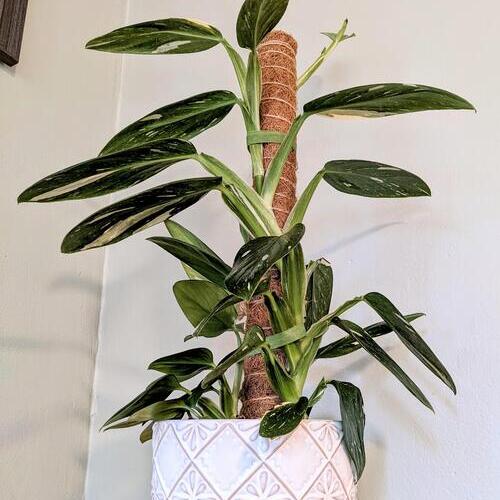
Monstera standleyana is a climbing member of the Araceae family, native to the tropical rainforests of Central America, with populations reported across Costa Rica, Panama, Honduras, Nicaragua, and parts of northwestern Colombia. Unlike its more famous relative Monstera deliciosa, this species does not develop the large split or perforated leaves collectors associate with the genus. Instead, it is grown almost entirely for its foliage pattern: glossy, lance-shaped leaves in deep green, marbled with irregular splashes of cream, white, or yellow variegation that make no two leaves look quite alike. The species was formally described in 1947 by American botanist Julian Steyermark and carries the epithet standleyana in honor of botanist Paul Carpenter Standley.
In the wild, Monstera standleyana behaves as a climbing hemiepiphyte, germinating on the forest floor and then using aerial roots to attach to tree trunks as it grows upward toward the dappled light of the forest canopy. This climbing habit carries over into cultivation: given a moss pole, coco coir totem, or trellis, an indoor plant will produce larger, more upright leaves and a fuller growth habit, while a plant left to trail from a hanging basket takes on a cascading form with somewhat smaller leaves. Outdoors in its native range, vines can stretch to twenty feet or more; indoors, most specimens settle into a manageable two to five feet in height.
The plant is a frequent case of mistaken identity in the houseplant trade. Because its narrow, glossy, variegated leaves resemble certain philodendrons, it has long been mislabeled and sold as ‘Philodendron Cobra’ or ‘Philodendron standleyana,’ and it is sometimes confused with true Monstera obliqua or the closely related Monstera juliusii. Despite the nickname ‘five holes plant,’ it does not actually form fenestrations of any kind; the name is widely regarded among growers as a historical misnomer. Its manageable size, striking variegation, and relatively easygoing care make it a popular choice for collectors who want Monstera-genus foliage without the space demands of larger species.
Monstera standleyana is generally considered an easygoing, beginner-friendly aroid, though its variegated leaves do reward a bit more attentiveness than an all-green houseplant. The most important factor in keeping the foliage pattern vivid is bright, indirect light: too little light causes the plant to green up and lose contrast in its variegation over time, while harsh direct sun can scorch the pale, chlorophyll-poor sections of the leaves, which burn more easily than the solid green portions. A spot a few feet from an east- or west-facing window, or a filtered south-facing window, tends to strike the right balance.
Watering follows a straightforward dry-down rhythm: let the top inch or two of soil dry before watering thoroughly, then allow any excess to drain away completely rather than sitting in a saucer. The plant tolerates an occasional missed watering better than it tolerates consistently soggy soil, since its roots are adapted to the airy, well-drained conditions of a forest floor and tree trunk rather than dense, waterlogged substrate. Moderate to high humidity, in the range of 50 to 70 percent, supports the best growth and leaf size, though the plant is more humidity-forgiving than many of its Monstera cousins and can adapt reasonably well to typical indoor conditions.
Because Monstera standleyana is naturally a climber, providing some kind of vertical support early on encourages a fuller, more upright plant with larger leaves, though it also does perfectly well left to trail from a hanging planter or shelf. A chunky, fast-draining aroid mix, light monthly feeding during the growing season, and repotting only every year or two round out the plant’s basic needs. With consistent light and a sensible watering routine, most growers find this species to be one of the more forgiving and rewarding entries in the Monstera genus.
 Soil
Soil
Monstera standleyana needs a loose, chunky, well-draining aroid mix rather than dense, water-retentive potting soil. A good baseline combines regular potting soil with orchid bark, perlite, and a portion of horticultural charcoal, creating the airy structure this climbing hemiepiphyte’s roots are adapted to in the wild. The ideal soil pH falls in a mildly acidic to near-neutral range, roughly 5.5 to 7.0, which supports healthy nutrient uptake without encouraging salt or mineral buildup. Good aeration matters as much as drainage: the plant’s roots need consistent access to oxygen, and a mix that stays compacted or waterlogged quickly leads to stress.
Several soil problems show up disproportionately in this species when the mix isn’t right. Poor drainage or compaction traps water around the roots, leading to yellowing leaves, a mushy stem base, and eventually root rot. An inappropriate pH can lock out nutrients even when they are present in the soil, showing up as pale or stunted new growth. Salt build-up from tap water or over-fertilizing appears as a white crust on the soil surface and can damage fine root tips over time, so periodic deep watering to flush the mix is worthwhile. Nutrient deficiencies, often nitrogen, tend to show up as pale, small new leaves, while a root-bound plant in an overly small pot will show slowed growth and roots visibly circling at the drainage holes, signaling it’s time to refresh the mix or size up the container.
 Fertilizer
During the active growing season of spring through summer, Monstera standleyana benefits from a balanced, water-soluble houseplant fertilizer applied roughly once a month, diluted according to label directions to avoid overwhelming its relatively fine root system. Feeding can be reduced to every other month, or paused altogether, during the slower growth of fall and winter. Signs of over-fertilizing include a visible crust of salts on the soil surface, browning or burned leaf tips and margins, and stunted new growth, while under-fertilized plants tend to show pale, small new leaves and a general slowdown in growth despite otherwise adequate light and water. Growers who prefer organic options can use a diluted fish emulsion, worm-casting tea, or a slow-release organic pellet formulated for houseplants; because the plant is sensitive to concentrated salts, it is generally safer to fertilize slightly less than recommended and watch the plant’s response rather than over-apply.
 Watering
Monstera standleyana prefers a consistent dry-down-then-soak watering rhythm: let the top inch or two of soil dry out before watering thoroughly, and always allow excess water to drain away rather than letting the pot sit in a full saucer. Room-temperature filtered, distilled, or rainwater is gentler on the plant than heavily chlorinated or mineral-rich tap water, which can contribute to salt build-up and leaf-tip browning over time. Underwatering shows up as drooping, curling leaves and dry, crispy edges, though this plant tolerates an occasional missed watering fairly well; overwatering is the more common and more serious issue, typically appearing as yellowing lower leaves, a soft or mushy stem base, or a sour smell from the soil that signals root rot setting in. Watering needs shift with the seasons: during the active growing months of spring and summer the plant dries out faster and may need water roughly once a week, while growth slows in fall and winter, and the interval between waterings should stretch accordingly to avoid a consistently wet root zone.
Stop guessing. Most houseplant failures are caused by volumetric errors and improper moisture tension. Our deterministic calculator moves beyond "once-a-week" watering by analyzing the four critical pillars of root health:
Personalized for this plant
Disclaimer: Our calculator is pretty smart. We’ve crunched the numbers, but we’re not measuring the quantum state of your living room. Since we don’t know your exact indoor temperature, humidity, light, airflow, or whether your plant receives daily sweet nothings and motivational speeches, use this calculator as a guide—and always keep an eye on your plant.
 Lighting
Bright, indirect light is ideal for Monstera standleyana and is the single biggest factor in keeping its variegation vivid. A spot a few feet from an east- or west-facing window, or a south-facing window filtered through a sheer curtain, tends to work well. Direct, unfiltered sun, especially at midday, can scorch the leaves, and the pale cream or white variegated sections burn more readily than the solid green portions since they contain less chlorophyll to protect the tissue. Too little light causes new leaves to emerge smaller, more sparsely variegated, or almost entirely green, along with a general slowdown in growth and longer, leggier stem sections between leaves. If natural light is limited, a full-spectrum grow light positioned above or beside the plant for ten to twelve hours a day can help maintain both growth rate and variegation, and periodically rotating the plant encourages even growth on all sides.
 Temperature
Warm, stable temperatures between roughly 65 and 85°F (18 to 29°C) suit Monstera standleyana best, matching the consistently warm conditions of its Central American rainforest habitat. The plant is not frost-tolerant and can be damaged by sustained temperatures below about 50°F (10°C), so it should be kept away from cold drafts, drafty windows and doors, and unheated rooms in winter. It also prefers a stable environment over sudden temperature swings, so keeping it away from direct blasts of air conditioning or heating vents, as well as exterior doors that open frequently, helps the plant maintain steady growth.
 Humidity
Monstera standleyana grows best in moderate to high humidity, generally in the range of 50 to 70 percent, reflecting the moist air of its native rainforest habitat, though it is more tolerant of average indoor humidity than many of its Monstera relatives. In humidity that runs too low, leaves may show browning or crisping along the edges and slower, smaller new growth; very high humidity paired with poor airflow can occasionally encourage fungal or bacterial leaf spotting. A room humidifier offers the most reliable and consistent humidity boost, while grouping plants together or using a pebble tray beneath the pot can provide smaller, supplementary increases. Light misting can offer brief relief in especially dry conditions but has limited lasting effect and should be paired with good air circulation to avoid leaving moisture sitting on the leaves.
 Propagation
Stem cuttings are the most common and reliable way to propagate Monstera standleyana, and the plant roots readily in either water or a moist propagation mix as long as the cutting includes at least one node and, ideally, a leaf and an aerial root. Division of an established plant with multiple stems is a secondary option for growers who want to create a new, more mature-looking plant right away rather than waiting for a cutting to establish. Late spring through summer, during the plant’s active growing season, is the best window for propagation, since warmth and longer daylight hours speed up root development.
Step-by-step stem cutting method:
1. Locate a healthy section of vine with at least one node, ideally with a visible aerial root and an attached leaf.
2. Using clean, sharp shears, cut a couple of centimeters below the node.
3. Wear gloves if you are sensitive to the plant’s sap, which can irritate skin.
4. Place the cutting in a glass of room-temperature water, making sure the node is submerged, or insert it into a moist, airy propagation mix.
5. Position the cutting in bright, indirect light away from direct sun.
6. If rooting in water, change the water every few days to keep it clean and watch for new roots to form.
7. Once roots reach an inch or two long, or a soil-rooted cutting resists a gentle tug, pot it into a chunky aroid mix.
8. Keep humidity elevated and light bright but indirect while the new plant establishes itself over the following weeks.
Water propagation tends to be the more popular method among home growers because roots are easy to monitor, while propagation directly in soil or moist media often produces a sturdier root system with less transplant shock once potted. Rooting generally takes a few weeks to a couple of months, and a newly rooted cutting typically needs several more months of steady growth before it can be treated as a well-established, independent plant.
 Potting
A pot with ample drainage holes, sized only one to two inches larger in diameter than the current root ball, suits Monstera standleyana well; oversized pots hold excess moisture that can lead to root problems. A chunky, well-aerated aroid mix of potting soil, orchid bark, and perlite keeps oxygen available to the roots while still retaining enough moisture between waterings. Repotting every one to two years is usually sufficient, and the plant will signal it’s ready sooner if roots begin circling visibly at the drainage holes or emerging from them, growth stalls despite good care, or water starts running straight through the pot without being absorbed.
When repotting, gently loosen the root ball, trim away any obviously rotted, mushy, or dead roots with clean shears, and avoid disturbing healthy roots more than necessary. Move the plant into its new pot with fresh mix, add or extend a climbing support such as a moss pole at the same time if desired, and water it in well. Spring or early summer, when the plant is actively growing, is the best time to repot, and keeping the plant out of direct sun with stable humidity for a week or two afterward helps it recover from the disturbance with minimal stress.
 Pruning
Prune Monstera standleyana during the active growing season, spring through summer, when the plant recovers from cuts quickly and any resulting cuttings root well.
Light, occasional pruning as needed throughout the growing season is enough; there is no need for a fixed pruning schedule.
Pruning is used to remove damaged or yellowing leaves, control the plant’s size and shape, manage its trailing runners, and generate healthy cuttings for propagation.
Use clean, sharp bypass shears or scissors, wiping the blades with rubbing alcohol before and after use to avoid spreading disease. Wearing gloves is a good precaution, since the plant’s sap can irritate skin.
Keep the plant out of direct sun for a few days after a heavier pruning session, maintain normal watering and humidity, and monitor cut ends for any signs of rot or infection.
Avoid removing more than about a quarter of the plant’s foliage in a single session, and always use clean tools to prevent introducing bacterial or fungal pathogens through fresh cuts.
 Blooming
Monstera standleyana flowers only rarely, and almost never indoors, since reaching flowering maturity generally requires the size, age, and closely mimicked native conditions that are difficult to replicate in a home environment. When a mature plant does bloom, typically outdoors in a tropical climate or greenhouse setting, it produces a single, understated inflorescence typical of the Araceae family: a small, cream-colored spathe wrapped around a central spadix. The bloom is subtle rather than showy and lasts only a short time, generally a matter of days, and there is no strong seasonal pattern documented for indoor specimens given how infrequently flowering occurs in cultivation. Growers should not expect regular blooming and are best served treating this plant as a foliage specimen rather than a flowering one.
 Pests and Diseases
Name: Spider mites
Symptoms: Fine webbing on leaf undersides, stippled or speckled yellowing across the leaf surface, and a general dull or dusty appearance to the foliage.
Treatment: Rinse the plant thoroughly under lukewarm water, increase ambient humidity since mites favor dry air, and treat with insecticidal soap or horticultural oil, repeating every week or so until no mites remain.
Name: Mealybugs
Symptoms: Small white, cottony clusters in leaf axils and along stems, along with sticky honeydew residue and possible sooty mold growth.
Treatment: Dab visible clusters with a cotton swab dipped in rubbing alcohol, then treat the whole plant with insecticidal soap or neem oil, repeating every one to two weeks until the infestation clears.
Name: Cottony cushion scale
Symptoms: Small, waxy white or tan bumps clustered on stems and leaf undersides, often accompanied by sticky honeydew and yellowing foliage.
Treatment: Scrape or wipe off visible scale with a soft cloth or alcohol-dipped cotton swab, then apply horticultural oil or insecticidal soap to smother remaining insects and any eggs.
Name: Aphids
Symptoms: Small, soft-bodied insects clustering on new growth and the undersides of leaves, often with sticky honeydew and curled or distorted new leaves.
Treatment: Rinse the plant with a strong stream of water to dislodge aphids, then treat with insecticidal soap or neem oil, repeating every week until they are gone.
Name: Root rot
Symptoms: Yellowing or wilting leaves despite moist soil, a mushy or blackened stem base, and a sour smell from the potting mix.
Treatment: Remove the plant from its pot, trim away any soft or discolored roots with sterilized shears, repot into fresh, fast-draining mix, and reduce watering frequency going forward.
Name: Leaf spot
Symptoms: Brown, tan, or black spots on the leaves, sometimes with a yellow halo, that can enlarge or merge in humid, poorly ventilated conditions.
Treatment: Remove and dispose of affected leaves, avoid overhead watering and misting that leaves moisture sitting on foliage, improve airflow, and apply a fungicide labeled for houseplants if the issue persists.
Name: Sooty mold
Symptoms: A black, powdery coating on leaf surfaces, typically developing on the sticky honeydew left behind by a pest infestation such as scale, mealybugs, or aphids.
Treatment: Treat the underlying pest infestation first, then gently wipe the mold away from leaves with a damp cloth once pests are under control.
 Special Features
Monstera standleyana’s defining feature is its variegated foliage: glossy, lance-shaped leaves marbled with irregular splashes of cream, white, or yellow, with no two leaves patterned quite the same way, making each plant feel genuinely one of a kind. Unlike many of its Monstera relatives, it never develops fenestrations, which sets it apart visually and makes it a good option for growers who want the genus’s characteristic glossy foliage and easy climbing habit without the size and floor space larger, fenestrated species eventually demand. Its natural climbing habit also makes it a versatile styling choice, equally at home trained upright on a moss pole for a fuller, more architectural look or left to trail from a hanging planter or high shelf for a cascading display.
 Plant Benefits
Monstera standleyana has no established herbal, medicinal, or pharmaceutical use; like other Monstera species, its tissues contain calcium oxalate crystals that make it unsuitable for ingestion, and it is grown purely as an ornamental foliage plant.
 Additional Information
Monstera standleyana is frequently mislabeled in the plant trade as ‘Philodendron Cobra’ or ‘Philodendron standleyana,’ owing to its resemblance to certain philodendrons, so buyers should look for confirmed node structure and leaf morphology, or purchase from a reputable specialty nursery, to ensure accurate identification. Despite its common nickname, the ‘five holes plant,’ it does not develop fenestrations of any kind; the name is considered a long-standing misnomer among growers. Variegated forms, including ‘Albo Variegata’ and ‘Aurea Variegata,’ generally command a higher price than the standard green-and-cream form and may require slightly brighter light to compensate for their reduced chlorophyll content.
 Life Cycle
Monstera standleyana begins life as a small seedling or rooted cutting with simple, solid-colored juvenile leaves. As the plant matures and, ideally, gains height on a climbing support, its leaves lengthen into the characteristic lance shape and develop the plant’s signature cream, white, or yellow variegation, with each new leaf displaying a somewhat different pattern. In its native habitat, a mature climbing vine can eventually flower and set fruit, completing a full reproductive cycle, though this is rare even in the wild and exceptionally rare in cultivation, where the plant is almost always propagated vegetatively through stem cuttings rather than grown from seed. Given consistent warmth, humidity, and light, the plant continues to grow and lengthen indefinitely as a vine rather than following a fixed annual or biennial life cycle.
 Are Monstera Standleyana Poisonous, Toxic
Like other members of the Araceae family, Monstera standleyana contains calcium oxalate crystals throughout its leaves, stems, and sap, making it toxic if chewed or ingested by cats, dogs, and children. When plant tissue is damaged, the needle-shaped crystals are released and can irritate the soft tissue of the mouth and throat on contact. Typical symptoms include oral pain and burning, excessive drooling, pawing at the mouth in pets, mild swelling of the lips or tongue, and occasional vomiting; direct skin contact with the sap can also cause localized irritation. Most sources describe the toxicity as mild, with symptoms generally resolving on their own, though a child or small pet that ingests a larger quantity may experience more pronounced discomfort. First aid involves rinsing the mouth with cool water or milk, wiping away visible plant material, offering a cold treat to ease irritation, and contacting a veterinarian, pediatrician, or poison control center if symptoms are significant or persist. The safest approach is to keep the plant out of reach of curious pets and children, particularly the trailing vines, and to wash hands after pruning or handling cut stems.
 Frequently Asked Questions
Monstera standleyana is a climbing aroid native to Central America, grown for its glossy, lance-shaped leaves marbled with cream, white, or yellow variegation rather than for fenestrations.
No. Monstera standleyana is frequently mislabeled as ‘Philodendron Cobra’ in the trade due to its resemblance to certain philodendrons, but it is botanically a true Monstera species.
No. Despite its nickname, the ‘five holes plant,’ Monstera standleyana does not develop fenestrations or splits in its leaves even at maturity; it is grown for its variegation instead.
Yes. Like other Monstera species, it contains calcium oxalate crystals that can irritate the mouth and throat if chewed or ingested by cats, dogs, or children, though the effect is generally mild.
It needs bright, indirect light to maintain vivid variegation. Direct sun can scorch the pale sections of the leaves, while too little light causes new growth to fade toward solid green.
Water once the top inch or two of soil has dried out, then soak thoroughly and let excess water drain away. This typically means watering roughly once a week during the growing season and less often in winter.
A moss pole or similar support isn’t required but is recommended, since it encourages larger, more upright leaves; the plant also does well left to trail from a hanging planter.
The most reliable method is a stem cutting that includes at least one node, rooted in water or a moist propagation mix under bright, indirect light.
Loss of variegation is usually caused by insufficient light. Moving the plant to a brighter, indirectly lit spot typically restores more pronounced patterning in new growth.
Indoors it typically reaches two to five feet in height when given a climbing support, though outdoor vines in tropical climates can stretch to twenty feet or more.
 Can I grow Monstera Standleyana in my indoor space
Difficulty: Easy
Size: Medium
Light: Medium to High
Water: Medium
Flowering: Yes
Pet Safe: No
Air Purifier: Medium
 Monstera standleyana Engl. botanical details
Common Name: Monstera Standleyana
Other Common Names: Cobra Monstera, Five Holes Plant, Philodendron Cobra (trade misnomer), Philodendron standleyana (trade misnomer)
Botanical Name: Monstera standleyana Engl.
Native Area: Tropical rainforests of Central America, including Costa Rica, Panama, Honduras, and Nicaragua
Family Name: Araceae
Plant Type: Evergreen tropical perennial vine (climbing hemiepiphyte)
Genus: Monstera
Kingdom: Plantae
 Photo Gallery
 My Monstera Standleyana Plant Care Recommendations
If you find the Houseplant Encyclopedia helpful and would like to support Healthy Houseplants, you can use the links below to shop for recommended plants, products, and plant-care supplies.
Some links are affiliate links, which means I may earn a small commission if you make a qualifying purchase through them, at no additional cost to you. Thank you for supporting Healthy Houseplants and helping me continue to provide free plant-care information!

Want even more personalized plant-care help? Check out my AI Julie Chatbot—trained on my 20 years of houseplant knowledge, not just information from the internet!  Try it now:Ask AI Julie
 Buy Monstera Standleyana Online
✅ “Bring Home This Beauty Today”
✅ “Get Your Own Monstera Standleyana Before It’s Gone”
✅ “Shop Trusted Sellers – Limited Availability”
✅ “Free Delivery”
As an Amazon Associate, I earn commission from qualifying purchases.
 Plant Puns and Jokes
Why did the Monstera Standleyana get cast in the school play? Because with all that variegation, it already knew how to steal the spotlight without a single fenestration.
 Signup to our newsletter and download Monstera Standleyana care guide

