


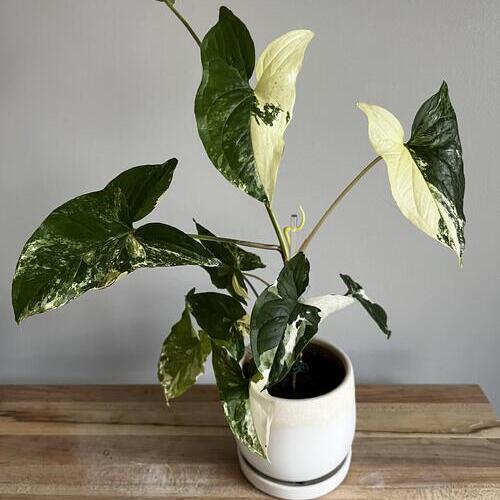
Syngonium podophyllum ‘Albo Variegatum’ is a stunning variegated cultivar of the widely grown Arrowhead Vine, belonging to the family Araceae. The species Syngonium podophyllum is native to a broad range spanning from Mexico through Central America and into parts of northern South America, where it grows as a hemiepiphytic climber in tropical and subtropical rainforests. The ‘Albo Variegatum’ cultivar is prized for its striking white-and-green variegation, which is caused by a chimeral mutation that results in sections of leaf tissue lacking chlorophyll. This variegation pattern is unstable, meaning each new leaf is unique and may display anything from subtle white speckling to dramatic half-moon patterns or entirely white sectors.
The foliage of Syngonium podophyllum ‘Albo Variegatum’ undergoes a fascinating morphological transformation as the plant matures. Juvenile leaves are simple, arrow-shaped (sagittate), and relatively compact, displaying the classic arrowhead form that gives the species its common name. As the plant matures and begins to climb, the leaves gradually transition into a more complex, deeply lobed, palmate shape with three to nine segments. The variegation appears as bold splashes, patches, and sectors of creamy white to pure white against a rich green background. Some leaves may emerge almost entirely white, while others may be predominantly green with only subtle white markings. The stems are slender and produce aerial roots at the nodes, which the plant uses to anchor itself to trees and other vertical surfaces in the wild.
Syngonium podophyllum ‘Albo Variegatum’ has become one of the most sought-after variegated houseplants in the collector community, commanding premium prices due to the unpredictable and visually dramatic nature of its variegation. Unlike tissue-culture-stable variegation found in some cultivars, the chimeral variegation of ‘Albo Variegatum’ cannot be reliably reproduced from tissue culture, making propagation through stem cuttings the primary method of multiplication and contributing to its relative scarcity. The plant is a vigorous grower under the right conditions, producing new leaves regularly during the growing season, and can be trained to climb a moss pole or allowed to trail from a hanging basket or shelf. Its combination of elegant leaf shape, dramatic color contrast, and relatively adaptable care requirements has cemented its position as a modern classic among variegated tropical houseplants.
Caring for Syngonium podophyllum ‘Albo Variegatum’ requires a thoughtful balance between providing enough light to maintain its variegation and protecting the delicate white tissue from sunburn. The white portions of the leaves contain little to no chlorophyll, making the plant somewhat less efficient at photosynthesis than its fully green counterpart. This means it benefits from brighter light conditions than a standard Syngonium podophyllum, though direct sunlight must still be avoided as it will scorch the vulnerable white sectors. Bright, filtered light from an east-facing window or a position near a south or west-facing window with sheer curtains is ideal. Understanding this fundamental relationship between light and variegation is the cornerstone of successful care for this cultivar.
Watering and soil management are equally important. Like all Syngonium species, the ‘Albo Variegatum’ prefers a well-draining, airy potting mix that retains some moisture without staying waterlogged. A chunky aroid mix composed of peat or coco coir, perlite, orchid bark, and charcoal provides the ideal balance of moisture retention and root aeration. Water when the top 2 to 3 centimeters of soil have dried out, and always ensure excess water drains freely from the pot. Overwatering is the most common cause of decline in this plant, leading to root rot that can quickly become fatal, especially since the reduced chlorophyll content already puts the plant at a metabolic disadvantage. During the winter months, reduce watering frequency to match the plant’s slower growth rate.
Humidity and temperature management round out the essential care requirements. Syngonium podophyllum ‘Albo Variegatum’ thrives in humidity levels of 60 to 70 percent, though it can tolerate levels as low as 50 percent without significant distress. A humidifier is the most reliable method for maintaining consistent humidity, particularly during the dry winter months when indoor heating can drop levels dramatically. Temperatures between 18 and 27 degrees Celsius (65 to 80 degrees Fahrenheit) are ideal, and the plant should be kept away from cold drafts, heating vents, and sudden temperature swings. Regular fertilization during the growing season with a balanced, diluted liquid fertilizer supports vigorous growth and helps the plant maintain healthy variegation patterns. With attentive care, this cultivar will reward you with a continuous stream of beautifully patterned leaves that make it a true centerpiece in any plant collection.
 Soil
Soil
Syngonium podophyllum ‘Albo Variegatum’ thrives in a lightweight, chunky, well-draining potting mix that provides excellent aeration while retaining moderate moisture. The ideal composition consists of approximately 35 to 40 percent peat moss or coco coir as a moisture-retentive base, 25 percent perlite or pumice for drainage and aeration, 25 percent orchid bark or pine bark fines to create air pockets around the roots, and 10 percent horticultural charcoal to filter impurities and prevent bacterial growth. The preferred soil pH range is 5.5 to 6.5, which is slightly acidic to neutral. Adding a small amount of worm castings (5 to 10 percent) provides gentle, slow-release nutrients and improves soil microbiology. Sphagnum moss can be blended in or used as a top dressing to increase humidity around the aerial roots.
The soil composition directly affects the health and variegation quality of this cultivar. Because the white leaf tissue produces less energy through photosynthesis, a stressed or unhealthy root system has an outsized negative impact on the plant’s ability to sustain growth. Poor drainage is the most critical soil problem, as waterlogged conditions rapidly lead to root rot, which can kill the plant before above-ground symptoms become obvious. Compacted soil restricts oxygen flow to the roots, slows nutrient uptake, and creates conditions favorable to anaerobic pathogens. An inappropriate pH outside the 5.5 to 6.5 range interferes with the plant’s ability to absorb essential nutrients; overly alkaline soils commonly cause iron chlorosis, which manifests as yellowing between the veins on the green portions of the leaves. Salt buildup from excessive fertilization or hard water causes brown, crispy leaf tips and margins and can be remedied by flushing the soil with distilled water. Nutrient deficiencies, particularly nitrogen and magnesium, appear as overall pale foliage and interveinal chlorosis on older leaves. Root-boundness develops when the plant outgrows its container, leading to circling roots, stunted growth, rapid soil drying, and roots emerging from drainage holes. Repotting into a slightly larger container with fresh mix resolves this.
 Fertilizer
Syngonium podophyllum ‘Albo Variegatum’ benefits from regular but gentle fertilization during its active growing season from spring through early autumn. A balanced liquid fertilizer with an NPK ratio of 20-20-20 or a formulation slightly higher in nitrogen such as 3-1-2, diluted to one-quarter to one-half the recommended strength, should be applied every two to four weeks during the growing season. Because the variegated tissue produces less energy through photosynthesis, this cultivar is more sensitive to fertilizer burn than its fully green counterpart, so erring on the side of dilution is always safer. Reduce fertilization to once every six to eight weeks in autumn and stop entirely during winter.
Signs of over-fertilization include brown or burned leaf tips and margins (particularly noticeable on the white sections), a white crystalline or crusty residue on the soil surface or pot edges, leaf wilting despite adequate moisture, and accumulation of salts in the soil that can damage the roots. If over-fertilization is suspected, flush the soil thoroughly several times with distilled or filtered water to leach out excess salts. Signs of under-fertilization include slow or stunted growth, pale or yellowing leaves (on the green portions), smaller-than-expected new leaves, and reduced variegation vigor.
Organic alternatives include worm castings worked into the top layer of soil, diluted fish emulsion applied monthly, or liquid seaweed extract used as a gentle foliar feed or soil drench. These organic options provide a slower, more consistent release of nutrients and are less likely to cause salt buildup. Syngonium podophyllum ‘Albo Variegatum’ may occasionally show signs of magnesium deficiency, manifesting as interveinal chlorosis on older green leaves. This can be corrected with a small amount of Epsom salt (magnesium sulfate) dissolved at one-half teaspoon per gallon of water, applied once monthly during the growing season. Calcium deficiency can appear as distorted or stunted new growth and can be addressed by incorporating dolomite lime or crushed oyster shell into the soil mix.
 Watering
Syngonium podophyllum ‘Albo Variegatum’ prefers consistent, moderate watering that keeps the soil lightly moist but never waterlogged. Water when the top 2 to 3 centimeters (about 1 inch) of the soil have dried out, which typically translates to every 5 to 8 days during the active growing season in spring and summer, depending on temperature, humidity, pot size, and soil composition. In autumn and winter, as growth slows, watering frequency should be reduced to every 10 to 14 days or whenever the soil has dried out more deeply. Always water thoroughly until it drains from the bottom of the pot, and empty the saucer afterward to prevent the roots from sitting in standing water.
Water quality is important for this cultivar. Filtered water, rainwater, or distilled water is preferred, as Syngonium can be sensitive to chlorine, chloramine, and fluoride found in municipal tap water. These chemicals can accumulate in the soil and contribute to brown leaf tips, particularly on the white variegated sections, which are more delicate. If only tap water is available, allow it to sit out in an open container for at least 24 hours to allow chlorine to dissipate, though this will not remove chloramine or fluoride. Always use room-temperature water to avoid shocking the roots.
Signs of underwatering include drooping, wilting leaves that perk back up after watering, dry and crispy leaf edges (especially on the white sections), slow or stunted growth, and soil pulling away from the sides of the pot. Signs of overwatering include persistently mushy or yellowing lower leaves, a sour or musty smell from the soil, soft or translucent stems near the base, fungus gnats around the soil surface, and root rot visible as brown, mushy roots when the plant is removed from its pot. Variegated leaves are more susceptible to rot and browning when overwatered, so erring on the slightly drier side is generally safer for this cultivar than keeping it too wet.
Stop guessing. Most houseplant failures are caused by volumetric errors and improper moisture tension. Our deterministic calculator moves beyond "once-a-week" watering by analyzing the four critical pillars of root health:
Personalized for this plant
Disclaimer: Our calculator is pretty smart. We’ve crunched the numbers, but we’re not measuring the quantum state of your living room. Since we don’t know your exact indoor temperature, humidity, light, airflow, or whether your plant receives daily sweet nothings and motivational speeches, use this calculator as a guide—and always keep an eye on your plant.
 Lighting
Syngonium podophyllum ‘Albo Variegatum’ requires bright indirect light to maintain its variegation and support healthy growth. The white portions of the leaves lack chlorophyll and cannot photosynthesize, so the green sections must compensate by receiving sufficient light to power the entire plant. An east-facing window providing gentle morning sunlight or a position two to three feet from a south or west-facing window with sheer curtains or diffused light is ideal. The plant can tolerate moderate indirect light, but variegation quality will decline over time in low-light conditions as the plant compensates by producing more green tissue to capture light.
Signs of insufficient light include a gradual loss of variegation with new leaves emerging predominantly or entirely green, leggy and elongated growth with stretched internodes, small and undersized new leaves, and the plant leaning or reaching dramatically toward the nearest light source. Signs of excessive light or direct sun exposure include scorched, brown, or crispy patches specifically on the white variegated sections (which are far more susceptible to burn than the green areas), bleached or faded overall leaf color, curling or wilting leaves, and dry crispy edges.
To adjust lighting, full-spectrum LED grow lights are highly effective, positioned 30 to 60 centimeters (12 to 24 inches) above the plant and run for 12 to 14 hours per day. Sheer curtains or light-diffusing window film can tame harsh direct sun. Rotating the plant a quarter turn every week promotes even variegation and prevents lopsided growth. If variegation begins to decline and leaves emerge increasingly green, increasing light exposure is usually the solution. Conversely, if a fully or mostly white leaf emerges, it may struggle to sustain itself and is more susceptible to browning; ensuring adequate (but not excessive) light helps maximize its longevity.
 Temperature
Syngonium podophyllum ‘Albo Variegatum’ performs best in temperatures between 18 and 27 degrees Celsius (65 to 80 degrees Fahrenheit), consistent with its tropical origins. It can tolerate brief dips to about 15 degrees Celsius (59 degrees Fahrenheit) but should not be exposed to sustained temperatures below this threshold, as cold stress damages the foliage and slows or halts growth entirely. The plant has no frost tolerance and will suffer severe damage or death if exposed to freezing temperatures.
This cultivar is sensitive to sudden temperature fluctuations and drafts. Avoid positioning it near air conditioning vents, heating registers, drafty windows, or exterior doors, especially during cold seasons. Cold drafts can cause leaf yellowing and drop, while hot air from heating vents desiccates the foliage and exacerbates humidity-related issues. The plant grows most vigorously when nighttime temperatures remain consistently above 16 degrees Celsius (60 degrees Fahrenheit) and daytime temperatures stay within the optimal range.
To protect the plant from temperature extremes, move it away from windows during cold snaps, use insulating curtains during winter nights, and never place it outdoors when temperatures drop below 15 degrees Celsius (59 degrees Fahrenheit). In excessively hot environments above 32 degrees Celsius (90 degrees Fahrenheit), increase humidity, provide additional shade, ensure good air circulation, and monitor watering closely, as the plant will lose moisture more rapidly through transpiration. The white variegated portions of the leaves are particularly susceptible to heat stress and may brown or crisp more quickly than the green sections in extreme warmth.
 Humidity
Syngonium podophyllum ‘Albo Variegatum’ thrives in humidity levels between 60 and 70 percent relative humidity, which reflects its tropical rainforest origins. It can adapt to humidity as low as 50 percent, but below this level, the plant may begin to show signs of stress. Higher humidity is particularly important for this variegated cultivar because the white sections of the leaves are thinner, more delicate, and more prone to browning and crisping in dry air than the green portions.
Symptoms of low humidity stress include brown, crispy tips and edges on the leaves (especially prominent on the white variegated sections), curling or puckering leaves, slow new growth, and a generally lackluster or dull appearance. The white portions of leaves are often the first to show damage from dry air. Symptoms of excessively high humidity, particularly when paired with poor air circulation, include fungal infections, bacterial leaf spot, mold growth on the soil surface, and soft or mushy patches on the leaves.
A dedicated ultrasonic cool-mist humidifier is the most effective and consistent method for maintaining adequate humidity for this species and is strongly recommended, especially during winter when indoor heating drastically reduces moisture in the air. Pebble trays placed beneath the pot provide a modest localized humidity increase as water evaporates around the plant and are a helpful supplementary measure. Grouping tropical plants together creates a beneficial microclimate of increased humidity through collective transpiration. Misting is the least effective method for this cultivar; while it provides a brief spike in humidity, it dissipates within minutes and can leave water droplets on the white leaf tissue, potentially promoting fungal issues or unsightly water spots. Placing the plant in a naturally humid room such as a bathroom or kitchen with adequate light can also be beneficial. To reduce excessive humidity, improve air circulation with a gentle fan, increase spacing between plants, and reduce misting.
 Propagation
Syngonium podophyllum ‘Albo Variegatum’ is most successfully propagated through stem cuttings, which is also the only reliable method for preserving the chimeral variegation pattern. Unlike stable genetic variegation, chimeral variegation cannot be reliably reproduced through tissue culture or seed, making stem cuttings the standard propagation technique. Division of multi-stemmed plants is possible but less common with this climbing cultivar. The best time to propagate is during the active growing season, from late spring through midsummer, when hormonal activity and growth vigor are at their peak.
Stem cutting propagation has a high success rate of approximately 80 to 90 percent under optimal conditions. When selecting cuttings, choose nodes that have leaves showing a good balance of green and white variegation. Cuttings from entirely white or heavily white sections have a significantly lower success rate because they lack sufficient chlorophyll to sustain the new plant through the rooting process. Conversely, cuttings from entirely green sections will root readily but may produce reverted, non-variegated growth. Roots typically appear within 1 to 3 weeks, and the cutting can be potted into soil within 3 to 5 weeks.
Stem Cutting Method (Step-by-Step):
1. Identify a healthy stem section with at least one node (the raised bump where a leaf meets the stem and aerial roots may be present). Select a node beneath a leaf that displays good variegation with a healthy mix of green and white.
2. Using clean, sterilized pruning shears or a sharp blade, cut approximately 1 to 2 centimeters (about half an inch to an inch) below the node at a 45-degree angle.
3. Remove any lower leaves that would be submerged in the rooting medium, retaining one to two variegated leaves above the node.
4. Allow the cut end to air-dry for 20 to 30 minutes to form a light callous, which reduces the risk of rot.
5. Optional but recommended: dip the cut end and node in rooting hormone powder or gel to accelerate root development.
6. Place the cutting in a jar of clean, room-temperature water with the node submerged but the leaves above the waterline. Alternatively, insert the node into moist sphagnum moss or a perlite-and-peat mixture.
7. Position the cutting in a warm location (22 to 27 degrees Celsius or 72 to 80 degrees Fahrenheit) with bright indirect light. Avoid direct sunlight, which can stress the cutting and scorch the white tissue.
8. If rooting in water, change the water every 3 to 4 days to keep it fresh and oxygenated. If using moss or perlite, keep the medium consistently moist but not waterlogged.
9. Roots should begin to appear within 1 to 3 weeks. Wait until the roots are at least 5 to 7 centimeters (2 to 3 inches) long and have developed secondary branching before transplanting.
10. Transplant the rooted cutting into a small pot with a well-draining aroid soil mix. Water gently and place in a warm, humid location with bright indirect light.
11. Maintain high humidity (70 percent or above) for the first two to three weeks after transplanting to reduce transplant shock. A clear plastic bag loosely draped over the cutting or a propagation box can help.
12. Gradually acclimate the new plant to normal growing conditions over one to two weeks by progressively increasing ventilation.
Division Method:
If the parent plant has developed multiple stems from the base, it can be carefully divided during repotting. Gently separate the root mass, ensuring each division has at least one healthy stem with variegated leaves and a sufficient root system. Pot each division into its own container with fresh aroid mix and provide high humidity and warmth as it establishes.
 Potting
Syngonium podophyllum ‘Albo Variegatum’ should be potted in a container with adequate drainage holes to prevent water accumulation and root rot. Terracotta, ceramic, and plastic pots are all suitable. Terracotta is often preferred for this cultivar because its porous walls wick away excess moisture, providing an additional safeguard against overwatering, which is particularly important for a plant with reduced photosynthetic capacity. However, terracotta dries out more quickly and may require more frequent watering, especially in warm or dry environments. Plastic pots retain moisture longer and are lighter for hanging or elevated displays. Nursery pots with transparent or semi-transparent walls allow root monitoring without disturbing the plant. Select a pot that is approximately 2 to 5 centimeters (1 to 2 inches) larger in diameter than the current root ball; oversized pots hold excess moisture that increases rot risk.
Repotting should be done every 1 to 2 years, or when the plant shows signs of being root-bound. Signs that repotting is needed include roots growing out of the drainage holes or circling the bottom of the pot, water running straight through the soil without being absorbed, noticeably stunted or slowed growth despite proper care, the plant becoming top-heavy and tipping over, and the soil drying out much more quickly than usual. The best time to repot is in spring or early summer at the beginning of the active growing season.
To repot with minimal stress, water the plant one to two days before repotting to hydrate the roots. Gently remove the plant from its current pot, supporting the base of the stem. Carefully loosen and inspect the root ball, trimming any dead, mushy, or circling roots with sterilized scissors. Place a layer of fresh aroid mix in the bottom of the new pot, position the plant so that the top of the root ball sits about 1 centimeter below the pot rim, and fill around the sides with additional mix, pressing gently without compacting. Water thoroughly and place in a warm, brightly lit location. Avoid fertilizing for three to four weeks after repotting. If the plant is trained on a moss pole, transfer the pole with the plant or install a new one before placing the plant. Providing increased humidity for one to two weeks after repotting helps ease the transition.
 Pruning
Pruning serves multiple purposes for this variegated cultivar: it maintains a compact and attractive shape, encourages branching and bushier growth, removes damaged or diseased foliage, controls trailing length, and — critically — allows you to manage the plant’s variegation by selectively removing reverted (all-green) stems that would otherwise outcompete the slower-growing variegated sections.
The ideal time for significant pruning is during the active growing season from spring through early summer, when the plant recovers quickly and can push out new growth. Light maintenance pruning, including the removal of dead, yellowing, or fully reverted green leaves, can be done at any time of year.
Prune as needed. A shaping session once or twice per year in spring is generally sufficient, with ongoing removal of reverted growth and damaged leaves as they appear. Regularly inspect the plant for all-green shoots, which should be removed promptly to prevent reversion from dominating the plant.
Use sharp, clean pruning shears, scissors, or a sterilized blade. Sterilize your tools before and between cuts with rubbing alcohol or a diluted bleach solution (one part bleach to nine parts water). Wear gloves to protect your skin from the sap, which contains calcium oxalate crystals and can cause irritation.
Return the pruned plant to its normal location with bright indirect light. Maintain regular watering and humidity levels. Avoid fertilizing for one to two weeks after heavy pruning. Monitor the cut sites for signs of infection such as darkening or soft tissue, and trim further if needed.
Managing variegation is the most important pruning consideration unique to this cultivar. If the plant begins producing mostly green leaves, increasing light exposure and pruning back the green growth to a node that previously produced variegated foliage can sometimes encourage the return of variegated growth. Conversely, entirely white leaves, while striking, are metabolically costly for the plant and may brown quickly; they generally do not need to be removed unless they are dying, as the plant will shed them naturally. Always wash hands thoroughly after handling the plant and keep pruned material away from pets and children.
 Blooming
Syngonium podophyllum ‘Albo Variegatum’ very rarely flowers in indoor cultivation. In its natural tropical habitat, mature plants can produce inflorescences consisting of a cream-to-greenish spathe surrounding a cylindrical spadix, which is the typical flowering structure of the Araceae family. Flowering typically occurs during the warm, wet season in late spring through summer and is triggered by the plant reaching full maturity with established climbing growth and abundant aerial root attachment. Each inflorescence may last several days. Indoor specimens almost never reach the maturity or receive the environmental conditions necessary to trigger flowering. The flowers are not considered ornamentally significant; the plant is grown exclusively for its stunning variegated foliage. On the rare occasions that a spadix is successfully pollinated, it develops into a cluster of small berry-like fruits that transition from green to red or orange as they ripen.
 Pests and Diseases
Common Issue: Spider Mites
Symptoms: Fine, silky webbing on the undersides of leaves and in leaf axils. Tiny yellow or white speckled dots (stippling) on the upper leaf surface. Leaves may become dull, dry, and curl. The delicate white variegated sections often show damage first. Severe infestations cause widespread yellowing and leaf drop.
Treatment: Isolate the plant immediately. Rinse all leaf surfaces, especially the undersides, with lukewarm water. Apply neem oil or insecticidal soap thoroughly every 5 to 7 days for at least three consecutive treatments. Increase ambient humidity, as spider mites thrive in dry conditions. For persistent infestations, use a miticide. Inspect all nearby plants for spread.
Common Issue: Mealybugs
Symptoms: White, cottony, waxy masses clustered in leaf axils, along stems, on the undersides of leaves, and around nodes. Sticky honeydew residue on leaves and surrounding surfaces. Yellowing, wilting, or stunted growth. Sooty mold may develop on the honeydew.
Treatment: Dab individual mealybugs with a cotton swab soaked in 70 percent isopropyl alcohol. For larger infestations, spray the entire plant thoroughly with neem oil or insecticidal soap every 7 to 10 days until cleared. Systemic insecticides can be used for severe or persistent infestations. Check all nearby plants and treat if necessary.
Common Issue: Scale Insects
Symptoms: Small, round, brown or tan raised bumps that adhere to stems and the undersides of leaves and can be scraped off with a fingernail. Sticky honeydew residue. Leaf yellowing and stunted growth. Sooty mold may develop.
Treatment: Scrape off scale insects manually with a soft brush or cotton swab dipped in rubbing alcohol. Apply horticultural oil or neem oil to smother remaining insects. Repeat treatment every 7 to 14 days until eradicated. Systemic insecticides may be required for heavy infestations.
Common Issue: Thrips
Symptoms: Silver or bronze streaking and scarring on leaf surfaces, particularly along the veins and on new growth. Tiny, narrow, fast-moving insects visible on leaf surfaces. Distorted or curled new leaves. Small black fecal dots on leaves. The white variegated areas may show damage more prominently.
Treatment: Rinse the plant with water to dislodge thrips. Apply neem oil or insecticidal soap, covering all leaf surfaces, every 5 to 7 days for three or more treatments. Blue sticky traps can help monitor and reduce adult populations. Spinosad-based insecticides are effective for severe infestations.
Common Issue: Fungus Gnats
Symptoms: Small, dark flies hovering around the soil surface. Tiny, translucent larvae in the top layer of soil. Generally more of a nuisance than a threat to adult plants, but larvae can damage young roots and cuttings. Their presence usually signals overly wet soil.
Treatment: Allow the top layer of soil to dry out between waterings to disrupt the larval life cycle. Apply BTI (Bacillus thuringiensis var. israelensis) via mosquito dunks or bits dissolved in watering water. Place yellow sticky traps near the plant to capture adults. Top-dress the soil with a thin layer of sand, perlite, or diatomaceous earth to prevent egg laying.
Common Issue: Root Rot (Pythium, Phytophthora)
Symptoms: Yellowing and wilting leaves despite moist soil. Soft, mushy, dark brown or black roots with a foul odor. Stems becoming soft and translucent near the soil line. Overall plant decline and stunted growth. Particularly dangerous for this cultivar due to its reduced photosynthetic capacity.
Treatment: Remove the plant from its pot and inspect the roots. Cut away all affected roots with sterilized scissors, trimming back to firm, white, healthy tissue. Treat remaining roots with a 3 percent hydrogen peroxide solution or copper-based fungicide. Repot in fresh, sterile, well-draining aroid mix in a clean pot with drainage holes. Reduce watering frequency and ensure the soil dries appropriately between waterings.
Common Issue: Bacterial Leaf Spot (Xanthomonas, Erwinia)
Symptoms: Water-soaked, dark, mushy spots on the leaves, often surrounded by a yellow halo. Spots may enlarge rapidly and merge, causing large sections of leaf tissue to collapse. A foul smell may accompany severe infections. The white variegated portions of leaves may be more susceptible to bacterial invasion due to thinner tissue.
Treatment: Remove and destroy all infected leaves immediately. Do not mist or wet the foliage. Improve air circulation around the plant. Apply a copper-based bactericide to the remaining healthy foliage. Sterilize all tools and wash hands after handling the infected plant. Isolate the plant until symptoms are fully resolved.
Common Issue: Fungal Leaf Spot (Cercospora, Colletotrichum)
Symptoms: Circular brown or tan spots with darker margins or concentric rings appearing on the leaves. Spots may have a target-like appearance. Affected leaves may yellow and drop prematurely.
Treatment: Remove and discard infected leaves. Avoid overhead watering and misting directly on the foliage. Apply neem oil, copper fungicide, or chlorothalonil-based fungicide according to label directions. Ensure good air circulation and avoid crowding plants. Reduce humidity slightly if excessively high.
Common Issue: Browning of White Variegated Tissue
Symptoms: The white portions of leaves develop brown, crispy patches or edges without any apparent pest or disease involvement. This is not a disease per se but rather a physiological condition specific to variegated plants. It occurs when the delicate, chlorophyll-free tissue is exposed to excessive direct light, low humidity, inconsistent watering, or fertilizer burn.
Treatment: This issue is managed through optimizing care conditions rather than treating a pathogen. Ensure the plant receives bright indirect light without direct sun exposure. Maintain humidity at or above 60 percent. Water consistently and avoid allowing the soil to become excessively dry. Use diluted fertilizer to prevent salt burn. Remove severely browned leaves for aesthetic purposes. Some minor browning of highly white tissue is considered normal and unavoidable.
 Special Features
Syngonium podophyllum ‘Albo Variegatum’ is celebrated for its dramatic chimeral variegation, which produces a stunning contrast of crisp white and rich green on every leaf. Because the variegation is chimeral rather than genetic, each leaf is a unique work of art — some may display bold half-moon patterns where one side is entirely white and the other green, while others feature marbled splashes, delicate speckles, or sweeping sectors of white across the leaf surface. This unpredictability is a major part of the cultivar’s appeal to collectors and enthusiasts. The plant undergoes a striking morphological transition from juvenile arrowhead-shaped leaves to deeply lobed, palmate mature foliage when given a climbing support, adding another layer of visual interest as the plant develops. Its versatile growth habit means it can be trained to climb a moss pole for more dramatic foliage, allowed to trail from a shelf or hanging basket, or maintained as a compact bushy plant through regular pruning. The combination of its sculptural leaf shape, high-contrast variegation, and adaptable growth form makes it one of the most visually striking and collectible variegated houseplants available.
 Plant Benefits
Syngonium podophyllum ‘Albo Variegatum’ has no established herbal or pharmaceutical applications. Like other members of the Araceae family, it contains calcium oxalate crystals that render it toxic rather than medicinally useful. No part of this plant should be consumed or applied topically. However, as an ornamental houseplant, it offers indirect wellbeing benefits associated with indoor greenery, including improved mood, reduced stress, and a sense of connection to nature through biophilic interaction. The species Syngonium podophyllum has been included in studies examining the air-purifying potential of indoor plants, where it demonstrated a moderate capacity to remove certain volatile organic compounds from indoor air through foliar absorption and soil microbial activity, though variegated forms with less chlorophyll may be somewhat less effective in this regard than fully green specimens.
 Additional Information
Syngonium podophyllum ‘Albo Variegatum’ is often confused with Syngonium podophyllum ‘Albo’ marketed under various trade names. The chimeral nature of its variegation means it cannot be reliably reproduced through tissue culture, which is why it commands higher prices than tissue-culture-stable variegated Syngonium cultivars such as ‘Mango’ or ‘Pink Splash.’ To maintain and maximize variegation, growers should provide ample bright indirect light and promptly prune any fully reverted green growth, as green shoots are more vigorous and can outcompete the variegated portions if left unchecked. Conversely, if the plant produces an entirely white leaf, it will be metabolically costly because it cannot photosynthesize, and the plant may eventually drop it. The ideal variegation balance is roughly 50 to 70 percent green and 30 to 50 percent white, which provides enough chlorophyll for sustained healthy growth while maintaining the striking visual contrast. In tropical and subtropical regions (USDA zones 10 to 12), the species can be grown outdoors in shaded locations, though the variegated cultivar should always be protected from direct sunlight. Advanced growers have had success cultivating this plant in semi-hydroponic systems using LECA or Pon, which provide excellent root aeration and reduce the risk of overwatering-related root rot.
 Life Cycle
Syngonium podophyllum ‘Albo Variegatum’ is a perennial plant with an indefinite lifespan when given proper care. It begins life as a cutting or seedling in a juvenile phase, producing the characteristic simple, arrow-shaped leaves that give the species its common name. During this phase, the plant grows compactly and may produce multiple stems from the base. As the plant matures and is provided with a vertical climbing support, it transitions into its adult phase, where the leaves become progressively larger, more deeply lobed, and palmate, developing three to nine distinct segments. This transition can take one to several years depending on growing conditions. Growth is most active during the warm months of spring and summer when light, temperature, and humidity are optimal. During autumn and winter, growth slows or pauses in response to reduced light and cooler temperatures. The plant can produce inflorescences and fruit when fully mature in tropical conditions, but this is exceedingly rare indoors. With regular repotting, fertilization, adequate light, and pruning to manage variegation, the plant can thrive for many years, continuously producing new leaves and extending its vine.
 Are Albo Variegated Arrowhead Vine Poisonous, Toxic
Syngonium podophyllum ‘Albo Variegatum’ is toxic to cats, dogs, and humans, including children. All parts of the plant, especially the leaves, stems, and sap, contain insoluble calcium oxalate crystals (raphides) stored in specialized cells called idioblasts. When any part of the plant is chewed, bitten, or crushed, these microscopic needle-shaped crystals are released and penetrate the soft tissues of the mouth, tongue, throat, and digestive tract. In pets, symptoms include immediate drooling, pawing at the mouth, oral pain and swelling, difficulty swallowing, decreased appetite, and vomiting. In children, symptoms are similar: burning and pain in the mouth and throat, swelling of the lips, tongue, and oral tissues, drooling, nausea, and vomiting. Skin contact with the sap can cause contact dermatitis, redness, and irritation in sensitive individuals. Severity is generally mild to moderate; life-threatening reactions are rare but can occur if significant swelling obstructs the airway. First aid involves removing any plant material from the mouth, rinsing the mouth thoroughly with water or milk, offering small sips of water or milk to soothe irritation, and avoiding inducing vomiting. Contact a veterinarian for pets or Poison Control (1-800-222-1222 in the US) or a medical professional for children. Preventive measures include placing the plant well out of reach of pets and children, using elevated plant stands or hanging planters, and wearing gloves when pruning or handling the plant to avoid skin contact with the sap.
 Frequently Asked Questions
Syngonium podophyllum ‘Albo Variegatum’ was once extremely rare and expensive, but it has become more widely available in recent years as nurseries have increased propagation efforts. While it is still considered a collector’s plant and commands a higher price than standard Syngonium varieties, it is now accessible through many online specialty plant retailers at more moderate prices than during its peak scarcity.
Provide bright indirect light to maintain variegation, plant in a well-draining aroid soil mix, water when the top inch of soil is dry, maintain humidity between 60 and 70 percent, and keep temperatures between 18 and 27 degrees Celsius (65 to 80 degrees Fahrenheit). Fertilize with a diluted balanced liquid fertilizer every two to four weeks during the growing season. Prune reverted green growth promptly to preserve variegation.
Loss of variegation, where new leaves emerge predominantly or entirely green, is most commonly caused by insufficient light. The plant compensates for low light by producing more chlorophyll-rich green tissue. To encourage variegation to return, increase bright indirect light exposure and prune back any reverted all-green stems to a node that previously produced variegated growth.
Yes, Syngonium podophyllum ‘Albo Variegatum’ is toxic to cats, dogs, and other pets. All parts of the plant contain insoluble calcium oxalate crystals that cause oral irritation, drooling, difficulty swallowing, and vomiting if ingested. Keep the plant out of reach of pets and children.
The best method is stem cuttings taken during spring or summer. Cut a stem section with at least one node and a well-variegated leaf, and root it in water or moist sphagnum moss in a warm, brightly lit location. Choose cuttings with a good balance of green and white variegation; entirely white cuttings lack sufficient chlorophyll to sustain themselves. Roots typically appear within one to three weeks.
Browning of the white variegated tissue is a common and often unavoidable issue with this cultivar. It is usually caused by direct sunlight scorching the chlorophyll-free tissue, low humidity drying out the delicate white sections, inconsistent watering, or fertilizer burn. Optimize care by providing bright indirect light without direct sun, maintaining humidity above 60 percent, watering consistently, and using diluted fertilizer.
Syngonium Albo Variegatum features bold, sectoral white-and-green chimeral variegation with large patches and half-moon patterns, while Syngonium Milk Confetti has finer, more speckled and splattered variegation with smaller spots of white, cream, and pink on a green background. Albo is a chimeral mutation propagated only by cuttings, while Milk Confetti has more stable tissue-culture-compatible variegation.
A moss pole is not required but is highly beneficial. As a climbing species, Syngonium Albo produces larger, more mature, and more dramatically shaped leaves when given vertical support. Without a pole, the plant can trail attractively from a shelf or hanging basket or be maintained as a compact bush through regular pruning, but the leaves will remain in their smaller, juvenile arrowhead form.
Syngonium Albo Variegatum needs bright indirect light, more so than a standard green Syngonium. The white variegated tissue cannot photosynthesize, so the green portions must compensate by receiving ample light. An east-facing window or a filtered south or west-facing window is ideal. Too little light causes variegation loss; direct sun scorches the white sections.
Syngonium Albo Variegatum grows at a moderate pace, somewhat slower than its fully green counterpart due to the reduced chlorophyll in its variegated leaves. Under optimal conditions with bright indirect light, warm temperatures, high humidity, and regular fertilization, it can produce a new leaf every one to three weeks during the active growing season. Growth slows considerably in winter.
 Can I grow Albo Variegated Arrowhead Vine in my indoor space
Difficulty: Intermediate
Size: Small to Medium
Light: Medium to High
Water: Medium
Flowering: Yes
Pet Safe: No
Air Purifier: Medium
 Syngonium podophyllum 'Albo Variegatum' botanical details
Common Name: Albo Variegated Arrowhead Vine
Other Common Names: Albo Syngonium, Variegated Arrowhead Plant, White Variegated Syngonium, Syngonium Albo
Botanical Name: Syngonium podophyllum 'Albo Variegatum'
Native Area: Mexico, Central America (Guatemala, Honduras, El Salvador, Nicaragua, Costa Rica, Panama), and parts of northern South America (Colombia, Ecuador, Bolivia, Brazil)
Family Name: Araceae
Plant Type: Perennial, hemiepiphytic climbing vine
Genus: Syngonium
Kingdom: Plantae
 Photo Gallery
 My Albo Variegated Arrowhead Vine Plant Care Recommendations
If you find the Houseplant Encyclopedia helpful and would like to support Healthy Houseplants, you can use the links below to shop for recommended plants, products, and plant-care supplies.
Some links are affiliate links, which means I may earn a small commission if you make a qualifying purchase through them, at no additional cost to you. Thank you for supporting Healthy Houseplants and helping me continue to provide free plant-care information!

Want even more personalized plant-care help? Check out my AI Julie Chatbot—trained on my 20 years of houseplant knowledge, not just information from the internet!  Try it now:Ask AI Julie
 Buy Albo Variegated Arrowhead Vine Online
✅ “Bring Home This Beauty Today”
✅ “Get Your Own Albo Variegated Arrowhead Vine Before It’s Gone”
✅ “Shop Trusted Sellers – Limited Availability”
✅ “Free Delivery”
As an Amazon Associate, I earn commission from qualifying purchases.
 Plant Puns and Jokes
Why did the Syngonium Albo break up with its partner? Because the relationship was too one-sided — it was always half green, half white, and could never commit to one look!
 Signup to our newsletter and download Albo Variegated Arrowhead Vine care guide

