


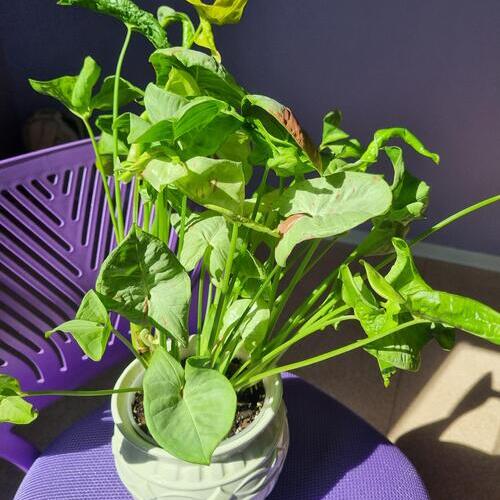
Syngonium podophyllum ‘Milk Confetti’ is a striking variegated cultivar of the widely grown arrowhead vine, a tropical aroid native to the rainforests of Central and South America. In the wild, Syngonium podophyllum climbs high into the forest canopy using aerial roots, changing leaf shape dramatically as it matures from a compact, arrow-shaped juvenile form into a lobed, multi-fingered adult form once it has something substantial to climb. ‘Milk Confetti’ is prized for retaining an especially soft, milky-green to near-white leaf base scattered with irregular flecks and splashes of soft pink, resembling confetti tossed across the foliage, a pattern distinct from the more solidly pink-marked ‘Confetti’ or ‘Pink Spot’ cultivars it is sometimes confused with.
Each leaf of ‘Milk Confetti’ is genuinely unique, since the pink speckling is the product of unstable variegation rather than a fixed, repeating pattern, meaning no two leaves and no two plants ever display quite the same combination of markings. New growth typically emerges with a soft pink or coppery blush before settling into its mature, pastel-mottled coloration. Unlike some variegated aroids, this cultivar is comparatively stable and does not readily revert to solid green, which has helped make it one of the most popular and widely available variegated Syngonium selections in cultivation today.
As a juvenile plant, ‘Milk Confetti’ has a naturally compact, mounding growth habit that later develops into a vining or climbing form as it matures, with stems capable of trailing attractively from a hanging basket or climbing a moss pole or trellis when given support. It is considered a fast grower relative to many other variegated houseplants, and its adaptability to a range of indoor light conditions, along with its comparatively easy care, has made it a favorite among both beginner and experienced houseplant collectors.
Syngonium ‘Milk Confetti’ is one of the more forgiving variegated houseplants, but because its pale, low-chlorophyll leaf tissue photosynthesizes less efficiently than solid green foliage, consistent bright, indirect light is the foundation of good care. A spot near an east- or west-facing window, filtered through a sheer curtain, or a few feet back from a bright south-facing window, allows the plant to maintain vigorous growth and vivid pink speckling without risking scorched or bleached leaves from harsh direct sun.
Watering on a let-it-dry-somewhat rhythm suits this plant well. Allowing the top inch or two of the potting mix to dry out between waterings, then watering thoroughly until liquid drains from the bottom of the pot, mimics the natural wet-and-dry cycle it experiences in the wild and helps prevent the soggy, oxygen-poor soil conditions that lead to root rot. A well-draining, chunky mix enriched with organic matter such as peat or coco coir, along with perlite or orchid bark for aeration, supports healthy root growth and reduces the risk of overwatering issues.
Beyond light and water, ‘Milk Confetti’ appreciates warm room temperatures, moderate to above-average humidity, and light monthly feeding during the growing season to fuel its naturally fast growth rate. It tolerates average household humidity reasonably well but will reward extra humidity with larger, glossier leaves and crisper variegation. Because it is toxic if ingested, place it thoughtfully in homes with curious pets or small children, and because its sap can irritate skin, handle pruning and propagation with a bit of care. With these fairly simple conditions met, this cultivar grows quickly and reliably, making it an excellent choice for growers who want a dramatic variegated plant without demanding, finicky care.
 Soil
Soil
Syngonium ‘Milk Confetti’ does best in a loose, well-draining potting mix rich in organic matter rather than a dense, water-retentive soil. A good blend combines a peat-based or coco-coir base with perlite or orchid bark for aeration and pine bark for structure, which allows the roots to access both moisture and oxygen. The ideal pH range is slightly acidic to neutral, roughly 5.5 to 7.0, which supports efficient nutrient uptake without locking out key micronutrients. Good drainage is essential, since this plant’s fine roots are vulnerable to rot in compacted or waterlogged media; the mix should feel light and crumbly and allow excess water to pass through quickly after watering. Amendments like horticultural charcoal can help keep the mix fresh between waterings, while a modest amount of worm castings or compost provides slow-release organic nutrition. Because soil structure directly governs moisture retention and root oxygenation, poor soil quality is one of the most common underlying causes of decline in this otherwise easy-care plant. Watch for common soil problems including poor drainage from mixes that are too dense or fine, compaction over time as organic matter breaks down, inappropriate pH that locks out iron and manganese and causes pale or yellowing new growth, salt build-up from tap water and fertilizer residue visible as a white crust on the soil surface, nutrient deficiencies once organic matter is depleted, and root boundness once the root mass fills the pot, all of which are addressed through periodic repotting and occasionally flushing the soil with plain water.
 Fertilizer
Feed Syngonium ‘Milk Confetti’ with a balanced, water-soluble liquid houseplant fertilizer, diluted to roughly half to quarter strength, about once a month during the active growing season of spring and summer, or use a slow-release granular fertilizer applied once in early spring for a more hands-off approach. Reduce or pause feeding entirely in fall and winter when growth naturally slows, since unused fertilizer salts can accumulate in the soil and stress the roots during dormancy. Signs of over-fertilization include a white crust on the soil surface, burned or browned leaf tips and margins, and wilting despite adequate watering, while under-fertilization typically shows as pale, small new leaves and noticeably slowed growth. Organic alternatives such as diluted fish emulsion, worm casting tea, or a light top-dressing of compost can supplement or replace synthetic fertilizer for growers who prefer a gentler approach. This species has no unusual nutrient requirements beyond typical aroid needs, though adequate magnesium and iron support healthy green tissue in the non-variegated portions of each leaf, so an occasional micronutrient supplement can help if leaves show interveinal yellowing.
 Watering
Water Syngonium ‘Milk Confetti’ when the top one to two inches of potting mix have dried out, then water thoroughly until liquid runs from the drainage holes, discarding any excess that collects in the saucer. Room-temperature filtered water, rainwater, or tap water left out for twenty-four hours to let chlorine dissipate is gentler on this plant than straight tap water, which can lead to mineral buildup over time. Signs of underwatering include drooping or curling leaves, dry and crispy leaf edges, and slowed growth, while signs of overwatering include yellowing lower leaves, mushy or blackened stems, a sour smell from the soil, and eventual root rot. During the active growing season in spring and summer, the plant dries out faster and may need water roughly every five to nine days depending on light, humidity, and pot size, while in fall and winter growth slows and watering can typically be reduced to every two to three weeks. Always check the soil with a finger or moisture meter rather than watering on a fixed schedule, since light levels, humidity, and pot material all affect how quickly the mix dries.
Stop guessing. Most houseplant failures are caused by volumetric errors and improper moisture tension. Our deterministic calculator moves beyond "once-a-week" watering by analyzing the four critical pillars of root health:
Personalized for this plant
Disclaimer: Our calculator is pretty smart. We’ve crunched the numbers, but we’re not measuring the quantum state of your living room. Since we don’t know your exact indoor temperature, humidity, light, airflow, or whether your plant receives daily sweet nothings and motivational speeches, use this calculator as a guide—and always keep an eye on your plant.
 Lighting
Syngonium ‘Milk Confetti’ thrives in bright, indirect light, which is essential for keeping its pale, low-chlorophyll variegation vivid and for sustaining its naturally fast growth rate. An east- or west-facing window filtered through a sheer curtain, or a spot a few feet back from a bright south-facing window, works well. The plant can tolerate medium or even fairly low light, but variegation will fade toward duller green and growth will slow considerably under these conditions. Signs of insufficient light include leggy, sparse stems reaching toward a light source, smaller new leaves, and a gradual dulling or loss of pink speckling. Signs of excessive or direct light include bleached, papery white patches especially on the palest leaf areas, and brown, crispy scorch marks along the leaf edges. If natural light is suboptimal, rotate the plant periodically for even growth, move it closer to a brighter window, or supplement with a full-spectrum LED grow light positioned six to twelve inches above the foliage for ten to twelve hours a day, particularly in winter or in low-light rooms.
 Temperature
This cultivar thrives in warm, consistent temperatures between roughly 60 and 85°F (15 to 29°C), with growth slowing noticeably below 60°F (15°C). As a plant of tropical rainforest origin, it has little tolerance for cold and should not be exposed to temperatures below about 50°F (10°C), which can cause chilling injury, blackened tissue, or leaf drop. It is also sensitive to sudden temperature swings and cold drafts from air conditioning vents, open windows, or exterior doors in winter. To protect it from temperature extremes, keep it away from drafty windows and heating or cooling vents, bring it indoors before nighttime temperatures drop in autumn if it has spent summer outdoors, and avoid placing it near frequently opened exterior doors during cold months.
 Humidity
Syngonium ‘Milk Confetti’ appreciates elevated humidity in the range of roughly 50 to 70 percent but is fairly adaptable and can tolerate average household humidity in the 40 percent range once established, since it is generally tougher than many other variegated aroids. Low humidity stress typically shows up as brown, crispy leaf edges and tips and slower unfurling of new leaves, while excessively high humidity combined with poor air circulation can encourage fungal or bacterial leaf spotting, since constantly damp foliage creates a favorable environment for pathogens. To raise humidity, group the plant with other tropical houseplants, place it on a pebble tray filled with water so evaporation surrounds the foliage without the roots sitting in water, or run a small room humidifier nearby. Of these methods, a humidifier provides the most effective and consistent increase in ambient humidity, while pebble trays offer a modest, localized boost; light misting can provide brief relief but should not replace ambient humidity control, since prolonged leaf wetness raises the risk of fungal issues in this species.
 Propagation
Syngonium ‘Milk Confetti’ propagates readily from stem cuttings, making it one of the easier variegated aroids to multiply at home. Step 1: Select a healthy stem section at least four to six inches long with one or more visible nodes and at least one leaf, since roots and new growth emerge only from nodal tissue. Step 2: Using clean, sharp, sterilized shears or a blade, cut just below a node. Step 3: Remove any leaves that would sit below the waterline or soil line to prevent rot. Step 4: Place the cutting in a clean container of water with the node submerged, or directly into a light, well-draining propagation mix such as perlite, sphagnum moss, or a standard aroid blend kept consistently moist. Step 5: Provide bright, indirect light and warmth around 70 to 80°F (21 to 27°C) to encourage steady root development. Step 6: If propagating in water, change the water every few days to keep it fresh and oxygenated; if propagating in soil or moss, keep the medium evenly moist but not soggy. Step 7: Watch for new root growth, which typically appears within two to four weeks, faster than in many other houseplants due to this species’ vigorous growth habit. Step 8: Once roots are one to two inches long, transplant a water-rooted cutting into potting mix, watering it in well and keeping humidity elevated for the first week or two to ease the transition. Both water propagation and direct soil or moss propagation have high success rates for this fast-growing species, though soil propagation tends to produce a sturdier root system from the start and avoids a second transplant shock. The best time to propagate is during the warm growing months of spring and summer, and new cuttings typically establish into an actively growing young plant within four to eight weeks.
 Potting
Choose a pot with ample drainage holes, in a material such as plastic, glazed ceramic, or terracotta, sized only slightly larger than the current root ball to avoid excess soil moisture around the roots. Repot Syngonium ‘Milk Confetti’ roughly once a year or once the plant has doubled in size, whichever comes first, since this fast grower depletes the nutrients and structure of its potting mix relatively quickly. Signs that repotting is needed include roots visibly circling the base or emerging from drainage holes, water running straight through the pot without being absorbed, and noticeably slowed growth despite otherwise good care. When repotting, gently loosen the root ball, trim away any mushy, blackened, or clearly dead roots with sterilized shears, and tease apart tightly circling roots so they can spread into the fresh mix. Use a well-draining, organically rich aroid blend as described in the soil section, and settle the plant at the same depth it was previously growing. To minimize transplant stress, repot during the active growing season, water thoroughly right after repotting, and keep the plant in slightly reduced light for a week or two afterward while it settles into its new container.
 Pruning
The best time to prune Syngonium ‘Milk Confetti’ is during the active growing season in spring or summer, when the plant recovers quickly and responds with vigorous new growth.
Because this cultivar grows quickly, it benefits from light, regular pruning every few months to maintain a full, bushy shape rather than becoming sparse and leggy.
Pruning is used to remove yellowing or damaged leaves, control legginess or trailing length, encourage fuller, bushier growth by prompting new branching, and to take healthy stem cuttings for propagation.
Use clean, sharp pruning shears or scissors, and sterilize the blade with rubbing alcohol before and between cuts to prevent spreading disease between plants; consider wearing light gloves since the sap can irritate skin.
Keep the plant in stable warmth, indirect light, and its usual watering routine following pruning; avoid fertilizing immediately after a heavy trim to let the plant recover first.
Wear gloves when pruning, since the sap contains irritating calcium oxalate crystals that can cause skin and eye irritation, and dispose of trimmings out of reach of pets and children given the plant’s toxicity.
 Blooming
Syngonium ‘Milk Confetti’ is grown for its ornamental foliage and rarely flowers indoors, since blooming typically requires the plant to reach full climbing maturity, a stage most houseplants never reach without a very tall support and years of vigorous growth. When mature specimens do flower in more favorable outdoor or greenhouse conditions, blooming tends to occur during the warm season and produces a typical aroid inflorescence: a pale green to white spathe surrounding a slender central spadix, lasting only a few days. Because the plant’s climbing juvenile-to-adult transition is slow to achieve indoors and its ornamental value rests entirely on its variegated leaves, most home growers will never see ‘Milk Confetti’ bloom, and this has no bearing on the plant’s health or care needs.
 Pests and Diseases
Name: Spider mites
Symptoms: Fine webbing on the undersides of leaves, tiny stippled yellow or bronze speckling across the leaf surface, and an overall dusty or dull appearance to the foliage.
Treatment: Isolate the plant, rinse foliage thoroughly under lukewarm running water, and treat with insecticidal soap or neem oil every seven to ten days until no signs remain, while raising humidity to discourage their return.
Name: Mealybugs
Symptoms: Small cottony white clusters in leaf axils and along stems, sticky honeydew residue on leaves, and sooty mold developing on that residue over time.
Treatment: Dab visible clusters with a cotton swab dipped in rubbing alcohol, then treat the whole plant with insecticidal soap or neem oil, repeating weekly for several weeks to catch newly hatched insects.
Name: Aphids
Symptoms: Small clustered insects, often green or black, on new growth and stem tips, along with distorted or curled new leaves and sticky honeydew residue.
Treatment: Rinse the plant with a strong stream of water to dislodge aphids, then treat with insecticidal soap or neem oil, repeating every five to seven days until the infestation clears.
Name: Root rot
Symptoms: Wilting or drooping despite moist soil, yellowing lower leaves, a foul odor from the soil, and mushy, blackened roots when the plant is removed from its pot.
Treatment: Remove the plant from its pot, trim away all rotten roots with sterilized shears, repot into fresh, well-draining mix in a clean pot, and reduce watering frequency going forward.
Name: Bacterial leaf spot
Symptoms: Small water-soaked lesions on leaves that darken and may develop a yellow halo, sometimes with a wet or greasy appearance, often worsened by wet foliage.
Treatment: Remove and discard affected leaves, avoid overhead watering or wetting the foliage, improve airflow around the plant, and apply a copper-based bactericide if the issue persists.
Name: Fungal leaf spot
Symptoms: Circular brown or tan spots on the leaf surface, sometimes with concentric rings, that can enlarge and merge over time, especially in high humidity with poor airflow.
Treatment: Remove affected leaves, avoid wetting foliage during watering, increase air circulation, and apply a fungicide labeled for houseplants if spotting continues to spread.
 Special Features
Syngonium ‘Milk Confetti’ stands out among variegated houseplants for its uniquely soft, milky-pastel coloration, with pale green to near-white leaves speckled in irregular flecks and splashes of blush pink that genuinely resemble scattered confetti. Because the variegation pattern arises from unstable genetic expression, every leaf is a one-of-a-kind combination of color and pattern, giving each plant an individual character that many collectors find especially appealing. Unlike some highly variegated cultivars prone to reverting to solid green, ‘Milk Confetti’ tends to hold its coloration well over time, making it a comparatively reliable choice for growers who want dramatic variegation without constant maintenance to preserve it. Its adaptable growth habit, thriving as a compact mounding plant when young and a trailing or climbing vine as it matures, adds further versatility, allowing it to be styled in a hanging basket, trained up a moss pole, or kept pruned into a full, bushy tabletop plant.
 Plant Benefits
Syngonium ‘Milk Confetti’ has no established herbal, medicinal, or pharmaceutical uses, and, like other Syngonium species, its tissue contains calcium oxalate crystals that make it unsuitable and unsafe for any form of ingestion or home remedy use. Its primary benefit is purely ornamental and psychological, contributing to indoor greenery that many people associate with reduced stress and a more calming, connected living space, though this is a general benefit of houseplants rather than a property specific to this cultivar.
 Additional Information
Syngonium ‘Milk Confetti’ is propagated commercially through stem cuttings and tissue culture, which helps preserve its distinctive milky-pink variegation more reliably than growing from seed would, since seed-grown offspring of a variegated cultivar rarely display the same coloration as the parent plant. It is often confused with the closely related ‘Confetti’ and ‘Pink Spot’ cultivars; ‘Milk Confetti’ is distinguished by its paler, milkier green leaf base and by white, pink-speckled sheaths where the petiole meets the stem. Because it is a relatively new and fast-multiplying cultivar, it has become widely available and affordably priced compared to many other collector-grade variegated aroids.
 Life Cycle
As a tropical evergreen perennial, Syngonium ‘Milk Confetti’ does not follow an annual life cycle or seasonal dormancy the way temperate plants do, but it does slow its growth during the shorter, cooler days of fall and winter and resumes vigorous leaf production in spring and summer. In its juvenile stage, which is how most houseplants are grown and sold, it produces compact, arrow-shaped leaves and a mounding habit; if given a moss pole or other support and allowed to climb over years of growth, it can transition into its adult form, producing larger, deeply lobed, multi-fingered leaves quite different in appearance from its youthful foliage. Individual leaves typically remain functional for one to two years before naturally yellowing and dropping as the plant redirects energy into new growth, and under favorable conditions a mature, well-supported specimen may eventually reach reproductive maturity capable of flowering, though this is rare in home cultivation.
 Are Syngonium Milk Confetti Poisonous, Toxic
Syngonium podophyllum, including the ‘Milk Confetti’ cultivar, contains insoluble calcium oxalate crystals throughout its leaves, stems, and sap, and is classified as toxic to cats, dogs, and children if chewed or ingested. When plant tissue is bitten into, these needle-shaped crystals penetrate the soft tissue of the mouth and throat, triggering immediate oral pain, intense burning, and swelling of the lips, tongue, and throat. Common symptoms include excessive drooling, pawing at the mouth in pets, difficulty swallowing, vomiting, and, in more significant exposures, breathing difficulty if swelling becomes severe. Contact with the sap can also cause skin and eye irritation. Severity is generally mild to moderate, and fatalities are rare, but the reaction is genuinely painful and distressing. If ingestion occurs, rinse the mouth with cool water or milk, wipe away visible plant material, offer a small amount of a cool drink or dairy to ease irritation, and contact a veterinarian, pediatrician, or poison control center promptly, especially if swelling or breathing changes appear. To prevent exposure, keep the plant on a high shelf, in a hanging basket out of reach, or in a room inaccessible to pets and young children, and promptly clean up any dropped or trimmed leaf debris.
 Frequently Asked Questions
 Can I grow Syngonium Milk Confetti in my indoor space
Difficulty: Easy
Size: Small
Light: Medium
Water: Medium
Flowering: Yes
Pet Safe: No
Air Purifier: Low
 Syngonium podophyllum 'Milk Confetti' botanical details
Common Name: Syngonium Milk Confetti
Other Common Names: Milk Confetti Arrowhead, Milk Confetti Arrowhead Vine, Syngonium 'Milk Confetti', Arrowhead Vine, African Evergreen, American Evergreen, Goosefoot Plant
Botanical Name: Syngonium podophyllum 'Milk Confetti'
Native Area: Tropical rainforests of Central and South America, from southern Mexico through much of tropical South America, where the parent species Syngonium podophyllum grows as a climbing understory vine
Family Name: Araceae
Plant Type: Evergreen tropical perennial vine; climbing or trailing aroid
Genus: Syngonium
Kingdom: Plantae
 Photo Gallery
 My Syngonium Milk Confetti Plant Care Recommendations
If you find the Houseplant Encyclopedia helpful and would like to support Healthy Houseplants, you can use the links below to shop for recommended plants, products, and plant-care supplies.
Some links are affiliate links, which means I may earn a small commission if you make a qualifying purchase through them, at no additional cost to you. Thank you for supporting Healthy Houseplants and helping me continue to provide free plant-care information!

Want even more personalized plant-care help? Check out my AI Julie Chatbot—trained on my 20 years of houseplant knowledge, not just information from the internet!  Try it now:Ask AI Julie
 Buy Syngonium Milk Confetti Online
✅ “Bring Home This Beauty Today”
✅ “Get Your Own Syngonium Milk Confetti Before It’s Gone”
✅ “Shop Trusted Sellers – Limited Availability”
✅ “Free Delivery”

As an Amazon Associate, I earn commission from qualifying purchases.
 Plant Puns and Jokes
Why did the Syngonium ‘Milk Confetti’ get invited to every party? Because it already showed up dressed in confetti, ready to celebrate on every single leaf.
 Signup to our newsletter and download Syngonium Milk Confetti care guide

