


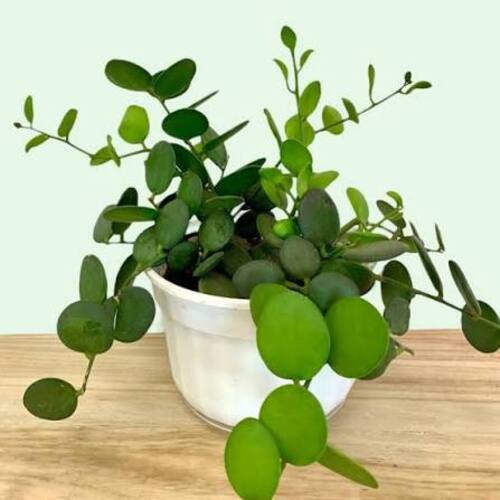
Xerosicyos danguyi, commonly known as the Silver Dollar Vine, is a distinctive and charming succulent climbing vine native to the dry, rocky, deciduous forests and scrubland of southwestern Madagascar. It belongs to the Cucurbitaceae family — the same botanical family that includes cucumbers, melons, squash, and gourds — making it a rare and unusual succulent representative of a family otherwise dominated by soft-stemmed, fast-growing annual vines. In its native Madagascan habitat, Xerosicyos danguyi has adapted to survive extended seasonal drought and intense sun exposure through succulent water-storing tissues in its leaves and stems, along with a vigorous climbing habit that allows it to scramble over rocks and through the sparse, thorny vegetation of its dry forest environment in search of light.
The most immediately charming and distinctive feature of Xerosicyos danguyi is its foliage: nearly perfectly circular, thick, succulent leaves measuring 1–2.5 inches (2.5–6 cm) in diameter, held on slender petioles that radiate outward from twining stems in a pattern reminiscent of scattered silver coins — the origin of the enchanting common name Silver Dollar Vine. The leaves are a pale, silvery sage-green to grey-green, with a smooth, slightly glaucous (waxy, matte) surface that helps reflect intense sunlight and reduce water loss through transpiration, a classic adaptation among succulents native to sun-exposed habitats. The near-perfect circularity of the leaves, combined with their pale, coin-like colouring, gives the plant an almost whimsical, decorative quality that has made it an increasingly popular choice among succulent and unusual-plant collectors.
As a climbing vine, Xerosicyos danguyi produces slender, wiry stems equipped with simple, unbranched, thread-like tendrils that emerge from the leaf axils and allow the plant to grip and climb any available support — trellises, moss poles, wire frames, or neighbouring plants. Left unsupported, the plant will trail attractively from a hanging basket or high shelf, its long stems cascading downward while still displaying the same charming circular leaves along their length. Given a support structure to climb, it can reach considerable lengths of 6–10 feet (1.8–3 metres) or more over several years of vigorous growth. This dual capacity for both climbing and trailing display, combined with its extreme drought tolerance, low maintenance requirements, and genuinely charming, conversation-starting foliage, has established Xerosicyos danguyi as a beloved and increasingly sought-after addition to succulent and unusual houseplant collections worldwide.
Caring for Xerosicyos danguyi is a straightforward and highly rewarding experience that makes it an excellent choice for succulent enthusiasts and beginners alike who want to branch beyond the standard rosette succulents into something more unusual and characterful. Its fundamental care requirements mirror the conditions of its native Madagascan dry forest habitat: maximum available bright light, highly conservative watering following a strict drought-tolerant regime, excellent drainage, and warm temperatures. When these core conditions are consistently provided, the Silver Dollar Vine grows steadily, developing its charming coin-shaped foliage along ever-lengthening climbing or trailing stems.
The single most important care principle for Xerosicyos danguyi is strict adherence to a ‘soak and dry’ watering regime, exactly as would be applied to any other succulent from an arid or seasonally dry habitat. The plant’s thick, water-storing leaves and stems allow it to withstand extended periods of drought far better than almost any excess soil moisture, and overwatering — leading to root and stem rot — is by a significant margin the most common cause of decline and death in cultivation. Water thoroughly only when the soil has dried out completely throughout the pot, then withhold water until the soil is fully dry again before the next watering. This typically translates to watering every 2–3 weeks in the active growing season and considerably less often — sometimes once a month or less — during autumn and winter.
Providing adequate support for climbing and ensuring maximum available bright light are the other two pillars of excellent Silver Dollar Vine care. While the plant will trail attractively without support, providing a small trellis, moss pole, or wire hoop allows it to display its full climbing habit and encourages denser, more vigorous foliage production as the vine seeks out light while climbing. This is a genuinely high-light species that performs best with several hours of direct sun daily or very bright indirect light — insufficient light causes the characteristic circular leaves to become smaller, more widely spaced, and less vividly silvery, while etiolating the vining stems into thin, weak growth. With bright light, a well-draining gritty succulent mix, and a disciplined drought-tolerant watering schedule, Xerosicyos danguyi rewards its keeper with years of charming, low-maintenance, genuinely unusual foliage display.
 Soil
Soil
Xerosicyos danguyi requires an extremely well-draining, gritty, low-fertility potting medium that closely replicates the rocky, fast-draining substrates of its native Madagascan dry forest habitat. As with virtually all succulents adapted to arid or seasonally dry environments, the speed and completeness of drainage is the single most important characteristic of the growing medium, far outweighing considerations of organic richness or moisture retention.
The ideal potting medium consists of 50–60% coarse perlite, pumice, or horticultural grit combined with 40–50% quality cactus and succulent potting mix. Alternatively, a 50/50 blend of coarse sharp sand and standard cactus mix provides excellent drainage characteristics. The mix should feel loose and gritty, allowing water to pass through almost instantaneously upon application.
Optimal soil pH is between 6.0 and 7.0 (mildly acidic to neutral). This range supports adequate nutrient availability without promoting the pathogen activity that thrives in more acidic, organically rich conditions. Xerosicyos danguyi is relatively tolerant of a range of pH conditions provided drainage is excellent.
Drainage is the single most critical soil characteristic for this species. The roots of Xerosicyos danguyi, like those of most succulents from seasonally dry habitats, are highly susceptible to rot in persistently moist conditions. The medium must drain completely within moments of watering and dry out fully between waterings.
Horticultural charcoal added at 5–10% by volume helps maintain a clean, aerobic root environment and inhibits anaerobic bacterial and fungal activity. A thin top-dressing layer of coarse grit or decorative gravel over the soil surface helps prevent soil splash and moisture accumulation at the base of the stems.
The most serious and common problem for Xerosicyos danguyi. Persistently moist or waterlogged soil causes rapid root and stem base rot. Symptoms include yellowing or blackening at the stem base, soft mushy tissue, and a foul soil odour. Immediate repotting into fresh, gritty, well-draining medium is the only effective response.
Fine organic components of the potting mix break down and compact over time, reducing drainage and aeration. Signs include water pooling on the surface and slower recovery between waterings. Repot into fresh gritty mix every 2–3 years.
Alkaline soil above pH 7.5, often caused by hard tap water, can cause nutrient lock-out and mild chlorosis. Use filtered water or rainwater periodically and check soil pH occasionally if growth seems poor despite good care.
Accumulation of mineral salts from tap water and synthetic fertilizers manifests as white crusty deposits on the soil surface and pot rim. Flush the soil thoroughly with clean water every 2–3 months and apply fertilizer at reduced strength.
Xerosicyos danguyi is a low-nutrient-demand species, and true deficiency is uncommon in regularly repotted plants. Pale, less vividly silvery leaf colouring in actively growing specimens may occasionally indicate mild nutrient depletion, addressed with light fertilization during the growing season.
This species tolerates and even benefits from being mildly root-bound, as root restriction helps moderate growth and reduce overwatering risk. Repot only when roots are visibly emerging from drainage holes or growth has notably stalled.
 Fertilizer
Xerosicyos danguyi is a low-nutrient-demand species that requires only light, infrequent fertilization during its active growing season. As with most succulents adapted to nutrient-poor, rocky native substrates, overfertilization poses a greater practical risk than underfertilization, producing weak, uncharacteristically soft growth and increasing susceptibility to rot and pest issues.
A balanced, water-soluble cactus and succulent fertilizer with an NPK ratio of approximately 5-10-5 or similar low-nitrogen formula, diluted to one-quarter of the label-recommended strength, is ideal. Low-nitrogen formulas help maintain the plant’s naturally compact, firm growth habit rather than promoting soft, rapid, rot-prone tissue.
Apply dilute fertilizer once per month during the active growing season (April through September). Withhold all fertilization from October through March during the winter rest period.
Always water the plant thoroughly before applying dilute fertilizer to prevent root burn on dry roots. Apply the diluted solution evenly to the soil surface. Never apply fertilizer to a newly repotted, drought-stressed, or pest-affected plant.
Unusually soft, pale, rapidly elongating growth that lacks the characteristic firmness of healthy Silver Dollar Vine tissue; white salt crust on the soil surface; leaf tip or margin browning; increased susceptibility to stem rot.
Pale, washed-out leaf colouring; very slow growth during the active growing season in a plant that has not been repotted for several years; smaller than expected leaf size on new growth.
A light application of worm castings worked gently into the top of the potting mix at the beginning of the growing season provides a gentle, slow-release nutrient source with minimal burn risk. Diluted liquid seaweed extract applied once or twice during the growing season supports micronutrient availability without promoting excessive soft growth.
Phosphorus and potassium support the structural integrity and drought resilience of Xerosicyos danguyi more effectively than high nitrogen, which tends to produce soft, rot-prone growth. Favour low-nitrogen, balanced cactus and succulent formulas over general-purpose high-nitrogen fertilizers.
 Watering
Xerosicyos danguyi requires a strictly conservative, drought-tolerant ‘soak and dry’ watering approach identical in principle to that used for cacti and other arid-adapted succulents. The plant’s thick, water-storing leaves and stems allow it to withstand extended dry periods with ease, while persistent soil moisture rapidly causes fatal root and stem rot. Water thoroughly until water drains freely from the pot’s drainage holes, then withhold all further water until the soil has dried out completely throughout the pot depth.
Spring and summer (active growth): water every 2–3 weeks, always confirming complete soil dryness before the next watering. Autumn and winter (rest period): water every 4–6 weeks at most, or withhold entirely during particularly cool, low-light periods. When in doubt, always err toward underwatering rather than overwatering with this species.
Xerosicyos danguyi is moderately tolerant of standard tap water but performs best with filtered water or rainwater, which avoids the gradual mineral salt accumulation associated with hard tap water. If using tap water, allowing it to stand overnight to off-gas chlorine is a reasonable precaution.
Slight softening, wrinkling, or puckering of the normally plump, firm circular leaves; leaves feeling less turgid when gently pressed. These symptoms resolve promptly after thorough watering and are far less concerning than any sign of overwatering.
Yellowing or blackening at the base of the stems; soft, mushy, collapsing stem tissue; a foul odour from the soil; leaves dropping unusually easily or appearing swollen and translucent; fungus gnats around the soil surface. These symptoms indicate serious and potentially fatal root or stem rot requiring immediate intervention.
During winter and in cool, low-light conditions below 60°F (15°C), the plant’s metabolic activity slows dramatically and its water requirements fall correspondingly. Reduce watering to the absolute minimum during this period — once every 4–6 weeks or even less — and never water a cold, dormant plant, as cold combined with wet soil dramatically accelerates rot risk.
Stop guessing. Most houseplant failures are caused by volumetric errors and improper moisture tension. Our deterministic calculator moves beyond "once-a-week" watering by analyzing the four critical pillars of root health:
Personalized for this plant
Disclaimer: Our calculator is pretty smart. We’ve crunched the numbers, but we’re not measuring the quantum state of your living room. Since we don’t know your exact indoor temperature, humidity, light, airflow, or whether your plant receives daily sweet nothings and motivational speeches, use this calculator as a guide—and always keep an eye on your plant.
 Lighting
Xerosicyos danguyi is a high-light species that thrives in the brightest available indoor location, ideally receiving several hours of direct sun daily combined with bright ambient light throughout the day. Light intensity of 1,500–3,000 foot-candles supports the most compact, vigorous growth and the richest silvery colouring of the circular leaves. A south- or west-facing windowsill is the ideal indoor position, and the plant also performs excellently outdoors in bright, sun-exposed positions during frost-free periods.
While Xerosicyos danguyi will survive in medium indirect light (500–1,000 foot-candles), growth slows considerably, the characteristic circular leaves become smaller and more widely spaced along the stem, and the vine’s climbing vigour diminishes noticeably. It is considerably less shade-tolerant than many popular succulent houseplants and performs best with generous direct sun exposure.
Etiolated, elongated stem growth with unusually wide spacing between leaves; smaller, less circular, less silvery leaves; weak, thin climbing stems that struggle to support their own weight; slow or stalled overall growth.
In very intense, prolonged direct sun — particularly through heat-magnifying glass during summer — the leaves may occasionally develop minor bleached or scorched patches, though this species is considerably more sun-tolerant than most houseplants and sun damage is uncommon compared to the far more frequent problem of insufficient light.
If natural bright light is insufficient, supplement with a high-output full-spectrum LED grow light providing 1,500–2,500 foot-candles, running 12–14 hours per day at a distance of 12–18 inches. When transitioning an indoor-grown plant to outdoor direct sun, acclimatise gradually over 1–2 weeks by starting in partial shade and progressively increasing sun exposure to avoid sudden sunscald on tissue unaccustomed to intense direct light.
 Temperature
Xerosicyos danguyi thrives at temperatures between 65°F and 85°F (18°C–29°C). This range reflects the warm, seasonally dry conditions of its native Madagascan habitat and is comfortably within the range of most indoor environments throughout the year.
This species is cold-sensitive and should not be exposed to temperatures below 50°F (10°C) for extended periods. Brief exposure to temperatures around 45–50°F (7–10°C) may be tolerated by a healthy, dry plant, but frost exposure is fatal. Temperatures below 40°F (4°C) will cause irreversible cold damage, manifesting as blackened, water-soaked, or collapsed leaf and stem tissue.
The plant handles high temperatures very well, tolerating up to 95°F (35°C) or more without significant stress, provided it is not simultaneously overwatered during heat spells. Its native dry forest habitat regularly experiences intense heat, and Xerosicyos danguyi is well-adapted to warm, sun-exposed conditions.
This species tolerates moderate temperature fluctuations reasonably well, provided temperatures remain within the safe range and the plant is kept dry during any cold exposure. Sudden cold snaps combined with moist soil pose the greatest risk to this species.
In regions with cold winters, bring outdoor-grown or summered specimens indoors before temperatures drop below 50°F (10°C). Keep indoor plants away from cold, draughty windows and exterior doors during winter. Ensure the plant is on the dry side heading into any period of cooler temperatures to minimise cold-and-wet rot risk.
 Humidity
Xerosicyos danguyi is native to a seasonally dry, low-humidity environment and is well-adapted to and comfortable with low to average indoor humidity levels of 20–50%. It requires no humidity supplementation whatsoever and performs excellently in the dry air typical of centrally heated homes during winter, making it a particularly convenient and forgiving choice for dry indoor climates.
This species does not display significant stress symptoms at low humidity levels within normal indoor ranges. Even very low humidity (10–20%) sustained over extended periods does not typically cause visible stress in healthy, well-watered specimens.
Ambient humidity above 70–80%, particularly combined with poor air circulation and cool temperatures, increases the risk of fungal diseases developing on the succulent leaf and stem tissue. Watch for soft, water-soaked patches or grey mould growth in excessively humid, stagnant conditions.
Not recommended or necessary for this species. Running a humidifier near Xerosicyos danguyi provides no benefit and may unnecessarily increase disease risk.
Misting is not recommended for this species. Water sitting on the succulent leaf surface in low-airflow conditions can encourage fungal spotting and is entirely unnecessary given the plant’s adaptation to dry conditions.
Not necessary or beneficial for this drought-adapted species.
If the plant is grown in a naturally humid environment such as a greenhouse or tropical climate, ensure excellent air circulation with fans, water very conservatively, and provide the most well-draining potting medium possible to offset the ambient moisture.
 Propagation
Xerosicyos danguyi propagates readily and reliably from stem cuttings, making it a straightforward and rewarding plant to multiply at home. As with most succulents, allowing the cut end to callous thoroughly before any soil contact is essential to prevent rot and ensure successful rooting. The best time to propagate is spring through summer when warm temperatures maximise rooting speed.
Always allow the cut end of any stem cutting to dry and form a firm callous for a minimum of 3–7 days before inserting into soil or rooting medium. Skipping or rushing this step is the primary cause of propagation failure in this species.
Success Rate: High (75–90%) when correctly calloused
Description: The standard and most reliable propagation method for Xerosicyos danguyi. Sections of healthy vine containing at least one node readily produce roots and new growth.
Steps:
Spring through summer (April–August) when warm temperatures above 70°F (21°C) accelerate both callousing and root development. Propagation in autumn and winter is possible but proceeds considerably more slowly due to cooler temperatures and reduced light.
Under optimal warm conditions, cuttings typically develop sufficient roots to sustain independent growth within 3–5 weeks, with visible new leaf growth confirming establishment within 6–8 weeks.
 Potting
Terracotta pots are strongly preferred for Xerosicyos danguyi, as their porous walls allow excess soil moisture to evaporate effectively, significantly reducing root and stem rot risk. For a climbing display, a pot with an integrated trellis or the addition of a small moss pole or wire hoop allows the vine to showcase its natural climbing habit. For a trailing display, a hanging basket allows the vine’s long stems to cascade attractively. Plastic pots retain moisture for longer and are less ideal for this drought-adapted species unless watering is carefully managed.
Drainage holes are absolutely mandatory. A layer of coarse perlite or grit at the base of the pot provides an additional buffer against moisture pooling at the root zone. Never allow the pot to sit in a saucer holding standing water.
Choose a pot only 1–2 inches larger in diameter than the current root ball. Xerosicyos danguyi tolerates and even benefits from mild root restriction, and an oversized pot holds excess moist soil relative to root volume, meaningfully increasing rot risk.
Every 2–3 years in spring, or when roots are visibly emerging from drainage holes or the plant has become notably unstable in its container. This species does not require frequent repotting.
Roots circling densely at the base of the pot or emerging from drainage holes; soil drying out unusually rapidly after watering; visibly stunted growth despite adequate light and seasonal fertilization; the plant becoming unstable or top-heavy in its current pot, particularly if trained on a climbing support.
Allow the soil to dry completely for 1–2 weeks before repotting to firm the root ball and simplify handling. Gently remove the plant from its pot, shake off old soil, and inspect the roots, trimming any dead or damaged roots with sterile scissors. Allow any cut root surfaces to air-dry briefly. Repot into fresh, gritty cactus and succulent mix in the new pot, positioning the plant at the same depth as previously. Withhold water for 5–7 days after repotting to allow any root disturbance to callous.
Root pruning is not routinely required for this species. If severely root-bound, simply step up to the next appropriate pot size with fresh gritty mix rather than pruning roots.
After repotting, keep the plant in bright but indirect light for 1–2 weeks rather than intense direct sun, and withhold water during this period to allow the root system to settle and any minor wounds to heal before resuming standard care.
 Pruning
Xerosicyos danguyi requires minimal routine pruning, as its natural climbing or trailing growth habit produces an attractive form without significant intervention. Pruning is performed primarily to control the overall length of the vine, remove damaged or etiolated stem sections, encourage bushier branching, and collect healthy cuttings for propagation. Given the plant’s succulent, moisture-storing tissue, all pruning tools and technique should prioritise clean, decisive cuts that minimise tissue damage and promote rapid callousing.
Prune in spring or early summer as the plant enters its active growing season, ensuring the fastest recovery and regrowth from cut points. Removal of individual damaged or etiolated stems can be performed at any time of year as needed.
Light trimming and tip-pinching once or twice per year is generally sufficient to maintain a full, well-branched form. More frequent trimming may be desired for actively climbing specimens that are outgrowing their designated support structure.
Control of overall vine length, particularly for climbing specimens that have outgrown their support; removal of etiolated, weak, or damaged stem sections; stimulation of bushier branching through tip-pinching; collection of healthy stem cuttings for propagation; general tidying of the plant’s form.
Clean, sharp scissors or small bypass pruning shears sterilized with 70% isopropyl alcohol before use. No special protective equipment is required given the plant’s very low toxicity, though washing hands after handling is always good general practice.
Monitor the plant over the following 2–4 weeks for new growth emerging from pruned points, confirming successful response to the pruning. Maintain the plant’s standard bright light and conservative watering regime during this recovery period. No special aftercare beyond standard care practices is required.
Xerosicyos danguyi tolerates pruning well and recovers quickly given its vigorous growth habit and low toxicity profile means minimal handling precautions are needed compared to many other popular succulents and houseplants. Avoid heavy pruning during the cooler, slower-growing autumn and winter months, as recovery and regrowth will be considerably slower during this period.
 Blooming
Xerosicyos danguyi produces small, inconspicuous flowers typical of the Cucurbitaceae family, though flowering is an uncommon and often overlooked event in indoor cultivation. The plant is dioecious — meaning individual plants bear either male or female flowers but not both — which is itself a botanically interesting characteristic shared with other members of the cucumber and squash family. When flowering does occur, it typically takes place in summer under conditions of intense light, warmth, and the plant’s general good health and maturity. The flowers are small, pale yellowish-green, star-shaped, and produced singly or in small clusters at the leaf axils, following the classic five-petaled structure common to Cucurbitaceae flowers, though considerably smaller and less showy than the flowers of cultivated cucumbers or squash.
Because the plant is dioecious, successful pollination and subsequent fruit production requires the presence of both a male and a female specimen in proximity, along with an effective pollinating agent (insects outdoors, or hand-pollination indoors). When pollination is successful, the plant produces small, oblong, gourd-like fruits characteristic of its cucumber family relatives, though these are rarely seen in typical indoor cultivation where solitary specimens are the norm. For the vast majority of indoor growers, Xerosicyos danguyi is grown exclusively for its charming circular succulent foliage, with flowering considered a rare curiosity rather than an expected or actively pursued display. No special intervention is required or recommended to encourage flowering in typical home cultivation.
 Pests and Diseases
Name: Mealybugs (Pseudococcus spp.)
Symptoms: White, cottony, waxy clusters at leaf axils, along the stems, and where tendrils meet the main vine; sticky honeydew residue on leaves and stems; sooty black mould developing on honeydew deposits; distorted or stunted new growth.
Treatment: Isolate the affected plant immediately. Remove visible mealybug clusters with a cotton swab or soft cloth soaked in 70% isopropyl alcohol. Spray the entire plant thoroughly with neem oil solution or insecticidal soap, paying particular attention to leaf axils and stem joints. For severe infestations, apply a systemic insecticide (imidacloprid) as a soil drench. Repeat contact treatment every 5–7 days for 3–4 cycles.
Name: Spider Mites (Tetranychus urticae)
Symptoms: Fine webbing between leaves and stems; tiny moving specks visible on leaf undersides under magnification; stippled, pale, or bronzed discolouration on the leaf surface; most common in hot, dry conditions with inadequate air circulation.
Treatment: Wipe leaf surfaces with a damp cloth to physically remove mites and webbing. Spray thoroughly with neem oil solution, insecticidal soap, or diluted 70% isopropyl alcohol (1:1 with water). Repeat every 5–7 days for 3–4 treatment cycles. Improve air circulation around the plant as a preventive measure.
Name: Scale Insects (Coccidae / Diaspididae)
Symptoms: Small, flat, brownish or yellowish shell-like bumps adhered to stems and the undersides of leaves; sticky honeydew deposits; progressive yellowing and weakening of affected growth.
Treatment: Physically scrape scale from stems and leaves using a soft toothbrush or cotton swab dipped in isopropyl alcohol. Apply neem oil or horticultural oil spray to smother remaining juvenile crawlers. Systemic insecticide soil drench for heavier infestations.
Name: Fungus Gnats (Bradysia spp.)
Symptoms: Small dark flies hovering around the soil surface; larvae visible in the top layer of moist soil; typically indicates soil that has been kept too consistently moist for this drought-tolerant species.
Treatment: Allow the soil to dry completely between waterings — this alone typically resolves fungus gnat infestations, as the larvae cannot survive in the dry, gritty medium this species requires. Apply a layer of coarse sand over the soil surface as an additional deterrent. Use yellow sticky traps to monitor and reduce adult populations.
Name: Root and Stem Rot (Pythium spp., Phytophthora spp., Fusarium spp.)
Symptoms: Soft, blackened, mushy tissue at the base of the stems; yellowing and wilting of leaves despite moist soil; a foul odour from the soil; roots appearing dark, mushy, and malodorous on inspection; sudden plant collapse in advanced cases. This is by far the most serious and common health issue affecting Xerosicyos danguyi and is almost always the result of overwatering or poor drainage.
Treatment: Remove the plant from its pot immediately and inspect the root and stem base. Trim all rotted, mushy, or discoloured tissue with sterile scissors until only firm, healthy tissue remains. Allow the cut surfaces to air-dry for several hours. Dust with powdered cinnamon or sulphur. Repot into completely fresh, dry, gritty succulent mix. Withhold watering for 7–10 days after repotting. If rot has progressed extensively up the main stem, take healthy cuttings from unaffected upper growth and propagate fresh plants rather than attempting to save a severely compromised specimen.
Name: Fungal Leaf Spot
Symptoms: Circular to irregular brown or tan spots on the leaf surface, sometimes with a darker margin; more common in overly humid or poorly ventilated growing conditions, which are atypical for the dry conditions this species prefers.
Treatment: Remove affected leaves promptly. Ensure the plant is in adequately bright, well-ventilated conditions consistent with its drought-adapted nature. Apply a dilute neem oil solution or copper-based fungicide if the condition persists or spreads.
Name: Powdery Mildew (Erysiphales)
Symptoms: A powdery white-grey coating on the leaf surface, typically beginning as small discrete patches that expand over time; more common in humid, poorly ventilated conditions atypical for this dry-adapted species.
Treatment: Improve air circulation immediately. Reduce ambient humidity if excessive. Apply a dilute sulphur-based fungicide or neem oil spray to affected surfaces. Remove heavily affected leaves.
 Special Features
Xerosicyos danguyi possesses one of the most whimsically charming foliage forms in the entire succulent world — its nearly perfectly circular, pale silvery-green leaves scattered along twining vine stems create an effect genuinely reminiscent of scattered silver coins, an aesthetic quality so distinctive that it has captured a devoted following among succulent enthusiasts and unusual plant collectors alike. As one of the very few succulent representatives of the otherwise soft-stemmed Cucurbitaceae family — the botanical family of cucumbers, melons, and squash — it represents a genuinely unusual and conversation-worthy botanical curiosity, illustrating the remarkable evolutionary adaptability of plant families to extreme environmental pressures. Its dual capacity to be grown as either a climbing vine on a small trellis or moss pole, or as a trailing plant cascading from a hanging basket or high shelf, gives it exceptional versatility in interior display applications rarely matched by other succulents of comparable ease of care. The plant’s genuine drought tolerance, generally low toxicity profile, tolerance of low indoor humidity, and straightforward propagation from stem cuttings make it a practically ideal choice for beginner succulent collectors seeking something more visually distinctive than the standard rosette-forming Echeveria or Haworthia varieties that dominate typical succulent displays. Its dioecious flowering habit — producing either male or female flowers on separate individual plants — adds a further layer of botanical interest for growers curious about the reproductive biology underlying its charming, coin-like foliage.
 Plant Benefits
Xerosicyos danguyi is not a documented edible or medicinal plant in mainstream botanical, pharmacological, or ethnobotanical literature, and no significant herbal or pharmaceutical applications have been identified for this species. Unlike some of its edible Cucurbitaceae relatives such as cucumbers and squash, Xerosicyos danguyi has not been developed or investigated as a food or medicinal crop, likely due to its specialised succulent adaptation and relatively limited native range in southwestern Madagascar. The plant’s primary benefits to its human keepers are aesthetic, psychological, and practical. Its generally low toxicity profile provides valuable peace of mind for pet-owning households seeking attractive but reassuringly safe succulent options. The well-documented psychological and stress-reducing benefits of living with houseplants apply readily to this species, and its distinctive, whimsical, coin-shaped foliage provides an ongoing source of visual delight and conversation that distinguishes it from more commonly encountered succulent forms. Its low-maintenance, drought-tolerant nature makes it an excellent choice for supporting a positive, low-stress plant-keeping relationship, particularly for owners who travel frequently or are new to succulent care.
 Additional Information
Xerosicyos danguyi belongs to the small genus Xerosicyos, which comprises only a handful of species, all endemic to Madagascar and all adapted to dry, seasonally arid habitats — a notable botanical rarity within the predominantly soft-stemmed, moisture-loving Cucurbitaceae family. The genus name Xerosicyos derives from the Greek xeros (dry) and sikyos (cucumber), directly referencing its status as a drought-adapted member of the cucumber family. The species epithet danguyi honours the French botanist René Vigué Danguy, who contributed to the botanical documentation of Madagascan flora in the early 20th century. Xerosicyos danguyi is sometimes confused in casual conversation with other unrelated succulent plants bearing similar common names referencing coins or silver dollars, such as Crassula ovata (Jade Plant, sometimes called the Money Plant) or Pilea peperomioides (Chinese Money Plant) — these are entirely different species from different plant families with distinct care requirements, and care information should not be conflated between them. As with many Madagascan endemic species, Xerosicyos danguyi faces conservation pressure from habitat loss in its native range due to agricultural expansion and deforestation, adding a layer of ecological significance to its cultivation and conservation in horticultural collections worldwide.
 Life Cycle
Xerosicyos danguyi is a long-lived perennial succulent vine that experiences a modest degree of seasonal growth variation reflecting the wet and dry seasons of its native Madagascan habitat, though it does not enter a true, complete dormancy as some other succulents do. In cultivation, growth slows noticeably during the cooler, lower-light months of autumn and winter, and resumes vigorously in spring as light and warmth increase. New growth emerges from the tips of existing stems and from nodes along the vine, with new circular leaves unfurling progressively as the stem extends. Slender, thread-like tendrils emerge from the leaf axils on actively growing stems, allowing the plant to grip and climb any available support as it seeks light in its natural rocky, scrubland habitat. Over several years of good care, the vine can extend to 6–10 feet (1.8–3 metres) or more, developing an increasingly dense and characterful branching structure. As a dioecious species, individual plants produce either male or female flowers, with successful fruiting requiring the presence of both sexes and effective pollination — a relatively rare occurrence in typical solitary indoor cultivation. Xerosicyos danguyi is an essentially indefinite-lived perennial under good care, with well-maintained specimens continuing to grow and produce their charming coin-shaped foliage for many years.
 Are Silver Dollar Vine Poisonous, Toxic
Xerosicyos danguyi is generally considered non-toxic or of very low toxicity to cats, dogs, and humans. It does not appear on major toxic plant databases such as the ASPCA’s list of plants toxic to cats and dogs, and no significant toxicity concerns have been documented for this species. This makes it one of the more reassuring succulent choices for households with curious pets, though as with any plant, moderation and common sense regarding ingestion are always advisable.
No parts of the plant are documented as significantly toxic. As a member of the Cucurbitaceae family (which includes edible cucumbers, melons, and squash), Xerosicyos danguyi does not contain the calcium oxalate crystals or other common toxic compounds found in many popular houseplant families such as Araceae.
No significant toxicity symptoms are expected from incidental ingestion of small quantities of leaf or stem material. As with any plant matter, ingestion of unusually large quantities may cause mild, non-specific gastrointestinal upset (nausea, mild digestive discomfort) in sensitive animals or children, though this is a general response to consuming unfamiliar plant fibre rather than a sign of true toxicity.
Very Low. Not considered a significant toxicity risk for typical household exposure to pets or children.
No specific first aid is required for normal handling or incidental leaf contact. If a pet or child consumes a large quantity of plant material and displays unusual symptoms such as persistent vomiting or lethargy, contact a veterinarian or Poison Control as a general precaution.
No specific preventive measures are required for this low-toxicity species. As general good practice, discourage pets from regularly chewing on any houseplant, as excessive consumption of any plant fibre can cause digestive upset regardless of specific toxicity.
 Frequently Asked Questions
Water your Silver Dollar Vine only when the soil has dried out completely throughout the pot — approximately every 2–3 weeks in spring and summer, and every 4–6 weeks or less in autumn and winter. Water thoroughly until it drains from the drainage holes, then withhold water until fully dry again. This species is far more tolerant of drought than of overwatering, and root or stem rot from excess moisture is the leading cause of decline.
No, Xerosicyos danguyi is generally considered non-toxic or of very low toxicity to cats and dogs, and it does not appear on the ASPCA’s list of toxic plants. As a member of the cucumber and squash family (Cucurbitaceae), it does not contain the calcium oxalate crystals found in many popular toxic houseplant families. As with any plant, discourage pets from consuming large quantities of any plant material.
Xerosicyos danguyi is a high-light species that thrives with several hours of direct sun daily combined with bright ambient light, ideally 1,500–3,000 foot-candles. A south- or west-facing windowsill is the ideal indoor position. Insufficient light causes etiolated, weak stem growth and smaller, less vividly silvery leaves. Supplement with a full-spectrum grow light if natural bright light is unavailable.
Leggy, etiolated growth with widely spaced leaves in Xerosicyos danguyi is almost always caused by insufficient light. This is a high-light species requiring several hours of direct or very bright indirect sun daily. Move the plant to your brightest available window or supplement with a grow light. Etiolated stem sections will not correct themselves, but can be pruned back to encourage new, more compact growth, and the trimmed sections can be used as propagation cuttings.
Propagate Xerosicyos danguyi from stem cuttings. Take a 4–6 inch section with at least one node and a couple of leaves, allow the cut end to callous for 3–7 days in a warm, dry location, then insert into dry, gritty cactus and succulent mix. Withhold water for 7–10 days, then water sparingly every 10–14 days. Roots typically establish within 3–5 weeks in warm conditions above 70°F (21°C). Spring through summer is the best time to propagate.
Xerosicyos danguyi requires an extremely well-draining, gritty mix. An ideal blend is 50–60% coarse perlite or pumice combined with 40–50% quality cactus and succulent potting mix. Standard potting soil retains too much moisture and can cause root rot. Always use pots with drainage holes, preferably terracotta, which helps wick away excess moisture. The optimal soil pH is 6.0–7.0.
A trellis, moss pole, or small wire hoop is not strictly necessary, but it allows Xerosicyos danguyi to display its natural climbing habit and encourages denser foliage production as the plant’s tendrils grip the support while seeking light. Without support, the vine will trail attractively from a hanging basket or high shelf, displaying the same circular leaves along its cascading stems. Both climbing and trailing displays are attractive options for this versatile vine.
Blackening at the base of the stems in Xerosicyos danguyi is almost always a sign of root or stem rot caused by overwatering or poor drainage. Remove the plant from its pot, trim away all soft, blackened, or mushy tissue with sterile scissors, allow the cut surfaces to dry, and repot into completely fresh, dry, gritty succulent mix. Withhold water for 7–10 days after repotting and reduce watering frequency going forward. If rot has progressed extensively, take healthy cuttings from unaffected upper growth to propagate a fresh plant.
Under optimal conditions — bright direct or very bright indirect light, warm temperatures, and a disciplined drought-tolerant watering schedule — Xerosicyos danguyi is a moderately vigorous grower, capable of extending its climbing or trailing stems by several feet over a single growing season. Over several years, a well-cared-for specimen can reach 6–10 feet (1.8–3 metres) or more in length.
Xerosicyos danguyi is well-adapted to low humidity of 20–50% and requires no humidity supplementation whatsoever, performing well in the dry air typical of centrally heated homes during winter. Avoid misting the leaves, as water sitting on the succulent leaf surface in low-airflow conditions can encourage fungal spotting, which is entirely unnecessary given this species’ natural adaptation to dry conditions.
 Can I grow Silver Dollar Vine in my indoor space
Difficulty: Easy
Size: Medium
Light: High
Water: Low
Flowering: Yes
Pet Safe: Yes
Air Purifier: Low
 Xerosicyos danguyi botanical details
Common Name: Silver Dollar Vine
Other Common Names: Dollar Plant Vine, Xerosicyos, Penny Plant Vine, Silver Dollar Cucumber Vine
Botanical Name: Xerosicyos danguyi
Native Area: Southwestern Madagascar. Found growing naturally in dry, rocky, deciduous forest and scrubland habitats, often scrambling over rocks and through sparse vegetation.
Family Name: Cucurbitaceae
Plant Type: Perennial succulent vine
Genus: Xerosicyos
Kingdom: Plantae
 Photo Gallery
 My Silver Dollar Vine Plant Care Recommendations
If you find the Houseplant Encyclopedia helpful and would like to support Healthy Houseplants, you can use the links below to shop for recommended plants, products, and plant-care supplies.
Some links are affiliate links, which means I may earn a small commission if you make a qualifying purchase through them, at no additional cost to you. Thank you for supporting Healthy Houseplants and helping me continue to provide free plant-care information!

Want even more personalized plant-care help? Check out my AI Julie Chatbot—trained on my 20 years of houseplant knowledge, not just information from the internet!  Try it now:Ask AI Julie
 Buy Silver Dollar Vine Online
✅ “Bring Home This Beauty Today”
✅ “Get Your Own Silver Dollar Vine Before It’s Gone”
✅ “Shop Trusted Sellers – Limited Availability”
✅ “Free Delivery”
As an Amazon Associate, I earn commission from qualifying purchases.
 Plant Puns and Jokes
Why did the Silver Dollar Vine feel so confident at the plant swap? Because it showed up with pockets full of leaves that looked exactly like loose change — everyone thought it was about to pay for the whole event!
 Signup to our newsletter and download Silver Dollar Vine care guide

