


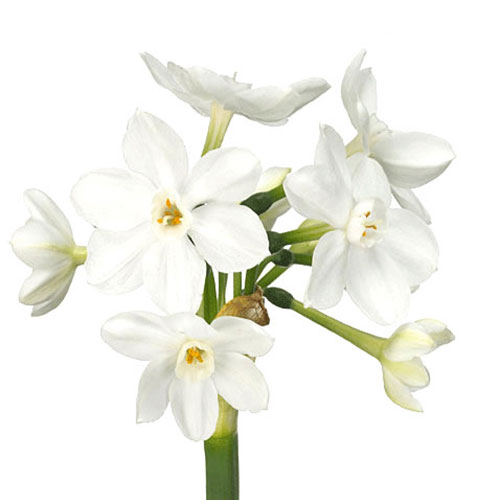
Paperwhite Narcissus, botanically Narcissus papyraceus, is a tender, autumn-flowering bulb species native to the Mediterranean basin, where it grows wild across rocky hillsides, coastal scrub, and open grassland from Portugal and Spain through southern France, Italy, Greece, and into North Africa and parts of the Middle East. Unlike the familiar spring-blooming daffodils of temperate gardens, paperwhites are adapted to a Mediterranean climate pattern of hot, dry summers and cool, wet winters, which means they naturally sprout and flower in the cooler months of the year rather than requiring the extended cold dormancy that most hardy narcissus species demand. This single trait of not needing a prolonged chilling period is what has made paperwhites the world’s most popular bulb for indoor winter forcing, since a dry, dormant bulb can be brought straight into a warm room in autumn and coaxed into bloom within a matter of weeks without any refrigeration.
Botanically, Narcissus papyraceus belongs to the same genus as daffodils and jonquils, and shares the family’s characteristic structure of a true bulb, strap-shaped basal leaves, and a central flower stalk, or scape, topped with an umbel of several flowers enclosed before opening in a papery bract, or spathe, from which the species draws its name. Each mature bulb typically produces one to three flower stalks, and each stalk carries a cluster of 4 to 8 small, intensely fragrant, star-shaped white flowers, each with six petal-like tepals surrounding a shallow, cup-shaped corona in the same pure white as the petals, distinguishing it from most other narcissus species and cultivars, which usually display a contrasting yellow or orange corona. The flowers open in succession over one to two weeks per stalk, and the plant’s narrow, blue-green, strap-like foliage typically emerges just ahead of or alongside the flower stalks.
Paperwhites have been cultivated and admired since antiquity, with historical references to narcissus bulbs appearing in ancient Greek and Roman writing, and the species has long been prized in Mediterranean and Middle Eastern gardens for its intense, sweet, and somewhat polarizing fragrance, often described as either intoxicatingly rich or overpoweringly musky depending on the individual’s sense of smell. In modern horticulture, paperwhites are grown almost exclusively as a winter forcing bulb in temperate climates outside their native range, where gardeners plant the bulbs in pots, bowls of pebbles and water, or garden beds in USDA zones 8 through 11 for a reliable, low-effort burst of fragrant winter or holiday-season bloom, while in their native Mediterranean range and in mild climates they can also be naturalized outdoors as an autumn- and winter-flowering garden perennial.
Caring for paperwhite narcissus indoors is refreshingly simple compared with most flowering bulbs, since the species does not require the cold chilling period that hardy daffodils and tulips demand before they will flower. Dry, dormant bulbs purchased in autumn can be planted directly into a shallow container of soil, or simply nestled into a bowl of decorative pebbles or gravel and topped up with water so that the base of each bulb just touches the waterline without submerging the bulb itself. Within one to two weeks in a bright, cool spot, roots begin to develop, followed by rapid shoot growth, and most paperwhites reach full bloom within four to six weeks of planting, making them one of the fastest and most reliable bulbs available for forced indoor flowering.
Light and temperature both play an outsized role in how paperwhites perform once they begin growing. Bright light, ideally including a period of direct sun each day, is essential to keep the emerging foliage and flower stalks compact and sturdy; insufficient light is the single most common cause of the tall, floppy, top-heavy growth that paperwhites are notorious for. Cooler room temperatures, generally in the 60 to 65°F (15 to 18°C) range rather than a warm, centrally heated room, similarly help slow and strengthen the stem growth, producing a study, well-proportioned display rather than weak, leggy stalks that flop over and require staking.
Because paperwhites forced in water and pebbles have no soil reserve of nutrients to draw on, and because the bulb itself contains all the stored energy the plant will use to flower this one time, ongoing fertilization is generally unnecessary for a single forcing cycle; the bulb is essentially treated as a single-use flowering unit in most indoor forcing setups, though bulbs forced in potting soil rather than water can be given a very light, diluted feeding to support any chance of future reflowering. After the blooms fade, water-forced paperwhite bulbs are typically discarded, since they rarely rebloom reliably indoors, while soil-planted bulbs can be moved outdoors in mild climates or allowed to die back naturally with the foliage left intact to help recharge the bulb for a possible future season.
 Soil
Soil
Paperwhite narcissus is remarkably adaptable and can be grown either in soil or entirely soil-free in water and pebbles, since the bulb itself carries all the stored energy needed for one flowering cycle. When soil is used, a light, fast-draining potting mix supports the healthiest root development and the best chance of the bulb storing enough energy for future bloom.
A well-draining, general-purpose potting mix amended with 20 to 30 percent perlite, coarse sand, or fine grit produces the loose, airy texture paperwhite roots prefer, whether the bulbs are planted in a shallow bulb pan or a deeper container alongside other bulbs.
A near-neutral pH between 6.0 and 7.0 is ideal, matching the mildly alkaline to neutral, often limestone-derived soils of the bulb’s native Mediterranean range.
Excellent drainage is essential; paperwhite bulbs are highly susceptible to rot if left sitting in consistently soggy soil, so pots must always have drainage holes when soil is used, and bulbs forced in water and pebbles must never have the bulb itself submerged, only the base and root zone in contact with the waterline.
A small amount of bulb fertilizer or bone meal worked into the soil at planting time can support root development in soil-grown bulbs, though this is optional for a single forcing cycle since the bulb is largely self-sufficient.
Waterlogged soil quickly leads to bulb and root rot, visible as a soft, mushy bulb base and yellowing, collapsing foliage. Always use a fast-draining mix and a pot with drainage holes for soil-grown paperwhites.
Dense, compacted potting mix restricts the rapid root growth paperwhites need to support their fast forcing timeline; loosen and amend the mix generously with perlite or grit before planting.
Strongly acidic soil can slightly slow root establishment; a near-neutral, general-purpose potting mix avoids this issue without any special amendment in most cases.
Since most paperwhite bulbs are treated as a single-season display, salt buildup is rarely a practical concern, but bulbs intended for a second season benefit from an occasional flush of clean water to prevent mineral accumulation.
The bulb itself supplies essentially all the nutrition needed for the current bloom cycle, so nutrient deficiency symptoms are uncommon during forcing; any pale or weak growth is far more often linked to insufficient light than to soil nutrition.
Root-boundness is not a practical concern for paperwhites, since bulbs are almost always forced for a single season and discarded or moved outdoors rather than left to grow in the same container long-term.
 Fertilizer
Fertilizer is generally unnecessary for paperwhites during a standard single forcing cycle, since the bulb already contains all the stored carbohydrate reserves needed to produce one full round of flowers regardless of soil or water conditions.
For soil-grown bulbs that a grower hopes to save and rebloom in a future season, a diluted balanced liquid fertilizer at roughly half strength can be applied occasionally once foliage is actively growing.
If fertilizing at all, apply no more than once every 3 to 4 weeks during active leaf growth, and stop entirely once flowering finishes and the foliage begins to yellow and die back.
Apply any diluted liquid fertilizer directly to the soil surface at watering time, avoiding contact with the bulb itself and never applying fertilizer to water-only forcing displays.
Excess fertilizer salts can cause leaf tip burn or a white crust on the soil surface; since paperwhites are rarely fertilized at all, overfertilization is an uncommon but avoidable problem.
Because the bulb is largely self-sufficient for a single bloom cycle, underfertilization does not typically affect the current season’s flowering; it may only become relevant if a grower is trying to recharge a bulb in soil for a future season.
A light application of compost tea or diluted liquid seaweed fertilizer is a gentle organic option for soil-grown bulbs being nurtured for potential rebloom.
 Watering
Paperwhites forced in soil are watered like most actively growing bulbs, kept lightly and evenly moist rather than either bone dry or waterlogged, while paperwhites forced in a bowl of pebbles and water are simply kept topped up so that the waterline touches the base of the bulb and root zone without submerging the bulb itself.
For water-and-pebble forcing, check the water level every 2 to 3 days and top up as needed to maintain contact with the root zone; for soil-grown bulbs, water when the top inch of soil has begun to dry, typically every 4 to 7 days depending on room conditions.
Plain tap water left to reach room temperature is perfectly suitable for paperwhites; some growers add a small amount of diluted alcohol (a technique known as the Cornell method) to the water after roots have established, which has been shown to modestly reduce stem height and produce a more compact display without affecting bloom quality.
In water-forced bulbs, roots that dry out and shrivel where they should be submerged, and stalled or wilting shoot growth; in soil-grown bulbs, dry, shrunken soil pulling away from the pot edges and drooping foliage.
A submerged, soggy bulb base that develops a soft, mushy texture and a sour smell, often followed by yellowing foliage and stalled growth; this is the most common cause of forcing failure and is avoided by keeping the waterline at the root zone only, never covering the bulb itself.
Watering needs remain fairly constant throughout the four-to-six-week forcing period since the plant is in continuous active growth from planting to bloom; once flowering finishes, water-forced bulbs are typically discarded, while soil-grown bulbs can be watered somewhat less as the foliage begins to yellow and die back naturally.
Stop guessing. Most houseplant failures are caused by volumetric errors and improper moisture tension. Our deterministic calculator moves beyond "once-a-week" watering by analyzing the four critical pillars of root health:
Personalized for this plant
Disclaimer: Our calculator is pretty smart. We’ve crunched the numbers, but we’re not measuring the quantum state of your living room. Since we don’t know your exact indoor temperature, humidity, light, airflow, or whether your plant receives daily sweet nothings and motivational speeches, use this calculator as a guide—and always keep an eye on your plant.
 Lighting
Paperwhites need bright light, ideally including several hours of direct sun each day, once shoots emerge, corresponding to roughly 1,000 to 2,500 foot-candles. A south- or west-facing windowsill is ideal during the growing and flowering period.
Tall, thin, pale, floppy stems that stretch toward the light source and often collapse under the weight of the flower cluster; this leggy, top-heavy growth is the most common complaint associated with indoor-forced paperwhites and is almost always a light problem rather than a watering or fertilizing one.
Direct, intense afternoon sun through unfiltered glass in a hot room can occasionally scorch tender new foliage tips, though excessive light is a far less common problem for paperwhites than insufficient light.
Rotate the container regularly so stems grow evenly rather than leaning toward a single light source, move the display to the brightest available windowsill as soon as shoots emerge, and consider adding a small stake or decorative support ring if stems begin to lean even with adequate light, since the plant’s fast, energy-driven growth can still outpace stem strength in some conditions.
 Temperature
Cooler room temperatures of 60 to 65°F (15 to 18°C) during active growth produce the sturdiest, most compact stems and the longest-lasting blooms, though paperwhites will still grow and flower successfully in warmer rooms up to about 70°F (21°C).
Paperwhites are tender bulbs, hardy only in USDA zones 8 through 11 outdoors, and are not frost-tolerant; a hard freeze will kill both the foliage and the bulb if grown outdoors in a marginal climate, and indoor-forced bulbs should never be exposed to near-freezing temperatures.
Warm rooms above 70°F (21°C) accelerate blooming but reliably produce taller, weaker, more floppy stems than cooler conditions, since the plant grows faster than its stem tissue can strengthen.
Keep paperwhites away from direct heating vents, radiators, and drafty cold windows alike; a cool, bright spot away from major temperature swings produces the most attractive, longest-lasting display.
 Humidity
Paperwhites are not particularly humidity-sensitive and perform well in the average indoor humidity range of 30 to 50 percent typical of most homes during the winter forcing season.
Very dry indoor air, especially near heating vents, can occasionally cause slightly crisp flower edges or a shorter bloom life, though this is a minor factor compared with light and temperature.
Excessive humidity combined with poor air circulation can occasionally encourage botrytis or gray mold on the flower petals, particularly in a tightly packed bowl of bulbs in a cool, damp room.
A humidifier is rarely necessary for paperwhites, but can be used in very dry, centrally heated rooms if flower petals seem to dry out unusually quickly.
Not typically needed for paperwhites, since bulbs forced directly in a bowl of water and pebbles already sit in a naturally humid microclimate around the root zone.
Light misting of the foliage is optional and mainly cosmetic for paperwhites, since the species does not rely on foliar humidity uptake the way many tropical houseplants do.
If gray mold appears on flowers in an overly humid, poorly ventilated room, increase air circulation with a small fan and space bulbs slightly further apart in the display container.
 Propagation
Paperwhite narcissus are propagated almost exclusively through bulb offsets, small daughter bulbs that form naturally at the base of a mature parent bulb, since the species is a bulb-forming perennial rather than one typically grown from seed in cultivation. Commercially sold forcing bulbs are themselves the product of this offset propagation carried out by growers over several seasons in the field.
Success Rate: High (80–95%) when offsets are large enough and divided at the correct time of year
Description: The standard method of propagating paperwhites, in which naturally forming daughter bulbs are separated from the parent bulb and grown on independently until they reach flowering size.
Steps:
Late spring to early summer, immediately after the foliage has yellowed and died back following flowering, is the correct time to lift, divide, and replant or store offset bulbs.
Large offset bulbs may flower within a single subsequent growing season, while smaller offsets typically take one to two additional years of vegetative growth to reach flowering size.
 Potting
A shallow, wide bulb pan or bowl without drainage holes works well for the classic pebble-and-water forcing method, while a standard pot with drainage holes is preferred for soil planting, particularly if the bulbs are intended to be grown on for a future season.
Drainage holes are important for soil-grown bulbs to prevent rot, but are intentionally absent in the traditional pebble-and-water forcing method, where water level is instead carefully controlled by the grower rather than allowed to drain freely.
Choose a container just large enough to fit the bulbs closely together, almost touching, since paperwhites are traditionally displayed in a dense cluster rather than spaced out as with most other potted plants.
Not applicable in the typical single-season forcing scenario, since most paperwhite bulbs are discarded after blooming; soil-grown bulbs being saved for future seasons are lifted and divided roughly every 2 to 3 years as offsets accumulate.
For bulbs being grown on in soil long-term, a dense cluster of offset bulbs crowding the container and producing progressively smaller or fewer flowers signals it is time to lift, divide, and replant.
Lift the bulb clump after foliage has died back, separate offsets as described in the propagation steps, and replant into fresh, well-draining soil at the same planting depth as before.
Root pruning is not practiced with paperwhite bulbs; damaged or rotted roots are simply trimmed away with clean scissors before replanting if necessary.
When moving bulbs from water forcing to soil, or from a nursery pot to a new container, handle the roots gently and keep the bulb at the same planting depth it was growing at previously to minimize transplant stress.
 Pruning
Paperwhite narcissus require very little pruning in the traditional sense, since the plant is grown through a single, fast forcing cycle from bulb to bloom. Most maintenance involves removing spent flowers and, for soil-grown bulbs kept for future seasons, allowing the foliage to die back naturally rather than cutting it prematurely.
Deadhead spent flower stalks as soon as individual blooms fade throughout the two-to three-week flowering period. Foliage should only be cut back after it has yellowed and died back naturally following bloom, typically several weeks after the flowers have finished.
Check the display every few days during bloom to remove fading flowers and improve its overall appearance. The primary purpose of any cutting during the growing phase is purely cosmetic; the true purpose of correctly timed foliage removal afterward is to allow the bulb to photosynthesize and store energy for a possible future season.
Use clean, sharp scissors or floral snips, wiped with rubbing alcohol between uses, and consider wearing light gloves when handling cut stems or bulb material, since the sap can cause skin irritation in sensitive individuals.
Never cut back green, actively photosynthesizing foliage early, as this significantly reduces the chance of the bulb storing enough energy to rebloom in a future season. Water-forced paperwhite bulbs are rarely worth saving through this process since they have depleted much of their reserve without the benefit of soil nutrients, so this careful foliage-preservation approach is mainly reserved for soil-grown bulbs.
 Blooming
Paperwhite narcissus bloom in autumn and winter in their native Mediterranean habitat, and when forced indoors they can be brought into flower at almost any point from late autumn through midwinter simply by staggering the planting date, making them a favorite for holiday-season displays from Thanksgiving through the New Year. From the time of planting, most bulbs take four to six weeks to reach full bloom under typical indoor conditions, with the process happening somewhat faster in warm rooms and somewhat slower and more compactly in cooler conditions around 60°F (15°C). Each flower stalk carries a cluster of 4 to 8 small, star-shaped, pure white flowers with a shallow central corona in the same white tone, and the blooms open in succession over roughly one to two weeks per stalk, with the overall display from a planted bowl of bulbs lasting two to three weeks in total. The flowers are intensely and distinctively fragrant, a trait that intensifies in warm, poorly ventilated rooms and is often the deciding factor in whether a household enjoys or avoids growing paperwhites indoors. Bright light and cooler room temperatures during the growth period both help produce sturdier stems and a longer-lasting bloom, while low light and warm rooms accelerate blooming but tend to produce taller, weaker stems and a shorter overall flowering window.
 Pests and Diseases
Name: Bulb Mites
Symptoms: Stunted or distorted shoot growth emerging from stored or planted bulbs, along with soft or discolored patches on the bulb itself upon close inspection.
Treatment: Discard heavily infested bulbs, as mite damage is rarely reversible; store healthy bulbs in a cool, dry, well-ventilated location to discourage mite activity before planting.
Name: Aphids
Symptoms: Small clusters of soft-bodied insects on new shoots and flower buds, sometimes accompanied by sticky honeydew residue and curling of new growth.
Treatment: Rinse affected foliage gently with lukewarm water or wipe aphids away by hand; a light insecticidal soap spray can be used for larger infestations, applied away from open flowers.
Name: Narcissus Bulb Fly
Symptoms: Primarily a concern for bulbs grown outdoors or over multiple seasons; larvae tunnel into the bulb, causing it to become soft, hollow, and fail to produce a shoot the following season.
Treatment: Discard any bulb found to be soft, hollow, or damaged upon lifting; there is no effective treatment once larvae have entered the bulb, so prevention through healthy bulb selection and good garden hygiene is the primary defense.
Name: Basal Rot (Fusarium)
Symptoms: A soft, brown, spreading rot beginning at the base of the bulb and moving upward, often accompanied by a sour smell and stunted or collapsing foliage.
Treatment: Discard affected bulbs immediately, as basal rot is not treatable once established; always select firm, healthy bulbs at purchase and avoid overwatering to reduce risk in future plantings.
Name: Gray Mold (Botrytis)
Symptoms: Fuzzy gray mold developing on flower petals or foliage, particularly in cool, humid, poorly ventilated conditions.
Treatment: Remove affected flowers and foliage promptly, increase air circulation around the display, and avoid overcrowding bulbs too tightly in a single container.
Name: Bulb Rot from Overwatering
Symptoms: A soft, mushy, waterlogged bulb base, especially common in water-forced displays where the bulb itself has been allowed to sit submerged rather than just the roots.
Treatment: Adjust the water level so it touches only the base and roots of the bulb, never the bulb body itself, and remove and discard any bulb that has already become soft and mushy, as the damage cannot be reversed.
 Special Features
Paperwhite narcissus is prized above all for its remarkably fast, reliable, and fragrant winter display, requiring no cold chilling period and no soil at all if grown by the classic pebble-and-water forcing method, which makes it one of the most accessible flowering bulbs available to indoor gardeners of any experience level. Its intensely sweet, musky fragrance fills a room within days of the first flowers opening, making it a beloved fixture of winter holiday decor across many cultures, while its clusters of pure white, star-shaped flowers offer a crisp, elegant seasonal display distinct from the yellow-trumpeted daffodils most people associate with the genus. Its speed from bulb to bloom, typically just four to six weeks, and its tolerance of casual, low-maintenance care make it a popular choice for gifting, holiday centerpieces, and simple seasonal projects with children, provided its toxicity to pets and children is respected in placement and handling.
 Plant Benefits
Paperwhite narcissus has no significant culinary use and, due to its toxicity, is not used as an herbal remedy in the way some other traditional plants are. Historically, extracts of various Narcissus species, including compounds related to galantamine found in some relatives of paperwhite, have been studied and in some cases developed into pharmaceutical treatments for conditions such as Alzheimer’s disease, though this application is associated primarily with other Narcissus species rather than Narcissus papyraceus specifically and should never be attempted through home use of the plant itself. The primary benefit of paperwhites to the home grower remains ornamental and sensory: a fast, dependable, richly fragrant floral display during the darkest, coldest months of the year.
 Additional Information
Paperwhites are one of the few narcissus commonly forced without any cold treatment at all, a trait shared with only a handful of other tender Mediterranean and North African narcissus species, which is why they remain the standard recommendation for gardeners wanting a quick, uncomplicated indoor bulb project. The species name papyraceus, meaning ‘papery,’ refers to the thin, papery texture of the bract, or spathe, that encloses the flower cluster before it opens. A well-known technique among experienced growers, sometimes called the Cornell method, involves adding a small percentage of alcohol, such as gin or vodka, to the water once roots have established, which has been shown in horticultural research to modestly stunt stem elongation and produce a shorter, sturdier display without harming the flowers.
 Life Cycle
In their native Mediterranean habitat, paperwhite narcissus follow an autumn-to-spring growth cycle: bulbs remain dormant through the hot, dry summer, then send up roots and foliage with the return of cooler, wetter autumn conditions, flower in autumn or winter, and gradually die back to dormancy again as the following summer approaches. When forced indoors outside this native climate pattern, the bulb is essentially tricked into skipping its natural dormancy trigger, sprouting and flowering on the strength of its stored reserves alone within four to six weeks of planting regardless of the true outdoor season. After flowering, water-forced bulbs have typically exhausted most of their stored energy and are usually discarded, while soil-grown bulbs allowed to complete a full natural die-back cycle can store enough new energy in a good growing season to flower again in a future year, and may also produce offset bulbs at their base that eventually mature into new, independent flowering bulbs of their own.
 Are Paperwhite Narcissus Poisonous, Toxic
Paperwhite narcissus, like all Narcissus species, is toxic to cats, dogs, and humans, with the bulb being significantly more toxic than the leaves or flowers. This makes paperwhites one of the more commonly reported plant toxicities during the winter holiday forcing season, when bulbs are often left accessible on low tables or countertops.
All parts of the plant contain toxic alkaloids, primarily lycorine, along with calcium oxalate crystals, but the bulb contains the highest concentration by far and poses the greatest risk if chewed or dug up and ingested.
Ingestion of any plant part, and particularly the bulb, can cause profuse drooling, vomiting, diarrhea, abdominal pain, and lethargy. Large ingestions of bulb material can lead to more severe symptoms including tremors, changes in heart rate and blood pressure, and difficulty breathing.
Handling the bulbs, particularly when cutting or peeling them, can cause a contact dermatitis known among florists and bulb handlers as ‘daffodil itch,’ resulting in redness, itching, and cracking of the skin from the calcium oxalate crystals and irritating sap.
Moderate to Severe, especially with bulb ingestion. Narcissus bulbs are considered one of the more seriously toxic bulbs commonly found in the home, and cases involving significant bulb consumption should always be treated as a veterinary or medical emergency.
If a pet or child ingests any part of the plant, especially the bulb, remove any remaining plant material from the mouth, rinse the mouth with water, and contact a veterinarian, physician, or poison control center immediately rather than waiting for symptoms to develop.
Wash affected skin thoroughly with soap and water and wear gloves when handling bulbs in the future to prevent recurring contact dermatitis.
Store dry bulbs in a sealed container out of reach of pets and children before planting, keep planted bowls and pots well out of reach on high shelves or in rooms pets cannot access, and dispose of spent bulbs and any bulb offsets or peelings promptly and securely rather than leaving them in an accessible compost or trash bin.
 Frequently Asked Questions
No, paperwhites are one of the few narcissus species that do not require a cold chilling period, so dry bulbs can be planted directly and forced into bloom in a warm room.
Most paperwhite bulbs reach full bloom within four to six weeks of planting under typical indoor conditions.
Yes, all parts of the plant are toxic to cats and dogs, with the bulb being significantly more toxic than the leaves or flowers, and ingestion can cause vomiting, drooling, and abdominal pain.
Tall, floppy stems are usually caused by insufficient light or a room that is too warm; move the display to the brightest available spot and, if possible, a cooler room to encourage sturdier growth.
Water-forced bulbs rarely rebloom reliably indoors and are usually discarded after flowering, but bulbs grown in soil and allowed to die back naturally can sometimes be saved and replanted for a future season.
No, paperwhites can be forced entirely in a bowl of pebbles and water, since the bulb already contains all the stored energy needed for one flowering cycle.
Provide bright light, keep the room cool, and consider adding a small amount of alcohol such as gin or vodka to the water after roots establish, a technique known to modestly reduce stem height.
For pebble-and-water forcing, check the water level every two to three days to keep it at the base of the bulb; for soil-grown bulbs, water when the top inch of soil begins to dry.
Paperwhites produce an intensely sweet, musky fragrance that is a natural trait of the species, and the scent tends to be stronger in warm, poorly ventilated rooms.
Paperwhites are a tender narcissus species with clusters of small, pure white, fragrant flowers and no cold-chilling requirement, while most garden daffodils are hardy, cold-requiring species with a single larger flower per stem and a contrasting yellow or orange central trumpet.
 Can I grow Paperwhite Narcissus in my indoor space
Difficulty: Easy
Size: Small
Light: High
Water: Medium
Flowering: Yes
Pet Safe: No
Air Purifier: Low
 Narcissus papyraceus botanical details
Common Name: Paperwhite Narcissus
Other Common Names: Paperwhites, Paper White Daffodil, Bunch-Flowered Narcissus, Polyanthus Narcissus, Chinese Sacred Lily (a related cultivar group)
Botanical Name: Narcissus papyraceus
Native Area: The western and central Mediterranean basin, including Portugal, Spain, southern France, Italy, Greece, and parts of North Africa and the Middle East.
Family Name: Amaryllidaceae
Plant Type: Perennial bulb, commonly forced as an annual indoor flowering display
Genus: Narcissus
Kingdom: Plantae
 Photo Gallery
 My Paperwhite Narcissus Plant Care Recommendations
If you find the Houseplant Encyclopedia helpful and would like to support Healthy Houseplants, you can use the links below to shop for recommended plants, products, and plant-care supplies.
Some links are affiliate links, which means I may earn a small commission if you make a qualifying purchase through them, at no additional cost to you. Thank you for supporting Healthy Houseplants and helping me continue to provide free plant-care information!

Want even more personalized plant-care help? Check out my AI Julie Chatbot—trained on my 20 years of houseplant knowledge, not just information from the internet!  Try it now:Ask AI Julie
 Buy Paperwhite Narcissus Online
✅ “Bring Home This Beauty Today”
✅ “Get Your Own Paperwhite Narcissus Before It’s Gone”
✅ “Shop Trusted Sellers – Limited Availability”
✅ “Free Delivery”
As an Amazon Associate, I earn commission from qualifying purchases.
 Plant Puns and Jokes
Why did the paperwhite narcissus get invited to every holiday party? Because it always knew how to make an entrance without needing to be chilled first.
 Signup to our newsletter and download Paperwhite Narcissus care guide

