


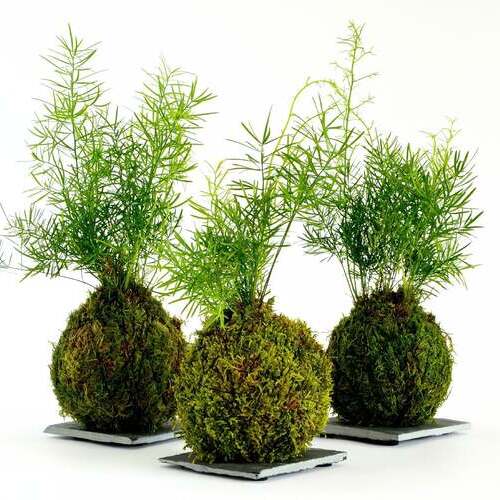
Kokedama, literally “moss ball” in Japanese, is not a single botanical species but a centuries-old horticultural technique in which the root ball of a plant is wrapped in a growing medium and bound in a layer of moss, most commonly sheet moss or cushion moss such as Hypnum plumaeforme. The style descends from nearai, a form of root-exposed bonsai display developed in Japan, and later evolved into a distinct decorative craft in its own right, gaining renewed popularity worldwide alongside the string gardening movement that emerged from Japan in the 1990s. Because the plant is grown without any conventional pot, kokedama functions as a piece of living sculpture that can rest on a dish, hang suspended from string as part of a “string garden,” or sit nestled into a tray of decorative stones, making it one of the most spatially versatile plant display styles available to the indoor gardener.
The moss itself, most often a species in the genus Hypnum, Thuidium, or a similar sheet-forming moss native to the humid, shaded forest floors of Japan, thrives where it forms dense, low mats over rocks, fallen logs, and exposed tree roots in its natural habitat. In cultivation, this moss is harvested or propagated specifically for its ability to hold a compact shape and retain moisture around a root ball, acting simultaneously as a decorative living skin and a slow-release humidity reservoir for whatever plant is housed within it. Ferns, small-leafed ivies, pothos, peace lilies, and dwarf conifers are among the most popular companion plants for kokedama, since their modest, fibrous root systems tolerate the compact, soil-light environment created by the technique far better than plants with large taproots or extensive root systems.
What makes the Japanese moss ball notable within the wider houseplant world is the way it reframes the relationship between a plant and its container: there is no rigid vessel at all, only moss, soil, and twine (traditionally cotton or jute string) holding the entire structure together. This makes kokedama both a display piece and a meditative craft object, closely tied to Japanese aesthetic principles of wabi-sabi, the appreciation of imperfect, transient, and naturally evolving beauty. Over time the moss thickens and spreads, the twine may loosen and require replacement, and the companion plant within matures and reshapes the overall silhouette, so that no two moss balls ever look quite alike and each one continues to change gradually with age and the attentiveness of its care.
Caring for a kokedama is fundamentally about managing moisture, since there is no pot to signal drainage or retention the way a conventional container does, and no drainage holes to prevent overwatering automatically. The most common and reliable watering method is the “dunk” technique: submerge the entire moss ball in a bowl or basin of room-temperature water for 10 to 15 minutes, until it stops releasing air bubbles, then lift it out and allow it to drain thoroughly, ideally over a sink or towel, before returning it to its display dish or hanging position. Most moss balls need this treatment every 1 to 2 weeks indoors, though the exact frequency depends heavily on the companion plant chosen, ambient humidity, room temperature, and how tightly the moss and soil core has been bound.
Light and placement matter just as much as watering technique. Because the moss layer itself prefers indirect, filtered light similar to a forest floor, kokedama are best kept out of direct sun, which can scorch the moss surface and dry out the root ball faster than watering can compensate, while placement should also respect the specific light needs of whichever companion plant is embedded inside. A bright windowsill softened by a sheer curtain, or a spot a few feet back from an east- or north-facing window, is usually ideal. Rotating the ball occasionally helps both the moss and the companion plant grow evenly on all sides rather than reaching or thinning toward a single light source.
Ongoing maintenance includes light misting between full dunks to keep the moss surface from crisping in dry indoor air, occasional trimming of both the moss and any companion foliage to maintain the ball’s rounded shape, and periodic feeding with a highly diluted liquid fertilizer, since the compact soil core holds only limited nutrient reserves compared with a full-sized pot. Because kokedama sit directly on furniture, shelving, or hang above flooring, it is also important to let them drain fully after every watering and to use a saucer, tray, or other moisture-proof surface underneath to protect wood, fabric, and flooring from residual dampness.
 Soil
Soil
The kokedama soil core must be moisture-retentive enough to sustain the companion plant’s roots between waterings while remaining light enough to be shaped and bound firmly by hand, since it will never sit inside a rigid pot.
The traditional core is a blend of akadama (a granular Japanese clay used widely in bonsai cultivation), peat moss, and a smaller proportion of standard bonsai or potting soil, typically combined in roughly equal parts to balance moisture retention with aeration. The mixture should be moist enough to hold together firmly in a ball when compressed by hand, without being muddy or dripping.
A slightly acidic pH between 5.5 and 6.5 suits both the moss exterior and the great majority of common companion plants, mirroring the naturally acidic organic substrate the moss favors in the wild.
Drainage functions very differently in a kokedama than in a potted plant, since there are no drainage holes. Excess water must be squeezed out gently by hand after each dunk, and the ball should always be allowed to drain fully before being returned to a dish or hanging display.
A small proportion of horticultural charcoal can be added to the soil core to help keep it fresh and reduce the risk of sour, anaerobic conditions developing inside the tightly bound ball. Worm castings mixed in sparingly at potting time provide a gentle, slow-release source of nutrients suited to the limited soil volume.
Insufficient draining after dunking leaves the core waterlogged, encouraging root and moss rot. Symptoms include a persistently heavy, soggy ball and a musty smell. Always drain thoroughly after every watering.
The akadama and peat core can compact and lose structure over one to two years, reducing aeration around the roots. Refresh the soil core when repotting to restore proper texture.
Hard tap water gradually raises the pH of the compact soil core over time, which can cause nutrient lock-out in the companion plant. Rainwater or filtered water helps maintain the ideal slightly acidic range.
Because the soil volume is small, fertilizer salts concentrate quickly. A white crust on the moss surface or browning tips are signs of buildup; flush gently with clean water during a dunk to help dissipate excess salts.
The compact core cannot buffer nutrient swings the way a full-sized pot can, so pale or slow growth in the companion plant often reflects depleted reserves rather than a light or water problem, and is corrected with light, regular feeding.
Fast-growing companion plants eventually outgrow the compact core, showing roots pushing through the moss layer. This is addressed by unwrapping the ball, trimming the roots, and re-forming it with fresh soil and moss.
 Fertilizer
Because the soil volume in a kokedama is small, fertilizer should be applied sparingly and diluted well beyond normal potted-plant strength to avoid overwhelming the compact root zone.
A liquid houseplant fertilizer diluted to roughly one-quarter of the label-recommended strength is appropriate for most companion plants used in kokedama.
Apply once every 4 to 6 weeks during the active growing season, spring through early fall, and withhold fertilizer entirely during the slower winter months.
Add the diluted fertilizer solution to the dunking water during a regular watering session so it disperses evenly through the compact soil core rather than pooling at the surface.
Browning tips on the companion plant’s foliage or a visible white salt crust forming on the moss surface indicate that fertilizer has been applied too strongly or too frequently.
Pale, slow growth in the companion plant over several months, despite otherwise good light and watering, typically points to depleted nutrient reserves in the small soil core.
A well-diluted organic liquid seaweed or fish emulsion fertilizer is a gentler alternative to synthetic formulas and reduces the risk of the salt buildup that can occur in such a small volume of soil.
 Watering
Kokedama are watered by fully submerging the ball in room-temperature water until it stops releasing air bubbles, then allowing complete drainage before it is returned to display. This dunk-and-drain method replaces the conventional top-watering used for potted plants.
Generally every 1 to 2 weeks indoors, though hanging or more exposed moss balls may dry faster and need more frequent watering, while balls kept in cooler or shadier spots may go slightly longer between dunks.
Rainwater or filtered water is preferred over hard tap water, which can leave mineral deposits on the moss surface and gradually raise the pH of the compact soil core over time.
The moss ball feels notably light in the hand and dry throughout, and the moss itself looks dull, faded, or crisp at the edges rather than plush and springy.
The ball remains persistently heavy and soggy well after it should have dried, often accompanied by a musty smell or blackened, slimy patches developing on the moss surface.
Watering needs increase somewhat during warm, dry months and decrease in winter as growth slows, so the interval should be adjusted by feel and weight rather than kept on a rigid fixed schedule.
Stop guessing. Most houseplant failures are caused by volumetric errors and improper moisture tension. Our deterministic calculator moves beyond "once-a-week" watering by analyzing the four critical pillars of root health:
Personalized for this plant
Disclaimer: Our calculator is pretty smart. We’ve crunched the numbers, but we’re not measuring the quantum state of your living room. Since we don’t know your exact indoor temperature, humidity, light, airflow, or whether your plant receives daily sweet nothings and motivational speeches, use this calculator as a guide—and always keep an eye on your plant.
 Lighting
Bright, indirect light is ideal for a kokedama, mimicking the dappled shade of a forest understory, and should also be suited to whichever companion plant is embedded inside. A bright windowsill softened by a sheer curtain, or a position a few feet back from an east- or north-facing window, is generally ideal.
The moss loses its vivid green color, fades toward brown or gray, and stops growing densely, while the companion plant may become leggy, pale, or stop flowering altogether.
Direct sun scorches the moss, turning it crispy, bleached, or pale, and dries out the root ball considerably faster than a normal watering interval can compensate for, risking permanent damage to both moss and companion plant.
If natural light is inadequate, a full-spectrum grow light placed 12 to 18 inches above the moss ball for 8 to 10 hours a day can supplement growth without the risk of heat damage that comes with direct sun exposure through glass. Rotating the ball periodically also helps distribute light evenly across the entire surface.
 Temperature
Kokedama do best in typical indoor temperatures between 60 and 75°F (15 to 24°C), matching the mild, temperate climate of their native Japanese forests.
Frost and freezing temperatures will kill both the moss and most companion plants, so kokedama displayed outdoors in temperate climates should be brought inside or moved to a sheltered space well before temperatures approach freezing.
Brief warm spells are tolerated reasonably well provided humidity and watering frequency are increased to compensate, but prolonged heat above 85°F (29°C) combined with dry air can dry the moss out rapidly between waterings.
Keep kokedama away from cold drafts, air conditioning vents, and heating registers, all of which dry the moss out unusually fast regardless of the watering schedule being followed.
 Humidity
Kokedama prefer moderate to high humidity, generally in the range of 50 to 70 percent, reflecting the moss’s native forest habitat.
The moss dries out between waterings, turns brittle, and loses its cushiony texture, while companion plant foliage may develop crisp, browning tips.
Excessively high humidity combined with poor airflow can encourage mold or algae growth on the moss surface, visible as a slimy or fuzzy film.
Running a humidifier nearby is one of the most effective ways to raise ambient humidity, particularly in centrally heated homes during winter when indoor air dries out significantly.
Placing the moss ball’s dish on a wide tray of pebbles and water provides a modest, localized humidity boost around the display.
Light misting of the moss surface every few days between full dunks helps maintain surface moisture without oversaturating the root ball, and is especially useful for freshly assembled kokedama still knitting together.
If mold or algae appear, improve air circulation around the ball with a small fan, space the watering interval out slightly, and gently rinse the moss surface with clean water to remove buildup.
 Propagation
Kokedama are propagated as an assembly technique rather than through seed or spore, and success depends primarily on binding a healthy root ball securely and evenly in moss.
Success Rate: Very High (85–95%) when the moss is kept consistently moist during the first few weeks
Description: The standard method of building a kokedama from a bare-rooted companion plant, a moist soil core, and a wrapped layer of sheet moss bound in place with string.
Steps:
Spring through early summer, when the companion plant is entering active growth and can establish new roots into the compact soil core most quickly.
A freshly assembled kokedama is display-ready within days, but full integration of the moss with the root ball, where the moss begins actively growing and knitting into a cohesive skin, typically takes 4 to 8 weeks.
 Potting
Kokedama are intentionally potless, displayed instead on a small dish, a shallow tray of decorative stones, or suspended by string as part of a hanging string garden. No container is used around the moss ball itself.
There are no drainage holes; excess water is removed manually by squeezing the ball gently and allowing it to drain fully over a sink or towel after every dunk.
Every 1 to 2 years, or sooner if the companion plant becomes visibly root-bound within the compact core.
Roots pushing out through the moss layer, stunted new growth in the companion plant, or the ball drying out unusually fast despite a normal watering schedule.
Unwind the string, gently remove the old moss, trim any circling or overly dense roots, and rebuild the ball with a fresh soil core and new moss following the same steps used in initial propagation.
Light root trimming is appropriate when refreshing a root-bound kokedama; remove no more than 20 percent of the root mass at one time to avoid excessive stress on the plant.
Handling the roots gently and completing the rebuilding process quickly minimizes transplant shock, and keeping the refreshed ball in a humid, shaded spot for the first week afterward helps it recover with minimal stress.
 Pruning
Kokedama require light, regular pruning rather than infrequent heavy cutting, since both the moss layer and the companion plant inside need to stay proportional to the compact ball for the display to retain its characteristic rounded shape.
Light pruning can be done throughout the year, but the most significant shaping is best carried out in spring or early summer when the moss and companion plant are actively growing and can recover quickly.
Prune every 4 to 6 weeks to maintain the rounded shape of the moss ball, remove dead or browning moss, and control the size of the companion plant’s foliage so it stays proportional to the ball.
Use small, sharp scissors or precision pruning shears sterilized with rubbing alcohol before use to prevent introducing pathogens to the moss or plant tissue.
Keep freshly pruned kokedama out of direct sun for a few days and maintain slightly higher humidity to support recovery. Avoid over-pruning moss in a single session, as it regenerates considerably more slowly than typical houseplant foliage.
 Blooming
The moss component of a kokedama does not flower; mosses are non-vascular plants that reproduce via spores released from small capsules rather than through flowers, seeds, or fruit. If a flowering companion plant such as a peace lily, African violet, or small orchid is used inside the moss ball, bloom time follows that species’ own natural schedule, generally occurring once or twice a year for a period of several weeks under bright, indirect light, consistent humidity above 50 percent, and stable indoor temperatures between 65 and 75°F (18 to 24°C). Flowers on companion plants housed in a kokedama are typically somewhat smaller and less frequent than the same species grown in a conventional pot, since the available nutrient reserve and root space are inherently limited by the compact moss-ball format.
 Pests and Diseases
Name: Fungus Gnats
Symptoms: Small flying insects around the moss ball, with larvae visible in overly moist soil near the surface just beneath the moss layer.
Treatment: Allow the ball to dry out slightly more between dunks, use yellow sticky traps to catch adults, and apply a diluted neem oil drench worked gently into the soil core.
Name: Mealybugs
Symptoms: White, cottony clusters at the base of companion plant stems and leaf joints, sometimes accompanied by sticky honeydew residue.
Treatment: Dab affected areas with rubbing alcohol on a cotton swab and follow up with an insecticidal soap spray, taking care to avoid oversaturating the surrounding moss.
Name: Spider Mites
Symptoms: Fine webbing and stippled, discolored leaves on the companion plant, most common when indoor air is unusually dry.
Treatment: Increase humidity, rinse the companion plant’s foliage under lukewarm water, and treat with insecticidal soap while protecting the moss itself from excess soap residue.
Name: Moss Mold or Algae Growth
Symptoms: A slimy green, black, or fuzzy film developing on the moss surface, often accompanied by a musty odor.
Treatment: Reduce watering frequency slightly, improve airflow around the ball, and gently rinse the affected moss surface with clean water.
Name: Root Rot
Symptoms: A foul odor from the soil core, blackened and mushy roots, and a wilting companion plant despite what appears to be adequate watering.
Treatment: Unwrap the moss ball, trim away all rotted roots with sterile scissors, allow the remaining root ball to dry out briefly, and rebuild it with fresh soil and moss.
Name: Moss Dieback
Symptoms: Large sections of the moss layer turning brown, dry, and crumbly rather than remaining plush and green.
Treatment: Soak the ball thoroughly, relocate it to a shadier and more humid spot, and patch severely dead sections with fresh moss secured in place with string.
 Special Features
The Japanese moss ball’s defining feature is its potless, sculptural form, which turns an ordinary houseplant into a piece of living art that can sit on a dish, nestle in a bowl of stones, or hang from a string as part of a string garden display. Its texture and living green surface add a tactile, forest-floor quality to interior spaces that conventional pots cannot replicate, and its compact, self-contained structure makes it especially well suited to small apartments, tabletop displays, and minimalist or Japandi-style interiors. Because kokedama is as much a craft practice as a plant style, many people also value the meditative, hands-on process of building and maintaining one as much as the finished display itself.
 Plant Benefits
Kokedama moss itself has no established herbal or pharmaceutical use. Any wellness benefit depends on the companion plant chosen; for example, a kokedama built around a pothos or peace lily can contribute modestly to indoor air quality by absorbing certain volatile organic compounds, while the overall practice of tending a kokedama is often cited anecdotally for its calming, mindfulness-related benefits rather than any medicinal properties.
 Additional Information
Kokedama is closely related to the string garden trend, in which multiple moss balls are suspended at varying heights by string to create a hanging indoor garden. The technique is also sometimes used as a teaching tool in bonsai practice, since building a kokedama requires many of the same root-handling and shaping skills used in traditional bonsai cultivation.
 Life Cycle
As a moss, Hypnum reproduces via spores released from small capsules and spreads vegetatively by fragmenting and regrowing, gradually forming dense mats over years in its natural habitat. Within a kokedama, the moss is maintained in a perpetual vegetative state, trimmed and refreshed rather than allowed to complete a full reproductive cycle. The companion plant inside follows its own natural life cycle, whether that is the steady vegetative growth of a fern or the periodic flowering cycle of a peace lily, constrained somewhat by the limited root space of the moss ball format.
 Are Japanese Moss Ball (Kokedama) Poisonous, Toxic
The moss itself (Hypnum and related sheet mosses) is considered non-toxic to cats, dogs, and humans, with no documented cases of poisoning from ingestion or incidental contact. However, the overall toxicity of a given kokedama depends entirely on the companion plant chosen and embedded within it, so pet owners and parents should evaluate the specific plant rather than the moss ball format itself.
The moss is non-toxic in all parts. Toxicity, if present, resides in the leaves, stems, or sap of the companion plant, not in the moss or soil core.
Popular kokedama companion plants such as pothos (Epipremnum aureum) and peace lily (Spathiphyllum) contain insoluble calcium oxalate crystals that are toxic if chewed or swallowed, affecting the mouth, throat, and digestive tract. Symptoms can include oral irritation, drooling, pawing at the mouth, vomiting, and difficulty swallowing.
The moss itself does not cause skin irritation. Some companion plants, such as certain ferns or ivies, may cause mild dermatitis in sensitive individuals on prolonged contact with sap.
Low to Moderate, entirely dependent on the companion plant used. The moss component alone poses no toxicity risk.
If a toxic companion plant is chewed or swallowed, rinse the mouth with water and offer a small amount of milk or water to dilute irritation. Contact a veterinarian or poison control center if symptoms persist or worsen.
Wash any affected skin area with soap and water if irritation develops after contact with a companion plant’s sap.
Place kokedama out of reach of curious pets and children, particularly when hung as part of a string garden at nose or paw height, or select a known pet-safe companion plant such as a fern, spider plant, or Rhipsalis to eliminate the risk entirely.
 Frequently Asked Questions
A kokedama is a Japanese planting style in which a plant’s root ball is wrapped in soil and moss instead of a pot, then bound with string.
Most kokedama should be dunked in water for 10 to 15 minutes every 1 to 2 weeks, then drained thoroughly before returning to display.
Yes, kokedama thrive indoors in bright, indirect light with moderate to high humidity and stable room temperatures.
With regular watering and occasional refreshing of the moss and soil, a kokedama can last for several years, though the moss and soil core typically need renewal every 1 to 2 years.
Ferns, pothos, ivy, peace lilies, and small dwarf conifers are popular choices because their root systems tolerate the compact, soil-light kokedama format.
The moss itself is non-toxic, but toxicity depends on the companion plant used, so pet owners should check the specific plant inside the moss ball.
Brown, dry moss usually signals underwatering, too much direct sun, or low humidity, while blackened or slimy moss usually signals overwatering.
A kokedama is made by wrapping a plant’s root ball in a soil mixture, covering it with sheet moss, and binding the moss in place with string.
Yes, a diluted liquid fertilizer applied roughly once every 4 to 6 weeks during the growing season supports the limited soil volume in a kokedama.
Yes, kokedama are often suspended by string at varying heights to create a hanging display known as a string garden.
 Can I grow Japanese Moss Ball (Kokedama) in my indoor space
Difficulty: Intermediate
Size: Small
Light: Medium
Water: Medium
Flowering: No
Pet Safe: Depends on companion plant; moss alone is Yes
Air Purifier: Low to Medium
 Hypnum plumaeforme (sheet moss, most common); companion plant species vary botanical details
Common Name: Japanese Moss Ball (Kokedama)
Other Common Names: String Garden Ball, Moss Ball Planter, Japanese Hanging Moss Ball, Nearai-Style Moss Ball, Living Moss Sculpture
Botanical Name: Hypnum plumaeforme (sheet moss, most common); companion plant species vary
Native Area: Japan, particularly the temperate, humid forest regions of Honshu and Kyushu, where the moss used in kokedama grows naturally on forest floors, rocks, and fallen logs.
Family Name: Hypnaceae (moss); companion plant family varies by species used
Plant Type: Perennial moss and mixed-media living planter style
Genus: Hypnum
Kingdom: Plantae
 Photo Gallery
 My Japanese Moss Ball (Kokedama) Plant Care Recommendations
If you find the Houseplant Encyclopedia helpful and would like to support Healthy Houseplants, you can use the links below to shop for recommended plants, products, and plant-care supplies.
Some links are affiliate links, which means I may earn a small commission if you make a qualifying purchase through them, at no additional cost to you. Thank you for supporting Healthy Houseplants and helping me continue to provide free plant-care information!

Want even more personalized plant-care help? Check out my AI Julie Chatbot—trained on my 20 years of houseplant knowledge, not just information from the internet!  Try it now:Ask AI Julie
 Buy Japanese Moss Ball (Kokedama) Online
✅ “Bring Home This Beauty Today”
✅ “Get Your Own Japanese Moss Ball (Kokedama) Before It’s Gone”
✅ “Shop Trusted Sellers – Limited Availability”
✅ “Free Delivery”
As an Amazon Associate, I earn commission from qualifying purchases.
 Plant Puns and Jokes
Why did the kokedama refuse to worry about anything? Because it had already learned to go with the flow of every dunk in the sink.
 Signup to our newsletter and download Japanese Moss Ball (Kokedama) care guide

