About Alocasia Silver Dragon
Alocasia Silver Dragon Introduction
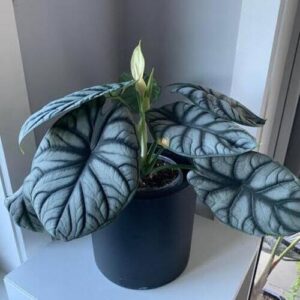
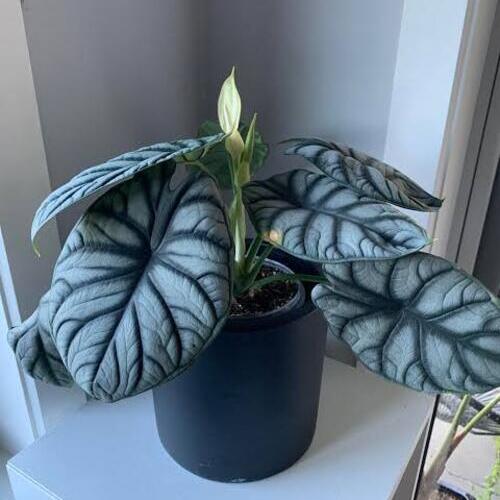
Alocasia Silver Dragon (Alocasia baginda ‘Silver Dragon’) is a compact, rhizomatous aroid prized for its thick, dorsally silvered leaves crossed with pronounced dark green venation, giving each leaf the scaled, metallic look that inspired its common name. It is a cultivar selected from Alocasia baginda, a species native to the limestone forests of Borneo, where it grows as an understory plant in warm, humid, low-light conditions beneath a closed forest canopy. Unlike many of its larger Alocasia relatives, Silver Dragon stays relatively small and clumping, making it a popular choice for indoor collections and terrariums.
The leaves are ovate to broadly arrow-shaped, held on relatively short, sturdy petioles, and can take on a slightly puckered or quilted texture as they mature. New growth often emerges with a coppery or bronze flush before settling into its signature silvery-grey coloration with contrasting near-black veins. The rhizome creeps slowly at or just below the soil surface, and the plant spreads over time by producing offsets, which makes it relatively easy to divide once established.
As a member of the Araceae family, Silver Dragon shares the family’s characteristic inflorescence: a spadix wrapped in a spathe, though indoor specimens rarely flower and are grown almost exclusively for their striking foliage. In its native habitat it experiences warm year-round temperatures, high humidity, and diffuse light filtering through the canopy, conditions that inform its cultivation needs indoors. It is considered a moderately challenging houseplant, rewarding attentive owners with one of the more visually distinctive leaf patterns in the Alocasia genus.
Alocasia Silver Dragon Care & Growing Guide
Alocasia Silver Dragon thrives when its indoor environment mimics the warm, humid, filtered-light conditions of a Bornean forest floor. Bright, indirect light is essential; a spot near an east- or north-facing window, or a few feet back from a bright south- or west-facing one, works well. Consistency matters more than intensity for this species, and sudden changes in light, temperature, or watering routine can cause stress responses such as leaf curling or dormancy.
Watering should follow a ‘moist but never soggy’ approach. Allow the top inch or so of soil to dry between waterings, then water thoroughly until it drains from the pot’s base, discarding any excess. Because Alocasias are sensitive to salt and mineral buildup, filtered, distilled, or rainwater is preferable to hard tap water over the long term. Humidity is one of the most important factors for this plant; levels below 50% can lead to crispy leaf edges and slowed growth, so a humidifier, pebble tray, or grouping with other plants is strongly recommended.
Beyond light, water, and humidity, Silver Dragon benefits from a well-draining, chunky aroid mix, warm and stable temperatures between roughly 65-80°F (18-27°C), and light, regular feeding during the growing season. It is worth noting that, like most Alocasias, this plant may go into a brief dormancy in cooler, darker months, during which growth slows or leaves die back; this is normal and not necessarily a sign of poor care. Patience and consistency, rather than intervention, are usually the best response during this period.
Soil
Alocasia Silver Dragon needs a light, chunky, fast-draining aroid mix rather than dense potting soil. A good base combines standard houseplant potting mix with perlite, orchid bark, and horticultural charcoal in roughly equal parts, sometimes with a handful of coco coir added for moisture retention. The ideal pH range is slightly acidic to neutral, around 5.5 to 6.5. Good drainage is critical, since the rhizome and roots are prone to rot in compacted or waterlogged conditions; the mix should hold some moisture but never stay saturated. Occasional amendments like worm castings or a slow-release organic fertilizer can support steady nutrient availability. Poor drainage and compaction are the most common soil issues, often showing up as yellowing leaves, a sour smell from the pot, or visible rot at the base; the fix is repotting into fresh, airier mix and trimming any affected roots. Inappropriate pH can lock out nutrients even when fertilizer is present, leading to slow growth despite feeding. Salt build-up from tap water or over-fertilizing appears as white crusting on the soil surface or pot rim and is addressed by flushing the soil thoroughly with distilled water every few months. Nutrient deficiencies typically show as pale or yellowing new growth and are corrected with a balanced, diluted liquid fertilizer. Root-boundness, where roots circle tightly and fill the pot, restricts water uptake and slows growth, signaling that it’s time to repot into a slightly larger container.
Fertilizer
During the active growing season (spring through summer), feed Silver Dragon every 4-6 weeks with a balanced, water-soluble houseplant fertilizer diluted to half or quarter strength, or use a slow-release granular fertilizer according to package instructions. Reduce or stop fertilizing in fall and winter when growth naturally slows. Over-fertilization shows up as brown, crispy leaf tips and edges, a white crust of salts on the soil surface, and stunted growth, while under-fertilization typically presents as pale, small new leaves and generally slow, weak growth. Organic alternatives such as diluted liquid seaweed extract, fish emulsion, or worm-casting tea can supplement or replace synthetic fertilizers and tend to be gentler on the roots. Like many Alocasias, Silver Dragon particularly benefits from adequate nitrogen and micronutrients such as magnesium and iron to maintain vibrant leaf color.
Watering
This plant likes consistently moist, but never waterlogged, soil. A practical rule is to check the top inch of the growing medium and water thoroughly once it has dried out, letting excess water drain completely from the pot. Filtered, distilled, or rainwater is preferred over hard tap water, since Alocasias can be sensitive to the chlorine, fluoride, and mineral salts often present in tap water, which can cause leaf-tip burn over time. Underwatering shows up as drooping, curling leaves and dry, crispy edges, while overwatering leads to yellowing leaves, a mushy or blackened base, and a sour smell from the soil, all signs of root rot. Watering needs shift with the seasons: during the warmer, brighter growing months the plant will dry out faster and need more frequent watering, while in cooler, darker months, or during natural dormancy, watering should be reduced significantly since the plant is using far less water.
Alocasia Silver Dragon Watering Calculator
🪴 Precision Watering Intelligence
Science-Based Hydration for Your Collection
Stop guessing. Most houseplant failures are caused by volumetric errors and improper moisture tension. Our deterministic calculator moves beyond "once-a-week" watering by analyzing the four critical pillars of root health:
- • Transpiration Coefficients: 120+ species mapped by metabolic rate.
- • Substrate Porosity: Adjusts for Standard vs. Cactus/Well-Draining mixes.
- • Geometric Volume (V = π r² h): Calculates exact cups based on pot surface area.
- • The Drainage Factor: Accounts for pot material (Terracotta) and the risk of a perched water table.
Personalized for this plant
Disclaimer: Our calculator is pretty smart. We’ve crunched the numbers, but we’re not measuring the quantum state of your living room. Since we don’t know your exact indoor temperature, humidity, light, airflow, or whether your plant receives daily sweet nothings and motivational speeches, use this calculator as a guide—and always keep an eye on your plant.
Lighting
Silver Dragon prefers bright, indirect light, similar to the dappled light it would receive under a forest canopy. An east-facing window, a few feet from a south- or west-facing window, or a spot with filtered light through a sheer curtain all work well. Direct, unfiltered sun, especially midday sun, can scorch the leaves, producing bleached or brown, crispy patches. Insufficient light shows up as leggy growth, smaller and darker leaves, slowed or stalled growth, and leaves stretching or turning toward the light source. Excessive light produces faded, washed-out coloration, curling leaves, and scorch marks. If natural light is too low, a full-spectrum grow light placed a foot or two above the plant for 10-12 hours a day can supplement or replace natural light effectively.
Temperature
Silver Dragon prefers warm, stable temperatures between about 65-80°F (18-27°C), reflecting its tropical origins. It is sensitive to cold and should never be exposed to temperatures below roughly 55°F (13°C), which can cause dieback or dormancy. Sudden temperature swings, cold drafts from windows or doors, and proximity to air conditioning vents or heaters can all stress the plant, leading to leaf drop or curling. To protect it from extremes, keep it away from drafty windows in winter and out of direct blasts from HVAC vents year-round, and consider moving it away from cold glass on particularly chilly nights.
Humidity
High humidity, generally in the 60-80% range, is one of the most important factors for keeping Silver Dragon looking its best. Low humidity often shows up as crispy, browning leaf margins, curling leaves, and slowed growth, while excessively high humidity combined with poor airflow can encourage fungal issues on the leaves. Effective ways to raise humidity include running a humidifier nearby, which is generally the most reliable and effective method; grouping plants together to create a shared humid microclimate; and using a pebble tray filled with water beneath (not touching) the pot. Misting offers only brief, minor humidity benefits and is not a substitute for ambient humidity, though it can help temporarily and also allows for light leaf cleaning.
Propagation
Alocasia Silver Dragon is most commonly and successfully propagated by rhizome or offset division, since it naturally produces small plantlets, or ‘pups’, around the base of the mother plant. Division tends to have a higher success rate and faster establishment time than other methods, since each division already has its own root system.
1. Wait until the plant is well-established with multiple offsets and healthy roots.
2. Remove the plant from its pot and gently brush away excess soil to expose the rhizome and roots.
3. Identify natural divisions where offsets can be separated from the main rhizome, each with its own roots attached.
4. Use a clean, sharp knife or shears to separate the offset from the parent plant, cutting through the rhizome if needed.
5. Allow the cut surfaces to air-dry and callus for a few hours to reduce the risk of rot.
6. Optionally dust the cut ends with cinnamon powder or a rooting hormone as an antifungal aid.
7. Pot each division into a small container with fresh, well-draining aroid mix.
8. Water lightly and place in a warm, humid spot with bright, indirect light.
9. Keep humidity elevated (a humidity dome or bag can help) while the new plant settles in.
10. Expect new growth within 4-8 weeks as a sign of successful establishment.
Late spring through summer, during the active growing season, is the best time to propagate, since warmth and natural vigor support faster recovery. Division-based propagation typically establishes within 1-2 months, whereas rhizome or stem cuttings without existing roots take longer and have a lower success rate, often requiring high humidity and patience over several months before new growth appears.
Potting
Use a pot with ample drainage holes, since standing water around the roots quickly leads to rot. Terracotta or unglazed ceramic pots are good choices because they wick away excess moisture, though plastic nursery pots work fine if watering is managed carefully. Pair the pot with a chunky, fast-draining aroid mix as described above. Repotting is generally needed every 1-2 years, or sooner if the plant is actively producing offsets and filling out its container. Signs that repotting is needed include roots visibly circling the pot or emerging from drainage holes, water running straight through without being absorbed, slowed growth despite good care, and the plant looking top-heavy or crowded. When repotting, gently loosen the root ball, trim away any mushy, blackened, or clearly dead roots with clean scissors, and move the plant into a pot only one size up to avoid excess soil holding too much moisture. Water lightly after repotting and keep the plant out of direct sun and in stable, warm conditions for a week or two to minimize transplant stress.
Pruning
Best Time to Prune
The ideal time to prune Alocasia Silver Dragon is during the active growing season, spring through summer, when the plant recovers quickly from cuts.
Frequency
Pruning is done as needed rather than on a strict schedule, generally whenever yellowing, damaged, or spent leaves appear.
Purpose
Pruning removes dead or dying foliage, redirects the plant’s energy toward healthy new growth, and helps maintain an attractive, tidy appearance.
Tools and Preparation
Use clean, sharp scissors or pruning shears, sterilized with rubbing alcohol before and between cuts to prevent the spread of disease. Wear gloves, since the sap can be irritating to skin.
Step-by-Step Guide
- Inspect the plant and identify any yellow, brown, damaged, or dead leaves.
- Sterilize pruning shears or scissors with rubbing alcohol.
- Cut the petiole (leaf stem) close to the base, near the rhizome, rather than mid-stem.
- Remove no more than 20-25% of the plant’s total foliage at one time to avoid excess stress.
- Dispose of removed foliage, especially any showing signs of pest or disease damage.
- Wipe down tools again after finishing.
Aftercare
After pruning, keep the plant in stable, warm, humid conditions and avoid fertilizing for a couple of weeks to let it recover.
Special Considerations
Always wear gloves when pruning, as the sap contains calcium oxalate crystals that can cause skin irritation, and keep cut foliage away from pets and children.
Blooming
Indoor specimens rarely bloom, as energy is typically directed into foliage rather than flowering. When blooming does occur, usually only on mature, well-established plants under near-ideal warm, humid, bright conditions, it can happen at almost any time of year, most commonly in the warmer growing months (spring through summer). The inflorescence is a typical aroid structure: a pale, greenish-white spathe wrapped around a slender central spadix, lasting only a few days to about a week before fading. The flowers are inconspicuous compared to the foliage and are not the plant’s primary ornamental feature.
Pests and Diseases
Pests
Name: Spider mites
Symptoms: Fine webbing on leaf undersides, stippled or speckled yellowing on leaves, overall dull or dusty appearance.
Treatment: Isolate the plant, rinse foliage thoroughly with lukewarm water, and treat with insecticidal soap or neem oil, repeating every 5-7 days until resolved. Increasing humidity helps deter future infestations.
Name: Mealybugs
Symptoms: Small, cottony white clusters in leaf axils and along stems, sticky honeydew residue, and yellowing or distorted new growth.
Treatment: Dab visible mealybugs with a cotton swab dipped in rubbing alcohol, then treat the whole plant with insecticidal soap or neem oil, repeating weekly until no signs remain.
Name: Aphids
Symptoms: Clusters of small green, black, or brown insects on new growth, sticky residue, and curled or distorted young leaves.
Treatment: Spray affected areas with a strong stream of water to dislodge aphids, then apply insecticidal soap or neem oil, repeating as needed until the population is under control.
Name: Fungus gnats
Symptoms: Small flying insects around the soil surface, larvae feeding on roots, and generally weakened growth in severe infestations.
Treatment: Allow the soil surface to dry out more between waterings, use yellow sticky traps to catch adults, and apply a BTI-based (mosquito bit) drench to eliminate larvae.
Diseases
Name: Root rot
Symptoms: Yellowing, wilting leaves, a mushy or blackened base, foul odor from the soil, and stunted or halted growth.
Treatment: Remove the plant from its pot, trim away all affected roots with sterilized shears, repot into fresh well-draining mix, and reduce watering frequency going forward.
Name: Bacterial leaf spot
Symptoms: Water-soaked, dark spots on leaves that may become yellow-haloed and enlarge over time, sometimes with a foul smell.
Treatment: Remove and dispose of affected leaves, avoid overhead watering and wetting the foliage, improve air circulation, and consider a copper-based bactericide for persistent cases.
Name: Fungal leaf spot
Symptoms: Circular brown or black spots with defined edges, sometimes surrounded by a yellow halo, on leaf surfaces.
Treatment: Remove affected leaves, avoid wetting foliage during watering, increase air circulation, and apply a fungicide labeled for ornamental houseplants if the issue spreads.
Special Features
Alocasia Silver Dragon stands out for its metallic, silver-grey leaves overlaid with bold, near-black venation, a pattern reminiscent of dragon scales that makes it one of the more visually striking and sought-after Alocasia cultivars among houseplant collectors. Its compact, clumping growth habit and manageable size make it well-suited to smaller spaces, terrariums, and cabinet setups where larger Alocasias would be impractical. Beyond its ornamental appeal, the plant’s tendency to produce offsets makes it relatively easy to propagate and share, adding to its popularity in the collector plant community.
Plant Benefits
Alocasia Silver Dragon has no established culinary, herbal, or pharmaceutical uses and is grown purely as an ornamental houseplant. Due to its calcium oxalate content, it is not used in traditional or modern herbal remedies and should not be consumed in any form.
Additional Information
Alocasia Silver Dragon is sometimes confused with other silver-leaved Alocasia cultivars, such as Alocasia ‘Silver Queen’ or ‘Bambino Arrow’, but is distinguished by its rounder leaf shape and heavier, more contrasted venation. It grows from a rhizome rather than a true bulb or tuber, and unlike some Alocasia species, it does not typically go fully dormant with total leaf loss under stable indoor conditions, though growth can pause noticeably in low light or cool temperatures.
Life Cycle
As a perennial rhizomatous aroid, Silver Dragon grows from an underground to near-surface rhizome that continuously produces new leaves while older leaves naturally yellow and die back over time. Under warm, humid, bright indoor conditions it can grow more or less continuously, cycling through leaf production year-round, though growth typically slows in cooler, lower-light months. Mature plants spread by producing offsets around the base of the rhizome, which can eventually be separated into new, independent plants. Given stable care, an individual plant can live and continue producing new growth for many years, effectively renewing itself as older leaves are replaced by new ones.
Are Alocasia Silver Dragon Poisonous, Toxic
Alocasia baginda ‘Silver Dragon’ contains insoluble calcium oxalate crystals (raphides) throughout its tissues, most concentrated in the leaves and stems/petioles. This makes the entire plant toxic if chewed or ingested by cats, dogs, and children. When plant tissue is bitten or chewed, the needle-like crystals are released and cause mechanical irritation to the mouth, tongue, lips, and throat. Common symptoms include immediate oral pain, intense drooling or foaming at the mouth, pawing at the face (in pets), difficulty swallowing, and swelling of the lips, tongue, or throat. In more significant ingestions, vomiting and reduced appetite may follow. Severity is generally mild to moderate; life-threatening reactions are rare but can occur if swelling is severe enough to affect breathing or swallowing. First aid steps include gently rinsing the mouth with water, offering a small amount of milk or a cold treat to soothe irritation, and contacting a veterinarian, pediatrician, or poison control center promptly, especially if swelling, drooling, or breathing difficulty is significant. Preventive measures include keeping the plant well out of reach of pets and small children, placing it in a hanging position or inaccessible room, and promptly removing any dropped or fallen leaf debris.
Frequently Asked Questions
Is Alocasia Silver Dragon toxic to cats and dogs?
Yes, all parts of the plant contain calcium oxalate crystals that are toxic to cats and dogs if chewed or ingested, causing oral irritation, drooling, and swelling.
How often should I water my Alocasia Silver Dragon?
Water when the top inch of soil has dried out, typically every 7-10 days, adjusting for light, temperature, and season.
Does Alocasia Silver Dragon need high humidity?
Yes, it prefers humidity levels of 60-80% and can develop crispy leaf edges in drier air.
What light does Alocasia Silver Dragon need?
It thrives in bright, indirect light and should be protected from direct, harsh sun which can scorch its leaves.
Why are my Alocasia Silver Dragon leaves curling?
Leaf curling is often caused by underwatering, low humidity, or temperature stress, and can also occur naturally before dormancy.
How do I propagate Alocasia Silver Dragon?
The most reliable method is division, separating rooted offsets from the parent rhizome and potting them individually in fresh aroid mix.
Why is my Alocasia Silver Dragon going dormant?
Cooler temperatures and lower light in fall and winter can trigger a natural rest period with slowed growth or leaf dieback, which is normal.
What soil is best for Alocasia Silver Dragon?
A chunky, well-draining aroid mix of potting soil, perlite, orchid bark, and charcoal with a slightly acidic pH around 5.5-6.5 works best.
How big does Alocasia Silver Dragon get?
It stays relatively compact compared to other Alocasias, typically growing to a small to medium size suitable for tabletops and shelves.
How often should I fertilize Alocasia Silver Dragon?
Feed every 4-6 weeks during the growing season with a balanced fertilizer diluted to half or quarter strength, and reduce or stop feeding in winter.
Can I grow Alocasia Silver Dragon in my indoor space
Difficulty: Intermediate
Size: Small
Light: Medium
Water: Medium
Flowering: No
Pet Safe: No
Air Purifier: Low
Alocasia baginda 'Silver Dragon' botanical details
Common Name: Alocasia Silver Dragon
Other Common Names: Silver Dragon Alocasia, Dragon Scale Alocasia (informal), Baginda Silver Dragon
Botanical Name: Alocasia baginda 'Silver Dragon'
Native Area: Borneo (Malaysian and Indonesian regions), growing naturally in limestone-rich, humid tropical forest understories.
Family Name: Araceae
Plant Type: Perennial, rhizomatous evergreen
Genus: Alocasia
Kingdom: Plantae
Photo Gallery
My Alocasia Silver Dragon Plant Care Recommendations
- Perky Plant fertilizer: https://amzn.to/3RdLA00
- Seaweed extract: https://amzn.to/3z2CsFh
- Rooting hormone: https://amzn.to/3bIXi0t
- Espoma fertilizer: https://amzn.to/3vPa9bs
- Worm compost: https://amzn.to/3HVL01u
- Full-spectrum Light Bulb-Large: https://amzn.to/3yR6VBu
- Full-spectrum Lighting: https://amzn.to/3qhhaiv
- Light meter: https://amzn.to/4dpmp3s
- Moisture meter: https://amzn.to/3TEUu5N
- Hygrometer: https://amzn.to/3Cf6h2F
- Pruning shears: https://amzn.to/3X6oOcg
- ProMix Potting Soil: https://amzn.to/3iVIrjE
- My Organic Green Gourmet Houseplant Fertilizer: Healthy Houseplants Store
- My Perfect Pumice: Healthy Houseplants Store
- My Healthy Houseplants Store: All Products
Buy Alocasia Silver Dragon Online
✅ “Bring Home This Beauty Today”
✅ “Get Your Own Alocasia Silver Dragon Before It’s Gone”
✅ “Shop Trusted Sellers – Limited Availability”
✅ “Free Delivery”
As an Amazon Associate, I earn commission from qualifying purchases.
Plant Puns and Jokes
Why did the Alocasia Silver Dragon refuse to fight the other houseplants? Because it already had scales, and it didn’t want to leaf anyone hurt.