


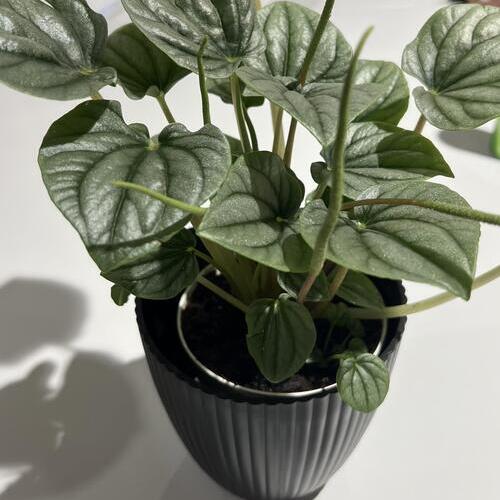
Emerald Ripple Peperomia (Peperomia caperata) is a compact, clump-forming perennial prized for its deeply corrugated, heart-shaped leaves that range from dark emerald green to near-black, often with a subtle metallic or purplish sheen. The crinkled, rippled texture of the foliage is the plant’s signature feature and the source of its common name, while the glossy surface catches light in a way that makes the ridges appear almost sculptural. Leaves are borne on slender, reddish petioles that rise from a low basal rosette, giving the plant a neat, mounding habit that rarely exceeds 8 to 10 inches in height.
Native to the tropical rainforests of South America, particularly Brazil, Peperomia caperata evolved as an epiphytic or semi-epiphytic understory plant, growing in the leaf litter, mossy banks, and crevices of larger trees where light is filtered and humidity is consistently high. This origin explains its preference for bright, indirect light, well-draining organic substrates, and its relatively small, shallow root system, which is adapted to absorbing moisture and nutrients quickly from thin layers of decomposing organic matter rather than deep soil.
Taxonomically, Peperomia caperata belongs to the Piperaceae family, the same family as black pepper (Piper nigrum), though peperomias themselves are grown almost exclusively as ornamental foliage plants rather than for culinary use. The genus Peperomia is enormous, comprising well over 1,000 recognized species, many of which share the compact growth habit, succulent-like water storage in their leaves and stems, and tolerance of lower light that make them popular houseplants. Emerald Ripple is one of the most widely cultivated cultivars within this genus, valued by both novice and experienced plant keepers for its manageable size, low maintenance needs, and striking texture.
Emerald Ripple Peperomia is widely regarded as one of the easiest houseplants to grow, making it an excellent choice for beginners, offices, and terrariums alike. It thrives in bright, indirect light but tolerates moderate or even low light conditions, and its semi-succulent leaves and stems allow it to store water, making it fairly forgiving of inconsistent watering schedules. A well-draining, chunky potting mix combined with a pot that has adequate drainage holes will prevent the root rot that is the most common cause of failure with this species.
Watering should follow a soak-and-dry approach: allow the top inch or two of soil to dry out between waterings, then water thoroughly until liquid drains from the bottom of the pot, discarding any excess. Because Emerald Ripple stores moisture in its leaves, it is considerably more tolerant of underwatering than overwatering, and a wilting or slightly wrinkled leaf is usually a faster, safer signal to water than a rigid schedule. Average household humidity is generally sufficient, though the plant will reward slightly elevated humidity with fuller, glossier growth.
Feeding is light and infrequent; a balanced, diluted liquid fertilizer applied monthly during the active spring and summer growing season is plenty, and fertilizer should be withheld or greatly reduced in fall and winter when growth naturally slows. Repotting is rarely urgent, as Emerald Ripple prefers to be slightly root-bound and generally only needs a new container every two to three years, or when roots are visibly circling the pot. With stable warm temperatures, indirect light, and careful attention to avoiding soggy soil, this compact tropical perennial will maintain its dense, rippled rosette of foliage for years with minimal intervention.
 Soil
Soil
Emerald Ripple Peperomia performs best in a light, well-draining, chunky potting mix that mimics the loose, organic-rich forest floor of its native habitat. An ideal blend combines standard peat-free or peat-based houseplant potting mix with perlite, coarse sand, or pumice, and a portion of orchid bark or coconut coir to improve aeration and prevent compaction; a common ratio is roughly two parts potting mix to one part perlite and one part orchid bark. The plant prefers a slightly acidic to neutral soil pH, generally in the range of 6.0 to 6.5, which supports efficient nutrient uptake without allowing salts or minerals to build up excessively.
Good drainage is essential because the plant’s shallow, semi-succulent root system is highly susceptible to rot in waterlogged conditions; a pot with ample drainage holes is strongly recommended regardless of soil quality. Soil amendments such as compost or worm castings can be mixed in sparingly at potting time to provide a slow, gentle nutrient source without overwhelming the plant’s modest fertility needs.
Common soil-related problems include poor drainage from overly dense, moisture-retentive mixes, which leads to root rot and yellowing leaves; soil compaction over time, which restricts oxygen to the roots and should be corrected by repotting with fresh, aerated mix; inappropriate pH, which can lock out nutrients and cause pale or stunted growth; salt build-up from fertilizer or hard tap water, visible as a white crust on the soil surface or pot rim, which is remedied by flushing the soil thoroughly with distilled water; nutrient deficiencies, often showing as pale leaves or slowed growth and addressed with a light, balanced feeding schedule; and root boundness, which occurs when the plant is left in the same pot too long, causing roots to circle the container and reducing the plant’s ability to take up water and nutrients, resolved by repotting into a slightly larger container with fresh soil.
 Fertilizer
Emerald Ripple Peperomia has light feeding requirements and benefits from a balanced, water-soluble liquid houseplant fertilizer (such as a 20-20-20 or similar balanced NPK ratio) diluted to half or quarter strength and applied once a month during the active growing season of spring through summer. Feeding should be reduced significantly or stopped entirely during fall and winter when the plant’s growth naturally slows and excess nutrients are more likely to accumulate rather than be used.
Signs of over-fertilization include a visible white or crusty salt buildup on the soil surface or pot rim, browning or burnt-looking leaf tips and edges, and stunted or distorted new growth. Signs of under-fertilization include pale or yellowing older leaves, slow or minimal new growth over an extended period, and a generally less vigorous, thin appearance to the rosette. Organic alternatives such as diluted worm casting tea, fish emulsion, or a light top-dressing of compost can supply gentle, slow-release nutrition and are well tolerated by this species. Emerald Ripple does not have unusual or specialized nutrient requirements beyond standard balanced fertility, though it can be sensitive to nutrient salt buildup, making an occasional thorough water flush of the soil a helpful preventive practice.
 Watering
Water Emerald Ripple Peperomia using a soak-and-dry method: allow the top inch to inch-and-a-half of soil to dry out completely before watering again, then water thoroughly until excess drains from the pot’s drainage holes, and empty any standing water from the saucer. This typically translates to watering roughly every one to two weeks, though frequency depends heavily on light, temperature, humidity, and pot size. The plant prefers room-temperature water and is sensitive to the chlorine, fluoride, and mineral salts found in some tap water supplies; filtered water, distilled water, or rainwater is ideal, though many growers successfully use tap water left to sit out for 24 hours to allow chlorine to dissipate.
Because its leaves and stems store water in a semi-succulent fashion, Emerald Ripple is considerably more tolerant of brief underwatering than overwatering. Signs of underwatering include slightly wrinkled, limp, or softened leaves and a lighter-than-normal pot, which typically resolve quickly after a thorough watering. Signs of overwatering are more serious and include yellowing lower leaves, a mushy or blackened stem base, a persistently soggy soil surface, and in advanced cases a foul odor indicating root rot.
Watering needs shift seasonally: during the active growth period of spring and summer, the plant uses water more quickly and may need watering slightly more often, while in fall and winter, when growth slows and light levels drop, the soil should be allowed to dry out further between waterings to avoid rot in cooler, slower-draining conditions.
Stop guessing. Most houseplant failures are caused by volumetric errors and improper moisture tension. Our deterministic calculator moves beyond "once-a-week" watering by analyzing the four critical pillars of root health:
Personalized for this plant
Disclaimer: Our calculator is pretty smart. We’ve crunched the numbers, but we’re not measuring the quantum state of your living room. Since we don’t know your exact indoor temperature, humidity, light, airflow, or whether your plant receives daily sweet nothings and motivational speeches, use this calculator as a guide—and always keep an eye on your plant.
 Lighting
Emerald Ripple Peperomia thrives in bright, indirect light, such as that found a few feet back from an east- or north-facing window, or filtered through a sheer curtain in a south- or west-facing room. It also tolerates moderate and even fairly low light conditions, making it suitable for interior offices or rooms without direct window exposure, though growth will be slower and less compact in dim settings. Direct, unfiltered sunlight, especially through south- or west-facing glass in the afternoon, should be avoided as it can scorch the thick, textured leaves.
Signs of insufficient light include leggy, stretched growth with elongated petioles, smaller new leaves, a loss of the leaves’ characteristic deep color and ripple texture, and a generally sparse, open rosette. Signs of excessive light include bleached, pale, or yellowing patches on leaves, brown crispy edges or scorch marks, and leaves that curl or become dull as a defense against intense exposure. If natural light is suboptimal, rotating the plant periodically to encourage even growth, moving it closer to or further from a window, or supplementing with a full-spectrum LED grow light positioned twelve to eighteen inches above the foliage for ten to twelve hours a day can help maintain compact, healthy growth.
 Temperature
Emerald Ripple Peperomia thrives in warm, stable temperatures between 65 and 80 degrees Fahrenheit (18 to 27 degrees Celsius), which closely mirrors the consistent warmth of its tropical rainforest habitat. The plant has limited tolerance for temperature fluctuations and should be protected from cold drafts near doors and windows, as well as from hot, dry air generated by heating vents or radiators. It is sensitive to cold and should never be exposed to temperatures below about 50 degrees Fahrenheit (10 degrees Celsius), as prolonged chill can cause leaf drop, blackened tissue, and root damage.
To protect the plant from extreme cold, keep it away from drafty windowsills in winter and avoid placing it outdoors once nighttime temperatures approach the 50s Fahrenheit; to protect it from excessive heat, keep it out of direct afternoon sun and away from appliances that generate consistent warm airflow. Stable, moderate indoor temperatures with minimal swings will keep the plant healthiest and most consistently ornamental year-round.
 Humidity
Emerald Ripple Peperomia prefers moderate to fairly high humidity, ideally in the range of 40 to 60 percent, reflecting its rainforest understory origins, though it adapts reasonably well to average indoor humidity levels found in most homes. To increase humidity, growers can group plants together to create a shared moisture zone, place the pot on a pebble tray filled with water (ensuring the pot base sits above the waterline rather than in standing water), or run a small room humidifier nearby. To decrease humidity in overly damp environments, improving air circulation with a small fan and avoiding overcrowding of foliage can help prevent fungal issues.
Symptoms of low humidity stress include crispy or browning leaf edges, slowed growth, and leaves that appear thinner or less plump than usual. Symptoms of excessively high humidity combined with poor airflow include soft, water-soaked patches on leaves and increased susceptibility to fungal or bacterial diseases such as leaf spot. Pebble trays offer a mild, localized humidity boost and are generally effective for modest increases; misting provides only a brief, superficial effect and is less reliable, with the added risk of promoting fungal spotting if water sits on the leaves; a humidifier offers the most consistent and effective humidity control, particularly in dry climates or heated indoor spaces during winter.
 Propagation
Emerald Ripple Peperomia is most commonly propagated through leaf cuttings and stem cuttings, both of which root readily in the right conditions, with stem cuttings generally offering the fastest and most reliable results and leaf cuttings offering a fun, low-cost way to produce multiple new plants from a single leaf.
Step-by-step leaf cutting method: 1. Select a healthy, mature leaf with at least an inch of its petiole (leaf stem) attached. 2. Using clean, sharp scissors or a blade, cut the leaf away from the main plant at the base of the petiole. 3. Allow the cut end to air-dry and callous over for a few hours to reduce the risk of rot. 4. Insert the petiole end into a small pot of moist, well-draining propagation mix (or place it in a small container of water), burying just the petiole so the leaf blade rests above the surface. 5. Place the cutting in bright, indirect light and maintain consistent light moisture without waterlogging the mix. 6. Cover loosely with a plastic bag or propagation dome to raise humidity, venting occasionally to prevent mold. 7. Check for root and small plantlet development at the base of the petiole after four to eight weeks. 8. Once roots are an inch or more long and a new tiny rosette has formed, transplant the young plant into its own small pot with standard peperomia potting mix.
Step-by-step stem cutting method: 1. Select a healthy stem section with at least two to three leaves attached. 2. Cut just below a leaf node using clean, sharp scissors. 3. Remove the lowest leaf to expose a node for rooting. 4. Allow the cut end to callous for a few hours. 5. Insert the cut end into moist propagation mix or water, ensuring the node is buried or submerged. 6. Place in bright, indirect light and keep consistently moist but not soggy. 7. Roots typically appear within two to four weeks. 8. Once roots reach one to two inches, pot the cutting into its own container.
Stem cuttings generally have a higher success rate and root more quickly than leaf cuttings, since they already contain an active growth node, while leaf cuttings, though slower and sometimes less consistent, can produce several new plantlets from a single leaf under ideal conditions. Late spring through summer is the best time to propagate, taking advantage of the plant’s natural active growth phase, and newly propagated plants typically take two to three months to become established, self-sufficient rosettes ready for standard care.
 Potting
Emerald Ripple Peperomia does best in a relatively small pot with excellent drainage, such as a terracotta or unglazed ceramic container with multiple drainage holes, since terracotta’s porous walls help excess moisture evaporate and further reduce the risk of root rot. The plant actually prefers being slightly root-bound and grows best in a pot only marginally larger than its root ball, using a well-draining, chunky soil mix as described in the soil section.
Repotting is generally needed only every two to three years, or when clear signs indicate the plant has outgrown its container: roots visibly circling the drainage holes or growing out of them, water running straight through the pot without being absorbed, noticeably slowed growth despite good care, or the plant becoming top-heavy and unstable in its container. When repotting, choose a new pot only one size (about one to two inches in diameter) larger than the current one to avoid excess soil retaining too much moisture.
Root pruning is rarely necessary for this species given its naturally compact root system, but if roots are extremely dense or circling tightly, gently teasing them apart or trimming away no more than the outer quarter of the root mass with clean shears can encourage healthier outward growth. To transition the plant with minimal stress, water it a day before repotting to keep the root ball intact, handle the roots gently, place fresh soil beneath and around the root ball in the new pot without burying the crown any deeper than it was previously growing, water thoroughly after repotting, and keep the plant out of direct sun and in stable conditions for one to two weeks while it adjusts.
 Pruning
The best time to prune Emerald Ripple Peperomia is during the active growing season in spring or summer, when the plant recovers most quickly from cuts. Light maintenance pruning can be done as needed throughout the year whenever damaged or leggy growth appears.
Pruning is used to remove damaged, yellowing, or dead leaves, control legginess in lower-light conditions, encourage bushier growth, and harvest healthy stem or leaf cuttings for propagation.
Use clean, sharp scissors or precision pruning snips. Sterilize the blades with rubbing alcohol before and between cuts to prevent the spread of disease, and work in good light so individual leaves and stems are easy to see clearly.
After pruning, keep the plant in its normal bright, indirect light location, maintain the usual watering schedule, and avoid fertilizing for one to two weeks to let the plant recover without added stress.
Avoid removing more than about a quarter of the plant’s total foliage in a single session to prevent excessive stress, and always use clean tools to minimize the risk of introducing bacterial or fungal pathogens through fresh cuts.
 Blooming
Emerald Ripple Peperomia can flower intermittently throughout the year when grown indoors under adequate light, though blooming is inconsistent and is grown primarily for foliage rather than flowers. The blooms appear as thin, upright, rat-tail-like spikes (spadices) in cream to pale green or reddish tones that rise several inches above the foliage on slender stalks. Individual spikes can persist for several weeks. Flowering is most likely to occur during the warmer growing months of spring through summer when light levels and temperatures are highest, and is rare during the dormant winter period. The flowers themselves are small, densely packed, and lack showy petals, so the display is subtle and textural rather than colorful; many growers remove the spikes for aesthetic preference since they contribute little visual impact compared to the foliage.
 Pests and Diseases
Name: Mealybugs
Symptoms: Small, white, cottony clusters at leaf joints and undersides of leaves; sticky honeydew residue; yellowing or distorted new growth.
Treatment: Isolate the plant, wipe off visible bugs with a cotton swab dipped in rubbing alcohol, and treat the entire plant with insecticidal soap or neem oil, repeating every seven to ten days until the infestation clears.
Name: Spider Mites
Symptoms: Fine webbing on the undersides of leaves and between stems, tiny speckled or stippled discoloration on leaf surfaces, and an overall dull, dusty appearance to the foliage.
Treatment: Increase humidity, rinse the plant thoroughly under lukewarm water to dislodge mites, and apply insecticidal soap or neem oil weekly until no further activity is observed.
Name: Fungus Gnats
Symptoms: Small, dark flying insects around the soil surface, along with larvae feeding on organic matter and fine roots in overly moist soil.
Treatment: Allow the soil to dry out more thoroughly between waterings, use yellow sticky traps to catch adults, and apply a beneficial nematode drench or a diluted hydrogen peroxide soil drench to eliminate larvae.
Name: Root Rot
Symptoms: Yellowing and wilting leaves despite moist soil, a mushy or blackened stem base, foul odor from the soil, and stunted overall growth.
Treatment: Remove the plant from its pot, trim away all blackened or mushy roots with sterilized scissors, repot into fresh, well-draining mix and a clean pot, and reduce watering frequency going forward.
Name: Bacterial Leaf Spot / Ring Spot Virus
Symptoms: Water-soaked or dark, sunken spots on leaves, sometimes with a yellow halo; in ring spot virus, distinctive concentric ring patterns may appear on foliage.
Treatment: Remove and discard affected leaves promptly, avoid overhead watering and wetting the foliage, improve air circulation, and isolate the plant from other houseplants since ring spot virus can spread and has no cure once established.
Name: Powdery Mildew
Symptoms: White, powdery patches on leaf surfaces, typically in overly humid conditions with poor air circulation.
Treatment: Improve airflow around the plant, avoid overcrowding, remove heavily affected leaves, and treat with a light application of neem oil or a fungicidal spray labeled for powdery mildew.
 Special Features
Emerald Ripple Peperomia stands out for its richly textured, deeply corrugated foliage, which gives it a sculptural, almost three-dimensional quality unusual among common houseplants and makes it a favorite for terrariums, dish gardens, and mixed foliage displays where its ripples contrast beautifully with smoother-leaved companions. Its compact, slow-growing rosette habit means it rarely outgrows its space, making it ideal for small apartments, desks, and shelves. As a semi-succulent plant, it is notably forgiving of occasional neglect, and its non-toxic nature adds a practical benefit for pet owners and families with small children. While its flower spikes are subtle rather than showy, the overall visual interest of the plant comes almost entirely from its glossy, richly colored, and intricately veined leaves, which remain the primary reason growers seek it out.
 Plant Benefits
Emerald Ripple Peperomia has no established significant herbal, medicinal, or pharmaceutical uses in mainstream or clinical practice; it is grown almost exclusively as a decorative foliage houseplant. Some traditional folk uses of various Peperomia species in their native regions have been documented anecdotally for minor topical or herbal remedies, but these are not scientifically validated for Peperomia caperata specifically, and the plant should not be used medicinally. Its primary benefit is ornamental and psychological, contributing to indoor greenery, biophilic design, and the general wellbeing associated with caring for houseplants.
 Additional Information
Emerald Ripple Peperomia is part of a broader group of ornamental peperomias sometimes marketed together with cultivars like ‘Little Fantasy’ (a dwarf sport) and various color forms such as ‘Luna Red’ or tricolor variegated types, all sharing the same rippled-leaf trait but differing in size or coloration. It was popularized in the houseplant trade in the mid-20th century and remains a staple of terrarium and dish garden design due to its compact size and tolerance of enclosed, humid environments. Unlike many trailing or climbing Piperaceae relatives, Emerald Ripple maintains a tidy rosette form throughout its life, making it a predictable and low-maintenance long-term houseplant.
 Life Cycle
Emerald Ripple Peperomia is a slow-growing, long-lived evergreen perennial that does not die back seasonally. New leaves emerge from the center of the rosette on reddish petioles, gradually unfurling and darkening to their mature deep green, corrugated texture over several weeks. The plant reaches a mature, full rosette size of roughly six to ten inches in height and spread within one to two years under good care, after which growth continues at a slow, steady pace, primarily through the production of new leaves and occasional offsets or side shoots at the base. Under favorable indoor conditions, individual plants can live for many years, periodically refreshed through repotting, pruning, and propagation of new generations from leaf or stem cuttings.
 Are Emerald Ripple Peperomia Poisonous, Toxic
Emerald Ripple Peperomia is considered non-toxic and is one of the safer common houseplants for households with pets and children. No part of the plant — leaves, stems, or roots — contains significant levels of toxic compounds affecting cats, dogs, or humans. Accidental ingestion of a small amount of foliage is unlikely to cause more than mild, transient gastrointestinal upset such as slight stomach discomfort or, rarely, mild vomiting due to the physical irritation of plant fiber rather than any toxic principle. Severity is considered negligible to mild. If a pet or child ingests a large quantity, monitor for vomiting, diarrhea, or lethargy, offer fresh water, and contact a veterinarian, pediatrician, or poison control center if symptoms persist or worsen, though serious reactions are not expected. As a general precaution with any houseplant, it is still wise to keep foliage out of easy reach of curious pets and young children, use hanging planters or high shelves where possible, and supervise pets in rooms with houseplants to discourage chewing habits.
 Frequently Asked Questions
 Can I grow Emerald Ripple Peperomia in my indoor space
Difficulty: Easy
Size: Small
Light: Medium
Water: Low
Flowering: Yes
Pet Safe: Yes
Air Purifier: Low
 Peperomia caperata botanical details
Common Name: Emerald Ripple Peperomia
Other Common Names: Ripple Peperomia, Emerald Ripple, Green Ripple Peperomia, Little Fantasy Peperomia (for the related dwarf cultivar), Peperomia caperata Emerald Ripple, Rippled Peperomia
Botanical Name: Peperomia caperata
Native Area: Tropical South America, primarily the rainforests of Brazil, with related populations found across other humid tropical regions of Central and South America.
Family Name: Piperaceae
Plant Type: Herbaceous perennial (evergreen, semi-succulent foliage plant)
Genus: Peperomia
Kingdom: Plantae
 Photo Gallery
 My Emerald Ripple Peperomia Plant Care Recommendations
If you find the Houseplant Encyclopedia helpful and would like to support Healthy Houseplants, you can use the links below to shop for recommended plants, products, and plant-care supplies.
Some links are affiliate links, which means I may earn a small commission if you make a qualifying purchase through them, at no additional cost to you. Thank you for supporting Healthy Houseplants and helping me continue to provide free plant-care information!

Want even more personalized plant-care help? Check out my AI Julie Chatbot—trained on my 20 years of houseplant knowledge, not just information from the internet!  Try it now:Ask AI Julie
 Buy Emerald Ripple Peperomia Online
✅ “Bring Home This Beauty Today”
✅ “Get Your Own Emerald Ripple Peperomia Before It’s Gone”
✅ “Shop Trusted Sellers – Limited Availability”
✅ “Free Delivery”
As an Amazon Associate, I earn commission from qualifying purchases.
 Plant Puns and Jokes
Why did the Emerald Ripple Peperomia refuse to enter the watering competition? It already knew it would win by a landslide of ripples, but decided to stay dry and let the succulents sweat it out instead.
 Signup to our newsletter and download Emerald Ripple Peperomia care guide

