Downpotting Houseplants: When Your Plant Needs a Smaller Pot
 Julie Bawden-DavisAugust 28, 2026


 Julie Bawden-DavisAugust 28, 2026
When you repot a houseplant, chances are you expect to move it into a larger pot. Sometimes, though, the healthiest thing you can do for your plant is exactly the opposite. You may need to do what I call downpotting—moving the plant into a smaller pot.
Recently, a reader contacted me about her ailing aloe vera, which ended up needing to be downpotted. The plant was growing in a pot that was much too large for its size, so I suggested she repot the aloe into a smaller container.
When she removed the plant from its pot, it became clear just how necessary downpotting was. Very little of the root system remained. The oversized pot had left the aloe surrounded by far more potting soil than its roots could use. Because there weren’t enough roots to take up the moisture throughout all that soil, the excess soil remained wet for too long. Those constantly wet conditions caused roots to rot and die back, leaving the aloe with an even smaller root system—and an even greater amount of excess wet soil surrounding what remained.
This is something I’ve seen many times with overpotted houseplants. Sometimes the plant develops obvious root rot and rapidly declines. Other times, the symptoms are much less dramatic. The plant simply stops growing and sits there.
Meanwhile, below the soil, the root system is shrinking rather than expanding.
Downpotting means repotting a plant into a smaller container than the one in which it is currently growing. This may sound counterintuitive. We’re so accustomed to hearing that plants should be moved into progressively larger pots, so going backward can feel wrong. But the size of the pot should be determined by the plant’s current root mass, not by the size of the pot it happened to be growing in before.
If a plant has lost a substantial portion of its roots, keeping it in the same oversized container won’t help those roots recover. It can perpetuate the conditions that caused the problem in the first place.
Downpotting restores a healthier relationship between the amount of roots and the amount of potting soil surrounding them.
Plant roots require both moisture and oxygen. When a relatively small root system is surrounded by a large volume of potting soil, there aren’t enough roots to use the moisture throughout the container. The soil around the active roots may begin to dry as the plant drinks, but soil farther away from the roots can remain wet.
That prolonged moisture can reduce the amount of oxygen available to roots and create conditions conducive to root decline and root rot. I sometimes describe severe overpotting as planting a houseplant in a lake. There simply aren’t enough roots to use all that moisture.
And contrary to a common belief, putting a small plant into a large pot doesn’t necessarily encourage the plant to develop a huge root system and “grow into” its new home. Sometimes the opposite occurs.
A plant doesn’t have to be dying before you consider the possibility that its pot is too large.
Watch for signs such as:
That last sign is especially important.
You can make an educated guess about whether a houseplant is overpotted by looking at it, but you won’t really know what is happening with the roots until you remove the plant from the pot.
Wet soil isn’t the only reason a houseplant can lose roots. Severe or repeated underwatering can also cause root dieback. When roots become excessively dry, portions of the root system can die. A plant may consequently end up with substantially less root mass than it once had.
The same thing can happen following root rot, disease, physical root damage or a period of serious plant stress. This creates an important situation that many indoor gardeners overlook.
Perhaps your plant was originally growing in an appropriately sized pot. If it subsequently loses half of its root system, that same pot may now be too large. Pot size isn’t permanent. It needs to correspond to the plant you have today.
This is one of the most important things I’ve learned from decades of growing and teaching about houseplants. When you’re repotting a struggling plant, don’t automatically decide ahead of time that you’re going up a pot size.
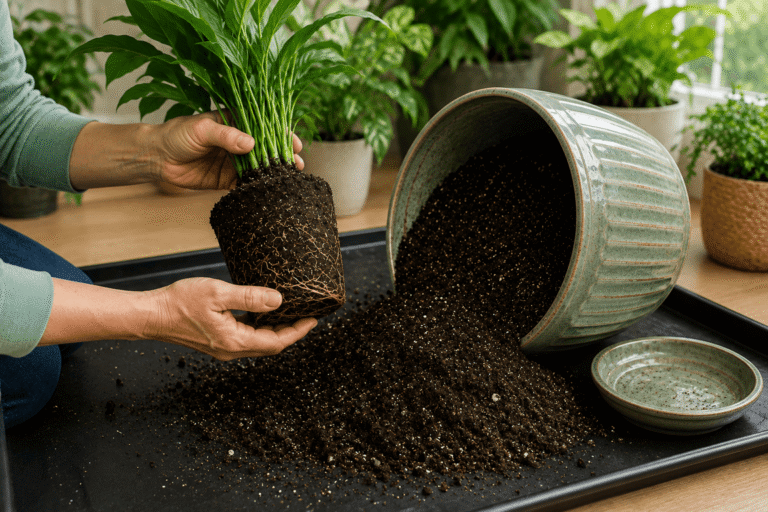
Remove the plant first. Then gently clear away enough potting soil to see the roots and examine their condition. Healthy roots will vary in appearance according to the plant, but you’re looking for a viable, substantial root system rather than roots that are sparse, mushy, rotted, dried up or dead.
Remove dead and rotted roots with clean pruning shears when necessary. Then examine what’s left. That’s the root system you need to pot—not the root system the plant used to have.
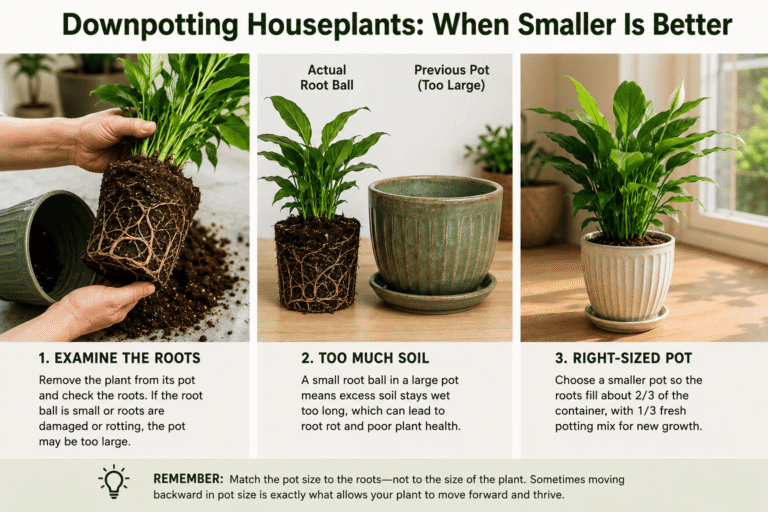
When choosing a new pot, I use my 2/3 roots-to-1/3 new soil ratio. The idea is simple. You want the existing root mass to occupy approximately two-thirds of the space, with roughly one-third available for fresh potting soil and new root growth.
This isn’t something you need to measure. Eyeball it. The goal is to provide enough fresh soil for the roots to expand without putting a small root ball in the middle of a huge amount of unused potting mix.
This below-ground ratio works alongside my 2/3 plant-to-1/3 pot ratio, which I’ve taught since the mid-1990s. Together, the two ratios help you choose a pot that makes sense both for the plant you see and the root system you don’t.
Once you’ve examined the roots, choose a clean container that corresponds to the remaining root mass. Make sure the pot has adequate drainage holes.
Add a high-quality, well-draining potting mix, and position the root ball so the plant will sit at approximately the same depth it was growing previously. Don’t bury the crown or stem more deeply in an attempt to make the smaller pot work.
Fill around the roots with fresh potting soil, firming the mix enough to eliminate large air pockets without packing it tightly.
When you’re finished, there shouldn’t be several inches of unused soil surrounding a tiny root ball. If there are, the new pot is probably still too large.
After repotting, return the plant to the same location whenever possible. A plant recovering from root loss is already under stress, so this generally isn’t the time to suddenly change several other growing conditions as well. Provide the plant with the appropriate light for the species and pay particularly close attention to watering while new roots develop.
This is where some indoor gardeners become nervous. If a plant has retained a substantial amount of foliage but lost much of its root system, the correctly sized new pot may look surprisingly small beneath it. That’s okay.
I’ve encountered situations in which root loss was so extensive that I temporarily used closer to a 3/4 plant-to-1/4 pot proportion while the root system recovered. The health of the roots takes priority over making the plant and pot look perfectly proportioned.
As the plant recovers and produces new roots, it can eventually graduate to a larger container.
A smaller pot doesn’t mean you’re sentencing your plant to remain small. The purpose of downpotting is to give the existing roots an environment in which they can function well and begin growing again.
Once those roots have developed sufficiently, the plant can be repotted into a somewhat larger container.
Think of the larger pot as something the plant grows its way into, rather than something you provide in advance in hopes that growth will follow. Healthy roots drive healthy top growth.
Not every plant with root problems needs to be downpotted. After removing the plant and examining its roots, you may discover that the root system is healthy but simply doesn’t warrant a larger container. In that case, you can remove some of the old, depleted potting soil, replace it with fresh mix and return the plant to the same pot or one of approximately the same size.
There are really three possibilities when you repot: Pot up, remain at the same pot size, or downpot. Which one you choose should depend primarily on what you find when you examine the roots.
I’ve heard from many Healthy Houseplants viewers who realized after learning about proper pot sizing that they’d been overpotting their plants.
One viewer told me that after watching my videos, she went through and repotted several plants into appropriately sized containers. Her bird of paradise had been growing in a pot about five times the size of its root ball. When she removed it, she discovered the beginnings of root rot.
Another viewer realized that an overpotted peace lily needed a smaller container and downpotted it.
These are common mistakes because putting a plant in a generous pot seems like a generous thing to do. But houseplants don’t need the biggest pots we can give them. They need pots that correspond to the roots they have.
If your houseplant has stopped growing, repeatedly suffers from overly wet soil, or simply doesn’t seem to be thriving, take a look below the soil line.
Sometimes moving backward in pot size is exactly what allows a plant to start moving forward again.
Tap a question to expand the answer.
Downpotting means moving a plant from its current container into a smaller one so that the amount of potting soil better corresponds to the plant’s existing root mass.
Remove the plant from its container and examine the roots. If the root system occupies only a small portion of the pot, particularly because roots have died back, a smaller container may be appropriate.
Yes. After removing rotted roots, the remaining root system may be substantially smaller and require a smaller pot. Remove the rotted roots and spray the remainder with Hydrogen Peroxide, then repot in a smaller container.
Yes. Severe or repeated underwatering can cause root death. If substantial root loss occurs, the plant may require a smaller pot even though excessive moisture wasn’t the original problem.
An appropriately sized pot doesn’t prevent healthy growth. If the root system is currently small, matching the container to those roots can provide better conditions for root recovery and future growth. The plant can be moved into a larger pot when its root system is ready.
No. Look at the roots first. Depending on their size and condition, you may need a larger pot, approximately the same size pot, or a smaller pot.
I use an approximate 2/3 roots-to-1/3 new soil ratio. It’s a visual guideline rather than an exact measurement. The goal is to avoid surrounding a small root system with an excessive volume of potting soil.