Every houseplant guide tells you a calathea wants 60 percent humidity. Almost none of them tell you that the humidity in your living room is set by decisions made when your house was built, and by whether the roof above you is doing its job.
This is why two people can follow identical care instructions and get completely different results, and why the same plant that thrived all summer starts crisping in November.
The Number on the Hygrometer Is Moving More Than You Think
Buy an inexpensive hygrometer and watch it for a week. It will read differently in the morning than the afternoon, differently upstairs than down, and dramatically differently in January than in July.
That’s not the instrument being unreliable. Relative humidity is genuinely a moving target. Understanding why explains most of the mysterious seasonal decline that plant owners often blame on themselves.
Rooms Have Microclimates and Plants Sit in Them
The spot beside a heating vent is dry and turbulent. The windowsill on a north wall is cool and stable. The bathroom is humid twice a day and ordinary the rest of the time. An upstairs room under an uninsulated roof plane swings further in both directions than anywhere else in the house.
Plants don’t experience “the house.” They experience about a cubic foot of air in one location. That means moving a struggling Ficus benjamina six feet can do more for the plant than any change to your houseplant care routine.
Warm Air Is a Bigger Container
Here is the piece of physics that makes the seasonal pattern make sense, and it’s simpler than it sounds.
Ask a roofer in a hot climate, such as someone at Roofing The Woodlands TX, what an under-ventilated attic does to a house. The answer is about moisture as much as heat, because trapped warm air holds water and eventually gives it back somewhere you didn’t want it.
The same principle runs in reverse indoors in winter. You pull in cold outdoor air that’s holding very little water, heat it to 70 degrees, and the amount of water in it hasn’t changed at all while its capacity has roughly doubled. The result is a room that reads 25 percent relative humidity while you haven’t changed anything about your habits. Your plants notice the drop in humidity immediately, though.
Why the Weather Service Talks About Dew Point Instead
Meteorologists worked out long ago that relative humidity on its own is misleading. The way they handle it is especially useful to plant owners.
As theNational Weather Service explains, dew point is the temperature air would have to be cooled to for it to reach 100 percent saturation. This measures the actual moisture present rather than a percentage of capacity. Their own illustration of why relative humidity misleads is a good one: a temperature of 30 with a dew point of 30 gives you 100 percent relative humidity, while a temperature of 80 with a dew point of 60 gives you 50 percent, and the second is far more humid in any way that matters.
Translated to your windowsill, a winter day at 100 percent outdoor humidity contains a fraction of the water a muggy summer afternoon does. Bring that air inside and heat it, and there is simply not much moisture available to your plants, no matter what the outdoor forecast said.
What Actually Raises Humidity Around a Plant
Given all this, the effective interventions to increase humidity are local rather than whole-house.
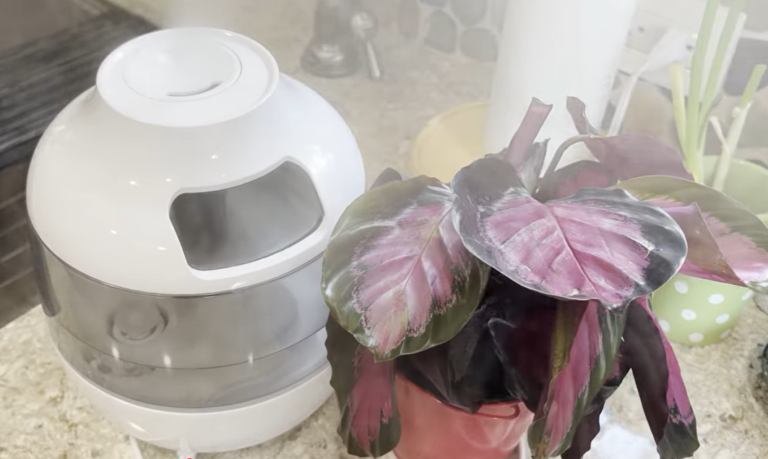
Grouping plants together works because they transpire into shared air. Pebble trays work modestly, and only if the pot sits above the waterline rather than in it. A small humidifier works genuinely well and is the only reliable option for a room that runs very dry. Misting doesn’t help much, because the effect lasts minutes, though it does no harm.
Choose For the Room You Have
What works best of all is choosing plants suited to the room you actually have, rather than the room you’d like. A pothos in a dry hallway will outperform a maranta in the same spot every time.
Plants Are an Effective Early Warning System for Home Health
Sudden unexplained improvement in a humidity-loving plant is a strange thing to be suspicious of, but if a fern in an upstairs room perks up in a season when everything else is struggling, something is adding moisture to that air. A persistent musty smell near a plant that isn’t overwatered, white bloom on a terracotta pot in one room only, or soil that stays wet far longer than the same mix elsewhere in the house are all worth investigating rather than celebrating.
Plant owners are unusually observant about the air in their homes, and that makes them likely to catch a slow roof or plumbing leak before it becomes a ceiling stain.
Read the Room Before You Change the Routine
When a plant declines, the reflex is to adjust what you’re doing, such as providing more water, less water, different fertilizer, or a bigger pot.
Before making such changes, try reading the location first. Where is the nearest vent, and is it blowing? Which direction does the window face, and has the sun angle changed with the season? Is this an interior wall or an exterior one? What does a hygrometer sitting next to the plant actually say at 8 am and again at 4 pm?
Most struggling houseplants aren’t being cared for badly. They’re sitting in a spot that changed while nobody was watching, and the fix is usually a location rather than a technique.
Julie Bawden-Davis is a best-selling garden author, blogger, YouTuber and Master Gardener dedicated to sharing indoor gardening expertise with aspiring gardeners. She has published several gardening books and more than 5,000 articles in major publications. A former garden columnist for the LA Times, San Francisco Chronicle and Parade.com, she is founder of HealthyHouseplants.com and its YouTube channel.
 Julie Bawden-DavisAugust 6, 2026