


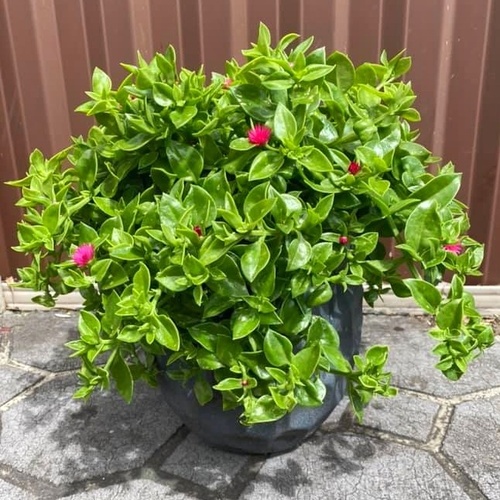
Baby Sunrose (Aptenia cordifolia) is a low-growing, mat-forming succulent groundcover prized for its glossy, heart-shaped leaves and cheerful, daisy-like flowers. Native to the coastal regions of South Africa, particularly the Eastern and Western Cape provinces, this plant thrives in sandy, well-drained soils along dunes and rocky outcrops where it has adapted to intense sun, salt spray, and periods of drought. Its trailing, fleshy stems root readily wherever they touch soil, allowing the plant to spread quickly and form a dense, weed-suppressing carpet.
The foliage is a defining feature: small, bright green, spade- or heart-shaped leaves with a slightly succulent, glistening texture that gives the plant part of its common alternate name, Heartleaf Iceplant. The tiny crystalline cells on the leaf surface catch light and sparkle, a trait shared with many members of the ice plant family. Flowers are small, star-shaped, and typically a vivid magenta-pink to red-purple, opening fully in bright sunlight and closing on cloudy days or at night, a behavior typical of many mesembryanthemum relatives.
As a member of the Aizoaceae family, Baby Sunrose is closely related to other well-known South African succulent groundcovers. It is widely cultivated worldwide in Mediterranean-climate gardens, coastal landscapes, and as a container or hanging basket plant. Because it is fast-growing, drought-tolerant, and tolerant of poor soils and salt air, it is a popular choice for erosion control, rock gardens, and low-maintenance xeriscaping, though in some regions (such as parts of California and Australia) it has naturalized and is considered mildly invasive along coastlines.
Baby Sunrose is considered one of the easiest succulent groundcovers to grow, making it an excellent choice for beginners and for gardeners looking to fill sunny, difficult-to-water areas with low-maintenance color. The single most important factor for success is light: this plant needs full sun for at least six hours a day to bloom well and maintain a compact, healthy habit. In lower light it will still survive but will stretch, produce fewer flowers, and become leggy.
Watering should follow a ‘soak and dry’ approach typical of succulents. Allow the top inch or two of soil to dry out completely between waterings, then water deeply. Overwatering is the most common cause of problems, leading to root rot and stem collapse, especially in cooler or humid conditions. In containers, always use a fast-draining succulent or cactus mix, and ensure the pot has drainage holes. Outdoors in the ground, sandy or gritty, well-drained soil is essential; heavy clay soils should be amended with coarse sand or perlite.
Beyond light and water, Baby Sunrose asks for very little. It tolerates poor, lean soils and generally does not need heavy feeding, though a light application of balanced fertilizer during the growing season can encourage more vigorous blooming. It is not frost hardy and should be treated as an annual in cold climates or brought indoors/protected where temperatures drop below freezing. Regular light pinching or trimming keeps the mat-forming habit dense and encourages branching, and the plant propagates so easily from stem cuttings that maintaining or expanding a planting costs almost nothing.
 Soil
Soil
Baby Sunrose performs best in sandy, gritty, fast-draining soil that mimics its native coastal dune habitat. A mix of standard potting soil combined with coarse sand, perlite, or pumice in roughly equal parts creates ideal drainage while still retaining enough structure for root anchorage. The plant is not fussy about pH, tolerating a fairly wide range from slightly acidic to slightly alkaline, roughly 6.0 to 7.5, though it shows a slight preference for neutral to mildly alkaline conditions given its native limestone-influenced coastal soils. Soil amendments such as coarse sand, pumice, or fine gravel improve drainage in heavier garden soils, while a small amount of compost can be worked in for very poor, sterile sand to supply trace nutrients.
Soil composition directly affects the plant’s health: because it is a succulent with water-storing leaves and stems, any soil that retains excess moisture around the roots quickly leads to rot. Conversely, extremely lean, sterile sand with no organic content at all can leave the plant under-nourished and slow to establish. The goal is a balance that drains within seconds of watering but still holds a light film of moisture and nutrients.
Common soil problems to watch for include poor drainage (heavy clay or compacted soil that stays wet, leading to root and stem rot), soil compaction (which restricts oxygen to the roots and stunts growth, especially in containers left too long without repotting), inappropriate pH (very acidic soils can lock out certain micronutrients), salt build-up (common in containers watered with hard tap water or over-fertilized, appearing as a white crust on the soil surface and pot rim), nutrient deficiencies (pale, yellowing new growth can indicate lean, exhausted soil), and root-boundness in container specimens, where a dense mat of roots circles the pot, reduces water uptake efficiency, and signals the need for repotting or root pruning.
 Fertilizer
Baby Sunrose is a light feeder that does not require heavy fertilization to thrive, reflecting its adaptation to lean, sandy native soils. During the active growing season (spring and summer), a balanced, water-soluble fertilizer diluted to half strength, applied once every 4-6 weeks, is generally sufficient to support healthy growth and flowering. Fertilizing should be paused or greatly reduced during fall and winter when the plant’s growth naturally slows.
Signs of over-fertilization include a white, crusty salt build-up on the soil surface or pot rim, burned or browned leaf tips and edges, and excessive soft, leggy growth at the expense of flowering. Signs of under-fertilization are less dramatic in this low-demand species but can include pale, yellowish new growth and a general lack of vigor or blooming over an extended period despite otherwise good care.
Organic alternatives such as compost tea, well-diluted fish emulsion, or a light topdressing of finished compost worked lightly into the surrounding soil in spring can provide gentle, slow-release nutrition without the risk of salt build-up associated with synthetic fertilizers. This species has no unusual or specific nutrient requirements beyond a standard balanced feeding approach; nitrogen should be kept moderate, as excess nitrogen tends to favor leafy growth over the compact, floriferous habit most growers want.
 Watering
Baby Sunrose follows a classic succulent watering pattern: water deeply, then allow the soil to dry out substantially before watering again. During the active growing season (spring through summer), this typically means watering every 1-2 weeks depending on climate, pot size, and rainfall; in cooler months or during winter dormancy, watering frequency should be reduced significantly, often to once every 3-4 weeks or less. The plant has no strong preference for water quality and does well with ordinary tap water, though in areas with very hard or heavily chlorinated water, occasional use of rainwater or filtered water can help prevent mineral salt build-up in the soil.
Signs of underwatering include leaves that appear slightly shriveled, wrinkled, or noticeably softer than usual, though the plant is quite drought-tolerant and can go a surprisingly long time before showing serious stress. Signs of overwatering are more serious and include yellowing, mushy, translucent leaves, blackened or soft stem bases, and a general wilting or collapse of the plant despite wet soil, which usually indicates root or stem rot has set in.
Watering needs shift seasonally: during the warm growing months with more sun and heat, the plant uses water faster and can tolerate more frequent watering, while in winter, when growth slows or stops, the roots are far more susceptible to rot and watering should be cut back drastically, sometimes to almost nothing if the plant is dormant and kept cool.
Stop guessing. Most houseplant failures are caused by volumetric errors and improper moisture tension. Our deterministic calculator moves beyond "once-a-week" watering by analyzing the four critical pillars of root health:
Personalized for this plant
Disclaimer: Our calculator is pretty smart. We’ve crunched the numbers, but we’re not measuring the quantum state of your living room. Since we don’t know your exact indoor temperature, humidity, light, airflow, or whether your plant receives daily sweet nothings and motivational speeches, use this calculator as a guide—and always keep an eye on your plant.
 Lighting
Full sun is ideal for Baby Sunrose, with at least 6 hours of direct sunlight daily; in cooler coastal or northern climates it can even handle a full day of sun without stress. In hot inland or desert climates, light afternoon shade can help prevent leaf scorch during the most intense summer heat. Indoors, place it in the brightest window available, ideally south- or west-facing.
Signs of insufficient light include leggy, stretched stems with wide spacing between leaves (etiolation), a loss of the plant’s naturally dense, mounding habit, and greatly reduced or absent flowering. Signs of excessive light or heat stress, though less common given the plant’s sun-loving nature, can include leaf scorch or bleaching (whitish or brown patches) in extremely intense, unshaded desert sun combined with high heat and low humidity.
If natural light is insufficient, especially for indoor or container specimens, moving the plant outdoors during the warm season, using a south-facing windowsill, or supplementing with a full-spectrum grow light for 10-12 hours a day can help maintain compact growth and encourage blooming.
 Temperature
Baby Sunrose thrives in warm temperatures between roughly 65-85°F (18-29°C) and grows most vigorously in this range. It is hardy outdoors year-round only in USDA zones 10-11, where winter temperatures stay above freezing; in zones 9 and below it is typically grown as a warm-season annual or overwintered indoors as a houseplant.
The plant has essentially no frost tolerance: exposure to temperatures at or below 32°F (0°C) will cause significant damage or death to foliage and stems, appearing as blackened, mushy tissue. It can tolerate brief dips into the high 30s to low 40s°F without serious harm but should be protected or brought inside well before a hard frost is expected.
To protect Baby Sunrose from extreme temperatures, gardeners in marginal climates can grow it in containers that are moved indoors for winter, apply frost cloth over garden plantings during cold snaps, or take stem cuttings in fall to root and overwinter indoors as insurance against losing the parent plant. In very hot climates, providing light afternoon shade during the most extreme summer heat helps prevent leaf scorch and stress.
 Humidity
Baby Sunrose is well adapted to low to moderate humidity, reflecting its native coastal, breezy habitat, and does not require any special humidity intervention in most climates. It generally tolerates average indoor humidity levels (around 30-50%) without issue, and its succulent leaves are naturally adapted to conserve moisture in dry air.
High humidity combined with poor air circulation is more of a concern than low humidity, as damp, stagnant conditions around the foliage can encourage fungal issues such as leaf spot or stem rot, particularly if the soil is also kept too moist. Symptoms of high-humidity stress include soft, translucent leaf patches, grey or black fungal spotting, and a general mushiness in stems and leaves. Low-humidity stress is uncommon in this species and, if it occurs at all in extremely arid, hot conditions, may show as slightly shriveled or crisp leaf edges.
Because this plant prefers drier air, humidifying methods like pebble trays or misting are not recommended and can actually promote fungal problems; instead, prioritize good airflow around the plant, whether outdoors with natural breezes or indoors with a small fan or well-ventilated location.
 Propagation
Baby Sunrose propagates extremely easily and reliably from stem cuttings, which is by far the most common and successful method used by gardeners. Seed propagation is possible but much slower and less predictable, and division of rooted mat sections is also viable for established garden plantings.
Step-by-step stem cutting propagation:
1. Select a healthy, non-flowering stem tip about 3-4 inches (7-10 cm) long from an actively growing plant.
2. Using clean, sharp scissors or pruning snips, cut the stem just below a leaf node.
3. Remove the lower leaves from the bottom inch or two of the cutting, leaving several leaves at the top.
4. Allow the cut end to callus over by setting the cutting in a dry, shaded spot for 1-2 days; this helps prevent rot once planted.
5. Prepare a small pot with well-draining succulent or cactus mix, lightly moistened.
6. Insert the callused end of the cutting about an inch into the soil, firming gently around the base.
7. Place the pot in bright, indirect light initially, avoiding direct hot sun for the first week.
8. Water lightly to settle the soil, then allow the top layer to dry before watering again.
9. Roots typically begin forming within 1-3 weeks; a gentle tug will reveal slight resistance once rooted.
10. Once rooted and showing new growth, gradually move the cutting into fuller sun and resume a normal soak-and-dry watering schedule.
Stem cuttings have a very high success rate, often 90% or better under proper conditions, and this is by far the preferred propagation method among growers. Division of an established mat, simply lifting and separating naturally rooted trailing stems, is nearly as reliable and offers a faster route to a larger established plant. Seed propagation has a lower and more variable success rate and takes considerably longer to reach a mature, floriferous plant, so it is rarely used outside of breeding or conservation contexts. The best time to propagate is in spring or early summer, when warm temperatures and active growth support the fastest rooting; new cuttings typically establish and begin vigorous growth within 4-6 weeks.
 Potting
Baby Sunrose does well in a relatively shallow, wide pot that accommodates its trailing, mat-forming habit, made from a porous material like terracotta that helps excess moisture evaporate. The pot must have at least one drainage hole, and a layer of coarse gravel or broken pottery at the bottom can further improve drainage in pots without excellent design. Ideal soil composition is a fast-draining succulent or cactus mix, ideally amended with extra perlite, pumice, or coarse sand to ensure water moves through quickly.
Repotting is generally needed every 1-2 years, or sooner if the plant is growing vigorously in a small container. Signs that Baby Sunrose needs repotting include roots visibly emerging from the drainage holes or circling densely at the soil surface, water running through the pot too quickly without being absorbed (a sign of a root-bound, soil-depleted mix), and slowed growth or reduced flowering despite otherwise good care.
When repotting, gently remove the plant from its old container and inspect the root ball; if roots are densely circling or matted, light root pruning with clean scissors can encourage healthier, more spreading root growth in the new pot. Choose a new pot only slightly larger than the previous one, as oversized pots hold excess moisture that can lead to root rot in this drought-adapted species. To minimize transplant stress, repot during the active growing season, water lightly a day or two before repotting to ease the plant from its pot, handle the root ball gently, and avoid heavy watering immediately after repotting, allowing the plant to settle for a few days in bright but indirect light before resuming a normal care routine.
 Pruning
The best time to prune Baby Sunrose is during the active growing season in spring and summer, though light shaping can be done at almost any time except right before an expected frost.
Light trimming every 4-6 weeks during the growing season keeps the plant dense and encourages continuous flowering; a harder cutback can be done once a year, typically in early spring, to rejuvenate leggy or overgrown plants.
Pruning serves several purposes for this species: it maintains a compact, mounding habit rather than allowing long, sparse trailing stems; it encourages branching and therefore more flowers; it removes any damaged, rotted, or frost-affected growth; and it controls the plant’s spread in garden settings where it might otherwise become invasive.
Use clean, sharp scissors, garden snips, or pruning shears. Wipe blades with rubbing alcohol before and between plants to prevent spreading disease. Water the plant lightly a day before pruning if the soil is very dry, to reduce stress.
Keep the freshly pruned plant in its normal light conditions, water lightly, and avoid heavy fertilization for a week or two while it recovers and pushes new growth.
Because stems root wherever they touch soil, pruned trailing stems in garden beds may have already rooted along their length; consider this when cutting back groundcover plantings, as removed sections may leave gaps that take time to refill.
 Blooming
Baby Sunrose blooms prolifically from late spring through summer and into early fall in most climates, and in frost-free, mild-winter regions it may flower nearly year-round. Individual flowers are short-lived, opening for a single day in bright sunlight and closing by late afternoon or on overcast days, but the plant produces a continuous succession of new blooms during the growing season. Optimal blooming occurs with full sun exposure (6+ hours daily), moderate warmth, and a soak-and-dry watering rhythm; too much shade or excess water reduces flower production. The star-shaped flowers, typically magenta, pink, or red-purple with a fine, daisy-like ring of narrow petals surrounding a small central cluster of stamens, are about 1.5 to 2.5 cm across and attract bees and other pollinators.
 Pests and Diseases
Issue: Aphids
Symptoms: Clusters of small green, black, or brown insects on new growth and flower buds; sticky honeydew residue; distorted or curled new leaves.
Treatment: Rinse plants with a strong spray of water, apply insecticidal soap or neem oil, and introduce natural predators like ladybugs in outdoor settings.
Issue: Mealybugs
Symptoms: Small, cottony white masses in leaf joints and along stems; sticky residue; stunted or yellowing growth.
Treatment: Dab individual pests with a cotton swab dipped in isopropyl alcohol, and treat more widespread infestations with insecticidal soap or neem oil applied every 7-10 days until resolved.
Issue: Scale insects
Symptoms: Small, brown or tan raised bumps along stems and leaf undersides that do not rub off easily; sticky honeydew; yellowing foliage.
Treatment: Scrape off visible scale with a soft brush or fingernail, then apply horticultural oil or insecticidal soap, repeating treatments as needed to catch newly hatched insects.
Issue: Snails and slugs
Symptoms: Irregular holes chewed in leaves, especially in cool, damp conditions; slime trails visible on and around the plant.
Treatment: Hand-pick pests in the evening or early morning, use pet-safe iron phosphate slug bait, and reduce moist mulch or debris near the plant base.
Issue: Root and stem rot
Symptoms: Blackened, mushy stem bases; yellowing, translucent, or collapsing leaves; foul odor from the soil; general wilting despite moist soil.
Treatment: Remove the plant from wet soil, trim away all affected, mushy tissue with a sterile blade, allow remaining healthy sections to dry and callus, and repot in fresh, fast-draining soil while reducing future watering frequency.
Issue: Fungal leaf spot
Symptoms: Small, dark, water-soaked or brown circular spots on leaves, sometimes with a yellow halo, typically appearing in humid or poorly ventilated conditions.
Treatment: Remove and dispose of affected leaves, improve air circulation around the plant, avoid overhead watering, and apply a copper-based fungicide if the problem persists or spreads.
Issue: Powdery mildew
Symptoms: White, powdery coating on leaf surfaces, particularly in humid conditions with poor airflow; can lead to leaf distortion or yellowing over time.
Treatment: Increase air circulation, avoid wetting foliage when watering, remove heavily affected leaves, and treat with a sulfur-based or potassium bicarbonate fungicide if needed.
 Special Features
Baby Sunrose offers a distinctive combination of glossy, light-catching succulent foliage and vividly colored, sun-tracking flowers that open and close with the daylight, giving garden beds and containers a lively, ever-changing appearance throughout the growing season. Its rapid, self-rooting trailing habit makes it exceptionally useful as a living mulch, erosion-control groundcover on slopes and banks, or spiller plant cascading over the edges of pots and hanging baskets. The plant’s tolerance for salt spray, poor soil, and drought makes it a standout choice for coastal gardens and xeriscape designs where many other flowering groundcovers would struggle, and its flowers are attractive to bees and other pollinators, adding a measure of ecological value to low-water landscaping.
 Plant Benefits
Aptenia cordifolia has a history of limited traditional and folk use in its native South Africa, where the succulent leaves have occasionally been used as a minor food source in salads or cooked greens by some communities, valued for their mild, slightly tangy, salty flavor typical of many mesembs. However, it is not a significant medicinal or pharmaceutical plant in modern herbalism, and no well-established, scientifically validated therapeutic uses or active pharmaceutical compounds have been widely documented for this species. It is grown almost exclusively for ornamental and landscaping purposes rather than for herbal or medicinal benefit.
 Additional Information
Baby Sunrose is sometimes confused with true ice plants in the genus Delosperma or Carpobrotus, close relatives within the Aizoaceae family that share a similar sparkling leaf texture and daisy-like flowers; gardeners should confirm the specific species when purchasing, as care needs are similar but not identical. In some coastal regions, notably parts of California, Australia, and the Mediterranean, Aptenia cordifolia has naturalized outside cultivation and can spread aggressively along dunes and disturbed coastal habitat, so gardeners in these regions may want to check local invasive-species guidance before planting it extensively near wild areas.
 Life Cycle
Baby Sunrose is a fast-growing, mat-forming perennial succulent in its native and warm-climate range, with a lifespan of several years when protected from frost. From a rooted cutting or seed, the plant establishes quickly, typically producing trailing stems and beginning to flower within its first few months of active growth. It follows a continuous vegetative and flowering cycle through the warm season, with growth slowing or pausing during cooler winter months. In frost-free climates it can persist and spread indefinitely as a semi-evergreen groundcover, continually rooting along its stems to renew itself, while in colder climates it is usually grown as a warm-season annual, completing its life cycle within a single growing season unless brought indoors or replaced by overwintered cuttings.
 Are Baby Sunrose Poisonous, Toxic
Aptenia cordifolia is not listed among plants toxic to cats, dogs, or humans by major veterinary and poison-control references. No specific toxic compounds, affected plant parts, target organisms, symptoms, or severity ratings have been established in the literature for this species. As a general precaution, ingestion of any unfamiliar plant material can occasionally cause mild gastrointestinal upset (drooling, mild vomiting, or diarrhea) in pets or children simply due to plant fiber and foreign material, rather than a specific toxin. If a pet or child consumes a significant amount of the plant and shows any signs of distress, it is always advisable to contact a veterinarian, physician, or poison control center for first-aid guidance. As a preventive measure, it is good general practice to keep any houseplant out of reach of pets and small children and to supervise them around garden plantings, regardless of a species’ known toxicity status.
 Frequently Asked Questions
Water deeply only after the soil has dried out, typically every 1-2 weeks in the growing season and much less often in winter, following a soak-and-dry approach typical of succulents.
Baby Sunrose is not listed as toxic to cats or dogs by major veterinary references, though any unfamiliar plant material can occasionally cause mild stomach upset if eaten in quantity.
It needs full sun, ideally at least six hours of direct light daily, to maintain compact growth and produce abundant flowers.
Baby Sunrose is closely related to true ice plants and shares the family Aizoaceae with genera like Delosperma and Carpobrotus, but it is a distinct species with its own characteristic heart-shaped leaves.
No, it has very little frost tolerance and is typically damaged or killed by temperatures at or below freezing, so it must be protected or brought indoors in cold climates.
The easiest method is stem cuttings: take a 3-4 inch tip cutting, let it callus for a day or two, then plant it in well-draining succulent mix, where it typically roots within 1-3 weeks.
Insufficient sunlight is the most common cause of poor flowering; the plant needs several hours of direct sun daily to bloom well, along with a proper soak-and-dry watering routine.
It needs sandy, fast-draining soil, ideally a succulent or cactus mix amended with coarse sand or perlite, with a pH range of roughly 6.0 to 7.5.
In some coastal regions outside its native South Africa, such as parts of California and Australia, it has naturalized and can spread aggressively, so gardeners should check local guidance before planting near wild coastal habitat.
It is a small, low-growing groundcover, typically reaching only a few inches in height while spreading two feet or more as trailing stems root along the ground.
 Can I grow Baby Sunrose in my indoor space
Difficulty: Easy
Size: Small
Light: High
Water: Low
Flowering: Yes
Pet Safe: Yes
Air Purifier: Low
 Aptenia cordifolia botanical details
Common Name: Baby Sunrose
Other Common Names: Heartleaf Iceplant, Red Apple, Dew Plant, Sun Rose, Baby Sun Rose, Trailing Iceplant, Hearts and Flowers
Botanical Name: Aptenia cordifolia
Native Area: Coastal South Africa, primarily the Eastern Cape and Western Cape provinces
Family Name: Aizoaceae
Plant Type: Perennial succulent groundcover (grown as an annual in cold climates)
Genus: Aptenia
Kingdom: Plantae
 Photo Gallery
 My Baby Sunrose Plant Care Recommendations
If you find the Houseplant Encyclopedia helpful and would like to support Healthy Houseplants, you can use the links below to shop for recommended plants, products, and plant-care supplies.
Some links are affiliate links, which means I may earn a small commission if you make a qualifying purchase through them, at no additional cost to you. Thank you for supporting Healthy Houseplants and helping me continue to provide free plant-care information!

Want even more personalized plant-care help? Check out my AI Julie Chatbot—trained on my 20 years of houseplant knowledge, not just information from the internet!  Try it now:Ask AI Julie
 Buy Baby Sunrose Online
✅ “Bring Home This Beauty Today”
✅ “Get Your Own Baby Sunrose Before It’s Gone”
✅ “Shop Trusted Sellers – Limited Availability”
✅ “Free Delivery”
As an Amazon Associate, I earn commission from qualifying purchases.
 Plant Puns and Jokes
Why did the Baby Sunrose refuse to worry about anything? Because no matter how dry things got, it always knew how to keep its cool and stay succulent about life.
 Signup to our newsletter and download Baby Sunrose care guide

