


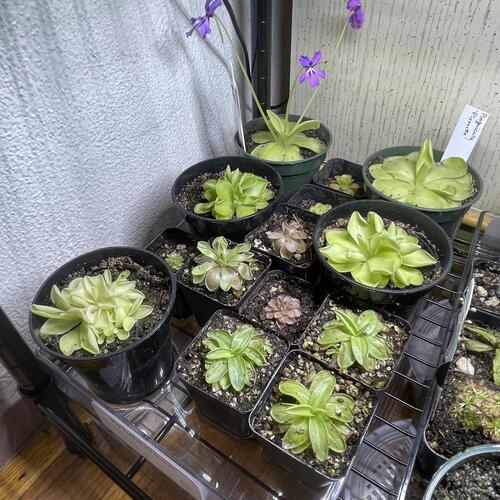
Butterwort refers to the roughly 80 to 110 species that make up the genus Pinguicula, a group of carnivorous plants in the bladderwort family, Lentibulariaceae. The name comes from the Latin word pinguis, meaning “fat” or “greasy,” a direct reference to the shiny, slippery texture of the leaves, which were historically thought to resemble butter. Rather than trapping insects with snapping jaws or bladders like their relatives the Venus flytrap and Utricularia, butterworts use a passive flypaper mechanism: the upper surface of each leaf is covered in two types of glands, one that secretes a sticky mucilage to snare small insects and another that releases digestive enzymes to break the prey down and absorb the resulting nutrients.
Butterworts are native to a remarkably wide range of habitats across the Northern Hemisphere and parts of South America, including the boggy meadows of Europe, the limestone cliffs of Mexico, the arctic tundra of North America, and the cloud forests of the Andes. This broad distribution has produced two very different growth strategies within the same genus. Temperate and arctic species, sometimes called “cold-hardy” butterworts, form a low rosette of carnivorous leaves in the warmer months and then contract into a tight, dormant, non-carnivorous winter bud called a hibernaculum to survive freezing conditions. Warm-growing species, most famously the Mexican butterworts, instead grow carnivorous “summer” leaves during the humid growing season and switch to thicker, succulent, non-carnivorous leaves during a drier winter rest, making them look almost like a different plant depending on the season.
The flowers of Pinguicula are one of the genus’s most ornamental features and are often mistaken for violets, to which they bear no botanical relation. Each bloom is held well above the sticky foliage on a slender, leafless stalk, an adaptation that keeps pollinators safe from the trap below. Flower colors range from deep violet and pink to white, yellow, and bicolor combinations, and many species have a distinctive spur at the back of the corolla that holds nectar. Because they thrive in nutrient-poor, mineral soils where competition from larger plants is limited, butterworts have become popular subjects for growers interested in carnivorous plants, valued both for their curious feeding habit and for their surprisingly delicate, orchid-like blooms.
Caring for butterworts starts with understanding that they are adapted to nutrient-poor, consistently moist substrates, which is the opposite of what most houseplants need. A well-draining, mineral-based mix of peat, sand, and perlite (or specialty mixes for Mexican species that include additional inorganic grit) keeps roots healthy while denying weeds and algae the nutrients they need to compete with the plant. Standing the pot in a shallow tray of water, refilled with distilled water, rainwater, or reverse-osmosis water, mimics the boggy or seasonally damp conditions of their native habitats and protects the plant from the mineral salt buildup that tap water can cause over time.
Light and temperature requirements vary somewhat by species group, but as a rule butterworts want bright, indirect light or a few hours of gentle direct morning sun; a windowsill or a spot under grow lights for 12 to 14 hours a day works well for most growers. Temperate species need a genuine winter dormancy with cooler temperatures to remain healthy long-term, while Mexican and other warm-growing species prefer stable indoor temperatures year-round with a drier rest period rather than a cold one. Because these plants derive nitrogen and other nutrients from captured insects rather than the soil, fertilizing the growing medium is unnecessary and can actually damage the roots; if supplemental feeding is desired, it should be limited to very dilute foliar applications or the occasional small insect placed directly on a leaf.
Beyond watering and light, day-to-day maintenance is refreshingly simple. Butterworts rarely need pruning beyond removing spent flower stalks and the occasional dead or blackened leaf, and pest problems are uncommon precisely because the plant is built to catch small crawling and flying insects itself. The main risks come from environmental mismatches, such as chlorinated or hard tap water, stagnant humid air that encourages fungal disease, or skipping the dry winter rest that Mexican species need to reset for the following growing season. With attentive water quality and an understanding of which growth type you’re growing, butterworts are one of the more forgiving carnivorous plants for a beginner to keep thriving for years.
 Soil
Soil
Butterworts need a mineral, nutrient-poor substrate rather than a rich, organic potting mix, since fertile soil encourages root rot and algae rather than helping the plant, which gets its nutrients from prey instead of the ground. A standard mix of roughly equal parts peat moss (or coco coir) and coarse sand or perlite works well for most temperate species, while Mexican and other warm-growing species often do better in an even more mineral-heavy blend with added pumice, lava rock, or vermiculite for extra drainage and aeration around the roots. Most butterworts tolerate a fairly wide pH range but generally do best in slightly acidic to neutral soil, roughly pH 5.5 to 7, with Mexican limestone-dwelling species tolerating or even preferring the higher end of that range. Good drainage is essential despite the plant’s love of moisture, since it prevents the roots from sitting in stagnant, oxygen-poor conditions even while the pot is kept damp or standing in a shallow water tray. Avoid any soil amendments containing fertilizer, compost, or manure, as these introduce nutrient levels and dissolved salts that butterwort roots are not adapted to handle. Common soil problems include poor drainage leading to root and crown rot, compaction from repeated watering that suffocates the roots and calls for repotting into fresh, looser mix, inappropriate pH from tap water or the wrong substrate blend, salt build-up from mineral-heavy tap water that appears as a white crust on the soil surface, nutrient imbalance from accidental use of fertilized potting soil, and root-boundness in older plants that have outgrown a shallow pot and need dividing or upsizing.
 Fertilizer
Because butterworts obtain nitrogen and other key nutrients from digesting trapped insects rather than from the soil, fertilizing the growing medium is unnecessary and can be actively harmful, since even mild fertilizer concentrations can burn the sensitive root system that has evolved for nutrient-poor conditions. If supplemental feeding is desired, the safer route is to occasionally place a very small live or freshly killed insect, such as a fruit fly or small gnat, directly onto a leaf, or to use an extremely diluted foliar orchid fertilizer (roughly a quarter-strength or weaker) misted lightly onto the leaf surface no more than once or twice a month during active growth. Signs of over-fertilization include blackened, mushy, or dying leaves and a rapid decline in the crown, while under-fertilization is rarely an issue since a healthy butterwort grown in the correct substrate and given occasional prey is self-sufficient. Organic alternatives to synthetic fertilizer largely come down to insect feeding itself, which mimics the plant’s natural nutrient source far more safely than any soil amendment.
 Watering
Butterworts are consistently thirsty plants that are typically grown standing in a shallow saucer of water, allowing the soil to stay evenly moist to wet during the active growing season without ever drying out completely. Purified water — distilled, rainwater, or reverse osmosis — is strongly preferred over tap water, since the dissolved minerals and chlorine in most tap water build up in the soil over time and can damage the fine root system. Underwatering shows up as shriveled, curling leaves and a rosette that pulls inward or collapses, while overwatering in a mix that lacks adequate drainage can lead to soft, blackened crowns and root rot, even though the plant tolerates far more standing water than typical houseplants. Watering needs shift seasonally: temperate species should be watered less, or the tray removed entirely, during their cold winter dormancy when the plant has contracted into its hibernaculum, while Mexican species generally need a noticeably drier rest period in winter with just enough moisture to keep the succulent winter leaves from shriveling, followed by a return to the tray method once new carnivorous leaves emerge in spring.
Stop guessing. Most houseplant failures are caused by volumetric errors and improper moisture tension. Our deterministic calculator moves beyond "once-a-week" watering by analyzing the four critical pillars of root health:
Personalized for this plant
Disclaimer: Our calculator is pretty smart. We’ve crunched the numbers, but we’re not measuring the quantum state of your living room. Since we don’t know your exact indoor temperature, humidity, light, airflow, or whether your plant receives daily sweet nothings and motivational speeches, use this calculator as a guide—and always keep an eye on your plant.
 Lighting
Most butterworts prefer bright, indirect light with a few hours of gentle direct sun, such as an east-facing windowsill, a lightly shaded south or west window, or 12 to 14 hours under a fluorescent or LED grow light positioned close to the foliage. Insufficient light causes leaves to stretch, lose their compact rosette shape, produce weak or sparse mucilage, and fail to flower, while the plant may also take on a duller, less colorful green. Excessive, intense direct sun, particularly through glass in summer, can scorch the leaf margins, cause them to curl or bleach, and dry out the sticky secretions the plant relies on to trap insects. If natural light is inconsistent, growers commonly supplement with LED or T5 grow lights placed 6 to 12 inches above the plant, adjusting the duration and distance seasonally, and rotating the pot periodically encourages even, symmetrical growth rather than leaning toward a single light source.
 Temperature
Ideal temperatures depend heavily on which type of butterwort is being grown. Temperate and arctic species do best with warm summers around 65 to 80°F (18 to 27°C) followed by a genuine cold winter dormancy that can safely dip near or just below freezing depending on the species, since this cold rest is necessary for long-term vigor and flowering. Mexican and other warm-growing species prefer more stable conditions year-round, generally 60 to 85°F (16 to 29°C), and do not tolerate hard frost, needing to be kept indoors or in a protected greenhouse through winter. Across both groups, sudden temperature swings and prolonged extreme heat can stress the plant and reduce its ability to trap prey, so providing some insulation from drafts, radiators, and unshaded summer windows helps keep growth steady and healthy.
 Humidity
Butterworts generally appreciate moderate to high humidity, roughly 50 percent or above, though many species are more flexible about ambient air moisture than other carnivorous plants because they rely primarily on wet soil rather than humid air. Low humidity paired with dry soil can cause leaf margins to curl and the mucilage on the leaf surface to dry out, reducing the plant’s ability to trap insects, while excessively high humidity combined with poor air circulation raises the risk of fungal issues like botrytis, especially on Mexican species during their drier winter phase. Simple methods such as grouping plants together, using a pebble tray filled with water beneath (not touching) the pot, or running a small room humidifier nearby are usually sufficient; misting directly onto the leaves is less effective and can interfere with the sticky trapping mechanism, so bottom watering and ambient humidity control are generally the better approach.
 Propagation
Butterworts can be propagated by leaf pulling (also called leaf cuttings), division of offsets, or seed, with leaf pulling being the most popular method among home growers for its reliability and relatively high success rate. To propagate by leaf pulling: 1) Wait until the plant is actively growing and select several healthy, undamaged outer leaves from the rosette. 2) Gently grasp each leaf at its base and pull it away from the crown with a slight twisting motion so the full leaf, including its base, comes away cleanly. 3) Lay the leaves flat, sticky-side up, on the surface of a moist, mineral propagation mix such as damp peat and perlite or pure sphagnum moss. 4) Place the tray in bright, indirect light and maintain high humidity, either with a humidity dome or a loosely covered container. 5) Keep the medium consistently moist but not waterlogged, checking regularly for mold and providing light air exchange if needed. 6) Within a few weeks to a couple of months, tiny plantlets should begin forming at the base of each leaf. 7) Once the new plantlets have several leaves of their own and a small root system, carefully transplant them into individual small pots with standard butterwort mix. Division of naturally offsetting species is faster and nearly guarantees success, since it simply involves separating an already-rooted offset from the parent plant at repotting time, while propagation from seed is the slowest method, often taking a year or more to reach a mature-looking rosette, though it allows for new genetic combinations in species that hybridize. Leaf pulling is generally most successful in spring or early summer at the start of active growth, with new plantlets typically reaching a size ready for individual potting within four to twelve months depending on species and growing conditions.
 Potting
Butterworts do best in shallow, wide pots, such as squat plastic pots or bulb pans, that suit their relatively shallow root systems better than deep containers, which tend to hold stagnant water at the bottom. Drainage holes are still recommended even though the plant is often grown standing in a water tray, since this allows the mineral, well-aerated substrate to avoid becoming fully waterlogged and anaerobic at the root zone. Repotting is generally needed every one to two years, or whenever the plant becomes root-bound, the substrate breaks down and compacts, or mineral salts visibly build up on the soil surface. Signs it’s time to repot include a crowded or dense mass of roots visible at the drainage holes, slowed growth despite good light and water, and a rosette that has significantly outgrown the pot’s diameter. Because butterwort roots are fine and easily damaged, aggressive root pruning is rarely necessary; instead, gently teasing the roots free of old substrate and trimming away only clearly dead or rotted sections is usually sufficient. To transition a plant to a new pot with minimal stress, repot at the start of the active growing season, use fresh mix similar in composition to the old one, keep the plant consistently moist for the first few weeks afterward, and avoid direct hot sun until the roots have re-established.
 Pruning
Prune butterworts primarily during the active growing season, removing spent flower stalks after blooming and any dead, blackened, or rotting leaves as they appear, rather than following a strict seasonal schedule.
Regular light grooming improves airflow around the crown, reduces the risk of fungal disease, redirects the plant’s energy toward healthy new leaves, and keeps the rosette looking tidy.
Use small, clean scissors or fine-tipped tweezers, sterilized with rubbing alcohol before and between plants to avoid spreading disease, and work in good lighting so damaged tissue is easy to distinguish from healthy leaves.
After pruning, maintain normal light and humidity but avoid overly saturating the crown for a day or two, and monitor the plant for a week to ensure no infection develops at the pruning sites; Mexican species entering their dry winter rest often shed several leaves naturally, which is a normal part of their cycle and not a sign of a problem requiring aggressive pruning.
 Blooming
Most butterwort species bloom in spring through early summer, with some Mexican species flowering intermittently again in fall under stable indoor conditions. A single flowering period typically lasts several weeks, with individual blooms persisting open for one to two weeks each on wiry, leafless stalks held above the foliage. Optimal blooming is triggered by a combination of increasing day length, bright light, and (for temperate species) a preceding cold dormancy that resets the plant’s flowering cycle; Mexican species often bloom most reliably during their humid summer growth phase. Flowers are five-lobed and bilaterally symmetrical, resembling small violets or snapdragons, usually 1 to 3 cm across, in shades of purple, pink, white, or yellow, often with a contrasting throat pattern and a backward-pointing nectar spur.
 Pests and Diseases
Issue: Aphids
Symptoms: Small clusters of soft-bodied insects on new leaves or flower stalks, sticky honeydew residue, and distorted new growth.
Treatment: Remove aphids by hand or with a gentle stream of water, and if the infestation persists use a very dilute insecticidal soap applied carefully to avoid coating the leaf traps.
Issue: Mealybugs
Symptoms: White, cottony masses typically at leaf bases or in the crown, along with stunted or distorted growth.
Treatment: Dab affected areas with a cotton swab dipped in diluted rubbing alcohol, and isolate the plant from others until the infestation is fully cleared.
Issue: Fungus gnats
Symptoms: Small flies hovering around the soil surface; larvae feeding on roots can weaken young or newly propagated plants.
Treatment: Allow the soil surface to dry slightly between waterings where possible, use yellow sticky traps to catch adults, and consider a mosquito-bit (BTI) soil drench for larvae.
Issue: Crown or root rot
Symptoms: Blackened, mushy tissue at the base of the rosette, a foul smell, and sudden collapse of the plant.
Treatment: Remove the plant from wet conditions, trim away all affected tissue with a sterilized tool, and repot into fresh, well-draining mix, reducing water until new growth confirms recovery.
Issue: Botrytis (gray mold)
Symptoms: Fuzzy gray mold on leaves or dying flower stalks, especially in cool, stagnant, humid conditions.
Treatment: Improve air circulation, remove affected tissue promptly, and reduce ambient humidity slightly while keeping the root zone moist as usual.
Issue: Algae growth on soil or in water tray
Symptoms: Green or black slimy film on the soil surface or tray water, which can compete with the plant and indicate excess nutrients or light exposure to standing water.
Treatment: Refresh the water tray regularly with purified water, reduce direct light on the tray itself, and gently scrape or replace the top layer of algae-affected substrate.
 Special Features
Butterworts stand out among houseplants for their carnivorous flypaper trapping mechanism, using glistening, dew-like leaves to lure, capture, and digest small insects such as fungus gnats and fruit flies, which makes them a genuinely useful natural pest control plant for a windowsill or grow room. Beyond their practical value, many species produce strikingly ornamental, violet-like flowers held on delicate stalks above the sticky foliage, offering an unexpected contrast between the plant’s predatory function and its delicate bloom. Mexican butterworts add a further layer of seasonal interest by transforming between a low, carnivorous summer rosette and a compact, succulent winter form, giving growers two distinct looks from the same plant across the year.
 Plant Benefits
Historically, some European butterwort species were used in folk medicine as a mild wound-healing or skin-soothing application due to the antimicrobial properties of their leaf mucilage, and in parts of Scandinavia the sticky leaves were traditionally used to curdle fresh milk into a soft, yogurt-like product called filmjölk. Modern pharmaceutical research into these antimicrobial and enzymatic properties remains limited and largely preliminary, so butterworts are grown today primarily as ornamental and pest-control plants rather than as a source of established herbal or medicinal treatments.
 Additional Information
Butterwort has been used as a subject of botanical curiosity since the 18th century, when Carl Linnaeus first classified the genus Pinguicula, and it remains a favorite entry point for beginners into the wider hobby of growing carnivorous plants because it is generally less fussy than sundews or Venus flytraps. Some Mexican species are also popular in specialty succulent collections during their winter dormant form, when they resemble a small, tidy rosette rather than an obviously carnivorous plant.
 Life Cycle
Butterworts are perennial plants that cycle between an actively growing carnivorous phase and a dormant or resting phase each year. Temperate species germinate or resume growth in spring, form a rosette of sticky, insect-trapping leaves through summer, flower once conditions are favorable, and then contract into a tight, non-carnivorous winter bud called a hibernaculum that survives cold temperatures with minimal water. Mexican and other warm-growing species instead alternate between broad, carnivorous “summer” leaves during the humid growing season and smaller, thick, succulent “winter” leaves during a drier rest period, without needing a cold dormancy. In both types, individual leaves are continuously produced and shed over the plant’s lifespan, while the crown itself can persist and produce new rosettes and offsets for many years under good care.
 Are Butterwort Poisonous, Toxic
Butterworts are not considered toxic to cats, dogs, or humans, including children. No part of the plant — leaves, flowers, or roots — contains compounds known to be poisonous if touched or accidentally ingested in small amounts. The sticky leaf secretions exist to trap small insects, not to harm larger animals, and there are no documented cases of toxic reactions in pets or people from casual contact or chewing. The primary risk is mechanical rather than chemical: curious pets may dig up or knock over the pot, and the mucilage can stick unpleasantly to fur, paws, or fingers, which is best resolved by gently washing the area with warm water rather than pulling roughly. Because the plant is grown in specialty substrates and sits in a water tray, the more realistic hazard is a pet drinking stagnant tray water or ingesting soil additives, so as a general precaution keep the water tray fresh and the plant out of easy reach of chewing pets. No specific first aid beyond basic cleaning is typically necessary, but any pet owner concerned about an ingestion should still contact a veterinarian for guidance, as with any plant material.
 Frequently Asked Questions
Butterworts are considered intermediate in difficulty. They are more forgiving than many carnivorous plants but still need purified water, mineral soil, and the correct light and dormancy conditions for their species type.
Butterworts trap and digest small insects such as fungus gnats, fruit flies, and gnats using sticky mucilage on their leaf surfaces, which supplies nitrogen and other nutrients the plant cannot get from poor native soils.
No, butterwort is not considered toxic to cats, dogs, or humans. The sticky leaf secretions are meant to trap small insects and pose no known poisoning risk to pets.
Butterworts need a nutrient-poor, mineral, well-draining mix, typically peat or coco coir combined with sand or perlite, with slightly acidic to neutral pH and no added fertilizer.
Most butterworts are kept consistently moist by standing the pot in a shallow tray of distilled water, rainwater, or reverse-osmosis water, with reduced watering during winter dormancy depending on the species.
Feeding is not strictly required if the plant is otherwise growing well in the right conditions, but occasional small insects landing on the leaves naturally supplement nutrients and support stronger growth.
Reduced stickiness usually indicates low humidity, insufficient light, or the natural transition into a dry-season or dormant, non-carnivorous leaf form typical of many Mexican species.
The most common method is leaf pulling, where a healthy leaf is gently removed with its base intact and laid on moist propagation mix until new plantlets form, typically within a few weeks to a couple of months.
Yes, butterworts can thrive indoors on a bright windowsill or under grow lights, provided they receive adequate light, purified water, and appropriate seasonal dormancy or rest conditions for their species type.
Yes, butterworts produce delicate, violet-like flowers on slender stalks above the foliage, typically blooming in spring through early summer depending on the species and growing conditions.
 Can I grow Butterwort in my indoor space
Difficulty: Intermediate
Size: Small
Light: Medium
Water: High
Flowering: Yes
Pet Safe: Yes
Air Purifier: Low
 Pinguicula spp. botanical details
Common Name: Butterwort
Other Common Names: Bog violet, Marsh violet, Flycatcher, Greasy plant, Pinguicula
Botanical Name: Pinguicula spp.
Native Area: Butterworts are native to temperate, arctic, and subtropical regions across the Northern Hemisphere and parts of South America, including much of Europe, North America, northern Asia, and notably the mountainous, limestone-rich regions of Mexico and Central America, which are home to the greatest diversity of species.
Family Name: Lentibulariaceae
Plant Type: Perennial (carnivorous herbaceous rosette)
Genus: Pinguicula
Kingdom: Plantae
 Photo Gallery
 My Butterwort Plant Care Recommendations
If you find the Houseplant Encyclopedia helpful and would like to support Healthy Houseplants, you can use the links below to shop for recommended plants, products, and plant-care supplies.
Some links are affiliate links, which means I may earn a small commission if you make a qualifying purchase through them, at no additional cost to you. Thank you for supporting Healthy Houseplants and helping me continue to provide free plant-care information!

Want even more personalized plant-care help? Check out my AI Julie Chatbot—trained on my 20 years of houseplant knowledge, not just information from the internet!  Try it now:Ask AI Julie
 Buy Butterwort Online
✅ “Bring Home This Beauty Today”
✅ “Get Your Own Butterwort Before It’s Gone”
✅ “Shop Trusted Sellers – Limited Availability”
✅ “Free Delivery”
As an Amazon Associate, I earn commission from qualifying purchases.
 Plant Puns and Jokes
Why did the butterwort get invited to every picnic? Because it always brings something sticky to the table and never complains about the flies.
 Signup to our newsletter and download Butterwort care guide

