Houseplant Lighting: The Complete Guide to Growing Healthy Indoor Plants
 Plant ParentJuly 24, 2012



 Plant ParentJuly 24, 2012
Disclosure: This article contains affiliate links, and one linked review is sponsored. If you buy through an affiliate link, we may earn a commission at no extra cost to you.
We’ve all tried growing houseplants in less-than-ideal lighting conditions. At first, the plant looks great and we pat ourselves on the back. But inevitably, it begins to lose leaves and look sickly. If it’s truly starved for light, the plant will eventually die.
Nurseries might go out of business if more indoor gardeners understood just how important proper lighting is to houseplants.
Unlike humans and animals, plants make most of their own food. Light provides the energy for photosynthesis, the process by which plants use water and carbon dioxide to produce sugars that fuel plant growth.
Without sufficient light, houseplants can’t photosynthesize effectively. They may begin using stored carbohydrates to survive. As those reserves are depleted, growth slows, leaves may yellow and drop, and the plant becomes increasingly weak.
Some plants tolerate low-light conditions better than others, but there’s an important difference between a plant surviving and thriving.
Houseplants receiving insufficient light may exhibit:
That last point is particularly important. When plants receive inadequate light, photosynthesis and growth often slow, and they may use considerably less water. As a result, potting soil can remain wet longer, reducing oxygen availability around the roots and creating conditions that favor root rot.
Proper lighting isn’t simply about making your plants look attractive. It affects nearly every aspect of their health.
One of the most confusing aspects of growing houseplants is determining what terms such as low light, medium light, bright indirect light and direct sunlight actually mean.
These descriptions appear on plant labels and in care guides, but the amount of light they represent can vary considerably. Understanding the differences will help you choose appropriate locations for your houseplants.
Low light refers to locations that receive limited natural illumination, such as areas several feet from a window or near a north-facing window in the Northern Hemisphere.
Low light does not mean no light. Plants that tolerate low-light conditions are generally adapted to growing beneath forest canopies, where taller vegetation filters much of the sunlight.
These plants can often survive with less light than other houseplants, but they may grow slowly and require less frequent watering.
Medium-light locations receive moderate natural illumination without prolonged exposure to strong direct sunlight.
An area near an east-facing window or somewhat farther from a bright south-facing window may provide medium light, depending on obstructions and the season. Many foliage houseplants grow well in these conditions.
Bright indirect light is one of the most frequently recommended growing conditions for houseplants. It refers to strong illumination without prolonged exposure to intense direct sunlight.
A location near a bright window where sunlight is filtered through a sheer curtain may provide excellent bright indirect light. A plant positioned just outside the path of direct sun can also receive substantial indirect light.
Many tropical foliage plants grow particularly well under bright indirect light because it resembles the filtered sunlight they receive in their natural habitats.
Direct sunlight occurs when the sun’s rays strike plant foliage without being substantially blocked or diffused.
Some houseplants, including many cacti and succulents, require several hours of direct sunlight for vigorous growth. Other plants, particularly those adapted to shaded tropical forests, may develop scorched foliage when exposed to intense afternoon sunlight.
Keep in mind that direct morning sunlight is often gentler than direct afternoon sunlight, particularly during hot weather.
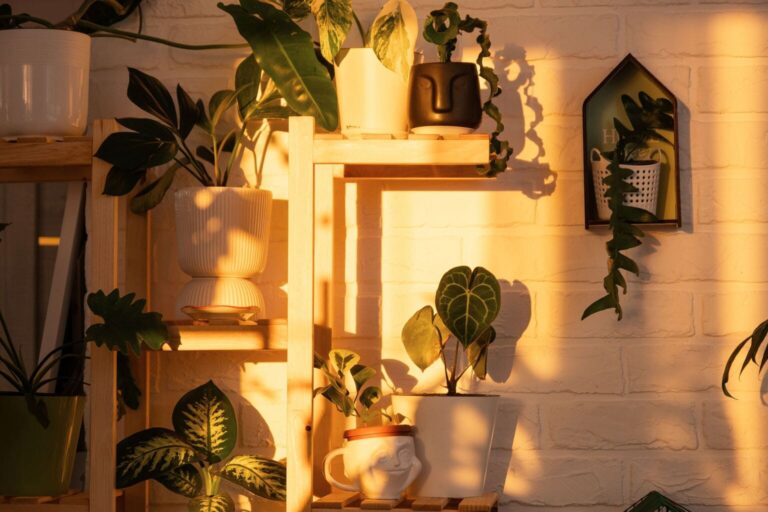
| Light level | Typical conditions | What to know |
| Low | Limited natural light, away from bright windows | Suitable for certain tolerant plants; growth may be slow |
| Medium | Moderate daylight, little intense direct sun | Suitable for many foliage houseplants |
| Bright indirect | Strong natural light without prolonged harsh sun | Ideal for many tropical houseplants |
| Direct sunlight | Sunlight falls directly on foliage | Important for sun-loving plants; can burn shade-adapted foliage |
These categories are useful starting points, but actual light levels should be evaluated rather than assumed.
Window direction plays a major role in determining the amount and intensity of natural light available to houseplants.
In the Northern Hemisphere, windows generally provide one of the following conditions.
North-facing windows usually receive mostly indirect light and relatively little direct sunlight. They can be suitable for low-light tolerant plants, especially when the windows are large and unobstructed.
However, a small north-facing window shaded by nearby buildings or trees may provide insufficient light even for plants described as low-light tolerant.
East-facing windows receive morning sunlight, which is generally less intense than afternoon sun. These locations are often excellent for tropical foliage plants that appreciate bright light without excessive heat.
South-facing windows typically provide some of the strongest natural indoor light, particularly during winter when the sun is lower in the sky. They can be excellent locations for sun-loving plants, although sensitive foliage may require protection from intense direct sunlight.
West-facing windows receive afternoon sunlight, which can be particularly intense and warm. These locations may suit sun-loving plants, but shade-adapted houseplants can experience leaf scorching.
Window direction is only one part of the equation. Geographic location, nearby buildings, trees, roof overhangs, curtains, screens and even the size of the window affect how much light actually reaches your plants.
In the Southern Hemisphere, north- and south-facing window patterns are generally reversed.
One of the biggest mistakes indoor gardeners make is assuming that a bright room automatically provides sufficient light for houseplants.
Human eyes adjust remarkably well to different lighting conditions. A room that looks bright to you may actually provide very little usable light to a plant sitting across the room. Light levels can decrease dramatically as you move away from a window. For example, a houseplant positioned directly in front of a bright window may receive considerably more light than the same plant placed six feet away.
The amount of reduction depends on window size, orientation, obstructions, and the surrounding room.
When deciding where to place a houseplant, consider:
Rather than assuming a location is suitable, observe how your plant responds and measure the light when possible.
Fortunately, there are several ways to evaluate the lighting conditions in your indoor garden.
The shadow test is a quick way to get a general idea of light intensity.
On a clear day, place your hand between the light source and a light-colored surface near the location where your plant grows. Observe the shadow your hand creates.
The shadow test is useful for making quick comparisons, but it doesn’t provide a precise measurement. A diffuse light source can produce a soft shadow even when considerable light is available. For more accurate results, use a light meter.
A light meter is one of the most useful tools an indoor gardener can own. Rather than relying entirely on how bright a room appears, a meter helps you determine the actual light reaching your plants.
Depending on the type of meter, readings may be expressed in foot-candles, lux, or measurements specifically designed for plant growth.
To evaluate a location, position the meter’s sensor near the foliage, facing the primary light source. Take measurements at different times of day to understand how conditions change. Don’t assume that a single measurement represents the amount of light a plant receives throughout the day.
Ready to buy a light meter? Here are two popular options:
Foot-candles and lux measure illuminance, or the amount of visible light reaching a surface as perceived by the human eye.
One foot-candle equals approximately 10.76 lux.
As a broad reference, these foot-candle ranges can help describe indoor lighting conditions:
| General category | Approximate foot-candles |
| Low light | 50–150 |
| Medium light | 150–500 |
| Bright light | 500–1,000 or more |
These are approximate horticultural reference ranges, not universal requirements. Individual plants differ considerably, and the duration of exposure matters. Some houseplants can tolerate light below these ranges for a time, while others need substantially more light for vigorous growth or flowering.
For a more detailed understanding of plant lighting, especially when using grow lights, two additional measurements are useful.
PPFD, or photosynthetic photon flux density, measures the number of photosynthetically active photons reaching a given area each second. It is expressed in micromoles per square meter per second (µmol/m²/s).
DLI, or daily light integral, measures the total quantity of those photons a plant receives over an entire day. It is expressed in moles per square meter per day (mol/m²/day).
Think of PPFD as how much usable light is arriving at a particular moment, while DLI tells you how much light the plant receives over the course of the day.
A plant receiving moderate light for many hours may accumulate a useful daily light total, while another plant receiving stronger light for only a short period may receive less overall. These measurements are especially helpful when selecting and positioning grow lights.
For ordinary indoor gardening, you don’t necessarily need to calculate DLI for every plant. Understanding that both light intensity and duration matter is the most important takeaway.
Even if your houseplants remain in the same locations year-round, the amount of natural light they receive can change significantly with the seasons.
During fall and winter, daylight hours shorten in much of the Northern Hemisphere. The sun also travels lower across the sky. This can cause some windows to receive less total daylight, although certain south-facing windows may actually receive more direct sunlight because of the lower sun angle.
During spring and summer, longer days increase the potential for light exposure, but roof overhangs, trees, and other obstructions may change which windows receive direct sun.
As seasons change:
Plants that grew vigorously during summer may slow considerably in winter if they receive less light.
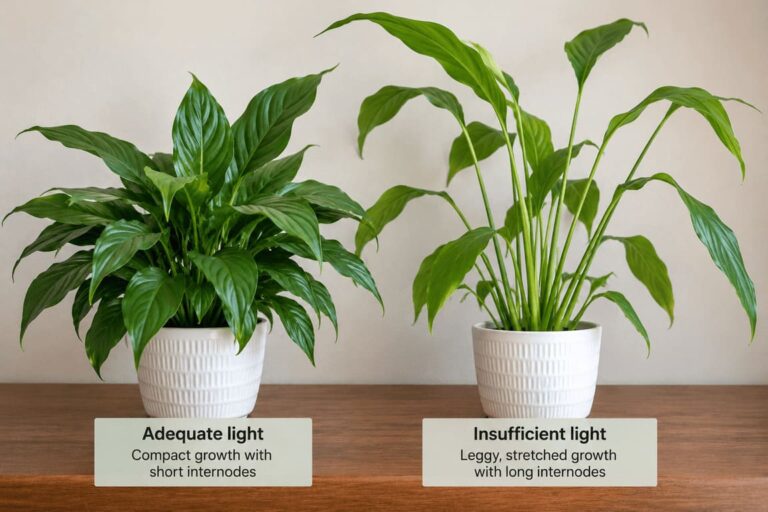
Houseplants often provide clues when lighting conditions are inadequate. Watch for the following symptoms.
Plants growing in insufficient light may develop elongated stems with excessive space between leaves. This condition is known as etiolation. The plant is essentially stretching toward available light.
When plants lack sufficient energy, newly produced foliage may be smaller than normal.
Some houseplants respond to inadequate light by shedding older leaves, particularly those receiving the least illumination. However, yellow leaves can have many causes, including watering problems, nutrient deficiencies, and natural aging.
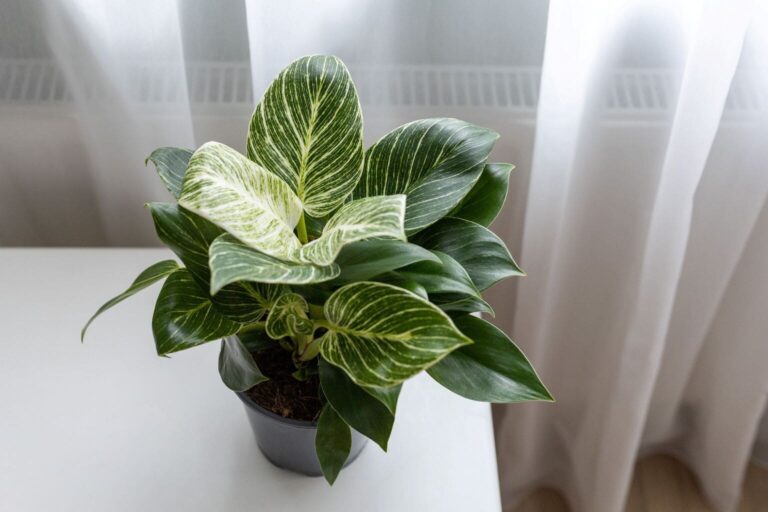
Variegated houseplants have leaves with more than one color, often combinations of green, white, cream, or yellow. The green portions contain chlorophyll, constituting the pigment plants use to capture light energy for photosynthesis. White or cream areas generally contain little or no chlorophyll. Because these lighter areas contribute less to photosynthesis, some variegated houseplants require brighter light than their all-green counterparts.
When light is insufficient, certain variegated plants may begin producing greener leaves, which contain more chlorophyll and can capture more light energy. Over time, the plant may lose some of its distinctive coloring.
If you notice new growth becoming increasingly green, check the light levels and consider moving the plant to a brighter location with appropriate indirect light.
Keep in mind that variegation is also influenced by genetics. Not all variegated plants respond to low light by turning greener, and increasing light won’t necessarily restore variegation that has been genetically lost.
Many flowering houseplants require higher light levels than foliage plants. A plant may remain green and reasonably healthy yet fail to produce flower buds because it isn’t receiving sufficient light.
If a plant is receiving too little light, it may use water more slowly. This can leave the potting mix wet for extended periods, increasing the risk of root problems.
If you notice several of these symptoms, evaluate lighting before automatically increasing fertilizer or water.
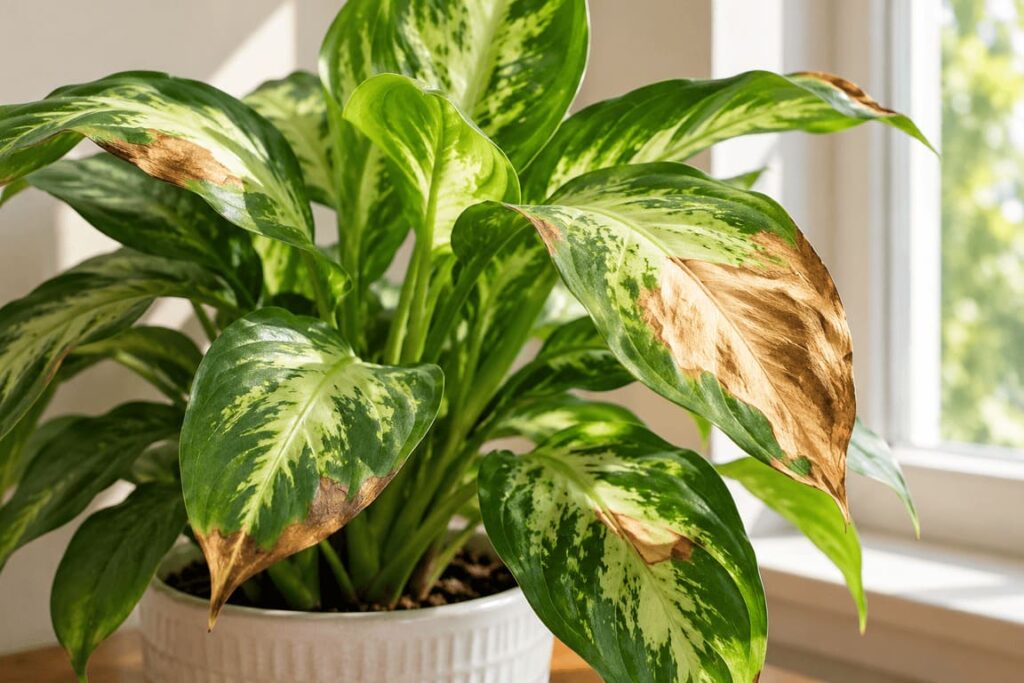
Although insufficient light is a common problem, excessive sunlight can also damage houseplants.
Signs may include:
Leaf scorch is especially common when a shade-adapted plant is suddenly moved into intense direct sunlight.
When moving plants into brighter conditions, make changes gradually so the foliage has time to acclimate.
Damaged leaves generally won’t return to their original appearance, but healthy new growth can indicate that conditions have improved.
Good news! You don’t need a home filled with sunny windows to grow healthy houseplants. Modern artificial lighting makes it possible to provide supplemental light or grow plants in locations where natural light is limited. However, not all artificial lights are equally effective.
The term full spectrum is widely used in plant-lighting marketing, but it doesn’t have one universally standardized horticultural definition. Generally, it refers to lighting that produces a broad range of wavelengths, often resembling the distribution of visible light in sunlight.
Plants use light primarily within the photosynthetically active radiation range, approximately 400–700 nanometers, although some wavelengths outside this range can also influence plant responses.
Blue and red wavelengths are particularly important for photosynthesis and plant development, but plants also use green light. A broad-spectrum white grow light can support healthy plant growth when it provides sufficient intensity.
The important point is that a light labeled full spectrum isn’t necessarily strong enough to grow houseplants successfully. Light intensity, distance from the plant, coverage, and daily duration are just as important.
LED stands for light-emitting diode. It describes the technology used to produce light, not the spectrum. Some LEDs produce relatively narrow wavelength ranges. Others combine different LEDs or use phosphors to produce broad-spectrum white light.
Modern LED grow lights offer several advantages:
Choose LEDs designed to provide adequate plant-growing light rather than assuming any LED bulb will work.
A standing option for larger setups
If you’re growing several plants, or you have a corner or room with very little natural light, a large standing grow light can be an easy solution. A fixture like the Glowrium LED grow light can cover multiple plants at once without needing shelves or special mounting. To see how it performed in testing, read our full Glowrium LED Grow Light G2 Pro review. Ready to buy? Check the current price on Amazon.
Absolutely. Modern screw-in LED grow bulbs can be effective for houseplants, particularly when supplementing natural light or illuminating a small growing area. These bulbs fit standard compatible fixtures, making them a convenient option for indoor gardeners who don’t want elaborate lighting equipment.
When choosing a screw-in grow bulb, consider:
A single screw-in bulb may work well for one plant or a small grouping, but it generally won’t illuminate an entire room adequately for plant growth.
If you want to try one, this screw-in grow bulb is an easy way to add light to a single plant or a small grouping. Check the listing for recommended distance and fixture compatibility before you buy.
Older full-spectrum bulbs marketed primarily for human lighting or seasonal affective disorder shouldn’t automatically be considered suitable grow lights. Their output and intended use may differ substantially from modern horticultural lighting.
Clip-on grow lights are a flexible choice for desks, shelves, windowsills, and individual plants. They attach to a shelf edge, table, or pot rim, so you can aim light right where a plant needs it. They work especially well for a single plant or a small group in a spot that doesn’t get much natural light. Browse clip-on grow lights.
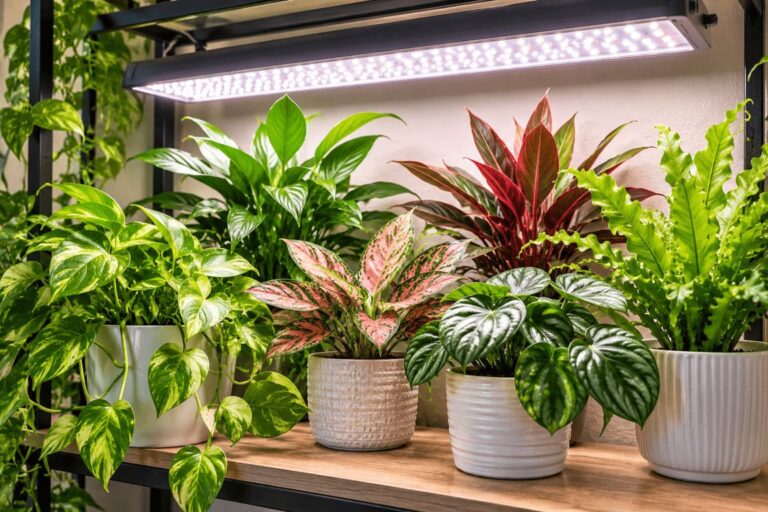
One of the most important factors in successful artificial lighting is distance. If a grow light is too far from the foliage, the plant may receive insufficient illumination. If the light is too close, excessive intensity or heat may damage leaves. Follow the manufacturer’s recommendations and adjust according to the plant’s response. For larger plants, consider whether the light reaches lower foliage as well as the top of the plant.
Houseplants need an appropriate daily period of light, followed by darkness. For many foliage houseplants, approximately 12–14 hours of supplemental or artificial lighting daily is a useful starting point, although requirements vary by species, light intensity. and available natural daylight. Some plants benefit from longer lighting periods, while others have specific day-length requirements for flowering.
Avoid leaving grow lights on continuously. Plants have biological rhythms, and a regular dark period is important for normal functioning. A timer makes it easy to provide consistent lighting.
Light doesn’t operate independently of other growing conditions. When a houseplant receives sufficient light, it can photosynthesize effectively and support healthy growth, provided water, nutrients and other conditions are appropriate.
As light decreases, growth may slow and water use may decline. This means that a plant growing in low light may need considerably less frequent watering than the same plant growing in bright conditions. Excessively wet soil can deprive roots of oxygen and encourage root-rotting pathogens.
Fertilizer requirements are also influenced by growth. A plant growing slowly because of insufficient light generally won’t benefit from increased fertilization. In fact, excessive fertilizer can contribute to salt buildup and root damage.
If your houseplant isn’t growing well, check its lighting conditions before assuming it needs more water or fertilizer.
Don’t have a particularly bright home? You can still enjoy growing houseplants by choosing species that naturally tolerate lower light levels. Many of these plants originate in shaded tropical environments and can survive with less illumination than sun-loving species.
Good choices include:
Keep in mind that low-light tolerance varies among species and cultivars. Variegated varieties may require brighter conditions to maintain their coloration, and some plants on this list perform considerably better in medium or bright indirect light.
A peace lily, for instance, may survive in relatively low light but often needs brighter indirect light to flower reliably. The goal is to match each plant to the lighting conditions you can realistically provide.
Our Picks for Better Houseplant Lighting
Use this checklist when evaluating a new location or troubleshooting a plant that isn’t growing well.
Remember that lighting conditions aren’t static. Checking periodically helps ensure that your plants continue receiving the illumination they need.
Yes, houseplants can grow without natural sunlight if they receive adequate artificial light. However, they cannot grow indefinitely in complete darkness because photosynthesis requires light.
Not necessarily. Bright indirect light can be considerably more intense than the illumination available in a deeply shaded room. A plant receiving bright indirect light near a window may receive many times more light than one positioned in a dark corner.
Some regular white LED bulbs can support plant growth if they provide sufficient usable light at the foliage. However, household bulbs aren't necessarily designed to deliver the intensity or coverage needed for sustained plant growth. Purpose-built grow lights generally make it easier to provide predictable lighting conditions.
Rotating houseplants periodically can help promote more even growth when light comes primarily from one direction. Plants naturally grow toward light, a response known as phototropism.
However, avoid constantly repositioning plants that are sensitive to environmental changes, and be mindful of flowering plants that may respond poorly to abrupt changes in orientation or conditions.
Many houseplants receive less total natural light during winter because daylight hours are shorter. Some plants may benefit from supplemental lighting, especially if they continue actively growing. Others naturally slow their growth and require less water and fertilizer during periods of reduced light.
Yes. Excessive light intensity can cause leaf bleaching, stress and other damage. Even efficient LED grow lights can produce enough intensity to harm plants when positioned too close. Choose appropriate equipment, follow placement guidelines and monitor plant responses.
When growing houseplants, one of the most important things you can do is understand the lighting conditions in your home and choose plants accordingly. Don’t rely entirely on how bright a room appears to your eyes. Observe your plants, evaluate the available light and use a light meter when necessary.
If natural lighting is insufficient, modern grow lights provide practical ways to supplement or replace sunlight.
Most importantly, remember that light affects everything from growth and flowering to watering and root health. Provide the right light, and you’ve taken one of the biggest steps toward growing healthy houseplants in the great indoors.