How to Use Moss Poles for Houseplants: A Complete Guide
 Plant ParentOctober 16, 2026



This article contains affiliate links. If you buy through them, we may earn a commission at no extra cost to you.
If you grow climbing houseplants such as Monstera, Philodendron, or Pothos, you’ve probably noticed that these plants have a tendency to reach, sprawl, and sometimes grow in directions you hadn’t anticipated.
That’s because many of these plants naturally climb in their native habitats. Rather than growing along the ground indefinitely, they use trees and other vegetation for support as they make their way upward toward available light.
Fortunately, you can encourage this natural growth habit indoors by providing your plants with a moss pole.
Moss poles are relatively inexpensive, easy to install, and can make a noticeable difference in how climbing houseplants grow and look. They also provide an attractive way to display plants that might otherwise trail over the sides of their containers.
Here’s what you need to know about choosing, installing, and maintaining moss poles for your indoor garden.
A moss pole is a vertical plant support designed to give climbing houseplants something to grow against and attach to. Traditional moss poles consist of a sturdy central support surrounded by sphagnum moss. Some commercial products use coconut coir instead, while others feature mesh or plastic structures filled with moss.
The pole is anchored in the plant’s potting mix, where it provides a surface that climbing stems and aerial roots can contact as the plant grows.
Moss poles come in different heights and designs. Some are flexible, allowing you to bend them into different shapes, while others are rigid and can be extended as your plant grows taller. You can purchase ready-made poles or make your own.
Although sphagnum moss and coconut coir poles are often grouped together under the term moss poles, they don’t function in exactly the same way.
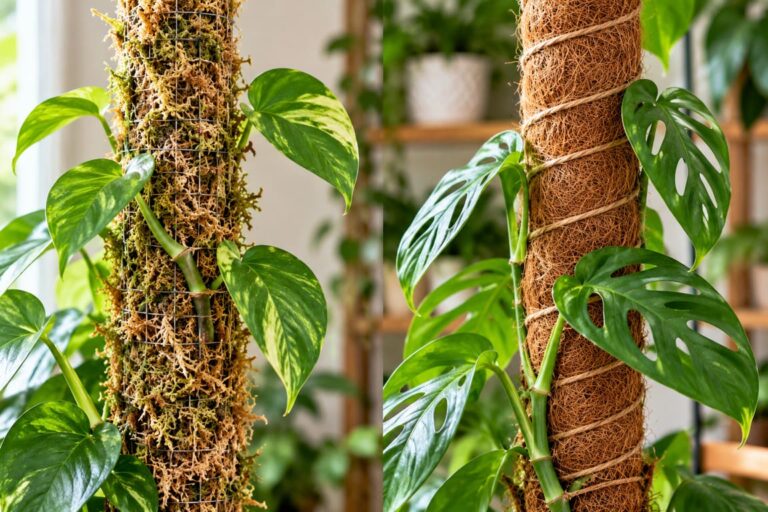
Sphagnum moss is valued for its ability to absorb and retain moisture. When kept appropriately moist, a sphagnum moss pole can provide a surface into which the aerial roots of climbing plants may grow.
This can help the plant anchor itself and, under suitable conditions, allow attached roots to absorb some moisture from the pole. Sphagnum poles are particularly useful when your goal is to encourage aerial roots to establish themselves within the support.
Coconut coir is a fibrous material derived from coconut husks. Commercial coir poles generally consist of coir fibers wrapped around a central support. These poles provide a textured surface against which climbing plants can grow. They are often durable and convenient to use.
However, a coir pole generally functions more as a physical support than as a moist rooting medium. Aerial roots may grip the surface of the coir, but they don’t necessarily grow into it the same way they do into loosely packed, moist sphagnum.
Both types can be useful. The best choice depends on your plant and what you want the support to accomplish.
There are several good reasons to provide climbing houseplants with moss poles.
In tropical forests, many climbing houseplants begin growing near the forest floor and use surrounding vegetation for support. Monsteras, for instance, can develop aerial roots that help them attach to trees as they climb.
A moss pole gives these plants an opportunity to follow a similar growth pattern indoors. Of course, a moss pole isn’t a tree trunk, but it provides the vertical support that many climbing plants naturally seek.
Without support, climbing houseplants may grow sideways, sprawl across nearby surfaces, or trail over the edges of their pots. There’s nothing necessarily wrong with allowing a plant to trail. Pothos and many philodendrons, for example, can look beautiful growing from hanging baskets. However, if you prefer an upright plant, a moss pole can help direct its growth. It can also prevent long stems from becoming unwieldy or pulling the plant out of balance.
Some climbing aroids, including certain Monstera, Philodendron, and Pothos species, develop larger and more mature foliage as they climb. Providing a suitable support can encourage the plant to grow in this direction.
However, a moss pole alone doesn’t guarantee larger leaves. Adequate light, proper watering, nutrients, root health, and the plant’s maturity also play important roles. For plants that naturally climb, though, vertical support can be an important part of encouraging mature growth.
Many climbing houseplants produce aerial roots along their stems. These roots help plants attach to supports in their natural environments. When aerial roots encounter a moist sphagnum moss pole, they may attach to or grow into the moss. This helps stabilize the plant and may provide an additional source of moisture.
Aerial roots don’t always attach automatically, however. Sometimes the plant needs to be positioned and secured against the pole while the roots establish themselves.
There are also aesthetic benefits to using moss poles. A Pothos or climbing Philodendron growing up a moss pole creates an entirely different appearance from the same plant trailing from a shelf.
Vertical growth can make a plant a striking focal point and help you take advantage of the space above a pot rather than allowing the foliage to spread across nearby furniture.
Moss poles are most useful for houseplants with a natural climbing growth habit. Some excellent candidates include the following.
Monstera deliciosa is one of the best-known plants for growing with vertical support. As the plant matures, its stems and large leaves can become heavy, and its aerial roots may extend in several directions.
A sturdy moss pole or other appropriate support can help keep the plant upright and encourage a more organized growth habit. For large, mature specimens, a substantial rigid support is more practical than a lightweight moss pole.
Monstera adansonii is another excellent candidate. This climbing species produces distinctive leaves with holes, known as fenestrations. It can trail attractively, but providing a moss pole allows you to train it upward and encourage its natural climbing habit.
Many climbing philodendrons benefit from vertical support. Heartleaf Philodendron, for example, is commonly grown as a trailing plant but can also be trained to climb. With suitable support and growing conditions, some climbing philodendrons may develop larger, more substantial foliage. Keep in mind, however, that not all philodendrons are climbers. Self-heading varieties, such as Philodendron ‘Birkin,’ grow in a more upright, compact form and generally don’t require moss poles
Pothos is frequently displayed in hanging baskets or allowed to trail across shelves. However, in its natural habitat, it can climb trees and develop considerably larger leaves as it matures. Training Pothos up a moss pole gives you another way to display this versatile houseplant and may encourage larger foliage over time.
Certain Syngonium and Rhaphidophora species can also benefit from vertical support. Syngonium podophyllum (arrowhead vine), for example, often develops a climbing growth habit as it matures, while Rhaphidophora tetrasperma naturally climbs and benefits from a sturdy support structure. Providing a moss pole gives these plants something to grow upward against rather than allowing their stems to trail.
The key is to consider a houseplant’s natural growth habit. Plants that naturally climb or scramble are generally the best candidates for moss poles. Those that grow in upright clumps or rosettes, such as peace lilies and many bromeliads, don’t climb and therefore won’t benefit from this type of support.
| Feature | Sphagnum moss pole | Coconut coir pole |
| Primary material | Sphagnum moss | Coconut husk fibers |
| Moisture retention | Can hold substantial moisture | Typically less effective as a moist rooting medium |
| Aerial root attachment | Roots may grow into moist moss | Roots may grip the textured surface |
| Primary benefit | Climbing support and potential rooting medium | Climbing support |
| Maintenance | May require frequent moistening | Often used primarily as a dry support |
| Best suited for | Growers encouraging aerial root establishment | Growers primarily seeking upright support |
Neither type of moss pole is automatically better for every situation. Sphagnum moss holds considerably more moisture than coconut coir fiber, making the former a better choice when you want to encourage aerial roots to grow into the support.
Coir poles, which tend to dry out quickly, are primarily useful for keeping climbing plants upright. If your goal is simply to provide vertical support, a coir pole may be perfectly adequate.
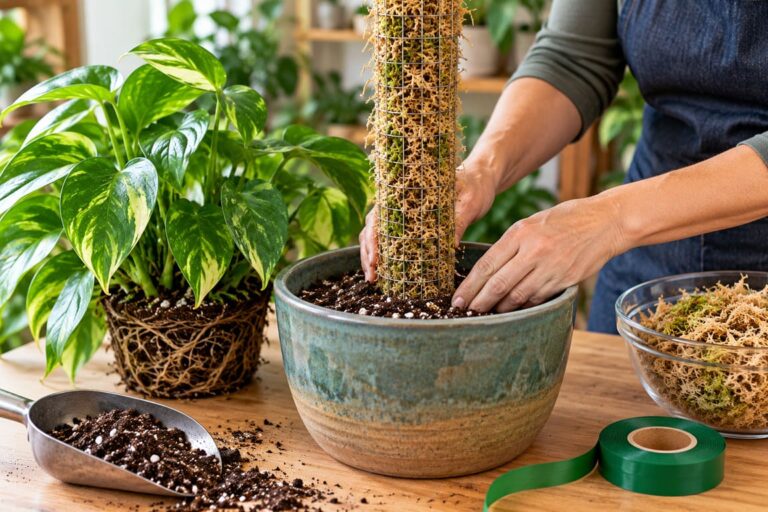
Installing a moss pole is straightforward, although it’s worth taking a little care with positioning.
Ideally, install the pole when repotting your houseplant. This allows you to position it without forcing the support through an established root system.
You can also add a pole to a plant that’s already potted, but you’ll need to work carefully to avoid damaging roots.
Select a pole that is sturdy enough to support your plant as it grows. Consider the plant’s current size, expected growth, and the weight of its foliage.
A small Monstera adansonii may do well with a relatively short pole, while a mature Monstera deliciosa will need something much more substantial.
Remember that part of the pole will be buried in the potting mix, so the usable height will be shorter than its overall length.
If you’re ready to buy, here are three popular moss poles to consider: option 1, option 2, and option 3. Check each listing for its height and weight capacity so you can match the pole to your plant’s size.
If you’re using a sphagnum moss pole and want to encourage aerial roots to attach, you can moisten the moss before installation. A gentle spray of water works well for lightly wrapped poles. Depending on the pole’s construction, you may also be able to soak the moss before positioning it.
Avoid directing a forceful stream of water at loosely attached moss, as this can dislodge the material.
Place the moss pole near the base of the climbing stem, preferably where the plant’s aerial roots can contact it. For many climbing plants, this means positioning the support behind the stem rather than in front of the leaves.
If you’re repotting, arrange the pole before filling the container completely with potting mix. Anchor the pole securely so it won’t shift or tip as the plant grows.
For an established potted plant, insert the pole cautiously, avoiding major roots whenever possible. Don’t force a thick support into a densely rooted container.
Gently bring the climbing stem against the pole. Pay attention to the locations of the aerial roots and position them toward the support when possible. Avoid twisting or sharply bending older, rigid stems. Young, flexible growth is generally easier to train than mature stems.
Use soft, flexible plant ties or stretchable green garden tape to hold the stem against the pole. Secure the stem loosely enough that the plant has room to expand as it grows. The goal is to support the plant, not restrict its movement or growth. Once aerial roots have attached securely, some ties may no longer be necessary.
If you’d like to try it, you can find stretchy green garden tape or a 2-pack if you have several plants to train.
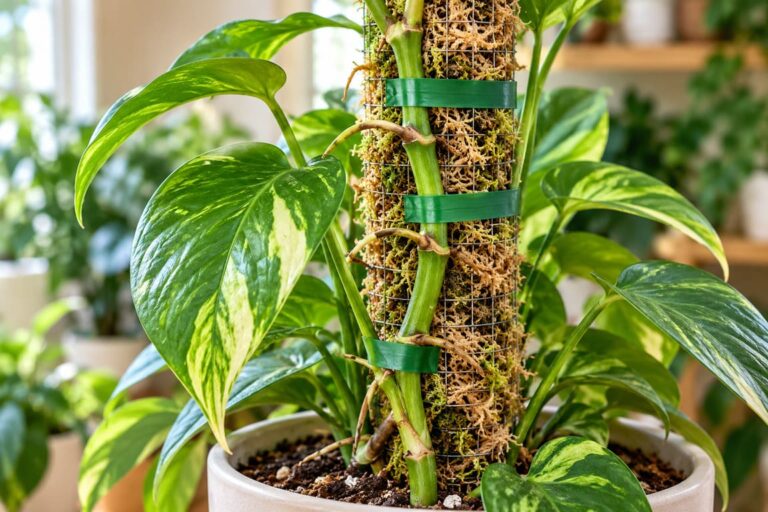
After installation, gently check that the pole remains upright and secure. A support that wobbles or leans excessively may need to be anchored more firmly. Large plants may require a heavier pot or a stronger support.
When training houseplants, one of the most important things to remember is that stems increase in diameter as they grow. String, wire, and other non-stretching materials can eventually become too tight. If left in place, such items may cut into the stem and cause a condition known as girdling.
Girdling can interfere with the movement of water and sugars through the plant’s vascular system. For this reason, I prefer using flexible green garden tape when attaching plants to supports. The tape stretches as the plant grows, reducing the risk of damage.
Here is the stretchy garden tape I use.
Even when using flexible tape, check the ties periodically to make sure they haven’t become restrictive. Never pull a stem tightly against a pole simply to create a more upright appearance.
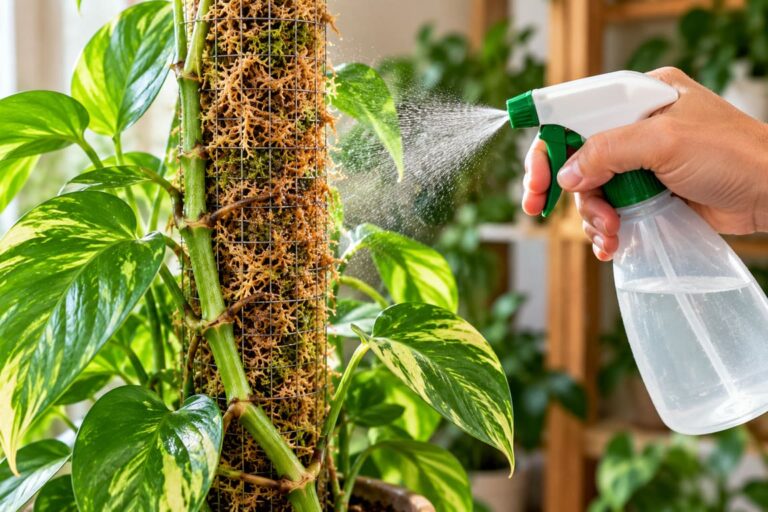
One of the advantages of sphagnum moss is its ability to hold moisture. Keeping the moss appropriately moist can encourage aerial roots to attach and grow into the material. However, the amount of attention a pole requires depends on its construction, the indoor environment, and how quickly it dries.
A fine-mist spray bottle can be useful for moistening the surface of a moss pole. Two good options are this fine-mist spray bottle and this alternative spray bottle. Spray gently to avoid dislodging loosely attached sphagnum. Thinly wrapped poles may dry relatively quickly, especially in warm or dry rooms. More substantial moss-filled supports may retain moisture longer. Note that misting can moisten the surface of a moss pole, but thoroughly hydrating a large pole may require more water than a few sprays.
If you live in a dry climate, you may need to moisten a sphagnum moss pole more frequently. Heating and air-conditioning can also reduce indoor humidity, causing the moss to dry out faster.
Rather than following a rigid watering schedule, check the moss regularly and moisten it as needed if you’re trying to maintain a moist rooting environment for aerial roots.
A humidifier can help maintain a more humid environment around tropical houseplants. This may slow the rate at which a moss pole dries. However, a humidifier doesn’t necessarily keep the interior of a moss pole moist, particularly if the moss is densely packed or the room is dry. You may still need to add water directly to the pole.
Keep in mind that keeping a sphagnum pole moist doesn’t mean also maintaining constantly moist soil. Excessively wet potting soil can deprive roots of oxygen and encourage root rot.
When moistening the pole, pay attention to how much water drains into the container below. Continue watering the plant according to its needs and the moisture level of the potting mix.
If you’re using a coir pole primarily as a physical support, it generally doesn’t need to remain wet. But if you want sphagnum moss to encourage aerial roots to grow into the pole, maintaining consistent moisture is important.
However, keeping the pole saturated at all times isn’t necessary, and constantly wet conditions can create maintenance problems. The objective is an appropriately moist rooting surface, not a dripping-wet support.
If you’re unable or unwilling to keep a moss pole moist, your plant can still benefit from vertical support. A trellis, stake, or coir pole may be a more practical option.
Installing a moss pole isn’t necessarily a one-time task. As your plant grows, you’ll need to monitor the support and make occasional adjustments.
Inspect ties periodically to make sure they aren’t cutting into expanding stems. Loosen, replace, or remove them when necessary.
As the climbing stem lengthens, gently direct new growth toward the pole. You may need to add another flexible tie until the plant establishes itself.
Eventually, your plant may reach the top of its support. Some moss pole systems are designed to accommodate extensions. Others may need to be replaced with taller supports. Choose an approach that maintains stability, especially with larger plants.
Sphagnum moss may gradually compact or deteriorate. Inspect the pole occasionally and replace damaged or excessively degraded material as needed. The useful life of a moss pole depends on its materials, construction, moisture exposure, and growing conditions.
Even though moss poles are easy to use, a few mistakes can limit their effectiveness.
Choosing a pole that’s too small. A lightweight pole may not support a large or rapidly growing Monstera.
Positioning the pole on the wrong side of the stem. Place the support where the plant’s aerial roots can reach it rather than simply where it looks attractive.
Using tight string or wire. Non-stretching ties can girdle growing stems.
Expecting immediate attachment. Aerial roots may take time to establish themselves, and some plants need continued guidance.
Assuming a moss pole replaces proper lighting. A plant still needs adequate light to photosynthesize and grow.
Keeping the potting mix too wet. Moistening a moss pole shouldn’t result in persistently waterlogged roots.
Expecting every plant to climb. Moss poles are designed for plants with climbing growth habits, not all houseplants.
Not every Monstera requires a moss pole specifically, but many benefit from some form of support as they mature. Monstera deliciosa, in particular, can become large and heavy. A sturdy support can help manage its growth. A moss pole, plank, or other suitable structure may be used depending on the plant’s size and your goals.
They may, especially when the roots encounter a suitable moist sphagnum surface. However, attachment isn’t guaranteed. Gently positioning the stem and aerial roots against the support can help encourage contact.
Yes, provided you can insert and secure the pole without significantly damaging the root system. For a densely rooted plant, it may be easier and safer to install the pole during repotting.
Absolutely. Pothos naturally climbs in suitable conditions and can be trained to grow upward rather than trail. Providing support may also encourage more mature foliage when the plant receives appropriate care.
A suitable climbing support can help some Monsteras develop more mature growth, which may include larger leaves. However, adequate lighting and overall plant health are essential. A moss pole won’t compensate for insufficient light or poor growing conditions.
That depends on your goal. Sphagnum moss is generally more useful when you want aerial roots to grow into a moist rooting medium.
Coconut coir can be an effective physical support and may require less attention if you’re not trying to keep the pole moist.
Yes. Moss poles can be made using a sturdy support, suitable mesh or wrapping material, and sphagnum moss. The finished pole should be securely constructed, stable, and appropriate for the size of the plant.
Wear gloves when handling sphagnum moss, as it can sometimes harbor the fungus Sporothrix, which causes a skin infection known as sporotrichosis. The fungus can enter through small cuts or scratches, so wearing gloves and washing your hands after handling the moss are sensible precautions.
If you prefer a ready-made option, commercial moss poles are widely available in different sizes and styles.
Here are a few to look at: option 1, option 2, and option 3.
One of the most rewarding aspects of growing houseplants is learning how they grow in nature and finding ways to recreate some of those conditions indoors.
For climbing plants such as Monstera, Philodendron, and Pothos, providing vertical support can make a significant difference in their appearance and growth habits.
Whether you choose a traditional sphagnum moss pole, a coconut coir pole, or another sturdy support, the key is to select something appropriate for your plant and guide its growth gently.
With proper lighting, good growing conditions, and a little attention as the plant matures, a moss pole can help transform a sprawling houseplant into an impressive vertical display.