A Healthy Houseplants viewer recently asked me a great question. Several of her houseplants were getting so large they were becoming difficult to manage, and she didn’t have additional space for bigger plants and pots. She wanted to know if she could trim both the foliage and roots and repot the plants into the same-size containers.
The answer is yes.
I’ve been recommending root pruning for decades, including in my book Indoor Gardening the Organic Way. It’s an especially useful technique when you have a houseplant you love that has reached the size you want it to remain.
Perhaps you have a large floor plant that’s threatening to hit the ceiling. Maybe a plant has reached the maximum size for its designated spot in your home. Or you simply don’t want to keep buying increasingly larger pots. You don’t necessarily have to.
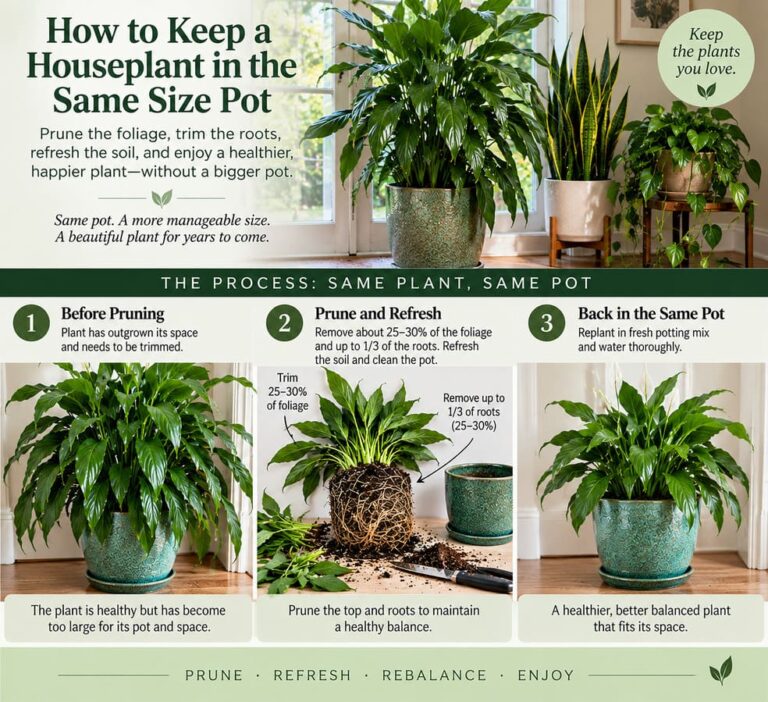
By pruning the roots and, when necessary, the top of the plant, refreshing the potting soil, and repotting into the same-size container, you can keep most houseplants at a manageable size while maintaining healthy growth.
When Should You Repot a Houseplant into the Same Size Pot?
Repotting doesn’t always mean potting up into a larger container. You can also repot a houseplant into the same-size container, a process I refer to as re-soiling.
Potting mix changes over time. Nutrients become depleted, the mix can become compacted, and mineral salts from fertilizer and irrigation water commonly accumulate. Generally, houseplants benefit from re-soiling every two to three years, depending on the plant.
You may also want to keep a houseplant in the same-size pot simply because it has reached the size you want it to remain. This is especially useful with large floor plants approaching the ceiling, plants that have outgrown their designated space, or plants growing in pots that you don’t want to replace with increasingly larger containers.
Before re-soiling, consider my 2/3-1/3 potting ratios. Above the soil, I generally aim for approximately 2/3 plant to 1/3 pot. Below the soil, I use approximately 2/3 root mass to 1/3 fresh potting soil.
If both the plant and root system have outgrown those proportions but you want to keep the plant in the same-size pot, you can prune the top growth and roots to bring everything back into balance.
Balance Root Pruning with Top Pruning
When your goal is to keep a houseplant in the same-size pot, you want to maintain a healthy balance between the root system and the foliage it supports.
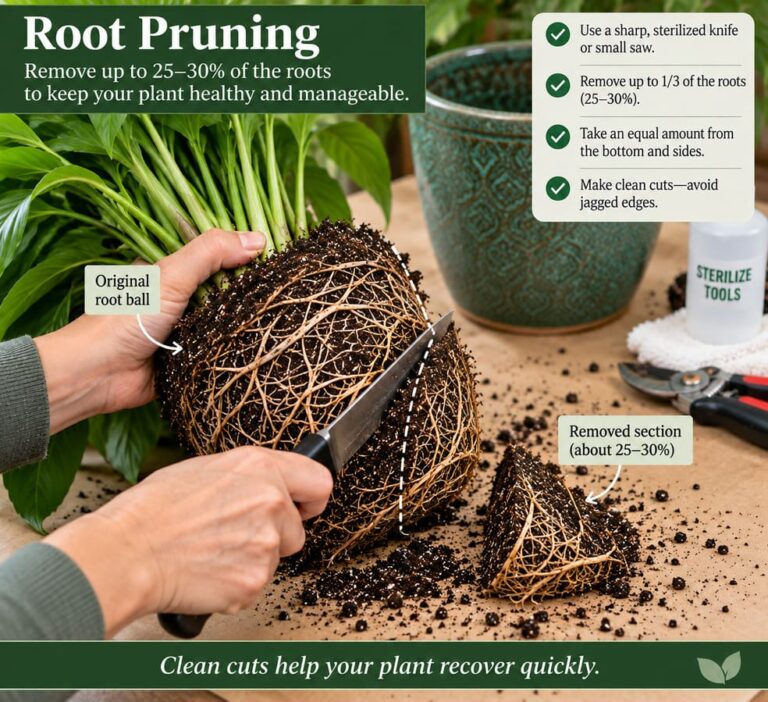
I generally recommend removing no more than 1/3 of the root system. For most plants, removing 25 to 30 percent is sufficient.
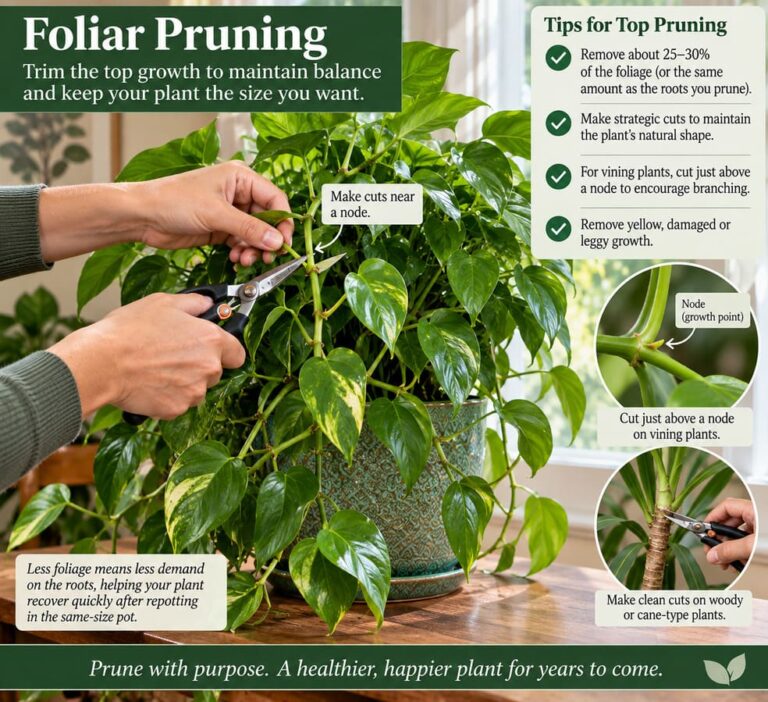
If you’re also reducing the size of the plant above the soil, remove approximately the same proportion of top growth. If you prune 25 percent of the roots, for instance, aim for roughly a 25 percent reduction in foliage.
You don’t need to measure this precisely. You’re trying to maintain balance between the roots and the foliage they support while bringing the plant back toward the appropriate 2/3–1/3 proportions for its pot.
There is an important exception. Suppose you remove the plant from its pot and discover that its root system hasn’t increased substantially—or that roots have died back—even though the plant has become too large above the soil. In such a case, don’t prune healthy roots simply to match the foliage.
In that situation, prune the top growth as needed to bring the plant back into proportion, but leave the healthy root system intact. Refresh the potting soil and repot according to the root mass you actually have.
This is why every plant needs to be evaluated individually.
How to Root Prune a Houseplant
Water the plant several hours before you plan to repot. This makes it easier to remove from the container and ensures the plant is well hydrated before the procedure.
Carefully remove the plant from its pot and examine the roots. If necessary, run a long knife around the inside edge of the container to loosen the root ball.
For a particularly large floor plant, get someone to help you. One person can carefully tip the pot while the other supports and eases out the plant. This prevents a large plant from suddenly falling out and damaging its foliage, or root system.
Using a sharp, sterilized knife or small pruning saw, slice away portions of the root mass from the bottom and sides. Work your way around the root ball so you’re removing roots relatively evenly rather than taking a large section from one area.
Make clean cuts. Avoid tearing or leaving badly jagged roots, which creates unnecessary injury and can increase the possibility of disease.
Remove no more than about one-third of the healthy root system.
How Much Should You Prune from the Top?
If you’re root pruning because you intentionally want to keep an oversized plant smaller, this is also the time to reduce the foliage.
How you prune depends on the type of houseplant.
With vining plants such as pothos and many philodendrons, shorten long vines by making cuts in appropriate locations near nodes. This encourages branching and helps create fuller growth.
With a peace lily, remove entire older leaves at their base rather than cutting individual leaves partway down.
On woody or cane-type houseplants such as ficus and dracaena, make strategic cuts to branches or stems to reduce height and width while maintaining an attractive shape.
The goal isn’t to hack one-third off every part of the plant. You’re reducing the overall amount of foliage by approximately the same percentage as the roots you’ve removed while preserving the plant’s natural form.
For instance, if you’ve removed approximately 25 percent of the root system, reduce the top growth by about 25 percent as well.
Julie Bawden-Davis is a best-selling garden author, blogger, YouTuber and Master Gardener dedicated to sharing indoor gardening expertise with aspiring gardeners. She has published several gardening books and more than 5,000 articles in major publications. A former garden columnist for the LA Times, San Francisco Chronicle and Parade.com, she is founder of HealthyHouseplants.com and its YouTube channel.
 Julie Bawden-DavisSeptember 15, 2026